
Many households with effective business operations wish to borrow larger amounts of money and for longer periods to invest in developing production scale and area, raising livestock, contributing to increasing profits and ensuring livelihoods.
However, many borrowers are concerned that production conditions are being affected by many unfavorable and unpredictable factors.
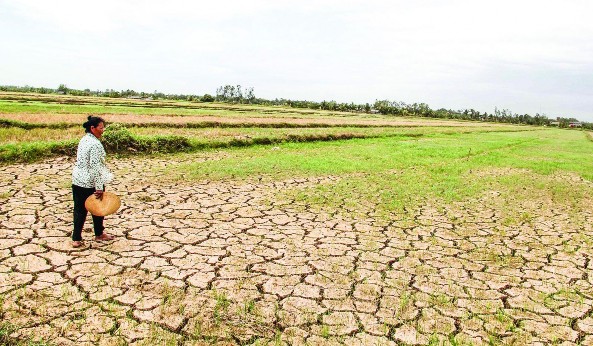
Appendix photo 7.5: Farmers in the Mekong Delta are vulnerable to falling back into poverty due to the impact of climate change. In the photo: Drought occurred in many localities in the Mekong Delta during the dry season of 2016, affecting production and people's livelihoods. Photo: Contributor
Due to lack of land for production, Ms. Nguyen Thi Nga, a farmer in Long Hoa ward, Binh Thuy district, Can Tho city, rented 13 hectares of land from a neighboring household to grow rice and vegetables. In the past few years, thanks to a loan of 10 million VND from the Vietnam Bank for Social Policies, she and her husband have invested in buying a weed cutter and a water pump to irrigate their fields and pump water for their rice fields. Thanks to her diligence in business, Ms. Nga's family economy has gradually stabilized.
Maybe you are interested!
-

 Working skills of journalists about banking in electronic newspapers today - 18
 -
 Skills for Working with Text Channels and Combining Image Channels
 -
 According to you, which electronic service distribution channel has the most development potential in Vietnam today: ATM, Pos, Internet Banking, Mobile Banking?
 -
 Comparison of Traditional Banking Services and Electronic Banking Services
 -
 Improving the Quality of Electronic Banking Services
Ms. Nga and her husband are saving to pay off a 10 million VND debt from the Social Policy Bank and cover the cost of raising their two children to go to school.
Ms. Nguyen Thi Nga shared: “My family’s life is now better than before. But I am very worried because farming is unpredictable, with pests and diseases, and can easily lead to crop failure. If that happens, I will not have money to pay for land rent, fertilizer and pesticide costs, bank interest, or for my children’s education. Sometimes I want to borrow more capital to rent land for farming, but I am afraid I will not be able to pay off the debt and principal.”
Implementing the “Project to strengthen and improve the quality of policy credit activities in the Southwest region”, the overdue debt situation in localities has been controlled and pushed back, but the level of sustainability is not high. The risk of overdue debt tends to increase again due to the impact of climate change, floods, droughts, and saltwater intrusion, which directly affect the lives and production and business of households.
According to Mr. Lai Xuan Mon, Chairman of the Central Executive Committee of the Vietnam Farmers’ Union, the Mekong Delta has strengths in agriculture. However, this is also a sector that is affected by many factors and is vulnerable, affecting people’s income and livelihoods.
Farmers in the Mekong Delta are facing a series of challenges such as climate change, environmental issues, counterfeit goods, etc. Farmers mainly engage in agricultural production, but capital investment in agriculture is still low; agricultural products often fall into a situation of good harvests but low prices, requiring "rescue".
In recent years, the poverty reduction results in the Southwest region have had a great contribution from the Vietnam Bank for Social Policies, providing a large source of capital for this difficult region.
Mr. Son Minh Thang, Deputy Head of the Standing Committee of the Southwest Steering Committee, worried: "Although many positive results have been achieved, credit capital in the region still does not meet the borrowing needs of the poor and policy beneficiaries."
According to Mr. Son Minh Thang, credit quality has many positive changes but is not uniform, not stable and still low compared to other regions. Therefore, the policy credit program in the Mekong Delta region really needs fundamental solutions to overcome shortcomings and limitations and enter a more solid consolidation phase.
Article and photos: MINH HUYEN
(To be continued)
[Article 4 – Can Tho Newspaper]
Improving the quality of policy credit for community prosperity
Final article: Promoting the effectiveness of policy credit capital
08/10/2017 - 21:33
According to the Development Strategy of the Vietnam Bank for Social Policies (VBSP), by 2020, the total outstanding loans for policy credit programs in the Southwest region are expected to reach VND41,000 billion, an increase of 46% compared to 2016 and an average growth of about 10%. To achieve the set target, many opinions say that from now until 2020, policy credit programs must be implemented closely to the actual local situation; ensuring that policy capital reaches borrowers in a timely manner to promote positive effects, contributing to sustainable poverty reduction.
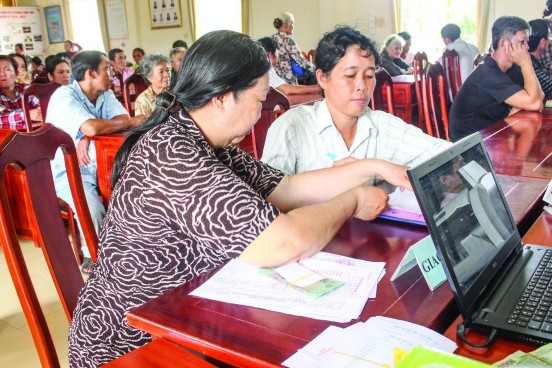
Appendix photo 7.6: Savings and Loan Group leaders guide borrowers on loan documents and procedures from the Vietnam Bank for Social Policies.
Go for quality
Implementing the “Project to strengthen and improve the quality of policy credit activities in the Southwest region”, policy credit has spread from the provincial, city to district and commune levels. People are directly selected to borrow capital and supervise the implementation of policy credit.
The VBSP has successfully implemented a specific and effective policy credit capital management method, suitable to the practical conditions of localities. This model has mobilized the strength of socio-political organizations and the whole society for the poor and other policy beneficiaries.
From now until 2020, the goal of the VBSP is that 100% of poor households, near-poor households, households that have just escaped poverty and other policy beneficiaries who have the need and meet the conditions will be able to borrow capital from policy credit programs and access other services provided by the VBSP. Strive to increase the deposit balance of members of the Savings and Loan Groups by at least 10% per year.
At the conference summarizing 5 years (2012-2016) of implementing the "Project to consolidate and improve the quality of policy credit activities in the Southwest region", Deputy Prime Minister Vuong Dinh Hue affirmed: "Policy credit must be considered a tool of the Party and the State, combined with fiscal and monetary policies. For preferential policy credit for policy beneficiaries, poor households, and near-poor households, the State offers preferential interest rates and provides capital compensation, so this is also a fiscal tool of the State. Policy credit has both economic, socio-political and profound humanitarian significance, closely linked to the sustainable poverty reduction policy and the national target program on new rural construction. This is a tool of the people, by the people and for the people".

Appendix photo 7.7: Many localities recommend that the Government and the People's Credit Fund continue to pay attention.
Center for implementing housing loan program in flooded areas of the Mekong Delta.
In photo: Farmers in Tan Hung district, Long An province harvest rice to avoid floods in the summer-autumn crop 2017. Photo: Contributor
To improve the operational efficiency of the policy credit program, many opinions suggest that the Savings and Loan Groups should continue to be strengthened. This is considered the most important measure, a solid foundation for continuing to implement new credit programs. According to Mr. Huynh Van Thuan, Director of the Can Tho Branch of the Social Policy Bank, the operation of the Savings and Loan Groups plays an important role in the operation of the Social Policy Bank because this is an extended arm of the Social Policy Bank.
Therefore, the Branch coordinates with the entrusted organizations to regularly consolidate and improve the operations of the Savings and Loan Groups, combining with the consolidation of the adjacent farming and residential areas to create favorable conditions for the Management Board of the Savings and Loan Groups to operate. Only when the Group operates well and stably will the quality of policy credit be improved. At the same time, the Can Tho City Branch of the Vietnam Bank for Social Policies also continues to improve and consolidate all aspects of operations at the Commune Transaction Points, serving the people better and better.
Timely and proper support
Many opinions say that local authorities and functional agencies need to effectively integrate capital lending and technology transfer, business guidance, vocational training, building and replicating sustainable poverty reduction models; investing capital with focus and key points through projects, cooperatives, etc.
According to Mr. Doan Tan Buu, Vice Chairman of Dong Thap Provincial People's Committee, relevant ministries and branches should consider and submit to the Prime Minister to assign the Vietnam Bank for Social Policies to lend to small start-up businesses as well as have a separate mechanism to handle debts for borrowers who are unable to repay such as the Mekong Delta flood-proof housing loan program, especially for the ethnic minority loan program.
Deputy Prime Minister Vuong Dinh Hue directed: Local authorities at all levels in the Mekong Delta region must strengthen direction, investigation, review, and statistical confirmation of poor households, near-poor households, and other policy beneficiaries to create conditions for these beneficiaries to promptly access policy credit sources.
The VBSP must continue to focus on human resources and direct drastic solutions to consolidate and improve the quality of policy credit in localities in the Mekong Delta. Focus on lending to a number of key programs and subjects, such as loans for job creation, loans for production and business development.
The Vietnam Bank for Social Policies needs to coordinate with localities to research and propose recommendations to adjust credit mechanisms and policies to effectively promote capital resources and suit local conditions.
In addition, it is necessary to pay attention to supplementing the mechanism of paying allowances to the Hamlet Chief in the work.
supervision and management of loans. In the coming time, Dong Thap will strengthen the direction and operation of the Board of Directors at all levels, especially for members who are Chairmen of the People's Committees at the commune level. Strengthen inspection and supervision, promote the role of the Poverty Reduction Committee, Hamlet Chief, Savings and Loan Group; maintain the operation of the Groups to urge and collect bad debts. At the same time, effectively carry out propaganda work so that borrowers use capital for the right purposes, repay debts and interest on time, and improve the quality of policy credit activities in the area.
From now until 2020, the Southwest Steering Committee, the Vietnam Bank for Social Policies, local Party committees and authorities at all levels will continue to closely coordinate and synchronously implement solutions to consolidate and improve the quality of policy credit activities in the region. In particular, special attention will be paid to credit quality, the entrustment of socio-political organizations, the quality of operations of Savings and Loan Groups, and transaction activities at the commune level.
At the same time, publicize information and policies related to policy credit activities at commune transaction points to create the best conditions for the poor and other policy beneficiaries to access capital from policy credit programs. Focus on promoting the role of community supervision in organizing the implementation of Party and State policies in the area.
In order for policy credit activities in the Southwest region to develop in a stable and sustainable direction, Mr. Son Minh Thang, Deputy Head of the Standing Committee of the Southwest Steering Committee, recommended: The Government needs to arrange increased capital sources and raise the lending limit for the social policy credit program in the Mekong Delta so that the Vietnam Bank for Social Policies can expand its credit activities.
At the same time, there is a mechanism to handle outstanding debts for ethnic minority households borrowing capital according to Decision 32/2007/QD-TTg of the Prime Minister on lending capital for production development for ethnic minority households in special difficulties and Decision 74/2008/QD-TTg of the Prime Minister on a number of policies to support the settlement of residential land, production land and job creation for poor ethnic minorities with difficult lives in the Mekong Delta in the period 2008-2010, and the housing loan program for residential clusters to overcome floods.
Increase capital sources for job creation loans from the central budget, local budgets and the Vietnam Bank for Social Policies to mobilize loans for vocational training programs in rural areas, support youth start-ups, etc. to limit black credit in rural areas. This will help workers have jobs and feel secure in their lives.
Article and photos: MINH HUYEN
[Article 5 – Ca Mau Newspaper]
Banks say it's voluntary, borrowers complain
08/27/2019 09:52
(CMO) In the context of a difficult credit market, to meet increasingly attentive customer needs, commercial banks have opened additional loan support services through insurance contracts (loans, people, etc.) and installed debt notification messages. In fact, this service business channel brings in profits no less than those from credit business for banks.
According to banks, credit business always has many potential risks that users cannot foresee. This is a sensitive investment channel and not everyone is confident enough to participate without fearing that their capital will be at risk. To reduce pressure and avoid serious consequences for consumers' families and relatives, commercial banks have opened additional credit insurance services for investments. These support services not only help consumers protect their collateral, but also help banks avoid bad debt.
Credit insurance - is it voluntary as advised?

Appendix photo 7.8: Customers transacting at VietinBank Ca Mau branch.
Currently, almost all commercial banks in the province have implemented insurance contracts for loans such as: "Credit security insurance"