
+ Restore health to sick, weak or post-reproduction livestock: Stimulates livestock's appetite, stimulates nerve cell regeneration, increases conception rate, increases fertility of female livestock.
+ Used in cases of anemia in livestock.
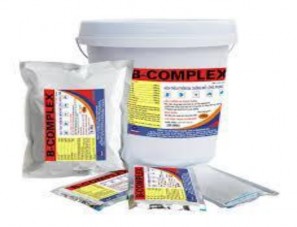
-Use:
+ Feeding and drinking: mix 0.05-0.1% into mixed feed for livestock to eat. Dissolve: 10-20ml into 1 liter of water for poultry to drink.
Maybe you are interested!
-
 Veterinary Pharmacology - Northeast College of Agriculture and Forestry - 1
 -
 Pharmacology - Tay Sai Gon College - 1
 -
 Pharmacology - Tay Sai Gon College - 2
 -
 Pig Farming - Northeast College of Agriculture and Forestry - 8
 -
 Pharmacology Part 1 - 7
+ Intramuscular or subcutaneous injection:
Buffalo, cow, horse: 5-10ml/head/day Pig, goat, sheep: 3-5ml/head/day
Photo 41: B.complex medicine
4.2.4. Injection of ADE
- Ingredient
Each ml contains:
Vitamin A 50,000 IU
Vitamin D3 25,000 IU
Vitamin E 20 mg
Solvent q.s. 1 ml
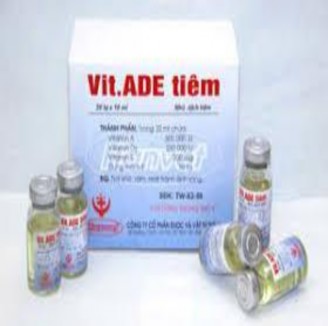
- Uses
- Treat and prevent diseases caused by Vitamin A, D3, E deficiency.
- Increase body resistance, anti-stress.
- Treatment and prevention of muscle degeneration in growing animals, bone inflammation and degeneration, skin and mucosal lesions.
- Stimulates growth for young livestock, slow-growing and stunted livestock
bone... Photo 42: Vitamin ADE
- Usage and dosage
Intramuscular (IM) or subcutaneous (SC) injection . Use for 3-5 days.
- Buffalo, cow, horse: 10-15ml
- Calves, goats, sheep: 2-5 ml
- Piglets: 1.5-2 ml
- Pigs: 3-5 ml
- Dogs, cats: 1-3 ml
4.2.5. Iron-containing blood tonics
4.2.5.1. The role of iron in the animal body
Iron plays an important role in the body, only iron two participates in the creation of hemoglobin. Creates muscle pigment (Miogrobin); participates in the creation of respiratory pigment (cytochrome). Therefore, when lacking iron, animals will be anemic. Anemia in young cattle will lead to pale skin and mucous membranes, stunted growth, and slow growth.
Young animals need iron to create haemoglobin. In piglets, the daily iron requirement is 10-12mg, but breast milk only provides 1mg/day. Therefore, iron supplementation is needed for young animals, animals with blood loss, and female animals after giving birth.
Iron supplements must use ferrous iron, not ferrous iron.
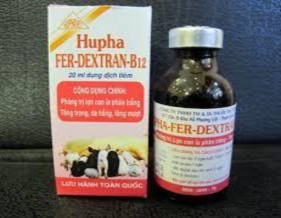
4.2.5.2. Fer-Dextran B12
- Properties : is a preparation consisting of Fe and B12, in solution form, brown in color.
- Effect:
Iron has the effect of nourishing the body, when iron dextran is introduced into the body. Dextran is broken down into glucose molecules. This is a type of sugar that is very necessary for the body, in the cells they will be converted into energy. Iron is also released from dextran and goes to the liver and bone marrow to create red blood cells.
new bridge. Photo 43: Iron pills
- Application and usage: Inflammation and treatment of iron deficiency anemia in newborn livestock, helping young livestock to be healthy and develop well. Prevent and treat white feces in piglets.
+ Pigs from 3-5 days old inject 1-2ml in the thigh muscle.
After 7 days, inject again for the second time.
+ Calves, horses: 3-5ml/head
+ Goats: 2-3ml/goat
+ Dogs: 1ml/dog
4.2.6. Hanlacvet
- Ingredient
1 g Hanlacvet contains:
Lactobacillus acidophilus: 1x10 8 - 1x10 9 CFU Excipients q.s: 1 g
- Uses
Prevention and treatment of intestinal diseases: diarrhea, white feces, green feces, dysentery, coccidiosis; some diseases caused by Parvo and Rotavirus in calves, pigs, dogs, cats, poultry...
Enhances resistance: stimulates growth in young livestock. Stimulates egg laying in poultry.
- Usage and dosage:
+Disease prevention:
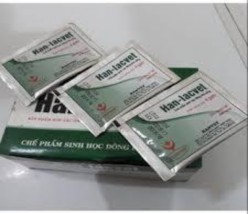
Photo 44: Han-lacvet medicine
Use immediately after birth: once every 2 days, for 10 consecutive days. Piglets, dogs, cats: 1g/pig
Calves, goats, sheep: 2-3g/head Poultry 1g/25 heads
+ Treatment : Use twice a day with a dose 2-3 times higher than the prevention dose.
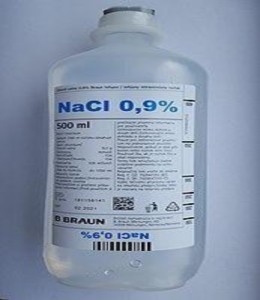
4.2.7. Sodium chloride 0.9%
- Properties: is a sterile solution, pure NaCl content 0.9% soluble in double distilled water
- Effect: provides water for the body, stabilizes blood pressure. Provides the body with an additional amount of Na + which helps retain water.
- Application and usage:
+ Used when the body is dehydrated with salt loss such as: severe diarrhea, vomiting, heatstroke, sunstroke, gastritis, enteritis. When transporting livestock, when livestock loses blood, severe burns. Wash wounds.
+ Make solvent for mixing medicine
+ Can be used orally, intravenously, or intraperitoneally.
- Dosage for intravenous injection
+ Buffalo, cow, horse: 200-1,000ml
+ Pig: 10-100ml
+ Dogs: 10-50 ml Photo 45: Physiological water
Questions and exercises
1. Describe the effects of oral medication for treating horse colic?
2. What are the applications of injectable drugs for treating equine colic?
3. Describe the applications of vitamin ADE?
Practical part
Lesson 5. Identify and determine the ingredients of drugs for treating digestive diseases that have been studied and researched?
Lesson 6. Identify and determine the ingredients of the supplements you have learned and researched?
Requirements for assessment of learning outcomes
Assessment of learning outcomes (periodic scores) is based on the form of testing each student on the names and ingredients of gastrointestinal drugs and supplements for pets.
Memorize
Each type of medicine for treating digestive diseases and student supplements must have defined effects and usage.
REFERENCES
1. Dao Cong Duan (2017). Veterinary pharmacology textbook , Agricultural Publishing House.
2. Dang Dinh Hanh, Nguyen Thi Tuyet, Nguyen Van Thien (2009). Horse breeding,
Agricultural Publishing House.