
(Bac Ninh), Phat Diem Cathedral, Bai Dinh Pagoda (Ninh Binh), Tra Kieu Capital, My Son Temple Complex (Quang Nam), La Vang Holy Land (Quang Tri), Cao Dai Holy Temple (Tay Ninh),... These holy sites are increasingly invested in upgrading, renovating, and repairing to be more spacious and majestic, but little attention is paid to the aspect of preparing conditions for tourists following the type of spiritual tourism such as: accommodation, meditation halls, holy temples, equipment for retreat activities, necessities,...
Festivals : "Ceremony" is a system of behaviors and movements that express people's respect for gods, reflecting people's legitimate dreams for life that they themselves are not yet able to realize. "Association" is a cultural, religious, and artistic activity of the community, originating from the needs of life. Festivals are collective activities and are often related to beliefs and religions. According to statistics from the Ministry of Culture, Sports and Tourism, there are currently 7,966 festivals nationwide, including 7,039 folk festivals (88.4%), 332 historical festivals (4.2%), 544 religious festivals (6.8%), ten festivals imported from abroad (0.1%), and the rest are other festivals (0.5%). Thus, it can be seen that the potential for developing spiritual tourism in Vietnam is very promising. In particular, many festivals have been recognized by UNESCO as intangible heritages with great influence in the region and internationally, recognized by the world such as the Gióng Festival (Hanoi), and the Hung King Worshiping Belief (Phu Tho).
Table 4.2. Typical spiritual tourist destinations in Vietnam
STT
Place name | Province | Religion, typical beliefs | |
North | |||
1 | Perfume Pagoda | Hanoi | Buddhism |
2 | Yen Tu Pagoda | Quang Ninh | Buddhism |
3 | Dau Pagoda, But Thap, Phat Tich | Bac Ninh | Buddhism |
4 | Bai Dinh Pagoda | Ninh Binh | Buddhism |
5 | Con Son - Kiep Bac | Hai Duong | Temple |
6 | Hung Temple | Phu Tho | Worship ancestors, saints, gods, and mothers |
7 | Giong Temple, Tan Vien, Chu Dong Tu | Hanoi, Hung Yen | Ancestor worship, saints, mother worship |
Maybe you are interested!
-
 Factors affecting tourist loyalty at spiritual tourist destinations in Vietnam - 2
 -
 Identify Rating Levels and Rating Scales
zt2i3t4l5ee
zt2a3gstourism,quan lan,quang ninh,ecology,ecotourism,minh chau,van don,geography,geographical basis,tourism development,science
zt2a3ge
zc2o3n4t5e6n7ts
of the islanders. Therefore, this indicator will be divided into two sub-indicators:
a1. Natural tourism attractiveness a2. Cultural tourism attractiveness
b. Tourist capacity
The two island communes in Quan Lan have different capacities to receive tourists. Minh Chau Commune is home to many standard hotels and resorts, attracting high-income domestic and international tourists. Meanwhile, Quan Lan Commune has many motels mainly built and operated by local people, so the scale and quality are not high, and will be suitable for ordinary tourists such as students.
c. Time of exploitation of Quan Lan Island Commune:
Quan Lan tourism is seasonal due to weather and climate conditions and festivals only take place on certain days of the year, specifically in spring. In Quan Lan commune, the period from April to June and from September to November is considered the best time to visit Quan Lan because the cultural tourism activities are mainly associated with festivals taking place during this time.
Minh Chau island commune:
Tourism exploitation time is all year round, because this is a place with a number of tourist attractions with diverse ecosystems such as Bai Tu Long National Park Research Center, Tram forest, Turtle Laying Beach, so besides coming to the beach for tourism and vacation in the summer, Minh Chau will attract research groups to come for tourism combined with research at other times of the year.
d. Sustainability
The sustainability of ecotourism sites in Quan Lan and Minh Chau communes depends on the sensitivity of the ecosystems to climate changes.
landscape. In general, these tourist destinations have a fairly high level of sustainability, because they are natural ecosystems, planned and protected. However, if a large number of tourists gather at certain times, it can exceed the carrying capacity and affect the sustainability of the environment (polluted beaches, damaged trees, animals moving away from their habitats, etc.), then the sustainability of the above ecosystems (natural ecosystems, human ecosystems) will also be affected and become less sustainable.
e. Location and accessibility
Both island communes have ports to take tourists to visit from Van Don wharf:
- Quan Lan – Van Don traffic route:
Phuc Thinh – Viet Anh high-speed boat and Quang Minh high-speed boat, depart at 8am and 2pm from Van Don to Quan Lan, and at 7am and 1pm from Quan Lan to Van Don. There are also wooden boats departing at 7am and 1pm.
- Van Don - Minh Chau traffic route:
Chung Huong high-speed train, Minh Chau train, morning 7:30 and afternoon 13:30 from Van Don to Minh Chau, morning 6:30 and afternoon 13:00 from Minh Chau to Van Don.
f. Infrastructure
Despite receiving investment attention, the issue of infrastructure and technical facilities for tourism on Quan Lan Island is still an issue that needs to be resolved because it has a direct impact on the implementation of ecotourism activities. The minimum conditions for serving tourists such as accommodation, electricity, water, communication, especially medical services, and security work need to be given top priority. Ecotourism spots in Minh Chau commune are assessed to have better infrastructure and technical facilities for tourism because there are quite complete and synchronous conditions for serving tourists, meeting many needs of domestic and foreign tourists.
3.2.1.4. Determine assessment levels and assessment scales
Corresponding to the levels of each criterion, the index is the score of those levels in the order of 4, 3, 2, 1 decreasing according to the standard of each level: very attractive (4), attractive (3), average (2), less attractive (1).
3.2.1.5. Determining the coefficients of the criteria
For the assessment of DLST in the two communes of Quan Lan and Minh Chau islands, the students added evaluation coefficients to show the importance of the criteria and indicators as follows:
Coefficient 3 with criteria: Attractiveness, Exploitation time. These are the 2 most important criteria for attracting tourists to tourism in general and eco-tourism in particular, so they have the highest coefficient.
Coefficient 2 with criteria: Capacity, Infrastructure, Location and accessibility . Because the assessment area is an island commune of Van Don district, the above criteria are selected by the author with appropriate coefficients at the average level.
Coefficient 1 with criteria: Sustainability. Quan Lan has natural and human-made ecotourism sites, with high biodiversity and little impact from local human factors. Most of the ecotourism sites are still wild, so they are highly sustainable.
3.2.1.6. Results of DLST assessment on Quan Lan island
a. Assessment of the potential for natural tourism development
For Minh Chau commune:
+ Natural tourism attractiveness is determined to be very attractive (4 points) and the most important coefficient (coefficient 3), so the score of the Attractiveness criterion is 4 x 3 = 12.
+ Capacity is determined as average (2 points) and the coefficient is quite important (coefficient 2), then the score of Capacity criterion is 2 x 2 = 4.
+ Exploitation time is long (4 points), the most important coefficient (coefficient 3) so the score of the Exploitation time criterion is 4 x 3 = 12.
+ Sustainability is determined as sustainable (4 points), the important coefficient is the average coefficient (coefficient 1), so the score of the Sustainability criterion is 4 x 1 = 4 points
+ Location and accessibility are determined to be quite favorable (2 points), the coefficient is quite important (coefficient 2), the criterion score is 2 x 2 = 4 points.
+ Infrastructure is assessed as good (3 points), the coefficient is quite important (coefficient 2), then the score of the Infrastructure criterion is 3 x 2 = 6 points.
The total score for evaluating DLST in Minh Chau commune according to 6 evaluation criteria is determined as: 12 + 4 + 12 + 4 + 4 + 6 = 42 points
Similar assessment for Quan Lan commune, we have the following table:
Table 3.3: Assessment of the potential for natural ecotourism development in Quan Lan and Minh Chau communes
Attractiveness of self-tourismof course
Capacity
Mining time
Sustainability
Location and accessibility
Infrastructure
Result
Point
DarkMulti
Point
DarkMulti
Point
DarkMulti
Point
DarkMulti
Point
DarkMulti
Point
DarkMulti
CommuneMinh Chau
12
12
4
8
12
12
4
4
4
8
6
8
42/52
Quan CommuneLan
6
12
6
8
9
12
4
4
4
8
4
8
33/52
b. Assessment of the potential for humanistic tourism development
For Quan Lan commune:
+ The attractiveness of human tourism is determined to be very attractive (4 points) and the most important coefficient (coefficient 3), so the score of the Attractiveness criterion is 4 x 3 = 12.
+ Capacity is determined to be large (3 points) and the coefficient is quite important (coefficient 2), then the score of the Capacity criterion is 3 x 2 = 6.
+ Mining time is average (3 points), the most important coefficient (coefficient 3) so the score of the Mining time criterion is 3 x 3 = 9.
+ Sustainability is determined as sustainable (4 points), the important coefficient is the average coefficient (coefficient 1), so the score of the Sustainability criterion is 4 x 1 = 4 points.
+ Location and accessibility are determined to be quite favorable (2 points), the coefficient is quite important (coefficient 2), the criterion score is 2 x 2 = 4 points.
+ Infrastructure is rated as average (2 points), the coefficient is quite important (coefficient 2), then the score of the Infrastructure criterion is 2 x 2 = 4 points.
The total score for evaluating DLST in Quan Lan commune according to 6 evaluation criteria is determined as: 12 + 6 + 6 + 4 + 4 + 4 = 36 points.
Similar assessment with Minh Chau commune we have the following table:
Table 3.4: Assessment of the potential for developing humanistic eco-tourism in Quan Lan and Minh Chau communes
Attractiveness of human tourismliterature
Capacity
Mining time
Sustainability
Location and accessibility
Infrastructure
Result
Point
DarkMulti
Point
DarkMulti
Point
DarkMulti
Point
DarkMulti
Point
DarkMulti
Point
DarkMulti
Quan CommuneLan
12
12
6
8
9
12
4
4
4
8
4
8
39/52
Minh CommuneChau
6
12
4
8
12
12
4
4
4
8
6
8
36/52
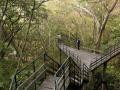
Basically, both Minh Chau and Quan Lan localities have quite favorable conditions for developing ecotourism. However, Quan Lan commune has more advantages to develop ecotourism in a humanistic direction, because this is an area with many famous historical relics such as Quan Lan Communal House, Quan Lan Pagoda, Temple worshiping the hero Tran Khanh Du, ... along with local festivals held annually such as the wind praying ceremony (March 15), Quan Lan festival (June 10-19); due to its location near the port and long exploitation time, the beaches in Quan Lan commune (especially Quan Lan beach) are no longer hygienic and clean to ensure the needs of tourists coming to relax and swim; this is also an area with many beautiful landscapes such as Got Beo wind pass, Ong Phong head, Voi Voi cave, but the ability to access these places is still very limited (dirt hill road, lots of gravel and rocks), especially during rainy and windy times; In addition, other natural resources such as mangrove forests and sea worms have not been really exploited for tourism purposes and ecotourism development. On the contrary, Minh Chau commune has more advantages in developing ecotourism in the direction of natural tourism, this is an area with diverse ecosystems such as at Rua De Beach, Bai Tu Long National Park Conservation Center...; Minh Chau beach is highly appreciated for its natural beauty and cleanliness, ranked in the top ten most beautiful beaches in Vietnam; Minh Chau commune is also home to Tram forest with a large area and a purity of up to 90%, suitable for building bridges through the forest (a very effective type of natural ecotourism currently applied by many countries) for tourists to sightsee, as well as for the purpose of studying and researching.
Figure 3.1: Thenmala Forest Bridge (India) Source: https://www.thenmalaecotourism.com/(August 21, 2019)
3.2.2. Using SWOT matrix to evaluate Quan Lan island tourism
General assessment of current tourism activities of Quan Lan island is shown through the following SWOT matrix:
Table 3.5: SWOT matrix evaluating tourism activities on Quan Lan island
Internal agent
Strengths- There is a lot of potential for tourism development, especially natural ecotourism and humanistic ecotourism.- The unskilled labor force is relatively abundant.- resource environmentunpolluted, still
Weaknesses- Poorly developed infrastructure, especially traffic routes to tourist destinations on the island.- The team of professional staff is still weak.- Tourism products in general
quite wild, originalintact
general and DLST in particularalone is monotonous.
External agents
Opportunity- Tourism is a key industry in the socio-economic development strategy of the province and Van Don economic zone.- Quan Lan was selected as a pilot area for eco-tourism development within the framework of the green growth project between Quang Ninh province and the Japanese organization JICA.- The flow of tourists and especially ecotourism in the world tends toincreasing
Challenge- Weather and climate change abnormally.- Competition in tourism products is increasingly fierce, especially with other localities in the province such as Ha Long, Mong Cai...- Awareness of tourists, especially domestic tourists, about ecotourism and nature conservation is not high.
Through summary analysis using SWOT matrix we see that:
To exploit strengths and take advantage of opportunities, it is necessary to:
- Diversify products and service types (build more tourism routes aimed at specific needs of tourists: experiential tourism immersed in nature, spiritual cultural tourism...)
- Effective exploitation of resources and differentiated products (natural resources and human resources)
div.maincontent .p { color: black; font-family:"Times New Roman", serif; font-style: normal; font-weight: normal; text-decoration: none; font-size: 14pt; margin:0pt; } div.maincontent p { color: black; font-family:"Times New Roman", serif; font-style: normal; font-weight: normal; text-decoration: none; font-size: 14pt; margin:0pt; } div.maincontent .s1 { color: black; font-family:"Times New Roman", serif; font-style: normal; font-weight: normal; text-decoration: none; font-size: 13pt; } div.maincontent .s2 { color: black; font-family:"Times New Roman", serif; font-style: normal; font-weight: normal; text-decoration: none; font-size: 13pt; } div.maincontent .s3 { color: #0D0D0D; font-family:"Times New Roman", serif; font-style: normal; font-weight: bold; text-decoration: none; font-size: 14pt; } div.maincontent .s4 { color: black; font-family:"Times New Roman", serif; font-style: italic; font-weight: normal; text-decoration: none; font-size: 14pt; } div.maincontent .s5 { color: black; font-family:"Times New Roman", serif; font-style: italic; font-weight: bold; text-decoration: none; font-size: 14pt; } div.maincontent .s6 { color: black; font-family:"Times New Roman", serif; font-style: italic; font-weight: normal; text-decoration: none; font-size: 14pt; vertical-align: -3pt; } div.maincontent .s7 { color: black; font-family:"Times New Roman", serif; font-style: italic; font-weight: normal; text-decoration: none; font-size: 14pt; vertical-align: -2pt; } div.maincontent .s8 { color: black; font-family:"Times New Roman", serif; font-style: italic; font-weight: normal; text-decoration: none; font-size: 14pt; vertical-align: -1pt; } div.maincontent .s9 { color: black; font-family:"Times New Roman", serif; font-style: normal; font-weight: normal; text-decoration: none; font-size: 14pt; } div.maincontent .s10 { color: black; font-family:"Times New Roman", serif; font-style: normal; font-weight: bold; text-decoration: none; font-size: 14pt; } div.maincontent .s11 { color: black; font-family:"Times New Roman", serif; font-style: normal; font-weight: normal; text-decoration: none; font-size: 14pt; } div.maincontent .s12 { color: black; font-family:Symbol, serif; font-style: normal; font-weight: normal; text-decoration: none; font-size: 14pt; } div.maincontent .s13 { color: black; font-family:Wingdings; font-style: normal; font-weight: normal; text-decoration: none; font-size: 14pt; } div.maincontent .s14 { color: black; font-family:"Times New Roman", serif; font-style: normal; font-weight: normal; text-decoration: none; font-size: 9pt; vertical-align: 5pt; } div.maincontent .s15 { color: black; font-family:"Times New Roman", serif; font-style: normal; font-weight: normal; text-decoration: none; font-size: 9pt; vertical-align: 5pt; } div.maincontent .s16 { color: black; font-family:Cambria, serif; font-style: italic; font-weight: normal; text-decoration: none; font-size: 14pt; } div.maincontent .s17 { color: #080808; font-family:"Times New Roman", serif; font-style: normal; font-weight: bold; text-decoration: none; font-size: 14pt; } div.maincontent .s18 { color: #080808; font-family:"Times New Roman", serif; font-style: normal; font-weight: normal; text-decoration: none; font-size: 14pt; } div.maincontent .s19 { color: black; font-family:"Times New Roman", serif; font-style: normal; font-weight: normal; text-decoration: none; font-size: 11pt; } div.maincontent .s20 { color: black; font-family:"Times New Roman", serif; font-style: normal; font-weight: normal; text-decoration: none; font-size: 10pt; } div.maincontent .s21 { color: black; font-family:"Times New Roman", serif; font-style: normal; font-weight: bold; text-decoration: none; font-size: 11pt; } div.maincontent .s22 { color: black; font-family:"Times New Roman", serif; font-style: normal; font-weight: normal; text-decoration: none; font-size: 11pt; } div.maincontent .s23 { color: black; font-family:"Times New Roman", serif; font-style: italic; font-weight: normal; text-decoration: none; font-size: 14pt; } div.maincontent .s24 { color: #212121; font-family:"Times New Roman", serif; font-style: normal; font-weight: normal; tex
Identify Rating Levels and Rating Scales
zt2i3t4l5ee
zt2a3gstourism,quan lan,quang ninh,ecology,ecotourism,minh chau,van don,geography,geographical basis,tourism development,science
zt2a3ge
zc2o3n4t5e6n7ts
of the islanders. Therefore, this indicator will be divided into two sub-indicators:
a1. Natural tourism attractiveness a2. Cultural tourism attractiveness
b. Tourist capacity
The two island communes in Quan Lan have different capacities to receive tourists. Minh Chau Commune is home to many standard hotels and resorts, attracting high-income domestic and international tourists. Meanwhile, Quan Lan Commune has many motels mainly built and operated by local people, so the scale and quality are not high, and will be suitable for ordinary tourists such as students.
c. Time of exploitation of Quan Lan Island Commune:
Quan Lan tourism is seasonal due to weather and climate conditions and festivals only take place on certain days of the year, specifically in spring. In Quan Lan commune, the period from April to June and from September to November is considered the best time to visit Quan Lan because the cultural tourism activities are mainly associated with festivals taking place during this time.
Minh Chau island commune:
Tourism exploitation time is all year round, because this is a place with a number of tourist attractions with diverse ecosystems such as Bai Tu Long National Park Research Center, Tram forest, Turtle Laying Beach, so besides coming to the beach for tourism and vacation in the summer, Minh Chau will attract research groups to come for tourism combined with research at other times of the year.
d. Sustainability
The sustainability of ecotourism sites in Quan Lan and Minh Chau communes depends on the sensitivity of the ecosystems to climate changes.
landscape. In general, these tourist destinations have a fairly high level of sustainability, because they are natural ecosystems, planned and protected. However, if a large number of tourists gather at certain times, it can exceed the carrying capacity and affect the sustainability of the environment (polluted beaches, damaged trees, animals moving away from their habitats, etc.), then the sustainability of the above ecosystems (natural ecosystems, human ecosystems) will also be affected and become less sustainable.
e. Location and accessibility
Both island communes have ports to take tourists to visit from Van Don wharf:
- Quan Lan – Van Don traffic route:
Phuc Thinh – Viet Anh high-speed boat and Quang Minh high-speed boat, depart at 8am and 2pm from Van Don to Quan Lan, and at 7am and 1pm from Quan Lan to Van Don. There are also wooden boats departing at 7am and 1pm.
- Van Don - Minh Chau traffic route:
Chung Huong high-speed train, Minh Chau train, morning 7:30 and afternoon 13:30 from Van Don to Minh Chau, morning 6:30 and afternoon 13:00 from Minh Chau to Van Don.
f. Infrastructure
Despite receiving investment attention, the issue of infrastructure and technical facilities for tourism on Quan Lan Island is still an issue that needs to be resolved because it has a direct impact on the implementation of ecotourism activities. The minimum conditions for serving tourists such as accommodation, electricity, water, communication, especially medical services, and security work need to be given top priority. Ecotourism spots in Minh Chau commune are assessed to have better infrastructure and technical facilities for tourism because there are quite complete and synchronous conditions for serving tourists, meeting many needs of domestic and foreign tourists.
3.2.1.4. Determine assessment levels and assessment scales
Corresponding to the levels of each criterion, the index is the score of those levels in the order of 4, 3, 2, 1 decreasing according to the standard of each level: very attractive (4), attractive (3), average (2), less attractive (1).
3.2.1.5. Determining the coefficients of the criteria
For the assessment of DLST in the two communes of Quan Lan and Minh Chau islands, the students added evaluation coefficients to show the importance of the criteria and indicators as follows:
Coefficient 3 with criteria: Attractiveness, Exploitation time. These are the 2 most important criteria for attracting tourists to tourism in general and eco-tourism in particular, so they have the highest coefficient.
Coefficient 2 with criteria: Capacity, Infrastructure, Location and accessibility . Because the assessment area is an island commune of Van Don district, the above criteria are selected by the author with appropriate coefficients at the average level.
Coefficient 1 with criteria: Sustainability. Quan Lan has natural and human-made ecotourism sites, with high biodiversity and little impact from local human factors. Most of the ecotourism sites are still wild, so they are highly sustainable.
3.2.1.6. Results of DLST assessment on Quan Lan island
a. Assessment of the potential for natural tourism development
For Minh Chau commune:
+ Natural tourism attractiveness is determined to be very attractive (4 points) and the most important coefficient (coefficient 3), so the score of the Attractiveness criterion is 4 x 3 = 12.
+ Capacity is determined as average (2 points) and the coefficient is quite important (coefficient 2), then the score of Capacity criterion is 2 x 2 = 4.
+ Exploitation time is long (4 points), the most important coefficient (coefficient 3) so the score of the Exploitation time criterion is 4 x 3 = 12.
+ Sustainability is determined as sustainable (4 points), the important coefficient is the average coefficient (coefficient 1), so the score of the Sustainability criterion is 4 x 1 = 4 points
+ Location and accessibility are determined to be quite favorable (2 points), the coefficient is quite important (coefficient 2), the criterion score is 2 x 2 = 4 points.
+ Infrastructure is assessed as good (3 points), the coefficient is quite important (coefficient 2), then the score of the Infrastructure criterion is 3 x 2 = 6 points.
The total score for evaluating DLST in Minh Chau commune according to 6 evaluation criteria is determined as: 12 + 4 + 12 + 4 + 4 + 6 = 42 points
Similar assessment for Quan Lan commune, we have the following table:
Table 3.3: Assessment of the potential for natural ecotourism development in Quan Lan and Minh Chau communes
Attractiveness of self-tourismof course
Capacity
Mining time
Sustainability
Location and accessibility
Infrastructure
Result
Point
DarkMulti
Point
DarkMulti
Point
DarkMulti
Point
DarkMulti
Point
DarkMulti
Point
DarkMulti
CommuneMinh Chau
12
12
4
8
12
12
4
4
4
8
6
8
42/52
Quan CommuneLan
6
12
6
8
9
12
4
4
4
8
4
8
33/52
b. Assessment of the potential for humanistic tourism development
For Quan Lan commune:
+ The attractiveness of human tourism is determined to be very attractive (4 points) and the most important coefficient (coefficient 3), so the score of the Attractiveness criterion is 4 x 3 = 12.
+ Capacity is determined to be large (3 points) and the coefficient is quite important (coefficient 2), then the score of the Capacity criterion is 3 x 2 = 6.
+ Mining time is average (3 points), the most important coefficient (coefficient 3) so the score of the Mining time criterion is 3 x 3 = 9.
+ Sustainability is determined as sustainable (4 points), the important coefficient is the average coefficient (coefficient 1), so the score of the Sustainability criterion is 4 x 1 = 4 points.
+ Location and accessibility are determined to be quite favorable (2 points), the coefficient is quite important (coefficient 2), the criterion score is 2 x 2 = 4 points.
+ Infrastructure is rated as average (2 points), the coefficient is quite important (coefficient 2), then the score of the Infrastructure criterion is 2 x 2 = 4 points.
The total score for evaluating DLST in Quan Lan commune according to 6 evaluation criteria is determined as: 12 + 6 + 6 + 4 + 4 + 4 = 36 points.
Similar assessment with Minh Chau commune we have the following table:
Table 3.4: Assessment of the potential for developing humanistic eco-tourism in Quan Lan and Minh Chau communes
Attractiveness of human tourismliterature
Capacity
Mining time
Sustainability
Location and accessibility
Infrastructure
Result
Point
DarkMulti
Point
DarkMulti
Point
DarkMulti
Point
DarkMulti
Point
DarkMulti
Point
DarkMulti
Quan CommuneLan
12
12
6
8
9
12
4
4
4
8
4
8
39/52
Minh CommuneChau
6
12
4
8
12
12
4
4
4
8
6
8
36/52
Basically, both Minh Chau and Quan Lan localities have quite favorable conditions for developing ecotourism. However, Quan Lan commune has more advantages to develop ecotourism in a humanistic direction, because this is an area with many famous historical relics such as Quan Lan Communal House, Quan Lan Pagoda, Temple worshiping the hero Tran Khanh Du, ... along with local festivals held annually such as the wind praying ceremony (March 15), Quan Lan festival (June 10-19); due to its location near the port and long exploitation time, the beaches in Quan Lan commune (especially Quan Lan beach) are no longer hygienic and clean to ensure the needs of tourists coming to relax and swim; this is also an area with many beautiful landscapes such as Got Beo wind pass, Ong Phong head, Voi Voi cave, but the ability to access these places is still very limited (dirt hill road, lots of gravel and rocks), especially during rainy and windy times; In addition, other natural resources such as mangrove forests and sea worms have not been really exploited for tourism purposes and ecotourism development. On the contrary, Minh Chau commune has more advantages in developing ecotourism in the direction of natural tourism, this is an area with diverse ecosystems such as at Rua De Beach, Bai Tu Long National Park Conservation Center...; Minh Chau beach is highly appreciated for its natural beauty and cleanliness, ranked in the top ten most beautiful beaches in Vietnam; Minh Chau commune is also home to Tram forest with a large area and a purity of up to 90%, suitable for building bridges through the forest (a very effective type of natural ecotourism currently applied by many countries) for tourists to sightsee, as well as for the purpose of studying and researching.
Figure 3.1: Thenmala Forest Bridge (India) Source: https://www.thenmalaecotourism.com/(August 21, 2019)
3.2.2. Using SWOT matrix to evaluate Quan Lan island tourism
General assessment of current tourism activities of Quan Lan island is shown through the following SWOT matrix:
Table 3.5: SWOT matrix evaluating tourism activities on Quan Lan island
Internal agent
Strengths- There is a lot of potential for tourism development, especially natural ecotourism and humanistic ecotourism.- The unskilled labor force is relatively abundant.- resource environmentunpolluted, still
Weaknesses- Poorly developed infrastructure, especially traffic routes to tourist destinations on the island.- The team of professional staff is still weak.- Tourism products in general
quite wild, originalintact
general and DLST in particularalone is monotonous.
External agents
Opportunity- Tourism is a key industry in the socio-economic development strategy of the province and Van Don economic zone.- Quan Lan was selected as a pilot area for eco-tourism development within the framework of the green growth project between Quang Ninh province and the Japanese organization JICA.- The flow of tourists and especially ecotourism in the world tends toincreasing
Challenge- Weather and climate change abnormally.- Competition in tourism products is increasingly fierce, especially with other localities in the province such as Ha Long, Mong Cai...- Awareness of tourists, especially domestic tourists, about ecotourism and nature conservation is not high.
Through summary analysis using SWOT matrix we see that:
To exploit strengths and take advantage of opportunities, it is necessary to:
- Diversify products and service types (build more tourism routes aimed at specific needs of tourists: experiential tourism immersed in nature, spiritual cultural tourism...)
- Effective exploitation of resources and differentiated products (natural resources and human resources)
div.maincontent .p { color: black; font-family:"Times New Roman", serif; font-style: normal; font-weight: normal; text-decoration: none; font-size: 14pt; margin:0pt; } div.maincontent p { color: black; font-family:"Times New Roman", serif; font-style: normal; font-weight: normal; text-decoration: none; font-size: 14pt; margin:0pt; } div.maincontent .s1 { color: black; font-family:"Times New Roman", serif; font-style: normal; font-weight: normal; text-decoration: none; font-size: 13pt; } div.maincontent .s2 { color: black; font-family:"Times New Roman", serif; font-style: normal; font-weight: normal; text-decoration: none; font-size: 13pt; } div.maincontent .s3 { color: #0D0D0D; font-family:"Times New Roman", serif; font-style: normal; font-weight: bold; text-decoration: none; font-size: 14pt; } div.maincontent .s4 { color: black; font-family:"Times New Roman", serif; font-style: italic; font-weight: normal; text-decoration: none; font-size: 14pt; } div.maincontent .s5 { color: black; font-family:"Times New Roman", serif; font-style: italic; font-weight: bold; text-decoration: none; font-size: 14pt; } div.maincontent .s6 { color: black; font-family:"Times New Roman", serif; font-style: italic; font-weight: normal; text-decoration: none; font-size: 14pt; vertical-align: -3pt; } div.maincontent .s7 { color: black; font-family:"Times New Roman", serif; font-style: italic; font-weight: normal; text-decoration: none; font-size: 14pt; vertical-align: -2pt; } div.maincontent .s8 { color: black; font-family:"Times New Roman", serif; font-style: italic; font-weight: normal; text-decoration: none; font-size: 14pt; vertical-align: -1pt; } div.maincontent .s9 { color: black; font-family:"Times New Roman", serif; font-style: normal; font-weight: normal; text-decoration: none; font-size: 14pt; } div.maincontent .s10 { color: black; font-family:"Times New Roman", serif; font-style: normal; font-weight: bold; text-decoration: none; font-size: 14pt; } div.maincontent .s11 { color: black; font-family:"Times New Roman", serif; font-style: normal; font-weight: normal; text-decoration: none; font-size: 14pt; } div.maincontent .s12 { color: black; font-family:Symbol, serif; font-style: normal; font-weight: normal; text-decoration: none; font-size: 14pt; } div.maincontent .s13 { color: black; font-family:Wingdings; font-style: normal; font-weight: normal; text-decoration: none; font-size: 14pt; } div.maincontent .s14 { color: black; font-family:"Times New Roman", serif; font-style: normal; font-weight: normal; text-decoration: none; font-size: 9pt; vertical-align: 5pt; } div.maincontent .s15 { color: black; font-family:"Times New Roman", serif; font-style: normal; font-weight: normal; text-decoration: none; font-size: 9pt; vertical-align: 5pt; } div.maincontent .s16 { color: black; font-family:Cambria, serif; font-style: italic; font-weight: normal; text-decoration: none; font-size: 14pt; } div.maincontent .s17 { color: #080808; font-family:"Times New Roman", serif; font-style: normal; font-weight: bold; text-decoration: none; font-size: 14pt; } div.maincontent .s18 { color: #080808; font-family:"Times New Roman", serif; font-style: normal; font-weight: normal; text-decoration: none; font-size: 14pt; } div.maincontent .s19 { color: black; font-family:"Times New Roman", serif; font-style: normal; font-weight: normal; text-decoration: none; font-size: 11pt; } div.maincontent .s20 { color: black; font-family:"Times New Roman", serif; font-style: normal; font-weight: normal; text-decoration: none; font-size: 10pt; } div.maincontent .s21 { color: black; font-family:"Times New Roman", serif; font-style: normal; font-weight: bold; text-decoration: none; font-size: 11pt; } div.maincontent .s22 { color: black; font-family:"Times New Roman", serif; font-style: normal; font-weight: normal; text-decoration: none; font-size: 11pt; } div.maincontent .s23 { color: black; font-family:"Times New Roman", serif; font-style: italic; font-weight: normal; text-decoration: none; font-size: 14pt; } div.maincontent .s24 { color: #212121; font-family:"Times New Roman", serif; font-style: normal; font-weight: normal; tex -
 Scientific Basis of Determining Vietnam Tourist Routes and Destinations, PhD Thesis in Geography and Geology, Hanoi University of Education
 -
 Summary of Reviews of Typical Tourist Destinations of Hai Phong City
 -
 Activities to promote tourist destinations in Dak Nong province - 14
STT
Place name | Province | Religion, typical beliefs | |
8 | Ba Chua Kho Temple, Phu Giay Temple, Tay Ho Temple,.. | Bac Ninh, South Dinh, Hanoi | Mother worship |
9 | Tran Temple | Nam Dinh | Worship the gods |
10 | Hoang Muoi Temple | Ha Tinh, Nghe An | Worshiping mothers, mandarins, girls, boys,... |
11 | Temple of Mother Au Co | Phu Tho, Lao Cai | Mother worship |
Central Highlands | |||
12 | Quang Tri Citadel, Truong Son Cemetery, Dong Loc T-junction... | Quang Tri, Ha Tinh | Spiritual tourism to repay gratitude |
13 | Phnom Penh Church | Quang Tri | Christianity |
14 | Thien Mu Pagoda | Hue | Buddhism |
15 | Non Nuoc Ngu Hanh Son Pagoda, Linh Ung Pagoda | Danang | Buddhism |
16 | Kate Festival and Pokrong Giarai Tower, Ponagar Tower Festival | Ninh Thuan, Nha Trang | religious Brahmin |
17 | Buffalo stabbing festival, grave abandonment, new rice celebration, forest worship,... of Ede, Gia Rai, Xo Dang, Mo Nong ethnic groups | Kon Tum, Dak Lak | Polytheism |
18 | Truc Lam Zen Monastery in Dalat | Lam Dong | Buddhism |
Southern | |||
19 | The Lady of the Land Association | An Giang | Mother Goddess Worship |
20 | Cao Dai Church | Tay Ninh | Caodaism |
21 | Ok Om Bok Association | Tra Vinh, Soc Trang | Buddhism |
22 | Ba Den Mountain Festival | Tay Ninh | Worship Mother Goddess, Saints |
23 | Con Dao | Ba Ria - Vung Tau | Spiritual tourism to repay gratitude |
Source: Author's synthesis
4.1.2. Religious activities
Our country is a multi-religious and multi-faith country. People are free to follow or not follow as well as practice beliefs/religions according to the provisions of the Law on Belief and Religion (2016, Point 1, Article 6). Accordingly, belief is understood as human belief expressed through rituals associated with traditional customs and practices to bring spiritual peace to individuals and communities. Religion is human belief that exists with a system of concepts and activities including objects of worship, doctrines, canon laws, rituals and organizations (Article 1 of the Law on Belief and Religion, 2016).
In Vietnam, religious and belief activities are quite developed, including: ancestor worship, worship of outstanding heroes in the history of building and defending the country, mother worship, and village tutelary god worship. Religious establishments with associated or related rituals such as communal houses, temples, shrines, and palaces... are abundant, stretching from North to South, and are also a significant source of humanistic tourism resources. With the policy of freedom of belief and the attention of the Party and State on the issue of belief, many temples, communal houses, shrines, and palaces are currently being repaired and restored. This is one of the favorable conditions to promote the development of tourism activities, especially spiritual tourism activities.
Religion: is an organization that takes spiritual beliefs as its center along with a system of dogmas, doctrines, clergy, churches... In some ways, religion is like a medium that helps people sympathize and communicate with objects such as God, Buddha, God, Saints... that people believe in and worship.
Religion in Vietnam is also very diverse. According to statistics from the Government's religious affairs committee, by 2018, the country had 12 religions recognized as legal entities and operating: Buddhism, Catholicism, Protestantism, Cao Dai, Islam, Hoa Hao Buddhism, Pure Land Buddhist Association, Tu An Hieu Nghia, Ba'hai, Minh Chon religion, Minh Ly religion and Buu Son Ky Huong, with a total of 37 church organizations, congregations, more than 20 million followers of religions, over 85,000 dignitaries, monks and nuns and more than 26,000 places of worship of religions in all provinces and cities across the country. Some of the most popular religions in Vietnam include:
Among religions, Buddhism is the most developed religion in Vietnam today. Buddhism has a long history, has many followers, and has a profound influence in the Vietnamese community. According to statistics from the Government Committee for Religious Affairs, Vietnam has more than 14,775 temples, monasteries, hermitages, and Buddhist prayer halls nationwide. Regarding population: about 80% - 90% of the Vietnamese population is inclined towards Buddhism. Of these, many temples, monasteries, hermitages, and Buddhist prayer halls are recognized as relics. Buddhism is a religion
Religion has many activities that attract a large number of followers, creating favorable conditions for the development of spiritual tourism and meditation tourism, contributing significantly to the socio-economic development of localities.
Christianity (Christianity): Believes in God and Jesus, followers of this religion believe that there is only one God, God, who created the universe, humans and all species on earth. Christianity believes that the human body is dust, but the soul is immortal, therefore, there is Heaven and Hell, which are places of eternal happiness and eternal suffering, after death people will go to one of these two places.
Christianity was introduced to Vietnam by Spanish, French, and Portuguese missionaries in the early 16th century in Nam Dinh (during the Le-Mac dynasty). Later, the French encouraged people to follow this new religion because they believed that it would help balance the number of Buddhists (the majority due to a long history of development) and the number of Catholics (the minority due to its recent introduction). In the beginning, from the 16th to the 19th century, the majority of Vietnamese people rarely joined Catholicism, so Catholicism only spread among a small number of people in the coastal provinces of Thai Binh, Nam Dinh, Ninh Binh, Thanh Hoa, and then spread to the Red River Delta and urban areas. During this period, priest Alexandre de Rhodes made great contributions to building the foundation of Catholicism in Vietnam. Currently, Vietnam has about 5.5 million Catholics and about 6,000 churches across the country. Currently, some important holidays of this religion in localities with many Catholic followers such as Easter (Christ's resurrection), Christmas (Christ's birth)... with unique spiritual rituals, have attracted many tourists from everywhere to visit and learn.
Cao Dai: is a religion of the Vietnamese people, founded in 1926. Cao Dai is a religious organization that synthesizes many beliefs, the main ones being Confucianism, Taoism, Buddhism, and Christianity. Therefore, beliefs, thoughts, and doctrines are also a synthesis of the above religions. Cao Dai followers practice religious laws such as not killing, living honestly, being sociable, doing good deeds, avoiding evil, helping others, praying, worshiping ancestors, and always showing love for people through vegetarianism with the simple goal of bringing happiness to everyone, bringing everyone back to God in heaven. Cao Dai developed strongly and spread to many localities in the early stages. Later, Cao Dai divided.
into many sects and is no longer as strong as before. Currently, the headquarters of the Central Cao Dai religion is located at the Tay Ninh Holy See, this is a spiritual tourist destination, a unique architectural work that attracts many tourists to visit and worship.
Hoa Hao Religion : or Hoa Hao Buddhism, is a Vietnamese religion originating from Buddhism. This religion was founded by Mr. Huynh Phu So, who became its leader in 1939 in Hoa Hao village, now in Chau Doc city, An Giang province. Hoa Hao religion believes in reincarnation, cause and effect, takes compassion and equality as the path of practice, encourages simple worship rituals (only flowers and clean water) and eliminates superstition. Ceremonies are organized simply, without eating or drinking, or festivals. Ceremonies, weddings or funerals are not as elaborate as those commonly seen in other religions. The religion does not have monks or a church organization, but only a number of dignitaries who take care of religious and worldly affairs. This religion currently has about 1.3 million followers, concentrated mainly in the Southwest region, especially the Long Xuyen quadrangle area.
Protestantism , also known as Christianity, has the same origin as Catholicism, founded by pastor Martin Luther. Protestantism believes in God and Jesus, but does not believe in the Virgin Mary. It has the same Bible and doctrine as Catholicism. It was introduced to Vietnam in 1911. At first, this religion was only allowed to operate in areas controlled by France and was banned in other areas. It was not until 1920 that Protestantism was allowed to operate throughout Vietnam. By 2004, the number of Protestants in Vietnam was about 1 million, mainly concentrated in Ho Chi Minh City, the Central Highlands and the Northwest.
Islam was introduced to Vietnam very early, first around the 10th - 11th centuries in the Cham community. Vietnam currently has about 60,000 Muslims, living mainly in the provinces of Binh Thuan, Ninh Thuan, An Giang, Tay Ninh, Dong Nai and Ho Chi Minh City.
With the diversity of beliefs, religions and places of worship along with many festivals with religious colors across the country, it brings great potential for spiritual tourism activities in Vietnam now and in the future.
4.2. Descriptive statistics of the research sample
The official sample survey results in the thesis with 700 questionnaires distributed collected 551 valid questionnaires, the response rate reached approximately 79%. The characteristics of spiritual tourists are described according to the criteria of age, gender, education, occupation and monthly income as follows:
Table 4.3. Characteristics of tourists in the survey sample
Group
Ingredient | Number | Proportion | |
Age | <25 | 178 | 32.3% |
25-35 | 127 | 23% | |
35-45 | 142 | 25.8% | |
45-60 | 97 | 17.6% | |
>60 | 7 | 1.3% | |
Job | Student | 170 | 30.9% |
Office staff | 79 | 14.3% | |
Civil servant/official | 140 | 25.4% | |
Freelance business | 61 | 11.1% | |
Housewife/Retired | 54 | 9.8% | |
Other | 47 | 8.5% | |
Sex | Male | 204 | 37% |
Female | 347 | 63% | |
Monthly income (VND) | <2.5 million | 150 | 27.2% |
2.5 -<5 million | 96 | 17.4% | |
5-<7.5 million | 139 | 25.2% | |
7.5-<10 million | 71 | 12.9% | |
>=10 million | 95 | 17.2% |
Source: Author's synthesis
Statistics from official data show that the proportion of tourists in the age group visiting spiritual tourist sites is relatively even. In which, the group of young tourists (under 25 years old) accounts for the highest proportion, approximately 1/3 (178 people) of the number of visitors participating in the survey, and the lowest is the group of people over 45 years old (18.9%, 104 people). This result also reflects the high similarity with the occupational proportion of tourists with the group of students accounting for 30.9% (170 people). Also in terms of occupation, the group of tourists who are civil servants and public employees is the second largest group of tourists with nearly 25.4% of the survey participants. Tourists who are office workers, freelancers or retired housewives and those with other occupations have similar proportions, all below 15% (Table 4.1, Figure 4.1).
Figure 4.1. Statistics on tourist characteristics by age and occupation
In terms of gender, the number of female customers participating in the survey was about 3/2 more than the number of male customers, with the rates of 63% (347 people) and 37% (204 people), respectively. The income spectrum was divided into 5 levels, in which the group of tourists with income under 2.5 million/month with 27.2% (150 people) and 5-7.5 million/month with 25.2% (139 people), respectively, accounted for the highest rate. Meanwhile, the group of tourists with income in the three groups of 2.5-5 million/month, over 10 million/month and 7.5-10 million/month had relatively equal rates, accounting for 17.4% (96 people), 17.2% (95 people) and 12.9% (71 people) respectively (Table 4.2, Figure 4.2).
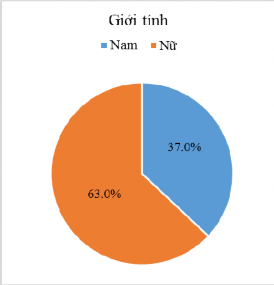
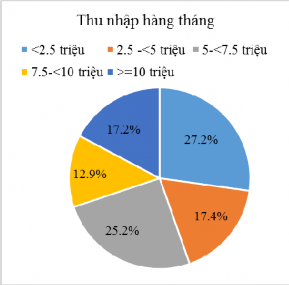
Figure 4.2. Statistics on tourist characteristics by gender and monthly income
The statistical results on the characteristics of spiritual tourism activities of tourists include two criteria: frequency of spiritual tourism and tourists' beliefs and religions. Regarding frequency, the
Most tourists only travel to spiritual sites less than 2 times/year with nearly 60% of respondents (328 people). Next, 148 people (equivalent to 26.9%) said they participate in spiritual tourism activities from 2-4 times/year and only 75 people (equivalent to 13.6%) have a frequency of spiritual tourism more than 4 times/year. Regarding beliefs and religions of tourists, the two most common groups of tourists are Buddhists and Catholics, accounting for 45.6% (251 people) and 22.7% (125 people), respectively. The group of tourists following religions such as Cao Dai, Hoa Hao and Protestantism has a relatively low rate, under 10%. However, the group of tourists following other religions or no religion accounts for nearly 1/5 with 110 respondents (Table 4.4, Figure 4.3)
Table 4.4. Characteristics of spiritual tourism activities of tourists
Group
Ingredient | Number | Proportion | |
Frequency of visits to spiritual sites | <2 times/year | 328 | 59.5% |
2-<4 times/year | 148 | 26.9% | |
4-<6 times/year | 46 | 8.3% | |
>= 6 times/year | 29 | 5.3% | |
Religious beliefs | Buddhism | 251 | 45.6% |
Cao Dai | 35 | 6.4% | |
Hoa Hao | 18 | 3.3% | |
Christianity | 125 | 22.7% | |
Good News | 12 | 2.2% | |
Other | 110 | 20.0% |
Source: Author's synthesis
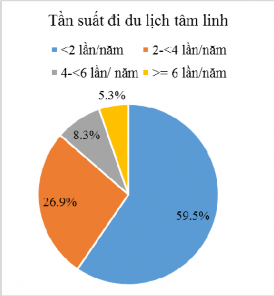
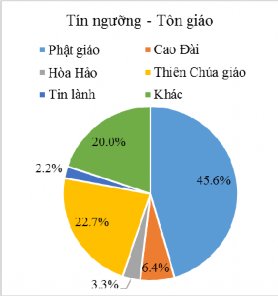
Figure 4.3. Statistics on tourist characteristics according to frequency of spiritual and religious tourism