
as well as foreign affairs. Trade relations between Vietnam and Japan have also entered a new phase with two characteristics: a steady increase in trade volume and the increasing interest of Japanese businesses and companies in the Vietnamese market. During this period, Japan ranked first among the 10 largest trading partners of Vietnam, including: Japan, Singapore, Hong Kong, South Korea, Taiwan, Thailand, China, Germany, Switzerland and the United States.
We can visualize the trade situation between Vietnam and Japan in recent years through the following chart:
Chart 3.1: Trade activities between Vietnam and Japan
Unit: Million USD
Maybe you are interested!
-
 Vietnam - Japan economic and trade relations in the international context. Current situation and solutions - 1
 -
 Vietnam - Japan economic and trade relations in the international context. Current situation and solutions - 12
 -
 Credit Activity Orientation at Vietnam Joint Stock Commercial Bank for Industry and Trade - Hai Phong Branch.
 -
 Current Situation and Impact of Wholesale Trade on Production and Export in Vietnam in the Period 1996-2000
 -
 Vietnam - Japan Trade Turnover Period 1998-2007
5669
6110
4100
4410
2250
2621
921
1716
2007
2005
2000
1995
0 1000 2000 3000 4000 5000 6000 7000
Export Import
(Source: www.mofa.gov.vn Ministry of Foreign Affairs of Vietnam)
In 2007, the export turnover between Vietnam and Japan reached 11.78 billion USD, of which the export turnover reached 6.1 billion USD and the import turnover reached about 5.67 billion USD, accounting for 11.24% of Vietnam's total export turnover. According to data published by the Ministry of Industry and Trade of Vietnam, by December 2007, Vietnam had trade relations with more than 180 countries and territories, Japan had become Vietnam's second most important market (after the US market) in terms of both export and import activities.
Vietnam exports to Japan products that Vietnam has advantages in, such as textiles, seafood, crude oil, coal, wood and wood products, handicrafts, etc., while importing products that mainly serve production. However, Vietnam's exports to Japan account for only nearly 1% of Japan's import market share, a modest figure compared to Vietnam's potential and the Japanese Government's enthusiastic support for Vietnam.
1.3. On labor cooperation
Japan is a potential market for Vietnamese workers. Since 1992, Vietnam has sent about 18,000 trainees to Japan. In 2004, Vietnam established a labor management office in Tokyo. In 2005, the Vietnamese government issued a decree on the management of Vietnamese workers working abroad. In 2006, we sent 5,360 trainees to Japan, an increase of 20% compared to 2005. In 2007, we sent 6,513 trainees, an increase of 15% compared to 2006.
1.4. About culture and education
The cooperation and exchange of cultural information between Vietnam and Japan has always been focused, strengthened and promoted. Japan regularly sends experts to Vietnam to assist in research projects on the preservation and restoration of traditional houses in the three regions of the North, Central and South. The two sides have established a Vietnam-Japan expert committee on the preservation of the Imperial Citadel of Thang Long. The two sides have also sent many delegations to visit, work, perform art, attend exhibitions, film festivals and organize festivals in each country.
The relationship between the two countries in education and training has developed in many forms: cooperation between the two governments, between schools, between organizations, between individuals. In recent years, Japan has been one of the largest non-refundable aid providers for the education and training sector in Vietnam.
Vietnam has also welcomed many Japanese professors and experts to teach, and Japanese scholars to learn about Vietnamese culture and history. With the assistance of the Japanese Government, Vietnam is piloting the teaching of Japanese in some secondary schools in Hanoi and Ho Chi Minh City. Japan plans to invite 2,000 Vietnamese youth to Japan over five years, under many programs including those for secondary and high school students.
1.5. About tourism
Cooperation in tourist exchange: Japan is always in the list of the 5 largest tourist sending markets, the number of Japanese tourists accounts for nearly 10% of the total number of tourists to Vietnam. In 2004, the number of Japanese tourists to Vietnam increased by 27.4% compared to 2003, reaching 267,210. The two sides signed a Joint Statement on Vietnam - Japan tourism cooperation (April 2005) to create conditions for attracting Japanese tourists to Vietnam. In 2005, the number of Japanese tourists continued to increase rapidly, reaching 320,605, an increase of 20% over the same period last year. In 2006, it reached about 383,896, ranking third among the countries sending the largest number of tourists to Vietnam. In 2007, there were 418,000 Japanese tourists to Vietnam, an increase of 11% compared to 2006.
Since January 1, 2004, Vietnam has officially unilaterally exempted visas for Japanese people traveling and doing business in Vietnam for 15 days and from July 1, 2004, decided to exempt short-term entry visas for all citizens holding Japanese passports. On March 8, 2005, the two sides exchanged a diplomatic note exempting entry visas for all citizens of Vietnam and Japan holding diplomatic and official passports for stays of no more than 90 days, effective from May 1, 2005.
2. Many items are in high demand in Japan that Vietnam has the ability to export.
2.1. Seafood group
2.1.1. Demand and characteristics of the Japanese market
Japan is one of the four countries with the highest average seafood consumption per capita in the world, about 72 kg/person/year (2002), higher than the US and EU. Seafood products consumed in Japan are very diverse and are changing the structure of the seafood consumption industry: reducing the proportion of expensive products and increasing the proportion of cheap products. However, many high-end seafood products are still more popular in the Japanese market than in any other country, such as bluefin tuna, grouper, eel, tiger prawns, silver shrimp, etc. Japan consumes a lot of seafood in raw form (as Sushi or Sashimi). Seafood is consumed strongly at the end of the year and the beginning of the new year, Golden Week (late April, early May), cherry blossom viewing season (April to June), Obon festival (August)... In the summer months, seafood consumption is not high because Japanese people are concerned that hot weather will affect the quality of seafood.
Although Japan ranks fourth in the world in terms of fishing and aquaculture output with nearly 10 million tons, it can only meet two-thirds of domestic market demand, one-third of which must be imported.
Seafood imports are now playing an important role in Japan's seafood business market and are taking up an increasingly larger proportion because fishing and aquaculture are on the decline and cannot supply enough for domestic demand, and imported seafood is often cheaper than domestic products.
Japan is considered the world's largest seafood importer, importing about 4 million tons annually with an import value of 16-18 billion USD. Seafood imported into Japan requires very high quality and import procedures are quite complicated because there are many non-tariff barriers. Currently, there are
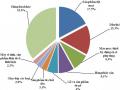
There are over 150 countries exporting seafood to Japan, of which there are about 10 major exporting countries, accounting for a high market share in the Japanese market: USA (11%), Russia (10%), China (9%), Korea (7%), Indonesia (6%), Thailand, Chile, Taiwan, India, Norway (5%).
2.1.2. Vietnam's strengths in exporting seafood to the marketJapanese school
- Many seafood businesses have experience in production, processing, and trading with Japanese partners and have established a stable position in this market.
- Vietnam's main seafood products such as shrimp, squid, octopus, crab... are considered delicious because they are raised using extensive, semi-natural methods.
- Many businesses, including private businesses, have invested heavily in modern processing equipment to create processed products suitable for the Japanese market.
- Many businesses have established quality management standards: GMP, HACCP... creating favorable conditions for market penetration.
- Shrimp and crab farming areas have been expanded, many modern, industrial shrimp farming facilities have been established, reducing the shortage of raw materials.
2.1.3. Opportunities for Vietnamese seafood exporting enterprises
- Economic and trade relations between Vietnam and Japan are developing well. The Japanese government creates many favorable conditions for Vietnam to export goods in general and seafood in particular to the Japanese market.
- The demand for seafood in the Japanese market is still high, especially in products that Vietnam has export advantages such as shrimp, squid, crab, etc.
- Our government has been paying much attention to developing the fisheries industry through the Vietnam Fisheries Development Planning Strategy to 2010, the Offshore Fishing Program, the National Breeding Program, etc.
- The Japanese government is allocating part of its ODA capital to help the Vietnamese seafood industry build a network to control the quality of exported seafood.
- Many major Japanese seafood importers have established representative offices in Vietnam to actively participate in bringing Vietnamese seafood products to the Japanese market.
- The Vietnam Fisheries Association is gradually growing and has become the strongest industry association, supporting its members to effectively penetrate the Japanese market.
2.2. Textiles
2.2.1. Demand and characteristics of the Japanese market
After World War II, Japan was once the world's leading textile powerhouse, but with the growth of other industries such as automobiles, motorbikes, electronics, information technology, etc., the textile industry is increasingly declining and is no longer an important industry in this country. Currently, Japan's domestic production only meets 40% of domestic demand and tends to decrease because domestic products are more expensive than imported goods. To satisfy the clothing needs of a country of 128 million people, Japan must import 22-25 billion USD worth of garments every year, the third largest market after the US and the EU.
The demand of the Japanese market is very high and diverse because Japan is one of the countries with the highest average income per capita in the world. With a high income, Japanese people spend a lot on clothing, moreover, Japan has four very distinct seasons so the fashion for the four seasons must also be different.
The quality requirements of Japanese textiles are very high. Garments with scratches or broken buttons are considered damaged and will be returned. The materials used to make the products are of great interest to the Japanese. Products made from natural materials such as cotton are popular, while products made from synthetic fibers are strictly controlled to avoid harming consumers. Japanese consumers are especially
Especially the middle class and above and the youth are very interested in brands, fashion, and models, so the "fashion" age passes very quickly, requiring constant changes in fashion.
Japan’s imported garments are quite diverse, from jackets, shirts, kimonos… to fashion clothes. In addition to garments, Japanese consumers also have a great demand for household textiles such as bed sheets, blankets, pillows, curtains…
The largest textile suppliers to the Japanese market today are: China (65%), Italy (8%), Hong Kong (6%), Thailand (2.2%) and Vietnam (2%) (in 2002).
2.2.2. Vietnam's strengths in exporting textiles to Japan
Copy
- The capacity of Vietnam's textile industry is very large, the Textile Association is strong.
- Textile machinery technology in the past 5 years has been invested
New and modern technology creates products that meet the demands of high-end markets, including the Japanese market.
- Many large enterprises have started to invest in fashion development (some companies have their own fashion design and fashion show departments), building brands, this is an important basis for enterprises to switch from processing to self-employment and move towards organizing product distribution in the Japanese market.
- Cheap labor costs, skillful workers can create complex products with good quality.
- Many Japanese enterprises invest and expand production scale in the Vietnamese market, creating a channel to supply textile products made in Vietnam to the Japanese market.
2.2.3. Opportunities for textile and garment exporting enterprisesof Vietnam
- Japan is a large non-quota market, the Japanese economy has recovered since 2003, and the consumer market has increased.
- Comprehensive economic and investment relations between Vietnam and Japan are in the development stage.
- The government is investing heavily in trade promotion, especially in the textile industry.
- JETRO supports Vietnamese enterprises in market development.
- Tourism is developing, Japanese consumers come to Vietnam more and start to love Vietnamese fashion.
2.3. Handicrafts
2.3.1. Japanese market demand and Vietnam's export situation
Japan is a place where Vietnamese carved wooden furniture, ceramics, rattan and bamboo products are concentrated. The demand for handmade wooden furniture in Japan is quite large and is currently growing strongly. Every year, Vietnam exports about 15 million USD worth of household items, mainly wooden furniture, to the Japanese market. An advantage for exporting this item is that imported goods do not have to undergo quarantine and hygiene inspection.
Ceramics are a product with great potential for development in Japan, and ceramic imports have increased rapidly in recent years. Vietnamese ceramics are present in Japan, but the turnover is still quite modest, about 5 million USD/year. To increase the export of this product to Japan, it is necessary to pay close attention to the shaping stage.
In addition, Vietnam's handicraft industry also has many other products that are favored by the Japanese market such as wool carpets, small handmade carpets, bamboo furniture, silk, brocade, coconut fiber products, water hyacinth stems, conical hats, flower mats, silk paintings, lacquer, eggshell paintings, paper fans, pearl lanterns, embroidery, household lace products, etc.