
1.4- Developing a sustainable tourism development strategy in Tikal Park, Guatemala [Appendix 7A, p. 192]. To develop a tourism development strategy for Tikal Park, Guatemala, the management unit divided the park into functional areas, high priority functional areas, medium priority functional areas; analyzed the interests of stakeholders and the planning framework. Because there are many visitors to the main area and service areas, the highest priority is to manage tourism activities. Once the system was established, the heritage site reoriented tourism services according to the main message it wanted to convey and the visitor experience. Based on these criteria, new tourism products were created that met the requirements of conservation and tourism activities. Tikal built management systems to ensure the conservation of natural and cultural resources, and to generate and manage revenue for conservation.
2. Domestic model
Maybe you are interested!
-
 Contribution to the Research Model of Intention to Revisit Tourist Destination
 -
 Visitors' Reviews of the Exhibition Activities at the Temple of Literature by Tourist Type
 -
 Factors Affecting International Tourist Attraction Activities
 -
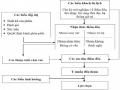 A General Model of Tourist Destination Perception and Choice
 -
 PEST Model Analyzes External Factors Affecting the Competitiveness of Tourist Destination
2.1- Tourism development model at My Son heritage, Quang Nam [4], focusing on the tourism development planning method (Public Using Plan-2009) introduced by UNESCO and applied at 2 World Heritages in Quang Nam: Hoi An and My Son. Accordingly, tourism development planning at the heritage site is established, while mobilizing the participation of the Project Management Board and relevant parties to ensure the implementation plan, limiting delays and internal conflicts. The content of the heritage tourism development plan in the direction of sustainable development includes: the role of the community, suitable product types, measures to strengthen relationships with relevant parties, managing the impact of tourists on the heritage, community cultural values, environment and budget planning [5].
2.2- Model of attracting tourists at the Exhibition "From Norodom Palace to Independence Palace", the Exhibition "From Norodom Palace to Independence Palace" (Exhibition) has a different approach from the traditional exhibition style: trying to spread out throughout history. Independence Palace has a history of 150 years but the Exhibition only focuses on telling the story of the first 100 years. The model of the Exhibition has attracted the attention of the public, historical researchers, and the media as soon as it was launched. According to Nguyen Van Huy [6], this Exhibition has a special appeal because of its freshness and beauty. The Exhibition does not have the beaten path, the old things repeated over and over again. Here is a new way of interpreting history to have something new from the old story, the implementers have used new technology effectively . Diversity in display styles combines traditional display with the use of projection media technology, interaction as an important method to bring Experience to visitors in the direction of avoiding boredom, monotony, visitors are encouraged and have many opportunities to interact. Finally, the preservation of heritage space, visitors to the Exhibition not only explore historical content but also enjoy the space of a building built during the colonial period. In the current context, when the architectural heritage of ancient houses is easily destroyed and deformed, the way to respect ancient architecture in this Exhibition has a new feature, giving a vivid message about the need to respect ancient architectural heritage when using or renovating relics, thereby attracting visitors.
2.3- Fisheries Co-management Model in Ben Tre. with specific models such as: Community protection and exploitation of aquatic resources, eco-tourism and production of ornamental flowers in the commune.
Vinh Binh, Cho Lach district, Rang Dong Aquatic Cooperative, Thoi Thuan commune, Binh Dai district on the water surface area has been assigned by the Provincial People's Committee to the Community for the purpose of supplementing, regenerating and protecting aquatic resources in the area, aiming to develop a community ecotourism model. According to Ms. Tran Thi Thu Nga, President of Ben Tre Aquatic Association [Appendix 5A, p.189]: Ben Tre is one of the two most successful models in Vietnam, a community-based approach to exploiting small-scale economic and social institutions suitable for coastal areas to manage economic institutions, natural resources and social most effectively.
3. Lessons learned
From domestic and foreign models, it can be seen that cultural tourism based on promoting the value of historical and cultural relics always has a special attraction for tourists, creating unique tourism products for the locality. Valuable lessons learned include:
- Correctly assess the value of historical-cultural relics, the elements that express and contain the value of the relic, thereby having appropriate management measures towards positioning the tourism brand from the heritage. Preserve and promote associated with research on the authenticity of the value of the relic, materials, design, craftsmanship, display of artifacts, folk stories, and anecdotes from the heritage.
1- Maximize tourism benefits for the community: engage the community in introducing relics; use local services; create opportunities for local cultural exchange with tourists; respect local cultural values; create experiences, guide visitors to minimize negative impacts on relics.
2- Enhance the experience of the values of the relics for visitors through simulations and role-playing; create many opportunities for visitors to have different experiences: entertainment, enjoyment, information, education, emotion, inspiration. However, when visitors visit, they can damage the relics. Therefore, the relics need to be managed in a way that balances the costs with the profits from allowing visitors to visit.
3- Detailed plan for tourism development at each relic, clearly describing the desired product, tasks and powers of the participating parties, and implementation roadmap. The goal of the tourism development plan at a relic is to help the management of tourism and tourism development in the historical-cultural space, contributing to the preservation of relics associated with local economic development, enhancing the role of the community, improving the material and spiritual life of the people.
4- There needs to be a full description and assessment of the site's tourist attractions, from value descriptions, stories, messages to barriers. Based on the list of tourist attractions, determine which areas of the site and which tourism products will be used by the public. In addition, this list is also the basis for developing content for tourism impact monitoring activities and many other management decisions.
5- The fisheries co-management model has a solid theoretical and practical basis, and has met the conditions to research and establish a new approach in coastal cultural heritage conservation, thereby expanding to other areas associated with sustainable tourism development in Ben Tre province.
6- Priority is given to training professional tour guides at national monuments.
Heritage guides are part of the heritage community, interpreters and educators, and are a direct link between the heritage and visitors. By sharing the benefits of tourism revenue with the local community, heritage guides will help increase local support for heritage protection. Heritage guides are the pioneers in creating the power to preserve and promote the value of historical and cultural heritage.
PhD student-2020.
[1] Augustyn, M. (1998), National strategies for rural tourism development and sustainability: The Polish experience. Journal of Sustainability Tourism, 6 (3), 191-209.
[2] C. Wayan Ardika (2019), Eco- Marine Tourism Development Towards The Renewal of Coastal Communities in Gerokgak Distrisct , Bali. P. 83-94.
[3] Minh Chau (2020), Cooperation in protecting heritage , accessed March 31, 2020 link: https://www.sggp.org.vn/hop-tac-bao-ve-di-san-654501.html
[4] Nguyen Duc Phuc (2014), Tourism development in My Son , Master's thesis, Danang University.
[5] Hoi An Monuments Conservation Center (2006-2012), Summary report on activities and task directions for the years 2006-2012 . Archives, Hoi An.
[6] Nguyen Van Huy (2018), New points in the exhibition "From Norodom Palace to Independence Palace (1868-1966)", Electronic Heritage World Magazine, accessed on November 23, 2018 link http://thegioidisan.vn/vi/nhung-diem-moi-trong-trung-bay-tu- dinh-norodom-den-dinh-doc-lap-1868-1966.html.
APPENDIX 25.
Introducing the TREE PLANTATION TOURISM Project
“ Program to support the development of tree planting tourism in Vietnam ” Vision: Unleashing potential, connecting partners!
Turn Vietnam into a new tourist center.
Author: Trinh Huy Chau - Economic Research Specialist - Central Institute for Economic Management, retired in Hanoi, 80 years old this year, devoted himself to designing the Cavigo Program ( Let's go all over Vietnam to plant trees! ) and sent it to the PhD student when he heard that there was a study on the management of Ben Tre's cultural heritage in tourism development, he sent the project to propose cooperation because he found it suitable.
Expected products:
New consulting center (Tree planting consulting center, abbreviated as Cavigo Center) 1 new website and scratch card type (Cavigo.vn.com page and Cavigo scratch card)
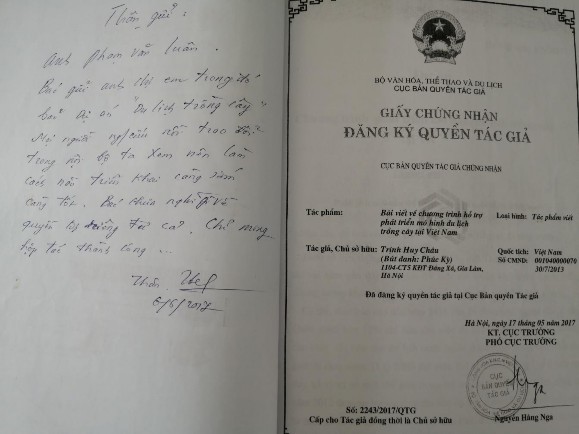
Source: PhD student-2020.
APPENDIX 26.
THERE ARE MANY DIFFERENT OPINIONS ABOUT THE TWO HISTORICAL FIGURE
A. PHAN THANH GIAN
During the process of researching the thesis, having access to many valuable and little-known sources of information about the first Doctor of the Six Southern Provinces, the researcher collected some data showing that the Ben Tre cultural sector needs to be more active and proactive towards a celebrity who deserves to be honored. This is the responsibility and sentiment of posterity ...
On January 2, 2008, the Department of Cultural Heritage, Ministry of Culture, Sports and Tourism issued Official Letter No. 04/DSVH-DT to the Institute of History "Regarding the evaluation of Phan Thanh Gian's career and contributions". On January 20, 2008, the Institute of History issued Official Letter No. 16/VSH in response:
“With a new understanding from a specific historical perspective, Phan Thanh Gian deserves to be honored in many different ways. The fact that Ben Tre province proposed to rebuild Phan Thanh Gian’s statue is, in our opinion, a way to recognize and honor his contributions to the nation’s history.”
After receiving a response from the Institute of History, on January 24, 2008, the Department of Cultural Heritage issued document No. 73/DSVH-DT to the People's Committee of Ben Tre province:
“1. Propose that the People's Committee of Ben Tre province assign competent agencies to inventory relics related to the character, on that basis, make a plan to restore, embellish and promote the value of the relics;
2. Collect in-depth research works and presentations at seminars on Phan Thanh Gian to have objective conclusions about Phan Thanh Gian's life and career;
3. Re-erecting the statue of Phan Thanh Gian is also a form of honoring this character to recognize his contributions to the country's history."
At this time, the statue of Phan Thanh Gian was placed at the High School named after him in Ba Tri district (Ben Tre); the memorial service for Phan Thanh Gian was held at Van Thanh Mieu Vinh Long on the 141st anniversary of his death. There is an event that cannot be ignored, this is the place where Confucius is worshiped and also the place where the library containing the books of the sages was built. In 1886, Phan Thanh Gian was the one who wrote the stele praising Confucianism, in order to encourage and promote the spirit of learning.
In 2017, the magazine Xua & Nay published Phan Thanh Gian - A Hundred Years of Looking Back to commemorate the 150th anniversary of his death. This is considered a fairly complete and systematic collection of works like a "Phan Thanh Gian dossier" over the past century.
In 2019, the work Phan Thanh Gian, Patriot and Pioneer of Modern Vietnam : The Last Years ( 1862-1867 ) by Phan Thi Minh Le and Pierre Ph. Chanfreau was published by Hanoi Publishing House through the translation Phan Thanh Gian - Patriot, Pioneer of Modern Vietnam: The Last Years (1862-1867), but later the Publishing Department issued an official document to withdraw and edit it.
With this information, it is clear that there has been a re-evaluation of Phan Thanh Gian's life, which has gone through many turbulent periods. Most notably, the 21st Century Scientific Conference on the historical figure Phan Thanh Gian held in Ho Chi Minh City in August 2003. The Journal of Historical Research, No. 5, October 9, 2003 reported: "In general, this Conference agreed on the following conclusions:
1. From now on, we should not judge or evaluate Phan Thanh Gian as a traitor.
glory;
2. When commenting on Phan Thanh Gian, it is necessary to emphasize the responsibility of the Nguyen Dynasty;
3. However, it is still necessary to clarify Phan Thanh Gian's responsibility for losing 6 provinces.
Southern Vietnam [1, p. 622].
In the conference, Professor Phan Huy Le stated: “Our historical documents show that Phan Thanh Gian did not surrender to the enemy as described in some French documents, but the loss of the three western provinces was also a disastrous consequence of the wrong policies of Tu Duc and the Nguyen Dynasty, of course Phan Thanh Gian was responsible. Phan Thanh Gian himself considered this an unforgivable “sin” and he committed suicide. Phan Thanh Gian’s death can be seen as the end of his tragic last years in the general tragedy of the country under the Nguyen Dynasty”; “The heartache and tragedy of Phan Thanh Gian was that on one hand he was a “peace advocate” with the court, extremely loyal to the king, on the other hand he loved his country and people. That contradiction pushed him to the point where he could only choose death to end his life and express his feelings” [1, p. 637]. Notably, former Prime Minister Vo Van Kiet, when attending this scientific conference, stated: “Phan Thanh Gian is a patriot who loves his people but is worried about not fulfilling his duties. He has made his own sentence, which is death. A clean life, worthy of leaving an example for posterity” [1, p. 645]. And also according to Mr. Kiet: “I think we should not demand that everyone love their country in the same way. Here, I would like to relate to the case of great intellectuals in Saigon who
The enemy called intellectuals “covered in blankets” (meaning that this group did not cooperate with them) such as engineer Luu Van Lang, Mr. Duong Minh Thoi, Mr. Nguyen Xuan Bai… We never demanded that these people go to the war zone like Mr. Huynh Tan Phat, Mr. Nguyen Huu Tho. But who dares to say that they do not love the country” [1, p. 643] with Phan Thanh Gian, “demanding that they be like Truong Dinh, Nguyen Trung Truc, Thien Ho Duong… is unrealistic for each person and each situation” [1, p. 644].
This perspective is satisfactory because when looking at our ancestors, we must consider them from specific historical circumstances and specific documents to have a scientific analysis and assessment. We cannot use the concept of the time we are living in to cruelly dismiss everything.
Regarding Phan Thanh Gian, he was the first person to pass the doctorate in the Southern region. With his talent, he proved that if one is studious, even if born in a remote place, at the end of the mountain, one can still train to become talented. In 1826, at the age of 30, he passed the doctorate exam, which was also the year Phan Thanh Gian first went on a business trip to many places. Due to his position, he broadened his horizons, saw with his own eyes the development of science and technology, the Western education system, which was very different from ours.
1. Various authors (2017), Phan Thanh Gian - Looking back at a hundred years - World Publishing House, published by Xua & Nay Magazine.
2. Le Minh Quoc (2020), Ben Tre People , Tre Publishing House, pages 184-187)
B. ENGINEER NGUYEN THANH NAM (Mr. Coconut Priest)
Up to now, the only official document researching Mr. Dao Dua is probably the "Master's Essay on Anthropology" Nam Quoc Phat Kien Hoa Pagoda - Dinh Tuong ,[1] mimeographed, defended by Bachelor of Arts in Humanities of Saigon, Phan Nghi Linh at the University of Literature (Saigon University) on December 11, 1964. The essay researched the conduct, the place where Dao Dua originated, the pagodas... and the value lies in the fact that the author conducted a field survey, met Dao Dua and witnesses from the years when Dao Dua was most popular.
Con Phung became famous for being the "headquarters" of "Monks who often wore "Dien" robes with square holes in the front and back, at first there were 4 holes, then gradually increased to 18 holes. Day and night they were always silent". The reason he wore "Dien" robes was because he followed the prophecy of Trang Trinh Nguyen Binh Khiem: "The emperor will break the field/ Without fighting, he will naturally succeed" . The remaining relic of Mr. Dao Dua today on Con Phung is the octagonal stove placed on the back of a turtle holding a sword, decorated with fragments of cups and bowls, with the inscription on the sides (original text): "Thich Hoa Binh Nam Nguyen Thanh, alias Mr. Dao Chua, born on December 15, Ky Dau 1909-1910 in Phuoc Thanh village, My Tho, Kien Hoa, Vietnam".
This is the way of writing in the style of Mr. Dao Dua, his real name is Nguyen Thanh Nam, born in 1910, the eldest son of Mr. Nguyen Thanh Thuc and Mrs. Le Thi Sen; studied in France on March 15, 1928; returned to Vietnam in 1935, married Ms. Lo Thi Nga; was an engineer who opened a soap factory on Ba Lai river, sold dried coconuts, but failed, then became a monk, founded Dao Dua.
Engineer Nguyen Thanh Nam studied abroad, has a systematic knowledge, and is not a person with little education, so when he calls his religion “moderate”, it is implied in the sense of “not too much, not too little”, just right, moderate, nothing too much, not too much. But people call it Coconut Religion because the “leader” of this religion only nourishes his body with… coconut. Since then, coconut has obviously become a familiar name, forgetting the original meaning of the founder.
The worshiping facility of the Coconut Religion in Con Phung is a project based on the idea of the Coconut Religion himself, carried out by Mr. Ba Dai. On the octagonal stove, it is clearly written: "The outstanding architect and engraver, Monk Huynh Van Dai, whose given name is Hoang Dai, was born in 1900 in Quang Tri, Vietnam. In 1920, he went to the capital city of Hue to receive the architectural project of the royal palace and mausoleum. In 1962, he returned to serve the heavenly order of peace and humanity in the Southern country, blessed by the free Buddhist monk Thich Hoa Binh Nam Nguyen Thanh. Buddhist year 2510 - Nham Ty - 1972".
Mr. Dao Dua, the founder of Dao Dua at that time, had strange actions and statements such as calling himself "Cau Hai" to the person opposite, taking many titles such as Thich Hoa Binh, Ban Si, King Minh Mang reincarnated, Dai De Nam Nguyen Thanh, Mr. Dao Chu, President Hoa Binh... in the process of moving towards the goal called "peace movement" from the time of Ngo Dinh Diem to Nguyen Van Thieu. The newspaper Dan Chu Moi on September 11, 1971 wrote: "The incomprehensible actions, the fiery declarations of the monk, in the midst of the current fierce and frustrating war, are imbued with a special subtle nuance that makes everyone consider them as cool breezes in the hot noon. It must be said that Mr. Dao Thich Hoa Binh is also very skillful, because every time the situation is tense, he sees Cau Hai appear, then no matter how dramatic the situation is, it is infected with an unusual and humorous character".
At the end of March 1964, Mr. Dao Dua set up his headquarters at Con Phung, gradually attracting about 1,500 followers, after the Mau Than event (1968) the number increased to 5,000 people, most of whom followed the religion to avoid war and military service. His first job was to build an 18-meter-high Bat Quat platform; then he carried out many other projects.
In September 1969, when he heard the news of President Ho Chi Minh's death, Mr. Dao Dua had someone design a ceremony ground to hold President Ho's funeral with thousands of people attending. Mr. Sau Vo