
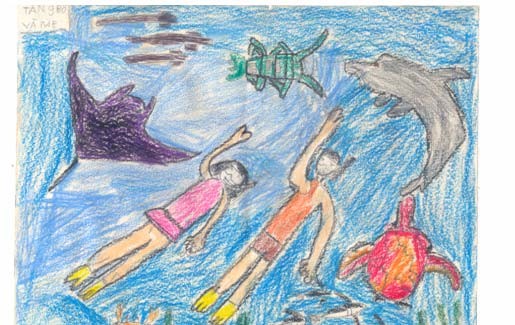
Painting by Do Duc Vinh, class 4D, Dich Vong A primary school - Hanoi
Maybe you are interested!
-
 Managing Teaching Activities According to the Competency Approach for Primary School Students
 -
 Life skills education for primary school students of ethnic minorities in the Central Highlands through teaching activities - 34
 -
 Developing Differentiated Teaching Capacity for Primary School Teachers
 -
 Managing the training of differentiated teaching capacity for primary school teachers in extremely disadvantaged areas of Bac Kan province - 2
 -
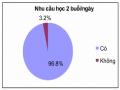 Analysis of Current Data on the Implementation of the Project for Developing a Primary School with 2 Sessions/Day Teaching in Primary Schools
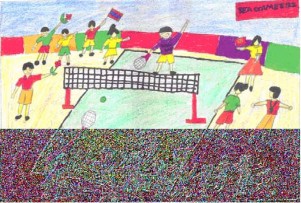
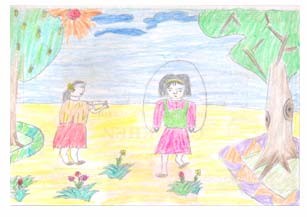
Paintings by students of Nui Voi Primary School (Dong Hi - Thai Nguyen)
+ Requirements to be achieved when using teaching methods and forms of organizing teaching of the subject of Drawing in grade 5.
Teachers use suggestive methods to guide students to think and learn about the topic.
Pay attention to: Image, space, time, color.
There are many ways to ensure the visual quality of drawing lessons: you can draw a given topic in class or outside the classroom, or organize students to draw outdoors, in the schoolyard, in the park, or in the fields or mountains.
The impact of reality creates excitement for students. For 5th graders, the awareness and perception of things have been formed relatively concretely, so we must avoid teaching in a formal way, heavy general theory and redrawing according to other people's lessons.
Freedom of thought and expression plays an important role in the process of building a picture. Teachers only guide and suggest students to do their own work, and should not directly interfere with students' work.
Activity 4: Teaching and learning the subject of modeling and shaping for grade 5
 Mission
Task 1. Students study the sculpting exercises of Grade 5 Fine Arts, state the requirements of the sculpting exercises of Grade 5.
Task 2. Discuss in groups, discover the difficulties and advantages when doing modeling exercises in grade 5, propose solutions, methods, and forms of organizing effective teaching of the subject.

Task 3. Design and present a specific lesson plan on modeling and shaping.
Feedback
Feedback for task 1
The subject of Modeling and Modeling in grade 5 has 4 lessons. Content:
- Mold familiar animals
- Body shaping
- Molding according to the topic of your choice
- Molding according to the topic Requirements:
- Students have specific perception of the object they are practicing modeling and shaping. They know the parts that make up the object and the characteristics, state, and movements of the object.
- Teachers can guide students to create shapes in many forms, with many different types of materials, especially creating shapes with locally available materials such as: plants, wood scraps, gravel, paper, packaging, bottles...
- Not all lessons need to use clay as a material.
- Students know how to create shapes from a clay bar, create shapes by joining individual blocks together, and visualize the shapes of objects from existing blocks.
- Students can create products independently but can also collaborate to create a group of products with a common purpose.
- Students improve basic shaping and block creation skills:
+ Rotate skills to create round shapes
+ Vertical rolling skill to create cylinders
+ Ability to flatten and create arrays
...
On that basis, combine the blocks into specific shapes.
Create an object from specific assembled shapes.
Feedback for task 2
* Difficulties and advantages when implementing the subject of Modeling and Pose in grade 5
This is not a new subject but it can easily create difficulties for teachers when teaching. Many places do not have teaching aids to do exercises. Teachers are not equipped with basic knowledge and skills to teach, along with many issues regarding hygiene regulations, classroom conditions, etc., so in the program there is an extension that allows students to draw or tear and paste instead of modeling exercises. Most localities change the lesson each time they teach modeling exercises.
In fact, the subject of Modeling is very suitable for the psychological characteristics and creative thinking ability of children in primary school. This is a part of learning that children are not constrained at all. The method of creating shapes from specific materials easily creates excitement for children and children consider it an attractive game, adults consider it a game with a lot of creativity, many personal marks, and a very high ability to cooperate and share.
However, due to the mechanical teaching method, many teachers are reluctant to teach this subject. Specifically, they do not know how to handle exercises if there is a lack of clay, or the clay is small and of poor quality... How to teach the Pose Modeling Exercise effectively? From the program to reality, it has suggested that teachers when instructing students not only do exercises in one way, which is modeling. Students can perform modeling methods with many different materials from one topic. They can create animal shapes from stones, pebbles, then add details of eyes, mouth, and add fins and tails. Teachers can also guide students to create shapes from waste materials such as cardboard, bottle caps... create shapes from dry branches, dry leaves... If students are proficient in creating shapes from different materials, the exercises will be more vivid and have more associative elements than using only one way of modeling with clay.
- Difficulty in practice room conditions for sculpting exercises
Currently, most primary schools do not have a dedicated room for art practice. This also affects the innovation of teaching methods in general and art teaching methods in particular. To overcome this situation, teachers can take advantage of spaces inside and outside the classroom to guide students in practical exercises, including modeling exercises.
The practice space must ensure the following factors: Hygiene, adequate lighting, stimulating imagination and creativity of each student, conditions for students to cooperate in small groups and an area to display completed products.
- Teaching methods for the subject of Modeling.
Teachers can use many different methods to carry out lectures, but it is essential that those methods promote initiative and arouse students' interest in learning. It is essential to guide students to complete the product by their own thinking, imagination and ingenuity.
+ Teachers suggest students to think about shapes related to the shaping exercises. For example: The bottle has the shape of a dragonfly's body, adding which details to which position of the bottle will make a complete dragonfly? The pebble has the shape of a fish's body, adding which details to make a fish? How to combine dry leaves into a butterfly? This dry branch can form a small tree trunk, on that tree attach the shape of a singing bird, attach the shape of a resting butterfly.
+ Teachers divide students into groups to work together to create a common product. In the group, individuals are assigned to create different shapes and then combine them into a group of individual products. For example: Festival theme, some students mold people, some students mold trees, flags, drums, some students mold flowers, leaves, grass, then combine them into a common exercise and the teacher can evaluate the results according to that group.
Feedback for task 3:
Design a lesson plan for sculpting and shaping for grade 5.
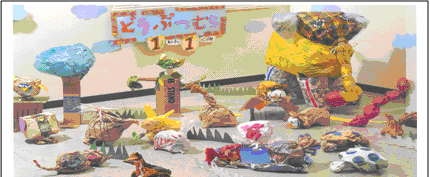
Students choose a lesson from the 5th grade art program and design it in groups.
Note:
+ Identify the correct requirements of the lesson.
+ In addition to molding products, students must be instructed to create products using other shaping methods and from other locally available materials.
+ Teaching methods attract students. Students are self-motivated and enthusiastic in doing their homework.
+ There is cooperation and sharing in small groups.
Activity 5:
Teaching and learning general art subject grade 5
 Mission
Task 1. Students study the general art knowledge lessons in the 5th grade program, state the requirements to achieve the general art knowledge subject in 5th grade.
Task 2. Discuss in groups, discover the difficulties and advantages when implementing common art lessons and innovate teaching methods for this subject in grade 5.

Task 3. Prepare and teach an excerpt of a lesson on general art knowledge in the 5th grade program.
Feedback
Feedback for task 1
The 5th grade art knowledge subject has 4 lessons. Content:
- Introduce the author and the work.
- Educate on the beauty of traditional Vietnamese visual arts. Specifically:
- Author To Ngoc Van and the work Young girl with lilies
Request:
- Author Nguyen Do Cung and the work Guerrilla Shooting Practice
- Author Nguyen Thu and the work Uncle Ho goes on a business trip
- Brief introduction to ancient Vietnamese sculpture
- Students learn about the lives and creative careers of three authors who have had a great influence on Vietnamese visual arts.
- Know the names and see some typical works of those 3 artists.
- Listen to lectures and briefly understand the content and artistic value of 3 typical paintings by 3 artists.
- Know some other works of those 3 artists.
- Through feeling the beauty of the works, forming creative thinking and artistic emotions when studying other subjects as well as educating students about aesthetic awareness in life and activities.
- Students understand and initially feel the value of national art through some typical traditional sculptures. From there, they educate pride, awareness of preserving and promoting the national cultural capital that our ancestors have created for generations.
Feedback for task 2
Teaching the subject of General Art in grade 5. Requirements for teachers:
When teaching lessons introducing authors and works
- Teachers must read documents about the lives and creative careers of the authors introduced in the program to expand on the knowledge provided in textbooks and manuals.
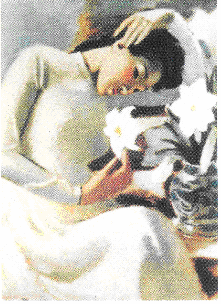
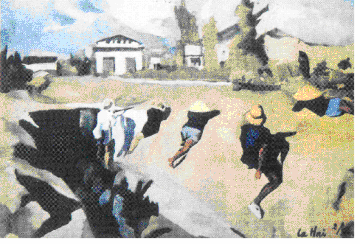
Girl with lilies
(To Ngoc Van )
Guerrilla Shooting Practice (Nguyen Do Cung)
- Create teaching methods that are suitable for the painting lesson. Avoid repeating the same teaching method, which will make students bored with the lesson and bored with the teacher's explanations about the work.
- Teachers should have their own unique ways of analyzing works in addition to the suggestions in the textbook. Avoid analyzing works in the same way: bright colors, clear light and dark, soft lines... The lack of knowledge of teachers will make students unable to see the unique creativity of each work. That will also cause students to be bored and uninterested in the painting.
- Teachers can turn a lecture about the author or work into a storytelling session. An engaging story about the author, an engaging story about the circumstances of the work's creation, the content of the work, as well as the artist's way of coloring and drawing... will bring students to engage in a self-conscious way without cramming and to perceive the work in a moody way, the sublimation of the work in the imagination of each individual student. If students engage well, they can recount what they have just felt and that is the focus to evaluate the effectiveness of a lesson about the author and the work.
- The visual of the fine arts lecture must ensure the following elements: