
training, practice and experience in the work of the teaching profession and ensuring effective implementation. It includes the ability to transfer knowledge, skills, experience and working habits to situations within the scope of the teaching profession and the training, counseling, guidance and support for students to learn and educate themselves to improve their personality. It also includes the organization, implementation, change, innovation and personal effectiveness needed to work with colleagues, leaders and managers.
1.2.2. Fostering teaching capacity for primary school teachers to meet the requirements of the new general education program
Training is the activity of enriching and increasing the existing level of knowledge, skills, attitudes and methods to help cadres, teachers and employees perform their work with better results.
Training contributes to building a team of teachers with professional ethics, adequate qualifications and professional capacity to ensure the quality of professional activities.
Training is considered as the process of updating knowledge and skills to apply knowledge to compensate for missing or outdated knowledge compared to the development needs of society, often determined by certificates. Therefore, training has the following basic elements:
Maybe you are interested!
-
 Managing the training of differentiated teaching capacity for primary school teachers in extremely disadvantaged areas of Bac Kan province - 2
 -
 Organizing training on teaching capacity for primary school teachers to meet the requirements of the new general education program in Dien Bien district, Dien Bien province - 15
 -
 Organizing training on teaching capacity for primary school teachers to meet the requirements of the new general education program in Dien Bien district, Dien Bien province - 1
 -
 Organizing Capacity Training to Develop School Education Programs According to the New General Education Program for Management and Teaching Staff
 -
 Current Status of Organizing and Implementing Training on Teaching Capacity According to Stem Education Orientation for High School Teachers
- Update knowledge, improve skills and methods to perform assigned tasks.
- Training has specific purposes, objectives, content, programs and implementation methods:
+ The subjects receiving training must have professional qualifications, certain cognitive abilities and must have the need to be trained to improve their professional skills, meeting the educational career to serve the increasingly strong development needs of society.
+ The purpose of training is to improve qualities and expertise so that employees have the opportunity to consolidate and expand their knowledge, skills and techniques to achieve efficiency in their current work.
According to author Nguyen Thi Nguyet Que (2010), training is a planned educational process that increases human values, changes attitudes, knowledge, and skills through collecting and processing information in an activity or a chain of action needs to enhance personality values, improve productivity and work efficiency. After being trained, teachers' capacity is increased, meeting the needs of developing primary education human resources in each school. [35]
According to author Luc Thi Nga (2005), training is a purposeful activity to update new and progressive knowledge or improve teachers' qualifications to increase capacity and qualities according to the requirements of each level of education. Training is carried out on the basis of previously trained basic qualifications. Training is a regular and continuous activity for each teacher, level of education, and field of study, constantly improving the qualifications of the team to adapt to socio-economic development. Training content is implemented at different levels, suitable for each specific subject. [31]
Thus, " training " is an activity to update knowledge and skills for both teachers and learners. In another aspect, training is defined as a process of systematically changing human behavior and attitudes through learning. Learning arises in the process of teaching in practice, self-study and from other documents.
Fostering teaching capacity for primary school teachers is through organizing and directing training activities, helping primary school teachers to implement training goals and content to develop a system of knowledge, skills, and attitudes about teaching activities and educating students in primary schools according to the educational program.
Primary school in 2020 aims to form skills and expertise proficiently and effectively to meet the requirements of educational innovation in the spirit of Resolution 29-NQ/TU on fundamental and comprehensive innovation of education and training.[32].
1.2.3. Organizing training on teaching capacity for primary school teachers to meet the requirements of the new general education program
The socio-economic development strategy for the 2011-2020 period clearly states that "innovation of education management mechanisms and development of teachers and management staff are key factors". From the contents of the Strategy, it can be affirmed that the Party has determined to continue promoting educational innovation at a new level, more strongly, more drastically and more thoroughly in order to create new, truly effective and practical changes in the quality of education .
Resolution 29-NQ/TU affirms: “ Continue to strongly innovate teaching and learning methods in a modern direction; promote the positivity, proactiveness, creativity and application of knowledge and skills of learners; overcome the one-way imposition and mechanical memorization. Focus on teaching how to learn, how to think, encourage self-study, create a basis for learners to update and innovate knowledge, skills, and develop capacity. Shift from mainly learning in the classroom to organizing diverse learning forms, paying attention to social activities, extracurricular activities, and scientific research. Promote the application of information and communication technology in teaching and learning .”[32]
Therefore, the work of building an organization to foster teaching capacity for primary school teachers to meet the requirements of general education reform is a very new and urgent issue. This is one of the top important goals in the process of improving teaching capacity for teachers to meet the requirements of the current general education program.
The focus of organizing training to improve teachers' teaching capacity is to equip, update, and improve knowledge, skills, and teaching methods to meet the needs of today's society in the 4.0 era; in addition, to improve the capacity of training, scientific research, technology transfer, and international cooperation for the teaching staff, contributing to the successful implementation of the
The Party and State's fundamental and comprehensive reform of education and training, while meeting output standards and professional standards for primary school teachers, is necessary to effectively implement the new general education program.
Organize training on teaching capacity for primary school teachers to ensure appropriate and effective content that is integrated, developmental, comprehensive and inheritable; enhance the application of teaching practice and practical experience, focusing on improving teaching capacity to meet the new general education program for primary school teachers.
Innovate teaching methods towards approaching learners' capacity, diversify forms of knowledge acquisition organization, promote learners' positivity, self-awareness, and initiative, form and develop self-study capacity (using textbooks, listening, taking notes, searching for information, etc.), on that basis cultivate flexible, independent, and creative qualities of thinking; enhance community connection activities, creative experiences, educational science research, promote the application of information and communication technology in educational activities, promote learners' core personal values; actively innovate the work of testing and evaluating educational quality, ensuring objectivity in testing and evaluating output quality.
Based on the content of the training program, each teacher needs to build his/her own learning ability and knowledge acquisition in accordance with the training content to meet the new requirements of the profession. Integrate related content to create integrated modules/topics; streamline and avoid overlapping educational content, ensure differentiation according to the potential of learners and the actual needs of primary schools in general, and primary schools in Dien Bien district in particular.
Diversify teaching and learning methods, enhance experiential learning, and use advanced teaching methods to form and develop pedagogical capacity for learners.
The work of organizing and managing human resources of schools by superior agencies needs to be
Science closely follows the objectives and content of the training program to suit the actual needs of teachers in terms of capacity to be improved and control the stages in the process of training primary school teachers.
Strengthening the management of training activities, including training planning, training organization, measures to direct training activities and inspect and evaluate training results, and support policies for teachers and learners, has the effect of motivating training activities to achieve high results.
Thus, organizing teaching capacity training is a purposeful and planned activity of the management entity that impacts teachers to meet the requirements of the new general education program .
1.3. Basic issues on capacity building for primary school teachers to meet the requirements of the new general education program in 2019
1.3.1. New general education program and requirements on teaching capacity for primary school teachers
The goal of the primary education program is to help students form and develop the basic elements that lay the foundation for harmonious physical and mental development, qualities and abilities; focus mainly on education about personal values, family, community and necessary habits and routines in learning and living, focusing on reducing content, especially reducing difficult and complicated knowledge in some subjects, increasing the initiative and creativity of teachers and learners.
The new general education program forms and develops 6 qualities for students: love of country, love of people, studiousness, diligence, honesty, responsibility. The program also forms and develops general and professional competencies for students. General competencies: autonomy and self-study, communication and cooperation, problem-solving and creativity.
professional capacity, formed and developed mainly through certain subjects and educational activities: language, calculation, information technology, physical, aesthetic, technological, natural and social learning capacity.
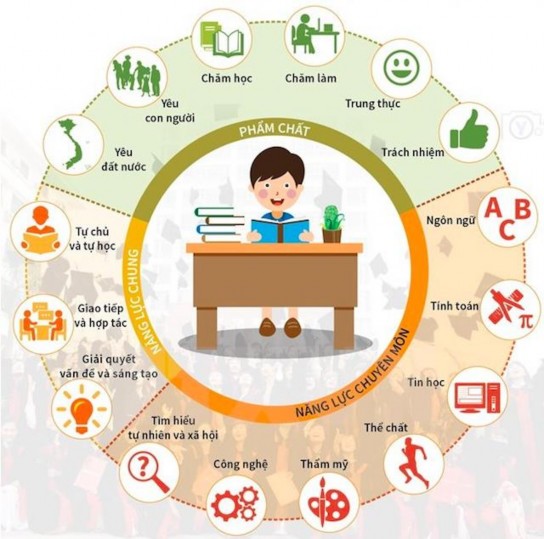
( source of draft new general education program )
Compulsory subjects and educational activities : Vietnamese ; Math ; Ethics ; Foreign language 1 ( in grades 3 , 4 , 5 ) ; Nature and Society ( in grades 1 , 2 , 3 ) ; History and Geography ( in grades 4 , 5 ) ; Science ( in grades 4 , 5 ) ; Information Technology and Technology ( in grades 3 , 4 , 5 ) ; Physical Education , Arts , Experiential Activities ( including
The content of the Physical Education subject is designed into modules ; the content of the Experiential Activities is designed into topics ; students can choose the modules and topics that suit their own wishes and the school 's organizational capacity . Elective subjects : Minority languages , Foreign language 1 ( in grades 1 and 2 ) .[New primary education program].
Teaching time , teaching and learning 2 sessions / day , each day arranged no more than 7 lessons . Each lesson lasts from 35 minutes to 40 minutes ; there is a break between lessons .
Based on educational objectives and requirements for quality and capacity at each educational stage and each level , the curriculum of each subject and educational activities determines the objectives , requirements for quality , capacity and educational content of the subject , experiential educational activities according to educational topics of each grade . The basic education stage implements the motto of comprehensive and integrated education , ensuring that students are equipped with basic general knowledge , meeting the requirements of strong differentiation after lower secondary school ; the career - oriented education stage implements the motto of differentiated education , ensuring that students are exposed to diverseprofessional development , preparing for the next stage
popular with quality
At the primary level, integrate related contents of a number of educational fields and subjects in the current curriculum to form integrated subjects; streamline and avoid overlapping educational content, and reasonably reduce the number of subjects.
The basic subjects of the new general education program are specifically required as follows:
Vietnamese / Literature is a compulsory subject from grade 1 .
to grade 12. The core content of the subject includes basic knowledge and skills , and the structure of Vietnamese language and literature based on data such as text types and diverse modes of expression , aiming to form and develop students ' qualities and abilities , meeting educational goals at each level . The Vietnamese subject at the primary level has a program designed according to reading skill circuits ;writing ; speaking and listening . Knowledge of literature , communication and Vietnamese language is integrated in the process of teaching reading , writing , speaking and listening . Materials are selected and arranged to suit the receptive ability of students at each level .
Mathematics is a compulsory subject in primary school that helps to form and develop students ' essential qualities , general abilities and mathematical abilities with core components : mathematical thinking and reasoning abilities , mathematical modeling abilities , mathematical problem solving abilities , mathematical communication abilities , and abilities to use tools and methods .