Chlorine vapor is converted into chlorine solution before mixing with wastewater and is divided into 2 groups: vacuum group and pressure group. Chlorine vapor is transported to the wastewater treatment plant in the form of compressed vapor in pressure-resistant balloons. The treatment plant must have a warehouse to store these balloons. The method of using chlorine vapor is less commonly used.
2.4.2.6 Method of chlorinating wastewater with calcium chloride:
Applicable to wastewater treatment plants with capacity under 1000m3 / day. The facilities and equipment used in this line are mixing tanks, preparation of lime chloride solution, mixing trough dosing equipment and contact tank.
With the lime chloride pre-mixed in the mixing tank until the solution is 10-15% then transferred to the solution tank. The metering pump will bring the lime chloride solution with a certain dose to mix into the wastewater. In the solution mixing tanks, the lime chloride is stirred with the feed water by the stirring blades attached to the electric motor shaft.
2.4.3 Wastewater treatment by physical and chemical methods
2.4.3.1 Coagulation method
Coagulation is the process of combining suspended particles when adding high molecular substances to water. Unlike the coagulation process, in coagulation, the combination occurs not only due to direct contact but also due to the interaction between the coagulant molecules adsorbed on the suspended particles.
Coagulation is carried out to promote the flocculation of aluminium and iron hydroxides with the aim of increasing their settling velocity. The use of coagulants allows to reduce the coagulant, reduce the coagulation time and increase the settling velocity.
The working mechanism of coagulants is based on the following phenomena: adsorption of colloidal molecules on the surface of colloidal particles, forming a network of coagulant molecules. The adhesion of colloidal particles due to Vanderwall forces. Under the influence of coagulants between
The colloidal particles form a three-dimensional structure, capable of separating quickly and completely from water.
Commonly used coagulants can be natural and synthetic compounds, natural coagulants such as starch, esters, cellulose, dectrin (C 6 H 10 O 5 ) n and activated silicon dioxide (xSiO 2 .yH 2 O).
2.4.3.2 Flotation method
Flotation is often used to separate impurities (in solid or liquid form) that are dispersed and insoluble and do not settle well from the liquid phase. In wastewater treatment, flotation is often used to remove suspended substances and thicken biological sludge. The basic advantage of this method compared to sedimentation is that it can completely remove small and light particles that settle slowly in a short time. When the particles have floated to the surface, we can collect them with a skimmer.
Flotation is accomplished by introducing small gas bubbles (usually air) into the liquid phase. These gases adhere to the particles and when the buoyancy of the collection of gas bubbles and particles is large enough, they will pull the particles to the surface, where they will then aggregate together into foam layers containing a higher concentration of particles than in the original liquid.
2.4.3.3 Adsorption method
Adsorption is widely used for the complete removal of dissolved organic substances from wastewater after biological treatment, as well as for local treatment when wastewater contains very small amounts of these substances. These substances are not biodegradable and are often highly toxic. If the substances to be removed are well adsorbed and the specific cost of the adsorbent is not large, this method is most reasonable.
Commonly used adsorbents are activated carbon, synthetic substances and waste from some manufacturing industries are used as adsorbents (ash, rust, sawdust, etc.). Inorganic adsorbents are clay, silica gel, aluminum colloid and hydroxides.
Metals are rarely used because of their high interaction energy with water molecules. The most common adsorbent is activated carbon, but it must have certain properties: weak interaction with water molecules and strong interaction with organic substances, coarse porosity to be able to adsorb large and complex organic molecules, and regeneration. In addition, the carbon must be resistant to water and permeable to water. It is important that the carbon has low catalytic activity for oxidation reactions because some organic substances in wastewater are susceptible to oxidation and resination. Resins block the pores of the carbon and prevent its regeneration at low temperatures.
2.4.3.4 Ion exchange method
Ion exchange is a process in which ions on the surface of a solid are exchanged for ions of a similar charge in a solution with which they come into contact. These substances are called ionites (ion exchangers), and they are completely insoluble in water.
Substances that can attract positive ions from an electrolyte solution are called cations and are acidic. Substances that can attract negative ions are called anions and are alkaline. If certain ionites can exchange both cations and anions, they are called amphoteric ionites.
Ion exchange method is often applied to remove metals such as Zn, Cu, Cr, Ni, Pb, Hg, Mn, etc. from water. Compounds of Arsenic, Phosphorus, Cyanide and radioactive substances.
Ion exchangers are inorganic or organic substances of natural or synthetic origin. Natural inorganic ion exchangers include zeolites, mineral metals, clays, feldspars, various micas... Synthetic inorganic include silicagel, permute (water softener), poorly soluble oxygens and hydroxides of some metals such as aluminum, chromium, zirconium... Organic ion exchangers of natural origin include humic acid and coal, which are acidic, synthetic substances are resins with large specific surfaces and are high molecular compounds.
2.4.3.5 Membrane separation processes
A membrane is defined as a phase that acts as a barrier between different phases. The application of membranes to separate substances depends on the permeability of those compounds through the membrane. Techniques such as electrodialysis, reverse osmosis, ultrafiltration and other similar processes are commonly used.
Reverse osmosis and ultrafiltration are processes that filter a solution through a semi-permeable membrane, under a pressure higher than the osmotic pressure. The membrane allows solvent molecules to pass through and retains the dissolved substances. The difference between the two processes is that ultrafiltration is usually used to separate solutions with a molecular weight above 500 and a low osmotic pressure (for example, bacteria, starch, proteins, clays, etc.). Reverse osmosis is usually used to remove materials with a low molecular weight and a high pressure.
2.4.3.6 Electrochemical method
The purpose of this method is to treat dissolved and dispersed impurities in wastewater, which can be applied in the processes of anodic oxidation, cathodic reduction, electrocoagulation and electrodialysis. All of these processes occur on electrodes when a direct current is passed through the wastewater.
Electrochemical methods help recover valuable products from wastewater with a relatively simple technological scheme, easy to automate and do not use chemical agents.
The major disadvantage of this method is high power consumption.
Electrochemical wastewater treatment can be carried out intermittently or continuously.
The efficiency of electrochemical methods is evaluated by a series of factors such as current density, voltage, voltage utilization factor, current efficiency, and energy efficiency.
2.4.3.7 Extraction method
Liquid phase extraction is applied to clean wastewater containing phenol, oil, organic acids, metal ions... This method is applied when the concentration of waste is greater than 3-4 g/l, because then the value of the recovered substance compensates for the cost of the process.
Wastewater treatment by extraction method includes 3 stages:
First stage: Mix the wastewater vigorously with the extractant (organic solvent) under the condition that the contact surface develops between the liquids to form 2 liquid phases. One phase is the extractant with the substance to be extracted, and the other phase is the wastewater and the extractant.
Second stage: Separate the two liquid phases mentioned above.
Third stage: Regeneration of extract.
2.4.4 Biological wastewater treatment
Among many wastewater treatment methods, biological methods are the most concerned and also the most effective. Compared with physical and chemical methods, biological methods play an important role in terms of scale and investment cost because the cost for a unit of reducing agent is the least. In particular, wastewater treatment by biological methods will not cause pollution or re-pollution of the environment, a disadvantage that chemical methods often have.
Biological measures are the use of very valuable characteristics of microorganisms, this characteristic has attracted and convinced scientists, investors and manufacturers. The ability of microorganisms to assimilate many different substrate sources from starch, cellulose, both oil and grease sources and their derivatives to high molecular compounds such as proteins, lipids, heavy metals such as lead, mercury, arsenic.
The essence of the biological method is thanks to the living activities of microorganisms (using nutrients and energy) to transform high molecular organic compounds in wastewater into simpler compounds. In the nutritional process
This microorganism will receive raw materials to build its body, thus increasing microbial biomass.
Biological methods can completely clean industrial wastewater containing dissolved or coarsely dispersed impurities from wastewater. For wastewater containing inorganic impurities, this method is used to remove sulfate salts, ammonium salts, nitrate salts, that is, many substances that have not been completely oxidized.
Table 2.8: System of methods and works for biological treatment of wastewater according to the oxidation principle.
Oxidation method
Principles of water treatment waste | Types of treatment works wastewater | |
Aerobic respiration (environment with enough free oxygen) | Absorb and oxidize organic matter in activated sludge (suspended growth microorganisms) | Traditional Arotens Stepped Air Blown Arotens Mixed Arotens Aroten oxidation channel combined with nitrification and denitrification |
Absorb and oxidize organic matter on biofilm (biofilm microorganisms) chief adhesion) | Biofilter Biofilter disc Air blowing project continues touch |
Maybe you are interested!
-
 Study on the effectiveness of hospital wastewater treatment by anaerobic (AO) method using improved ECO - BIO - BLOCK (EBB) biological media - 10
 -
 Research on biological filtration technology with submerged materials in wastewater treatment technology using microbial arrays - 2
 -
 Evaluation of Cod, Ammonium, Tss Treatment Efficiency on Pond System Using Improved Ebb Biological Media.
 -
 Study on the effectiveness of hospital wastewater treatment by anaerobic (AO) method using improved ECO - BIO - BLOCK (EBB) biological media - 2
 -
 Research on the treatment of seafood wastewater by electrocoagulation method combined with USBF - 19 tank
Aerobic respiration and anaerobic respiration (environment with or without free oxygen)
Transformation process organic matter by bacteria and algae | Aerobic microbial pond Facultative bioreactor Anaerobic bioreactor | |
Transformation process dirt in wet soil | Underground filter Filter field | |
Anaerobic respiration and fermentation (environment without free oxygen) | Respiration and growth anaerobic yeast | Methane tank Anaerobic filter |
Reverse filtration process anaerobic sludge bed | UASB tank |
(Source: Tran Duc Ha 2006)
The selection of biological wastewater treatment methods and works is often based on the concentration and state of organic substances that are easily oxidized biochemically in wastewater. The scope of application of biological wastewater treatment methods is shown in Table 2.9.
Table 2.9: Scope of application of biological wastewater treatment methods
BOD content of
wastewater
Organic matter insoluble | Organic matter glue | Organic matter dissolve | ||
High (BOD5>500mg/l) | Anaerobic biological treatment | |||
Average ( BOD5 = 300- 500mg/l) | Biological treatment with activated sludge | |||
Low (BOD5<300mg/l) | Biological treatment with activated sludge | |||
Bioremediation using biofilm | ||||
(Source: Tran Duc Ha 2006)
2.4.4.1 Wastewater treatment works in natural conditions
2.4.4.1.1 Public irrigation fields and filtration sites
Biological wastewater contains a significant amount of N, P, and K. Thus, wastewater is a good source of fertilizer with an appropriate amount of N for plant growth.
The ratio of nutrients in wastewater is usually 5: 1: 2= N:
P:K
harm
Industrial wastewater can also be used if toxic substances are removed.
To use wastewater as fertilizer, and at the same time solve water treatment
Waste in natural conditions is often used in public irrigation fields and filter fields.
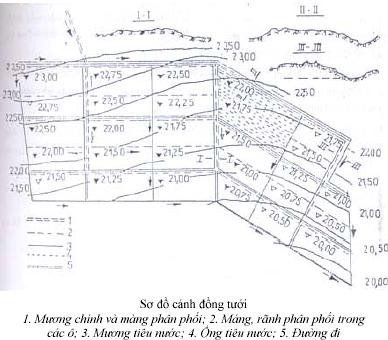
Operating principle: The treatment by irrigation fields and filter fields is based on the ability to retain water residue on the ground surface, water seeps through the soil when passing through the filter, thanks to the oxygen in the pores and capillaries of the topsoil layer, aerobic microorganisms decompose contaminated organic matter. The deeper the depth, the less oxygen, the oxidation process of organic matter gradually decreases. Finally, at a depth where only denitrification occurs. Irrigation fields and filter fields are often built in places where the source water level is lower than 1.5m from the ground surface.