
Vietnamese ethnic culture in the city center.
Nature has also bestowed Thai Nguyen province with many landscapes, caves, rivers and lakes... an attractive eco-tourism resource for tourists such as: Nui Coc Lake (Dai Tu District); Hang Pagoda, Tien Stream (Dong Hy District), Phuong Hoang Cave, Mo Ga Stream, Nam Rut Natural Landscape (Vo Nhai District)...
Coming to Thai Nguyen, tourists can return to visit the old war zone, immerse themselves in the natural scenery, primeval forests, natural caves and beautiful stilt houses, participate in festivals imbued with the cultural identity of ethnic minorities in the Northeast region such as: Long Tong festival (going to the fields), Duom Temple festival... enjoy specialties of the mountainous region such as: bamboo rice, wild canarium, bitter bamboo shoots... and the fragrant tea aroma of Tan Cuong and Trai Cai communes, famous for generations.
Maybe you are interested!
-
 The relationship between travel motivation, destination image and destination choice - A case study of Binh Dinh province tourism destination - 1
 -
 Impact of tourism on the cultural and social life of Thai people in Mai Chau - Hoa Binh and development solutions Case study of 4 villages: Lac village, Pom Coong village, Van village, Nhot village - 1
 -
 Impact of tourism on the cultural and social life of Thai people in Mai Chau - Hoa Binh and development solutions Case study of 4 villages: Lac village, Pom Coong village, Van village, Nhot village - 18
 -
 Managing national cultural identity education through experiential activities for students of Dai Tu secondary school for ethnic minorities, Dai Tu district, Thai Nguyen province - 2
 -
 Developing craft village tourism in Thai Nguyen specialty tea regions - 15
1.1.1. Natural characteristics
* Climate
Thai Nguyen has a tropical monsoon climate, but is mild, warm, humid, cool more than hot, the average annual temperature is 25 0 C (the dry season usually lasts 7-8 months, very favorable for tourism activities).
* Terrain
Thai Nguyen has a typical terrain of hills interspersed with low fields, mainly limestone mountains and bowl-shaped hills, with forests and mountains accounting for 2/3 of the territory.
* Hydrology, rivers and lakes
Thai Nguyen has two main rivers flowing through its territory, the Cau River and the Cong River, and is greatly influenced by the hydrological regime of these two rivers. Thai Nguyen has many caves, lakes, streams, and beautiful waterfalls, creating interesting green tourist destinations such as: Nui Coc Lake, Phu Xuyen Lake, Suoi Lanh Lake, Bao Linh Lake, Vai Mieu Lake, Cua Tu Waterfall, Ngao Dat...
* Land
The province's natural forest area is 102,190 hectares, and the planted forest area is about
44,450 ha (2010). This is a great advantage for forest development, providing raw materials for processing artificial wood and making paper. The agricultural land area of the whole province accounts for 23% of the natural area, the main annual crop is tea. In addition to food production, the province also has a relatively large area for planning grasslands, strongly developing large-scale livestock and dairy farming.
Thai Nguyen is a suitable land for growing tea. Thai Nguyen tea, especially Tan Cuong tea, has long been a famous specialty at home and abroad. The whole province currently has 15,000 hectares of tea (ranked 2nd in the country after Lam Dong province), of which over 12,000 hectares are for commercial tea, annually producing over 70,000 tons of fresh tea buds. The province has planned to develop tea trees to 15,000 to 20,000 hectares with a yield of about 105,000 tons of fresh tea buds/year. The province currently has over 10,000 hectares of fruit trees, by 2010 it will be increased to 15,000 hectares, which can grow trees such as lychee, apricot, longan, orange, tangerine, etc.
* Minerals
Thai Nguyen has the second largest coal reserves in the country, including fat coal and coal concentrated in Dai Tu and Phu Luong districts, with fat coal potential of over 15 million tons, of which the exploration reserves are about 8.5 million tons; coal has a search and exploration reserve of about 90 million tons. Metal minerals are abundant in Thai Nguyen province such as: iron ore, tin, lead, zinc, gold... in addition to copper, mercury... Non-metallic minerals such as: pyrite, barite, phosphorite... total reserves of about 60,000 tons. Thai Nguyen has many construction material minerals, of which the most notable is cement clay with reserves of about 84.6 million tons, Dolomite, recently discovered Kaolin clay mine in Phu Lac commune, Dai Tu district, with an estimated reserve of 20 million m3 , which is an abundant raw material area for the development of the construction materials industry, including cement and paving stones.
In general, Thai Nguyen province's mineral resources are very rich in variety. Iron potential gives the province a great comparative advantage in developing metallurgical and mining industries... to become one of the major metallurgical centers of the country.
1.1.2. Population, ethnicity and administrative organization
a. Population, ethnicity
At the time of the national census on April 1, 1999, Thai Nguyen province had 1,046,163 people (accounting for 1.41% of the country's population). In 2000, the average population of the province increased to 1,067,481 people; in 2005 it was 1,108,775 people; in 2006 it was 1,127,170 people, with a population density of 319 people/km 2 , the largest among the northern mountainous provinces of Vietnam, and by 2009 it was 1,124,786 people, with a density of 325 people/km 2 .
Compared to other provinces and cities in the country, Thai Nguyen is one of 38 provinces and cities with a population of over 1 million people. In 1991, Thai Nguyen province had a population of 1.38% of the total population of the country. By 1995, this rate was 1.40% and by 2003, Thai Nguyen province's population was 1.34% of the total population of the country.
Currently, Thai Nguyen province has 9 ethnic groups living together: Viet, Tay, Nung, San Diu, San Chay, Dao, Hmong, Hoa, Ngai.
* Vietnamese
The Vietnamese people account for 75.38% of the population in the province. This population consists of many components: a part that is indigenous, has been there for a long time, living with other ethnic groups; a part, in the early years of the 20th century, was recruited to work in mines and plantations of the French colonialists and the Vietnamese; a part migrated from the Northern Delta regions to earn a living.
* Tay people
In Thai Nguyen province, the Tay people have the second largest population after the Viet people, mainly concentrated in the districts of Dinh Hoa, Phu Luong, Vo Nhai, Dai Tu. The Tay people have a fairly developed agriculture, in addition to growing rice, they also grow corn, potatoes, cassava and other food crops. Besides farming and raising animals, the Tay people also have a tradition of some small-scale handicrafts. They quickly absorbed the culture of the Vietnamese people and achieved a high level of economic, cultural and living standards among the ethnic groups.
* Nung people
The Nung people have 54,628 people, living mainly in the districts of Vo Nhai, Dong Hy, Dai Tu. The Nung people have many branches (Nung Phan Sinh, Nung Chao, Nung Inh...), they are good at farming. The Nung people often live in strips along the roads in the valleys, they have a rich folk culture.
* Dao people
The Dao people have 21,818 people, the largest in Dai Tu district, then Dong Hy, Phu Luong, Vo Nhai... In Thai Nguyen, there are four main Dao groups: Red Dao, Tien Dao, Lo Gang Dao and Quan Chet Dao. Dao culture has many unique features, especially singing during Tet, festivals, weddings... The Dao people have a lot of experience in agricultural production in mountainous areas.
* San Diu people
The San Diu people in Thai Nguyen province have 37,365 people, most concentrated in Dong Hy district, then Phu Luong, Dai Tu, Phu Binh districts, Thai Nguyen city, with a tradition of working in wet rice fields because they are rich in experience and have very rich folk knowledge about cultivation. Previously, the marriage relationship of the San Diu people was only limited within their own ethnic group. Nowadays, due to the increasing solidarity, equality and harmony between ethnic groups, that relationship has been expanded.
* Vegetarians
The San Chay people in Thai Nguyen province consist of two local groups: Cao Lan and San Chi, distinguished by their language. According to the 1999 census, Thai Nguyen has 29,229 San Chay people, ranking second in the country (19.84%), after Tuyen Quang province (54,095 people) and ranking fifth among the ethnic groups in Thai Nguyen province. The San Chay people are concentrated in Phu Luong, Dinh Hoa, and Dai Tu districts.
* Hmong people
According to the 1979 census, there were 650 Hmong people in the former Bac Thai province. After 10 years (1989), the Hmong population in Thai Nguyen province alone reached
2,264 people, by 1999 it had increased to 4,831 people, most of whom lived in Vo Nhai, Dong Hy, Phu Luong districts. The Hmong people mostly migrated from Ha Giang and Cao Bang provinces to Thai Nguyen province.
* Chinese
The Chinese have been present in Thai Nguyen province for several centuries. They are immigrants originating from Guangdong and Guangxi (China). In 1979, there were 3,964 Chinese in Thai Nguyen. By 1989, due to the separation of the Ngai ethnic group, the number of Chinese in Thai Nguyen was 2,845. Ten years later (1999), the number of Chinese in Thai Nguyen was 2,573 (due to the separation of ethnic groups), with the largest concentration in Dinh Hoa district (accounting for 48.49% of the Chinese in Thai Nguyen province).
* The Ngai People
In 1989, the Ngai people were separated from the Chinese and became a separate ethnic group. This is the smallest ethnic group in Thai Nguyen province.
b. Administrative organization
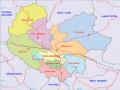
Thai Nguyen consists of 9 administrative units (1 city, 1 town and 7 districts). The provincial capital is Thai Nguyen city, Song Cong town and 7 districts: Dai Tu, Pho Yen, Phu Binh, Dinh Hoa, Vo Nhai, Dong Hy, Phu Luong.
1.1.3. Socio-economic characteristics
Thai Nguyen is the land connecting the mountainous region of Viet Bac with the Red River Delta, the gateway to protect the ancient capital of Thang Long and the present-day capital of Hanoi. Therefore, the province is identified as the economic-cultural center of the midland and northeastern regions of the North. Thai Nguyen has many economic, cultural and defense facilities of strategic importance to the country such as: Gang Thep Industrial Park (the first industrial park of the country established in 1963); Song Cong Industrial Park; 6 universities, nearly 20 colleges, professional and vocational high schools.
Thai Nguyen has National Highway 3 and Cau River, which are almost symmetrical axes running from the North to the South of the province. National Highway 3 connects Thai Nguyen with Hanoi and the provinces of the Red River Delta and with the northern provinces of the country. The geographical location of Thai Nguyen province has created many favorable conditions that many northern mountainous provinces do not have, giving the province the potential to develop not only now but also in the future.
Thai Nguyen City is the economic, political and cultural center of the province, one of the urban areas considered as satellite cities of the capital Hanoi, with convenient traffic routes Hanoi-Thai Nguyen (80km), 50km from Noi Bai airport, 45km from Soc Son export processing zone, located next to the strong economic triangle Hanoi-Hai Phong-Quang Ninh. Nui Coc Lake and Thai Nguyen City will be the future weekend getaway for tourists from Hanoi and other localities in the Northern region.
Route 18 is an industrial economic axis that will be built connecting Thai Nguyen-Kep-Pha Lai-Uong Bi-Cai Lan to the sea, facilitating the exchange between Thai Nguyen province and the Northeast region of the country. The northern economic axis of Hanoi-Noi Bai-Song Cong-Thai Nguyen is bustling, with an abundant industrial workforce, and the number of tourists to Thai Nguyen province is therefore also very large.
Thai Nguyen city, an urban area planned to develop to the west connecting with Nui Coc lake area, forming a natural urban-ecological tourist area.
However, the city center and lake area are favorable conditions for visitors to do business and travel.
1.2. TOURISM POTENTIAL OF THAI NGUYEN PROVINCE
1.2.1. Natural potential
* Nui Coc Lake Eco-tourism Area
Nui Coc Lake is considered a national tourist destination in the Northeastern mountainous sub-region, with eco-tourism and typical tourism products: resort and entertainment tourism; ecological research tourism of forests and lakes; mountain climbing and water sports tourism; cultural and historical tourism.
The lake belongs to Tan Thai commune, Dai Tu district, 15 km southwest of Thai Nguyen city center. Nui Coc Lake is an artificial lake, blocking the Cong River, located on the high mountainside, with a lake surface area of 25km2 , on the lake there are 89 islands, some islands are green forests, some islands are home to flocks of storks, some islands are the homeland of goats and some islands are the place to build a temple to worship the Lady of the Upper Realm... Nui Coc Lake is a beautiful scenic spot, coming to Nui Coc Lake tourist area, visitors will feel comfortable and satisfied with many entertainment and service activities, there are 6 main attractions: water music stage, legend
Thoai Cung, Fairy World Cave, Three Pine Cave, Crocodile Park, Water Park. Hotel and restaurant system with many types of rich and diverse services. For many years, Nui Coc Lake has become an attractive tourist destination for domestic and foreign tourists.
* Tan Cuong tea village tourism
Tan Cuong tea village is located next to the famous Nui Coc Lake tourist area of the province, in Tan Cuong commune (Thai Nguyen city), about 10 km from the center of Thai Nguyen city along the Dan-Nui Coc provincial road. Our country has many delicious tea regions, but Tan Cuong-Thai Nguyen tea has always been the most delicious and famous. Households in the commune mainly focus on growing tea trees, the whole commune has 1,200 households growing tea.
Tea area over 400 hectares, tea output of the commune each year over 1000 tons of dry buds.
Tan Cuong tea has a natural aroma, rich in sweet and astringent taste that only Tan Cuong land and sky can create. It is not clear exactly when tea trees appeared in Thai Nguyen, but according to the people of Tan Cuong tea region, the tea profession has existed in the lives of their ancestors for hundreds of years. Since the beginning of the 20th century, products bearing the brand name Tan Cuong-Thai tea with the fragrant aroma of young rice and elegant sweetness have been seen in Thai Nguyen, Hanoi and many provinces across the country, becoming a fragrant gift of friendship when meeting each other.
* Phoenix Cave - Mo Ga Stream
The relic is located in Phu Thuong commune, Vo Nhai district, close to National Highway 1B (Thai Nguyen - Lang Son), 42 km northeast of Thai Nguyen city. This is a beautiful scenic complex of Thai Nguyen province because of its majestic natural scenery, beautiful caves, many interesting shapes, clear streams and waterfalls, and cool, temperate climate.
Phuong Hoang Cave is located on the top of the mountain, the cave entrance is about 100m high from the foot of the mountain climbing up to the cave mouth through many cat ear cliffs, the cave goes deep into the mountain, in the cave there is a cool stream, many beautiful stalactites. At the foot of the mountain is Mo Ga stream, underground water flows from the mountain all year round. In front of the cave entrance there is a small waterfall created by many rock formations, stone steps. Phuong Hoang Cave - Mo Ga stream is an ideal green tourist destination, mountain climbing, eco-tourism exploration for visitors. In 1994, the landscape was ranked by the State as a national scenic relic.
* Khuon Tat Waterfall
Khuon Tat Waterfall is located in Tin Keo hamlet, Phu Dinh commune. From the top of the towering De Pass, you can see the seven-tiered waterfall, like a stilt house, with clear water pouring down all year round. The waterfall is over 20m high, the bottom tier is beautiful.