
G price of tourism products on the market (Specific tourist destination) t1 consumer income
t2 price of substitute products t3 lifestyle, taste
t4 value of tourism resources tn. international relations
2.2. Concept of characteristics of tourism supply
Tourism supply is the ability to provide goods and services to meet tourism demand. Tourism supply is the entire relationship between supply and price (ability to sell and willingness to sell).
Characteristics of tourism supply
+ Service is the main thing
+ Not flexible
+ Less adaptable when demand fluctuates.
+ Highly specialized
Factors affecting tourism supply
+ Tourism demand (in the long term)
+Development of productive forces
+ Value of tourism resources
+ Input factors
+ Number of people involved in production.
+ Level of centralization
+ Tax and investment policies
+ Tourism development policy
+ Events
3. Tourism market research
183.1. Objectives of tourism
In order to answer the following questions:
First, who are the business's customers?
Second, what kind of people are the business's customers?
Third, who can be classified as the major tourist customer group?
Fourth, how do customers react to the products and services that the business offers?
supply industry
Fifth, how are customer needs changing?
3.2. Stages of tourism market research
First, potential market research: to assess market potential, study purchasing behavior and travel readiness
Second is current research:
Includes visitor participation behavior and personal information exchanges, customer service performance behavior, and process quality research.
Third, market research in the results section: includes customer satisfaction information from statistics on customer indicators, service subscription rates for the next time:
3.3. Methods of tourism market research
3.3.1. Primary research: associated with collecting and processing information directly from the research subjects, which are customers. This method is carried out in many different ways: observation, interview, expert
3.3.2. Secondary research: is a form of research based on statistical data and selected related documents. Secondary research often aims to achieve the goal of capturing the general characteristics of the industry market. This method has outstanding advantages over primary research in terms of cost and simple implementation.
There are two basic sources of information for secondary research: internal sources and external sources.
External information sources include: population growth, tourist demand trends such as destination demand, spending structure for tourism services, etc.
Internal information sources include accounting systems that record revenue statistics….
3.4. Work conducted to research the tourism market includes:
+ Preparation work group: is the time for designing market research including
19
Question design to complete data collection forms
+ Information collection work group: implements identified information collection measures to collect the necessary information
+ Information processing group: analyzes and processes collected information. The collected results are necessary conclusions about the market as research objectives.
set out
Review questions
Question 1: Describe the concept of functional characteristics of the tourism market.
Question 2: Concept of tourism demand, factors affecting the formation of demand in the market
Question 3: Present the objectives of the stages of tourism market research.
Chapter 3. Product and service policies in tourism Chapter code: CBMA 10. 3
Introduce:
In chapter 3, we will provide learners with the concept, characteristics of tourism products, and its role in the marketing mix.
+ Definition of tourism product life cycle
+ Explain the development trends of new tourism products
+ Tourism product policy and its role in the marketing mix
Target:
+ Present the concepts and characteristics of tourism products and their role in the marketing mix.
+ Definition of tourism product life cycle
+ Explain the stages of the product life cycle as well as the marketing policies applied to each specific stage, thereby applying them to the business practices of specific products and services of tourism enterprises;
+ Explain the development trends of new tourism products
+ Tourism product policy and its role in the M-mix Contents:
1. Tourism product and service policy
201.1. Concept of tourism
“Tourism product is a whole consisting of heterogeneous tangible and intangible components.
A tourism product can be a specific item such as food, or a non-specific item such as the quality of service, the atmosphere at the resort” (Michael M. Coittman)
Tourism product is also called tourism experience and it is a whole so Krapf said "a hotel does not make tourism"
1.2. Characteristics of tourism products
Tourism products have many unique characteristics. These characteristics are also characteristics of tourism services. The following are characteristics of tourism products:
a) Customers buy products before seeing them.
b) Tourism products are often an experience so they are easy to imitate. The time it takes to buy the product and see and use it is too long.
c) Tourism products are far from customers.
Tourism products are a synthesis of different business sectors.
Travel products such as airline seats, hotel rooms, restaurant chairs cannot be kept in inventory.
In the short term, the supply of tourism products is fixed, but demand from tourists can increase or decrease.
Customers who buy tourism products are less loyal or not loyal to the company that sells the product.
Tourist demand for tourism products is susceptible to changes due to currency and political fluctuations.
1.3. Tourism product policy and its role in the marketing mix
Tourism products are mainly highly integrated services based on many different industries. Moreover, due to their unique characteristics, tourism products have a difficult life cycle to determine. Because of these characteristics, the product policy strategy in tourism marketing is to diversify products through the combination of constituent elements, enhancing the recognition of the business brand.
What is product policy in tourism marketing?
Product policy is understood as the totality of rules in creating and launching products.
products into the market to satisfy the needs and tastes of customers in each period.
21
business of the enterprise.
Product policy is the backbone of business strategy, not only ensuring that production and business activities go in the right direction but also closely linked to the stages of the enterprise's production expansion process.
As you know, tourism products are tours, accommodation services, food and beverage services... Therefore, its characteristic is that you have to use it to know it.
Appropriate factors in product policy in tourism marketing
Physiological satisfaction: delicious meals, palatable food and drinks, comfortable beds, comfortable environments
Economic satisfaction: price is equivalent to value and quality. fast service
Social satisfaction: when participating in a tour, tourists can interact, learn many useful things, and approach many new things.
Psychological satisfaction: when participating in the tour program, guests are guaranteed absolute safety and are treated with the highest level of respect.
To achieve product goals, travel businesses often focus on core products (sightseeing, accommodation, food and beverage), actual products (hotel quality, tour guide qualifications, etc.) and additional products (activities that add value to the product).
Convenience in the process of registering to buy a tour program Consulting customers to help them choose suitable products Quality of accommodation facilities, room service, food and drinks, etc.
Convenient payment method: accept late payment (must have guarantee) combined with modern payment method (VISA, ATM, ...)
Special offers for regular customers
Special offers for group travelers
Special price for children: special gift
Organize birthday parties for group members (if any)
Free services (luggage transport, souvenir photos, etc.)
In addition, product policies can be applied according to tourist seasons to ensure suitability.
22 to suit customer needs.
2. Research the product life cycle
2.1. Product life cycle concept
Services do not have a product life cycle. In tourism, tangible products such as tourist attractions have a product life cycle, and the product life cycle can be classified into three types: short-term, medium-term, and long-term.
Short term cycle
The short-term cycle of a tourist destination is considered to be one year or less. These cycles are easily recognized as the seasonal cycle of vacations during the year at a certain tourist destination. It is also possible for a tourist destination to have two cycles in a year, one for summer and one for winter, depending on the type of activity such as winter skiing, summer golfing, horse riding, etc.
Medium term cycle
The seasonal tourism cycle typically occurs over several years. This change may be due to visitor trends, political issues, security instability, or changes in the local economy or environment.
Long term cycle
The long-term life cycle of a tourist destination goes through four stages: Discovery stage, growth stage, maturity stage and decline stage. Each stage has its own characteristics and marketers need to know to implement appropriate marketing strategies for each stage to achieve business efficiency.
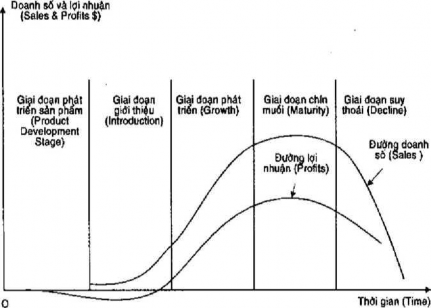
Diagram 11: The product life cycle relates to the objectives and activities of the Marketing Mix .
1
Marketing Objectives | Product formation | Infiltration school | Increase the number of benefits profit | Maintain the success of the unit Brand | Harvest or destroy | |
2 | Edge | Are not | Do not have | Currently | Compete | Edge reduction |
Maybe you are interested!
-

 Market Research and Tourism Program Design.
 -
 Research on Content, Influencing Factors and Experience in Developing Tourism Market
 -
 Initial research on Dong Ky wooden village in tourism development in the Northern Delta - 6
 -
 Research on building coffee tourism products into one of the main brands of Dak Lak tourism - 2
 -
 Characteristics of the Tourism Market
Product | No image yet | One type | Multi-voice | Wire n floor | Hard to sell | |
4 | Price | Are not | Browse input | Achieve need | Protect occupy | Profitable Con |
5 | Manure | Are not | Limited | Rolled many hotel, house | Maximum production | few products |
6 | Cheerleading | Are not | Newsletter | Pressure of edge | Reminder | Evening cheer |
3
Table 4: Marketing by product life cycle
1. 2.2. Characteristics of the stages in the product
2.2.1. Product discovery or introduction stage (Introduction stage)
This is the first step, finding a new tourist destination and developing a new product idea. In this stage, sales are low, on the contrary, investment costs are high. This is a place where tourism is newly formed, starting to attract some tourists, hotels, restaurants, and businesses with high prices. According to Plog, these places, at first, attract Allocentric customers, adventurous customers, who like to come first to newly discovered tourist destinations and do not need to be fully served. The discovery stage has many risks leading to business failure because of the low number of customers and high costs.
2.2.2. Growth stage
In the growth stage, the product becomes popular, attracts tourists, the business is favorable and prosperous, stimulating others to compete. In this stage, the tourist destination gradually becomes suitable for the average person (Midcentric) and in the business there are many competitors wanting to jump in, so it is necessary to sell more than promote.
2.2.3. Maturity stage
The maturity stage is also known as the saturation stage. During this stage, the business becomes fiercely competitive on price. Tourism suppliers seek to innovate.
24
products to achieve maximum customer satisfaction.
To reduce risks and avoid product decline, tourist destinations must find ways to reform their business models, adapt to new tourist markets, and develop new products and new ideas to attract tourists.
3. 2.2.4. Decline stage
This is the stage where the customer is bored and turns away from the product to go elsewhere.
Find other tourist attractions. During this period, tourism suppliers should find ways to put products that are no longer of use to tourists into other useful uses.
Not all products go through the above 4 stages and the length of each stage depends on the understanding of the marketer. Each stage of the product life cycle has a marketing strategy to suit the situation and reality of the environment to maintain product development capital. There are tourist destinations in the mature stage that can survive for many years, but there are also places that cannot overcome the initial discovery stage. For example, Antarctica is a very attractive tourist destination for tourists who want to see penguins, soak up and enjoy the year-round ice and snow. But certainly Antarctica cannot become a tourist destination in the mature stage. On the contrary, there are also tourist destinations that do not go through the discovery stage but have become mature, such as Cancun, Mexico. And also in cases where a tourist destination has gone through the four stages, it moves to a new stage of development, such as Atlantic City in the late 19th century.
3. Decisions related to tourism product policy
3.1. Tourists' attitudes
3.2. New product development
New products are a top concern for travel companies. Typically there are six types of new products:
Brand new
New production line
By-product – a new product that complements an existing product
Improved product: has more complete features
New market: existing products entering new markets
25
Cost Reduction: The new product has the same quality and lower price than the existing product.
New product development not only enables travel businesses to achieve their marketing goals,
target and profit but also ensure the reputation and class of the company.
New products also facilitate better exploitation of business capabilities.
This is also a way to attract old customers back to the company. Process of building a strategy to develop new tourism products;