
1.1.5. Sources of impact from tourism activities on the natural environment
Sources of impact of the proposed layout of construction works in the tourism development project.
Sources of input impacts of tourism development projects.
Sources of influence in the stages of development.
Maybe you are interested!
-
 Directions for Improving State Management of Tourism Activities in Dak Nong Province
 -
 Current Status of State Management Activities for Tourism Enterprises in Hanoi
 -
 Concept of State Management by Law for Tourism Activities
 -
 The Process of Formation and Development of Law and State Management by Law for Tourism Activities in the Democratic Republic of Vietnam
 -
 Factors Affecting State Management of Tourism Activities
Output impacts.
1.1.6. Some lessons learned on protecting the natural environment
1.1.6.1. Related to state management
In Nepal, the Annapuna Conservation Project (ACAP) is a typical example of building a Conservation Fund from tourism activities, the project uses money from the entrance fee revenue of the Annapuna Conservation Area (15 USD/foreigner and 1.5
USD/person from
countries in the South Asian region) for protection programs
talent
resources and environment in the region. Under the Upper Mustang project (an extension of the ACAP programs), the Government of the Kingdom of Nepal has decided to allocate 60% of tourism profits to activities to protect resources and environment in the region.
1.1.6.2. Related to the management of tourist areas and spots
One of the popular experiences in this field is the Indigenous Ecotourism project in Ryo Blanco in Ecuador. This project has taken measures to build pick-up points about 1km away from the community center, to reduce the density of accommodation construction in the central areas to limit the negative impact between tourists and local people. In Senegal, the Integrated Rural Tourism project in Casamance pays attention to the issue of limiting the service capacity of the inns, "controlling the maximum capacity of 2040 guests/time and only building in
villages with a population equal to or greater than 1,000 people” but not allowing an increase in labor
capacity of old accommodation facilities.
Another issue related to the management of tourist areas and spots is the need to conserve fuel and energy instead of firewood. Realizing this issue, in Nepal
The ACAP project has launched an alternative energy program to replace firewood, first of all
Encourage the use of kerosene in accommodation establishments to serve the needs of tourists. In which ACAP has provided a low-interest loan to those who have kerosene to supply kerosene at the lowest price; transport kerosene stoves as well as support the repair and maintenance of stoves.
1.1.6.3. Relating to the local community
The Spanish-language EcoEscuela de Espanol, founded in 1996 as part of an international conservation project in the San Andes village of Guatemala, is an example. Located in the May Biosphere Reserve, the school receives 1,800 visitors annually, mainly from the United States and Europe, and provides employment for 100 residents, 60% of whom were previously engaged in illegal logging, hunting, slash-and-burn farming, and agriculture. A 2000 monitoring report showed that most of the families who benefited from this business had reduced their hunting and slash-and-burn activities. In addition, the majority of households in the village benefited directly or indirectly from the school, which significantly reduced the pressure on the community to hunt for flora and fauna there.
1.1.6.4. Related to tourism business units and individuals
In Brazil, where nature-based tourism activities are strongly developed, the company Aretic Edge Tour, specializing in organizing adventure tours and ecotourism, has applied a number of measures to organize nature-based tourism but actively protect the natural environment, such as setting out organizational principles.
including: limiting the number of visitors per tour group to less than 10 people; no use of
animals and plants at tourist sites for food; food brought is prepared and packaged; dirty water is discharged into clean water sources; garbage is burned on site or taken away; walking single file on trails; not camping in areas where wild animals congregate; cleaning up the campsite before leaving.
1.2. History of research on the problem
Through the study of documents related to environmental protection in cultural tourism activities in Vientiane in economic development in general and in cultural tourism activities in the capital Vientiane in particular. I realized that many researchers are interested in this issue:
In 2002, the report of the Institute of Rural Development Planning "Master plan for conservation
Promoting values in Vientiane Capital by 2020" In 2002, Culture Publishing House
The ethnic group has produced a set of documents: "Education on conservation of the World Natural Heritage of Vientiane" at all 3 levels: Primary (5 books), Secondary (1 book), High School (1 book) for teachers. Department of Education and Training, Vientiane Capital Management Board and International Organization for Conservation of Fauna and Flora.
In 2003, the Vientiane Capital Management Board issued "Legal documents on management, protection and exploitation of Vientiane Capital".
Besides, there are many articles in Lao DL magazine about the environment.
Vientiane Capital in tourism development such as: DL Magazine No. 01/2006 "Actively investing in opening new tourist routes"; Magazine No. 03/2007 "Protecting the landscape environment in tourist areas, routes and destinations"; Magazine 10/2010 "Opening the project to protect the environment of Vientiane Capital"; Vientiane Environmental Protection Brochure of the Management Board of Vientiane Capital, 2010. In addition, there are circulars of the Ministry of Science, Technology and Environment on environmental protection work in Vientiane such as: "Circular guiding the protection of the environment of Vientiane Capital", 12/1999; Institute of Environmental Research
Tourism Development Research (2008), “Environmental Task Synthesis Report 2009”; General
Department of Tourism. Circular No. 10/2006/TT BTNMT (2006), “Guidelines for developing a clean development mechanism within the framework of the Kyoto Protocol” Ministry of Natural Resources and Environment.
In 2008, the Government reported at the ministerial level "Research on the accumulation of trace organic pollutants (PAHs, PCBs) in water, sediment, and riverine organisms, proposing solutions to manage and prevent the risk of accumulation in the environment in 2008 [28].
1.3. Natural and socio-economic conditions
1.3.1. Natural conditions
Vientiane is the capital of Laos, located in central Laos. The capital borders Vientiane province to the north, BoliKhamXay province to the south, XaySomBun province to the east, and NoongKhai province (Thailand) to the west.
The terrain of the capital Vientiane is the largest plain of the four plains of the Lao People's Democratic Republic, the Mekong River is the natural border between the capital Vientiane and Thailand.
The capital Vientiane has 9 districts (Muong), with a population of more than 598,000 people, with an average of 149 people/km2, the residents here are mainly Lao Lum, in addition to some foreigners such as Vietnamese and a few Chinese people living. This land always plays an important role in the fields such as: politics, culture, society... of the country.
Vientiane became the capital after King Xay Set Tha Thi Lat moved the capital from Luang Prabang to Vientiane in the 16th century (1560). The reason for the king to move the capital from Luang Prabang to Vientiane was because at that time Luang Prabang was close to Myanmar and the two countries were always at war with each other, Myanmar always threatened to attack Luang Prabang. Meanwhile, Vientiane was a fertile plain,
The economy was very developed, consistent with the country's development at that time [30].
Vientiane's land is very large, suitable for the construction of the country's capital.
countries in the fields of politics, military, economy, culture, society,...
Vientiane is a capital city with economic and cultural exchange relations with countries in the Southeast Asian region and around the world, through different periods, especially when Vientiane became the capital of Laos in 1916.
With the advantages of this land, Vientiane is integrating with the development trend in all aspects in the region and the world.
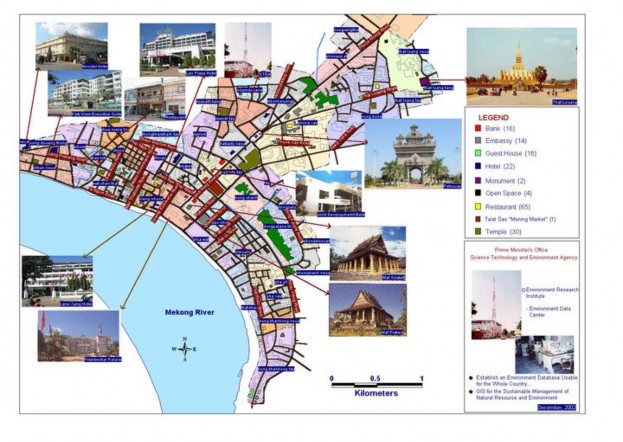
Figure 2: Map of the capital Vientiane
1.3.2 Socio-economic and cultural situation in Vientiane
* Economic situation
Due to the richness of the terrain combined with different natural conditions and locations
The geography makes the economic structure here rich and diverse, in which trade is the main profession, because this area is a stream of economic growth Vientiane Sa Van Na Khet Pak Se and an international triangle of Laos Thailand Vietnam. Vientiane has a favorable location for road and waterway traffic, which is a good condition for developing trade on the river, exchanging goods with many commercial centers and systems of city, district and village markets that have been formed quite a lot and among them are relatively large markets such as: Morning Market, Afternoon Market, Khua Din, That Luong, Thong Khan Kham and Si Khay. With the main products being brocade, wine, candy, fish, shrimp and handicrafts serving domestic and foreign people.
*Socio-cultural situation
Vientiane is the capital of Laos. This is a land of thousands of years of civilization, with a long history of development in the Southeast Asian region. The ancient civilization was identified in previous periods with the remaining relics found at many archaeological sites in Laos. The artifacts found at archaeological sites themselves speak to some extent about the ancient history of the Lao people, the process of hard work, creativity, and perseverance in fighting against nature to constantly develop, creating a unique culture. Those cultural values are the construction of castles, palaces, pagodas and towers everywhere in the capital Vientiane through different periods, especially the period of establishment and becoming the capital of Laos, from 1560, after moving the capital from the ancient capital of Luang Prabang to Vientiane, by King Chau Xay Nha Set Tha Thi Lat. Because this was a time of peace
was re-established and was a period of prosperous development of the Lao kingdom of Lan Xang [31].
Vientiane is a land with a long tradition of learning.
The feudal dynasty left us great achievements in many different fields of culture, politics, military, etc., which remain until today.
Vientiane currently has 118 primary schools and 487 secondary schools (According to statistics from the Department of Education and Training of the capital in 2006). The quality of teaching and learning of teachers and students is constantly improving. The tradition of studiousness left by our ancestors has been increasingly developed by the generations of descendants of the capital and has achieved many great achievements for the descendants of Laos today.
Vientiane is also a land rich in revolutionary struggle tradition with historical relics that have recorded the process of building and defending the country of our ancestors in the past periods, especially in the 19th century, because they participated in major uprisings of the nation in the struggle against foreign invaders such as Siam and in the two resistance wars against France and the US. Therefore, this land deserves to be a land of talented people with many historical events showing that this land has a rich culture, with 5 relics ranked at the national level. In particular, the people here have created a rich and diverse folk culture with a treasure trove of melodies, lam, folk songs, singing... clearly expressed in traditional festival activities in the capital Vientiane very uniquely.
1.3.3 Potential for cultural tourism development in Vientiane
Nowadays in countries around the world, the material, cultural and spiritual life of people has reached a high level, so the need for tourism is indispensable. The 5-6 day work week in some countries is creating conditions for people to have more free time to travel. The increasing demand for tourists requires tourism businesses to approach the market promptly to satisfy all the needs of tourists. According to the development trend of mass tourism in recent times, it has been shown that
out the main directions and complexities of the tourism industry. Thanks to its position
With its special geographical location and many historical and cultural relics, the capital Vientiane is making strong strides in developing cultural tourism. It is predicted that by the year
In 2020, Vientiane will still have a large number of tourists and increase strongly over time.
There are big differences in different regions of Lao PDR due to tourism.
again. In Vientiane, the Government and the City's leaders have had policies that are very suitable for the current era, tending to promote the development of cultural tourism. Because Vientiane's tourism is also an industry that promotes economic development, at the same time solving jobs for people and enriching people in tourist areas; it is also a very important factor that makes people from different walks of life around the world understand more about customs, production forms, understand the lives of the Lao people, contributing to building peace, strengthening solidarity and friendship.[20]
Because Vientiane is a capital that has existed in the world for a long time, rich in natural tourism resources and historical and cultural resources. Currently, the flow of tourists in the world is gradually coming to visit the capital of the country of a million elephants more and more. When there are visitors coming to visit Vientiane, of course, there will be a source of funds to exchange and use for investment in developing the city. Therefore, tourism is a source of foreign currency income quite high. According to statistics of the agency
Vientiane city tourism. From 249,255 people in 1995 increased to 486,613
The number of tourists in 2000 increased the city's foreign exchange earnings by over $30 million. In 2006, the number of tourists was 729,272, an increase of over $26 million. By 2012, the number of tourists was 1,290,031, an increase of over $56,190 million.