
CHAPTER 2 OVERVIEW OF DOCUMENTS
2.1 SOME STUDIES ON AGRICULTURAL PRODUCT VALUE CHAIN
It can be said that each province and each region has its own regional specialties. That is clearly shown in the agricultural crops.
karma because it depends
subject to natural conditions
Maybe you are interested!
-
 Evaluation of the Effectiveness of the Program for Stabilizing Agricultural and Forestry Production Associated with Product Processing
 -
 Factors Affecting Agricultural Product Production
 -
 Supporting Farmers to Participate More Directly in the Agricultural Product Consumption System
 -
 Bank Credit According to Agricultural Value Chain
 -
 The Relationship of Banks to Other Entities in the Agricultural Value Chain
However, local climate.
It is this uniqueness and difference that makes each locality in the country unique.
want to maximize the advantage
of mine to
create
uniqueness of the place
However, to sustainably develop local agricultural products is not simple. Especially in the current period of market opening. Currently, the production system and distribution channels of agricultural products have some weaknesses such as: the development of the industry is unstable and unsustainable, poor product quality, lack of market knowledge.
market and difficulty in accessing market information, lack of connection
In production and consumption, goods have no brand, thus reducing the competitiveness of the industry. In particular, there is a lack of market demand forecasting to plan production to meet market demand in terms of quantity and quality. Therefore, value chain approaches have appeared and are widely used to analyze agricultural products typical of the province and region in order to identify the limited links in the entire chain and propose solutions to increase the competitiveness of goods in the market.
2.1.1 Foreign research
Gooch and collaborators (2009), Pham Van Sang (2012) used
Value chain analysis framework for market assessment and quality management
Fresh Grapes, Fresh Apples and Processed
multi fruit
other Ontario regions,
Canada. Hosni and Lancon (2011) studied the value chain of Syris Apple in foreign markets. The study shows that in order to export Apple, Syris needs to solve the problems in the current Apple value chain. Agricultural extension organizations need to develop and provide new Apple varieties. At the same time, there is a need for independent Apple quality assessment and grading organizations.
to reduce quality risks. In the study “ Analysis of economic characteristics of three potential fruits in India ” in 2006 by Joshua N. Daniel and Prashant A. Dudhade pointed out that the production of tangerine, tamarind and kokum by smallholder farmers has not yet exploited its full potential in terms of area and output . At the same time, scattered and unconcentrated production has caused difficulties in processing and consumption. Meanwhile, James Ssemwanga (2008) with “Analysis of the Mango value chain from Homoshaassosa to Addis Ababa, Ethiopia ”
shared
Mango chain from
Assosa to Addis is short and inefficient, the market
The fruit market in Addis is dominated by organized groups that tend to not allow new entrants. The competition of Mangoes with imported fresh fruit products therefore requires the improvement and upgrading of Mango quality to increase the competitiveness of Ethiopian Mangoes. Another study by Zuhui Huang Zhejiang (2009) shows the important role of linkages in production, with “Chinese Pear Value Chain: Growth Targets for Smallholders” Zuhui Huang Zhejiang pointed out that smallholders in Hebei hardly benefit from the pear value chain because the level of value added in the middle and end stages is much higher than that in the beginning stage. The Zhejiang Pear value chain is shorter than that in Hebei and the value added in the first stage is higher than that in Hebei,
therefore households
small production
maybe
benefited. Cooperatives in
Extract
Giang helps smallholder farmers reduce costs and add more value in consumption. In 2010, through the study "Analysis of Rice and Maize value chains in some typical localities of Tanzania", Peniel Uliwa and colleagues pointed out that although Rice is the second most important food after Maize in this country, rice production productivity in Tanzania is still very low, the rice value chain
inefficient operations. For the value chain
Ngo, authors
point out
export potential and four main market segments for the type
the most important food of Tanzania and the region. At the same time, the study explained why food security is not guaranteed, despite large production, sometimes this country still needs to import food from outside. From there, the research team proposed strategies to improve the supply chain, existing business models and solutions to strengthen the connection between actors in the chain. With the study of Hualiang Lu (2006) on
“Value chain model
two stages to the
effective
in action
Marketing of fruit and vegetable chains” has shown that transaction costs have a great influence
to efficiency
of supply chain
Nanjing vegetable application. Specifically sales activities
Direct marketing incurs the highest transaction costs, and sales activities are the least efficient in the chain. Therefore, the vegetable production stage performs better than the marketing stage. Therefore, managers need to support marketing activities by addressing issues such as market information and finding ways to reduce transaction costs.
It can be affirmed that in the value chain analysis by the holistic method,
demand has brought a more comprehensive and in-depth view because the value chain shows
The following important issues are discussed: the role of technical support organizations, strengthening horizontal linkages, the role of leading enterprises in vertical linkages, and the role of the state in the industry chain.
2.1.2 Domestic research
GTZ, (2006) conducted a pilot analysis of the Coffee value chain for ethnic minorities in Daklak. The study pointed out that the challenges for this Coffee chain are poor farming skills, high input costs such as water, fertilizers, and pesticides. The lack of coffee processing conditions leads to low coffee quality. Furthermore, this coffee chain has too many intermediaries and lacks linkages, leading to high input prices but low output prices for growers. In another study, GTZ, (2006) analyzed the Watermelon product value chain in Long An. The study pointed out that
many problems
in the chain need help
help to
improve efficiency.
In the short term, Long An province needs to have sustainable development programs for Watermelon with technical support and changes in growing practices.
Gardens also need support.
support
access to bank capital. Market demand
Domestic and foreign markets also need to be studied more thoroughly along with necessary technical standards, to avoid the situation where melons are rushed to the Chinese border and then rejected due to quality, forced prices...
To build a plan for Vietnamese fruits to have a name on the market, a brand of international stature, Nguyen Quoc Nghi and Dinh Kim Xuyen, 2009, with the study " The situation of building some Vietnamese agricultural product brands in the integration competition " said that : The fierce competition of foreign agricultural products makes agricultural products
Domestically, the market is becoming unstable and gradually losing market share. The urgent requirement for Vietnamese agricultural products is to build a brand to increase competitiveness and position in the international market. For agricultural products, it is necessary to invest more in agricultural extension, technology for harvesting and preserving products, and research on new varieties. On the other hand, improving product quality must be based on customer requirements, and it is necessary to research both domestic and foreign markets to determine what characteristics and quality consumers need from products. Promotion, marketing and raising brand awareness are important factors in brand development not only for producers but also for consumers. However, businesses and producers have not yet realized the importance of building a brand and creating high quality products. This leads to difficulties in consumption and brand building (Hoang Viet Thang, Chau Minh Tuong, 2006). Also talking about the brand issue, Axis Research Market Research Company, 2006, "Value chain for Vinh Long grapefruit " results of the general system of products and consumption markets. The biggest difficulty for the grapefruit value chain is how to build trust of the components in the value chain, raise awareness and responsibility at each stage from choosing seeds, planting, caring... to harvesting and circulating goods.
At the same time, to build and develop a brand, it is necessary to have
unity and cooperation among agents such as producers,
traders, warehouses, cooperatives, companies, ... according to Nguyen Ngoc Huy, 2010 " The
Factors affecting the development of Nam Roi grapefruit and Vinh Kim star apple brands" , in the context of brand building, the profits of grapefruit growers following the GAP process are quite high, an average of 71.4 million VND/ ha / year ; Vinh Kim star apple has an average profit of 99.9 million VND/ha/year. Grapefruit growers mainly sell their products to wholesalers/retailers (41.1%) and 36% to traders, in addition to selling to cooperatives and companies with 70% payment in cash. In addition, Vinh Kim star apple has 53.6% of its output sold to wholesalers/retailers; 39.9% sold to
traders; the cooperative only purchases in small quantities, 6.5%. Through the survey, the
Factors affecting the brand of Nam Roi Grapefruit include three groups of factors.
Impact: (1) Group of internal factors of the farming household; (2) Group of consumption market factors; (3) Group of product quality factors. For Vinh Kim Star Apple, there are 6 groups of factors affecting the product brand: (1) Group of consumption market factors; (2) Group of factors on production conditions; (3) Group of product quality factors; (4) Group of factors on the level of participation of producers; (5) Group of factors on investment in the brand; (6) Group of factors on business ability.
In addition, in production and consumption, producers have some advantages such as: seedlings that meet the demand (price, quantity), have experience in production, closed dikes, diverse input material market with many different prices so it is easy to choose, output is very easy because there are many traders to buy, that is based on the author Vo Chi Cuong,
2008, “Comparison of production efficiency of Mango monoculture and Mango intercropping with Lemon”
Paper in Ke Sach district , Soc Trang province . Intercropping Mango - Lemon has brought higher economic efficiency to farmers than those who only cultivate Mango trees .
In addition, factors related to farm resources such as land area, production experience, main labor force of the farm, production capital also affect the profit of farming at different levels. In addition to production and branding, the issue of purchasing and
Export is also an issue that needs to be discussed. According to Doan Huu Tien,
2009 , “ Current status of grapefruit production ” . Southern Fruit Institute .
In the Mekong Delta, Hoang Gia Company is an export unit with the capacity to purchase, preserve and export directly. This company has a brand name in exporting Pomelos in the market in the past years and at present. The export market of Pomelos in 2007 of Hoang Gia Company is mainly exported to the European market. Pomelos of the Mekong Delta are also purchased by some companies in Ho Chi Minh City when they reach the raw material area and then transported to Ho Chi Minh City for preservation and export. In the first three months of 2008, the Cooperative
American Five Roi Grapefruit
Hoa has executed 2 supply contracts.
nearly 100 tons
Five-leaf pomelos are exported through export companies. Lo Ren Vinh Kim star apple cooperative signed a contract with Dat Vinh company to package Five-leaf pomelos for export.
Every week, a shipment of 17 tons of Nam Roi grapefruit is sent to the Dutch market (although
However, the grapefruit output was not sufficient so it had to stop operating for a period of time.
Le Thanh Loan, Dang Hai Phuong, Vo Hung (2006), in research
“Supply chain
Cashew Nuts in Vietnam: A Case Study
Dak
Binh Phuoc Province"
derived from the pricing model
enjoy
according to
From the perspective of households, this study analyzes the factors affecting farm gate price fluctuations in Dak Nong, Binh Phuoc province in 2006. The estimated model shows that an increase in the quality of information or price attainment helps improve farm gate prices. The study also shows that infrastructure creates a positive impact on farm gate prices. While there is still a lack of formal market information sources, relationship trading
relationship
non-competitive, improved farm gate prices and efficiency
in the market
The agricultural sector has called on governments, relevant organizations, processing enterprises and growers to engage in a number of infrastructure and procurement services, more efficient access to market price information, and the convergence of technical assistance and marketing advice under a strategic government policy package.
In value chain analysis, descriptive statistics, CBA,
Market analysis, SWOT analysis, etc. are methods used
The most popular method: Nguyen Vu Tram, 2010, " Analysis of distribution channels of Nam Roi grapefruit in Vinh Long " with the above research method gives us the following results :
fruit
that: small grapefruit growing area
fragmented retail, average production costs
The average profit of the household is over 2.3 million VND/cong/year, of which labor costs account for the largest 52.39%. The average profit of the household is 1.9 million VND/ton; the average profit of the warehouse owner is 2.24 million VND/ton; the average profit of the retail establishment is 1.55 million VND/ton. The actors in the channel all face difficulties in the consumption market and risks. Some solutions for the channel are: Promoting and managing the breeding of quality varieties; developing the domestic and export markets; attracting capital into the investment and processing sector; linking production - consumption; promoting post-harvest technology. Besides the above methods, the researcher also uses economic indicators to determine costs and profits.
The study on "Hoa Loc Mango value chain in Tien Giang province" has given
difficulties in the income ratio distributed to each agent is not equal. Although the profit ratio is high (63.12%), compared to the total
income, gardeners have the lowest rate..., and the general advantage of the whole
chain as well as proposing strategies to upgrade the Hoa Loc Cat Mango value chain - promoting the chain economy, expanding the market combined with expanding production to help increase sales output, increase income for each agent, especially the mango gardeners. (Vo Thi Thanh Loc, 2013). In the recent study of Cat Mango by Ngo Vinh Quang (2010), it was shown that mango production brings financial efficiency to gardeners, the cost of fertilizers, pesticides, nutrients, and labor are factors that differentiate the profits of Cat Mango growers and the profits of Cat Mango growers. Consumption channel
Fresh mango
weak
gardeners to warehouses for packaging and distribution
or traders outside the province account for 80% and 17% are sold to collectors, the rest are sold directly to retailers and processed for export. However, this study has not gone into depth in analyzing the value chain of Xoai Cat products, has not mentioned the impacts from external and internal factors, and has not found the right direction for this specialty Xoai Cat product.
2.2 CHARACTERISTICS OF THE STUDY AREA
2.2.1 Overview of Dong Thap province
2.2.1.1 Natural conditions
Dong Thap is a province located in the Southwest region, with an agricultural background.
development, is the third largest rice granary of Vietnam, is the province with the highest growth index
High GDP and economic competitiveness index ranked 2nd in the Mekong Delta region and 5th in the country in 2008.
copper
Located in the upper reaches of the Mekong River, Dong Thap has strengths in agriculture and aquaculture, with an average annual food output of over 2.6 million tons for consumption and export. There are many famous fruit trees such as Chau Thanh longan, Phong Hoa grapefruit, Cao Lanh mango, and pink grapefruit.
Lai Vung... Especially Sa Dec ornamental flowers with over 298 hectares and hundreds of precious flowers and ornamental plants supplying the whole country and exporting. The most developed aquaculture industry is catfish and giant freshwater prawn, annually supplying over 250,000 tons of fish and over 2,000 tons of giant freshwater prawn for processing and exporting. With a population of nearly 1.7 million people and an abundant labor force, the province especially focuses on training and vocational training for the workforce to meet the requirements of investors.
Geographical location
Dong Thap is a province in the Mekong Delta, within the limits of 10°07'10°58' North latitude and 105°12'105°56' East longitude, bordering Pray Veng province (Cambodia) to the North on a border length of 47.8 km with 4 border gates: Thong Binh, Dinh Ba, My Can and Thuong Phuoc, bordering Vinh Long province and Can Tho city to the South, bordering An Giang province to the West, bordering Long An and Tien Giang provinces to the East. The current provincial capital of Dong Thap is Cao Lanh city, 162 km from Ho Chi Minh city. Dong Thap has two type III urban areas: Cao Lanh city and Sa Dec town. (Source: Dong Thap province electronic information portal)
Hydrological and climatic conditions
Crisscrossing rivers: there are about 20 natural canals, 110 dug canals along with many large rivers that have formed a complete irrigation system to serve flood drainage, waterlogging and bring fresh water to the fields. In general, Dong Thap's terrain is very favorable for agricultural development. (Source: Dong Thap Province Electronic Information Portal)
15
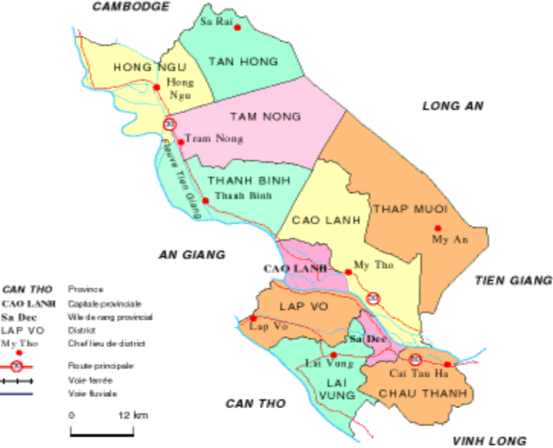
This climate feature is relatively favorable for comprehensive agricultural development. With its location in the lower reaches of the Mekong River and the East Sea tide, the Tien River is divided into two seasons: dry season and flood season. Dong Thap has a system of