
69
hotels of domestic investors, thereby improving and enhancing the quality of accommodation facilities in Myanmar.
According to the report of the tourism development plan 2013 - 2010, MOHT pointed out that Myanmar's infrastructure is not developed synchronously, which hinders the development of international tourism, specifically: Tourist destinations are quite far apart, so traveling by road takes time, not to mention that there are some areas that are prohibited from visiting, so tourists have to take detours. The quality of the roads is not good, making tourists feel uncomfortable when traveling, especially when traveling long distances. Domestic airlines face a lot of competition. This has slowed down the development of airlines and created conditions for international airlines to penetrate deeper into Myanmar's territory. In addition, the service quality of domestic airlines is only limited to serving domestic customers, and the ticket prices are still expensive. For example, a flight from Mandalay to Heho takes only 35 minutes, but the cheapest ticket price of Myanmar International Airlines in May, which is the low tourist season for international tourists, is 140 USD. Therefore, it is very difficult for tourists to choose means of transportation because airfare is quite expensive and the quality of road travel is still poor. In addition, the development of boats in Myanmar is being hindered by the high cost of ports and the government has issued a number of laws restricting the size of ships, preventing ships from docking at some ports for the convenience of tourists. Moreover, the lack of deep-sea ports in the country hinders the development of the international cruise industry. International cruise ships are all large ships and cannot dock in shallow water. Due to inadequate facilities and service provision, the number of international tourists coming to Myanmar by cruise ship is still very limited. For the railway industry, like the aviation industry, high ticket prices, frequent train delays and long travel times have reduced the number of international tourists choosing to travel by train instead of other means of transport.
Despite being a country rich in energy resources, Myanmar has the lowest per capita electricity consumption in ASEAN. Electricity is concentrated in major cities such as Yangon, Naypyitaw and Mandalay. Due to frequent power outages,
Most hotels and restaurants have their own generators as backup. Mobile and IT services are in a similar state. Myanmar is one of the least connected places in the world. Mobile data penetration is low and a very small number of users have access to the broadband Internet. Internet services for tourists are still quite poor.
According to MOHT, Myanmar’s international tourism promotion to other countries has not been effective, especially to the European and American markets. The agreements signed by Myanmar are still limited to the ASEAN countries, so it is necessary to develop a wider network of connections for tourism promotion to be effective.
In summary, chapter two has shown the rapid development of Myanmar tourism in general and international tourism in particular. Although there are still limitations and difficulties, Myanmar has initially successfully built and developed the foundation of international tourism in a relatively short period. Along with that, the awareness of DLBV development has helped Myanmar go in the right direction, developing in depth according to the experience of many previous countries; these are all lessons that Vietnam can learn from the development of international tourism in Myanmar. Chapter 3 will clarify the development of tourism in Vietnam in relation to Myanmar and provide specific solutions for international tourism in Vietnam in the future.
CHAPTER 3: SOME SOLUTIONS TO DEVELOP INTERNATIONAL TOURISM FOR VIETNAM
3.1. General development situation of international tourism in Vietnam in recent years:
3.1.1. Current status of international tourism development in Vietnam in recent years:
The number of international tourists to Vietnam has grown rapidly and continuously in recent years. As can be seen in the table below, the number of international visitors to Vietnam in December 2016 was estimated at 897,279, an increase of 17.9% over the same period in 2015. The total number of visitors in 2016 was estimated at 10,012,735, an increase of 26.0% over 2015 (General Department of Tourism, International visitors to Vietnam in December and the whole year 2016 , 2016)
Table 3.1: Number of international tourists to Vietnam in December and 12 months of 2016
Target
Estimated December 2016 (Number of visitors) | 12 months 2016 (Visitors) | December 2016 vs. previous month (%) | December 2016 vs. January 2/2016 (%) | 12 months 2016 vs. same period last year (%) | |
Total | 897,279 | 10,012,735 | 93.1 | 123.9 | 126.0 |
1. Air | 715,317 | 8,260,623 | 117.8 | 147.5 | 137.1 |
2. Sea route | 35,046 | 284,855 | 129.9 | 255.3 | 167.7 |
3. Road | 146,916 | 1,467,257 | 103.8 | 86.5 | 97.7 |
Maybe you are interested!
-

 Solutions for developing international payment activities at Techcombank, period 2007 - 2010 - 2
 -
 Solutions for developing international payment activities at Techcombank, period 2007 - 2010 - 12
 -
 Solutions for Developing International Banking Services to Improve the Operational Efficiency of Vietnamese Banks
 -
 Experience in developing international tourism in Thailand and solutions for Vietnam tourism - 15
 -
 Some solutions to limit risks in international goods trading activities of Vietnamese traders - 10
Source: Vietnam National Administration of Tourism
According to data from the Vietnam National Administration of Tourism, the number of international visitors to Vietnam in March 2017 is estimated at 1,005,821, down 16.1% compared to February 2017 and up 21.1% compared to the same period in 2016. In the first 3 months of 2017, the number of international visitors to Vietnam is estimated at
3,212,480 visitors, up 29.0% over the same period last year. Thus, it can be seen that the number of tourists coming to Vietnam is gradually increasing and the growth rate is quite fast.
Due to the increase in the number of tourists, total revenue from tourists has also increased steadily and continuously over the years as shown in the table below:
Table 3.2: Total revenue from tourists to Vietnam in the period 2011 - 2016
Year
Total revenue (trillion VND) | Growth rate (%) | |
2011 | 130.00 | 35.4 |
2012 | 160.00 | 23.1 |
2013 | 200.00 | 25.0 |
2014 | 230.00 | 15.0 |
2015 | 337.83 | * |
2016 | 400.00 | 18.4 |
Source: General Department of Tourism
*: According to new statistical method
It can be seen that the total revenue from tourists in 2016 was quite high, reaching 400 trillion VND, 3 times higher than the total revenue in 2011. However, the growth rate has tended to decrease during this period. Partly due to the impact of the global crisis, but partly due to our poor image promotion and weak tourism services. In fact, the rate of tourists returning to Vietnam is still not high. According to the results of a survey from the General Department of Tourism in 2014, 67% of the participants were visitors to Vietnam for the first time. The number of people returning for the second time was about 18%, the rest were visitors who returned three times or more. This means that about 33% of international tourists return to Vietnam while we have many attractive destinations and many tourists will not be able to visit all the places on their first visit to Vietnam.
According to data from the World Travel and Tourism Council, tourism contributed 6.6% of the national GDP in 2015. With a 6.6% contribution to GDP, Vietnam's tourism ranked 40th out of 184 countries in terms of direct contribution to GDP and 55th out of 184 countries in terms of total contribution to national GDP. Specifically, the total contribution of tourism to Vietnam's GDP, including direct and indirect contributions and public investment, was VND584,884 billion (equivalent to 13.9% of GDP). Of which, the direct contribution of tourism to GDP was VND279,287 billion (equivalent to 6.6% of GDP). (World Travel and Tourism Council
73
World Travel, Economic Impact of Travel and Tourism in Vietnam – 2016 , 2017)
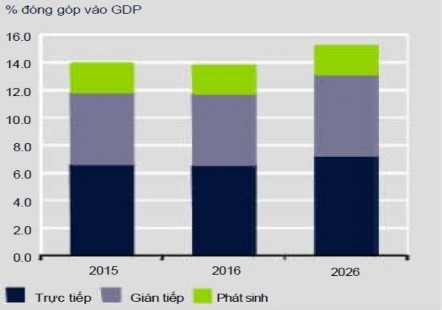
Figure 3.1: Total contribution of tourism to Vietnam's GDP in 2015
Source: World Travel and Tourism Council
It can be seen that tourism is developing strongly and contributing significantly to the GDP growth of our country. This is a good sign because tourism development will help the economy gradually shift its structure to services. With the orientation of developing tourism as a key industry, the government should have actions and policies to develop tourism more strongly.
In addition, investment in the tourism sector in 2015 reached 113,497 billion VND, accounting for 10.4% of the total investment in the country. The tourism industry is attracting quite strong investment in our country's economic sectors today, especially in the hotel sector. In recent years, the names of large corporations such as Intercontinental Hotels Group, Accor hotel, Hyatt, Wyndham Hotel Group have invested heavily in the Vietnamese market. According to the article "Leading hotel corporations are "total attack" on Vietnam" published on October 16, 2016, in Ho Chi Minh City, as of the third quarter of 2016, the total hotel supply reached 15,400 rooms. From the fourth quarter of 2016 to 2018, it is expected that 2,800 new rooms from 14 projects will continue to enter the market. In Hanoi, although the situation is not optimistic, from the third quarter of 2016, it is expected that 33 new projects will enter the market, of which 15 future projects will provide
74
at least 4,700 rooms. The most impressive is Da Nang, CBRE's Q3/2016 report said that the total hotel supply of this city has reached 11,5000 rooms in the 3-5 star segment. It is forecasted that in the next two years, Da Nang will continue to receive about 6,000 new rooms. Meanwhile, in Phu Quoc, from 2010 to 2017 (expected), the hotel supply will increase by 110%.
According to the World Travel and Tourism Council in 2015, the total contribution of tourism to the national employment sector (including indirect employment) was more than 6.035 million jobs, accounting for 11.2%. Of which, the number of direct jobs created by the tourism industry was 2.783 million (accounting for 5.2% of total employment).
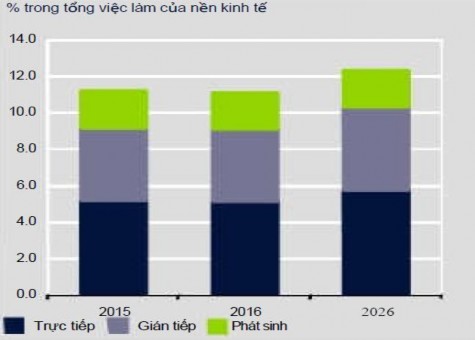
Figure 3.2: Total contribution of tourism to employment in Vietnam in 2015
Source: World Travel and Tourism Council
The tourism industry creates more and more jobs for society. The quality of tourism human resources through training and practical experience is increasingly improved thanks to the efforts of the industry and international support in tourism human resource development; the tourism training system is increasingly expanded and upgraded. However, the general quality of tourism human resources still does not meet the requirements of professionalism, management skills, communication and service quality.
In addition, tourism infrastructure has received attention and investment support from the State and attracted economic sectors to participate in investment. Many traffic works
In recent years, the traffic routes have been greatly improved, especially the routes in big cities and the routes connecting big cities with key tourist destinations such as the new Hanoi - Hai Phong highway, helping tourists shorten their travel time when coming to Ha Long, the new highway connecting Ho Chi Minh City with Phan Thiet also helps tourists save more than an hour sitting on the car. Many airports have been upgraded and become international airports such as the airport in Phu Quoc and the airport in Hue. In 2016, the quality of aviation services was improved with the flight network and increased frequency of domestic flights. In 2016, the air passenger market had strong growth, estimated at 52.2 million passengers, an increase of over 29% compared to 2015. Vietnamese airlines have promoted the exploitation of the domestic market, especially VietJet Air and Jetstar Pacific by expanding the flight network and increasing the frequency of domestic routes, operating 50 domestic routes connecting Hanoi, Da Nang and Ho Chi Minh City with 17 local airports, so the domestic passenger market had strong growth, reaching 28 million passengers, an increase of 30% compared to 2015. For the international market, in 2016, there were 52 foreign airlines from 28 countries and territories operating to/from Vietnam with 78 routes from 34 destinations to Hanoi, Ho Chi Minh City, Da Nang, Phu Quoc, Hai Phong and Nha Trang. (Civil Aviation Authority of Vietnam, In 2016, the quality of aviation services was improved , December 5, 2016)
The system of technical facilities, accommodation facilities and tourism services has developed rapidly, and the quality has been improved; many tourist areas, resorts, entertainment areas and high-class hotels of international standards have been established, but they still account for a small proportion and have not fundamentally changed the appearance of the industry; a system of national tourist areas with prominent brands has not been formed.
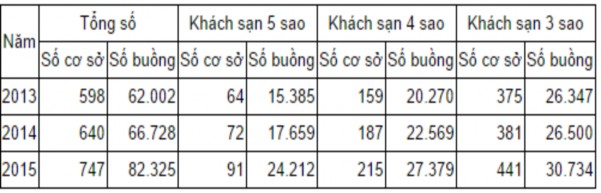
Table 3.3: Number of hotels by ranking in Vietnam in the period 2013 - 2015
Source: Vietnam National Administration of Tourism
From the table above, we can see that the number of 3-star hotels has increased the most over the years and the number of 5-star hotels has increased the least. Because 5-star hotels serve high-end and high-spending customers, and the investment capital is large and the capital turnover is slower, the number has not increased much. However, in the coming period, Vietnam is oriented to develop tourism to markets with high-end customers, so the development of high-end hotels and resorts from now on is necessary.
Tourism products have been innovated and developed more diversely in different regions. Travel companies have taken advantage of the strengths of natural and cultural resources to develop tour packages suitable to the tastes of each tourist.
Promotional activities are widely implemented domestically and internationally. In recent years, the promotion of tourism images in Vietnam has made many advances when our country has had the first image cooperation with foreign media agencies such as BBC. However, we have no way to measure the effectiveness of these promotional activities despite having to pay a large amount of advertising money to all parties.
State management of tourism has been gradually innovated; the Tourism Law and related laws and ordinances, and the system of legal documents guiding its implementation have been gradually completed and applied in practice. Typically, Vietnam has unilaterally exempted visas for 5 European countries: Germany, France, the UK, Italy and Spain since July 1, 2015 (Source: General Department of Tourism). According to the decision on visa exemption, citizens of these countries do not have to apply for a visa when entering Vietnam for a temporary stay of 15 days, applicable from July 1 to June 30, 2016. Germany, the UK and France are all markets