
The Party Committee, Trade Union, and Youth Union have coordinated and supported well in the Company's production and business tasks.
Labor force
The total workforce of the company as of December 31, 2011 was 216 people, down 12% compared to 2010 (in 2010 it was 242 people, down 26 people), of which 179 were male and 37 were female. University and college degrees were 102 people, accounting for 47.2%, and 2 were post-graduate degrees.
Average income in 2011 was adjusted up to 5.97 million VND/person/month.
Table 1.1: Some financial indicators of the company over the years 2011 - 2012
Target
Made in 2012 | Plan 2012 | % vs. KH | Made in 2011 | Year-on-year growth 2011 | |
Total revenue | 377,454 billion | 450 billion | - 16.1 % | 414,557 billion | - 8.95% |
Profit before tax | 8.518 billion | 9 billion | - 5.3 % | 10 billion | -14.8% |
Profit after tax | 6.514 billion | 7 billion | - 6.94 % | 8.346 billion | - 21.95% |
Number of shares outstanding average year | 3,846,190 shares | 4 million shares | 4 million shares | ||
Capital accumulation | 6.575 billion | 1.6 billion | |||
Total equity | 57.3 billion | 52.34 billion |
Maybe you are interested!
-
 Completing the organization of accounting for revenue, sales costs and determining business results at Hai Phong Paint Joint Stock Company - 1
 -
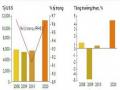 Business Performance of the Company in the Period 2009–2011 Table 2.1. Business Results of Viet Holiday Travel Company
 -
 Company's Business Performance Results for 3 Years (2018-2020)
 -
 Accounting for revenue, expenses and business results at Long Bien Industrial Gas Joint Stock Company - 2
 -
 Production and Business Performance Results of La Nga Forestry Company Limited
2.2 ORGANIZATION OF COMPANY ACTIVITIES
2.2.4 Management structure Diagram 2.1: Management structure diagram
Board of shareholders
Board of Control
Board of Directors
General Director
Deputy General Manager
Administration & Human Resources
the
Next room
maths
Fighting room
contractor
Design room
Technical
Project management and construction block
BP
Design Construction
Build
BP
Mechanical Engineering
Electricity
Supply & Materials Department
Design
Contract & Block Management
quantity
Construction management board
build
Labor safety board
dynamic
Exam block
labour
Project Development
2.2.5 Functions and tasks
Board of Directors:
The Board of Directors is the highest authority, responsible to the General Meeting of Shareholders, managing and organizing the decisions of the General Meeting of Shareholders.
Board of Directors:
The Board of Directors is elected by the Board of Directors, through the General Meeting of Shareholders, and is responsible for managing all daily production and business activities of the company according to the goals and orientations approved by the General Meeting of Shareholders and the Board of Directors.
Human resources and payroll department:
Has the function of assisting the General Director in the organizational structure model of the Company: Building an organizational model, determining the functions and tasks of the departments in the Company; Building the Company's rules and regulations; Making plans for recruitment, training and use of resources, labor and salary policies, calculating monthly salaries for officers and employees as well as bonuses, social insurance,
health insurance; Organizing clerical work, archiving, managing seals, receiving guests to do transactions, working with the Company, organizing daily security.
Accounting Department:
Advise the Company's Board of Directors on financial and economic management; thoroughly grasp and implement the Party's policies and State laws on economic and financial management;
Prepare short-term and long-term financial plans to serve the Company's production and business requirements;
Organize the management, exploitation and effective use of the Company's resources, capital, assets and facilities in production and business activities, on the basis of ensuring compliance with current regulations of the State and the Company;
Organize a suitable accounting apparatus to manage, monitor, supervise and inspect the Company's economic and financial activities, through recording and reflecting in accounting books and documents, accounting, analyzing economic activities, calculating product costs and profit and loss results in the Company's business activities;
Synthesize reports on the Company's accounting and financial operations to relevant Departments, ensuring accuracy, timeliness, and compliance with regulations;
Develop and propose to the Company's Board of Directors to issue regulations on Financial Management; regulations on management and use of capital, assets, materials, goods, etc. of the Company;
Disseminate and guide the implementation of current State regulations related to the professional expertise of the Department to the Company's Departments;
Guide to drafting and establishing economic contracts strictly in accordance with the law and performing payment and settlement procedures for completed economic contracts according to the content of the terms signed in the contract;
Organize the preservation and storage of records, professional documents, facilities and assets of the Company assigned to the Management Department;
2.2.6 General characteristics of business activities
Construction and Trade Joint Stock Company 2 operates in the following fields: construction, real estate investment and business, commercial design consultancy. The company's main activities are construction and business.
Construction and Trade Joint Stock Company 2 is one of the companies with a wide area of operation in the South. The company's office specializes in contracting for construction of civil and industrial works and construction of technical infrastructure works such as:
- Undertake construction and installation of construction foundations.
- Construction of all types of foundations.
- Construction and completion of structures. Typical projects include:
Project
EVATECH VIETNAM FACTORY - PHASE 3 EVATECH VIETNAM FACTORY- PHASE 3 | MS (Code) | CN | |
At (Loacted print) | Tan Uyen District, Binh Duong Province, Vietnam Tan Uyen District, Binh Duong Province, Vietnam | Year of Construction: (Year) | 2010 |
Owner | EVATECH VIETNAM CO.,LTD | Contract Value | Will be updated immediately after signing Contract; |
Work to be done (ACSC' scope) | General Contractor for Design and Construction of Construction & M&E (Main Contractor for Design and Build & ME Works) | ||
Project
(Project)
| ||
In (located in) | Dong Xuyen Industrial Park, Ba Ria Vung Tau | Year of Construction : 2009 (Year) |
Project Owner | PEB STEEL STRUCTURES CO., LTD | |
Work to be done (ACSC 'scope) | Main Contract, Building & ME Works | |

Project
COMAX METAL VIETNAM FACTORY COMAX METAL VIETNAM CO.,LTD | MS (Code) | CN |
At (Loacted in) | HO NAI Industrial Park, Trang Bom District, Dong Nai Province HO NAI IP, Trang Bom District, Dong Nai Province | Year of Construction: (Year) | 2010 |
Owner | COMAX METAL VIETNAM CO., LTD COMAX METAL VIETNAM Co.,Ltd | Contract Value (Contract Value) | 1,260,000 USD |
Work to be performed (ACSC' scope) | General Contractor for Design and Construction of Construction & M&E (Main Contractor for Design and Build & ME Works) | ||
Project
DDK Vietnam Factory | |||
Located in | VSIP 2 Industrial Park, Thuan An District | Year of Construction | 2009 |
Project Owner | DDK Vietnam Company | ||
Work to be performed (ACSC 'scope) | Construction & Electricity (Building & ME works, partnership with FUJITA CORP) | ||


2.3.4
Diagram 2.2: accounting organization
Chief Accountant
General Accounting
Treasurer
Accountant
cash
Accountant
TGNH
Accountant
debt
Accountant
tax
Accountant
Fixed assets
Accountant
project
Storekeeper
2.3.5
Chief Accountant:
- Responsible for all operations of the accounting department and financial reports.
- Assist the Director in managing and organizing the company's operating capital and be responsible to the Director for the company's accounting activities.
- Update legal documents guiding accounting work for implementation at the unit.
General accounting:
- Prepare accounting reports completely and on time.
- Organize the preservation and storage of accounting documents, keep accounting documents and data confidential.
- Timely and accurately calculate and pay salaries and salary deductions to employees in accordance with regulations.
- Responsible for recording in the general ledger, preparing the balance sheet and accounting reports in the accounting report.
Cash accounting:
- Track cash receipts and payments, create receipts and payment vouchers.
- Check and compare detailed cash figures, figures are recorded completely and accurately.
- Provide necessary information for preparing Financial Statements.
TGNH Accounting:
- Track income and expenditure through bank deposits.
- Check and compare detailed data of bank deposits, data is recorded completely and accurately.
- Provide necessary information for preparing Financial Statements.
- Reconcile bank deposit detail book with subsidiary ledger.
- Monitor exchange rate differences for transactions involving foreign currencies.
Accounts receivable:
- Enter data and manage receivables, customer receivables, payables, and payments to suppliers.
Tax accounting:
- Daily collect purchase invoices (VAT) from construction accountants and other departments to compile purchase invoices. At the same time, collect sales invoices for storage.
- At the end of the period, make a list of purchase invoices and a list of sales invoices to make a VAT declaration according to the form of the Tax Department.
- Determine provisional corporate income tax.
- Prepare tax declaration.
Fixed Asset Accounting:
- Record the increase and decrease transactions related to fixed assets, tools and equipment, and prepaid expenses.


- Collect and record documents related to regular repair costs and major repair costs of fixed assets.
- Keep accounting vouchers and accounting documents in accordance with company regulations.
company
- At the end of the period, check and compare detailed data of each fixed asset, tool, equipment, and expense.
prepaid fees to ensure complete and accurate recording.
Construction accounting:
- Track all costs incurred related to the project.
- At least 1 day a week must go to the construction sites to calculate the daily wages and get the payment statements to summarize the costs and make payments.
- Track workers' daily work.
- Enter data on expenses incurred and VAT.
2.3.6
a) General provisions
As a company with frequently arising transactions, the company's accounting work is quite complicated, however, the application still follows the foundation of the regulations of the Vietnamese accounting regime and the regulations issued by the Ministry of Finance:
- The company's accounting year begins on January 1st of each year and ends on December 31st of that year. The accounting period at the Company is calculated monthly.
- The currency that the Company uses in recording and reporting financial statements is the domestic currency: Vietnamese Dong (VND).
- Accounting method: The company uses the periodic reporting method.
- Fixed asset depreciation method: The company applies the straight-line depreciation method.
- VAT calculation method: The Company applies the VAT calculation method according to the deduction method.
b) Organization of application of accounting voucher system
Organizing documents is the first stage to perform bookkeeping and reporting, so organizing documents aims to help managers have timely, accurate and complete information to make business decisions. In addition, it also facilitates the coding and computerization of information and the basis for verifying business transactions, the basis for auditing accounting and the basis for resolving international disputes. The company registers to use most of the documents in the unified accounting document system issued by the Ministry of Finance, such as: VAT invoices, economic contracts, purchase requests, advance requests, receipts, payment vouchers, transfer checks, fund inventory tables, fixed asset delivery and receipt minutes, fixed asset revaluation minutes, fixed asset liquidation contracts, seller's sales invoices, warehouse receipt sheets, material inspection records, material receipt vouchers according to quotas, warehouse delivery vouchers, etc. Documents reflecting labor such as timesheets, product completion vouchers, maternity sickness certificates, etc. In addition to the documents issued by the Ministry of Finance, the Company also uses some document templates designed by the company itself (requests, reconciliations, economic contracts, etc.).
c) Accounting system
Applied uniformly according to the Vietnamese account system issued by the Ministry of Finance. Currently, the Company is applying according to Decision No. 15/2006/QD-BTC, including 10 types of accounts, in which accounts from type 1 to type 9 are implemented according to the method.
double entry, while type 0 accounts are made using the single entry method.
The Company does not use trade discount accounts (Account 521), sales discount accounts (Account 532) and has no sales returns, so the Company also does not use sales returns accounts (Account 531).
d) Accounting form:computerized accounting
Construction and Trade Joint Stock Company 2 applies the accounting mode of BASYS accounting software, version 10 - accounting software for medium and small enterprises.
 ng. The company has an IT engineer who helps the company install and design the program according to the company's requirements. The program also updates the initial documents into the machine, the machine will automatically create detailed books, and lists of goods invoices.