
Domestic Department: 4 people: 2 online sales in charge of selling inbound tours via the Internet, 2 Sales Administrators performing sales operations at the office. Organize design, sale and implementation of tourism programs for Vietnamese and foreign customers in Vietnam who want to travel within Vietnam.
Information technology department: consists of 3 people, responsible for maintaining and repairing the company's information technology operations, limiting disruptions when damaged.
Tour guide team: consists of 10 people and contracted tour guides outside the company. Provided according to the requirements of each group of guests. Currently, the main target customers of the company are British tourists, so the number of tour guides using English accounts for a large proportion, the rest are tour guides using other foreign languages. Along with the increasingly fierce competition between travel companies, the selection and use of tour guides with high foreign language proficiency, professional proficiency, good communication skills, and good understanding of customer psychology.
Fleet: 7-seat cars: 5 cars, 16-seat cars: 7 cars, 24-29-seat cars: 3 cars, 45-seat cars: 4 cars.
2.1.5. Business performance of the company in the period 2009-2011 Table 2.1. Business results of Ky Nghi Viet Travel Company
Unit: Billion VND
Target
Year 2009 | Year 2010 | 2011 | 2010/2009 | 2011/2010 | |||
STĐ | % | STĐ | % | ||||
Revenue | 24,38375 | 27.62779 | 28,93167 | 3.24404 | 13.3 | 1,30388 | 4.72 |
Expense | 21,76662 | 23.85892 | 23,98012 | 2,0923 | 9.61 | 0.1212 | 0.51 |
Profit | 1.91050 | 2.75127 | 3.61463 | 0.84077 | 44.0 | 0.86336 | 31.4 |
Submit budget | 0.70662 | 1.01760 | 1.33692 | 0.31098 | 44.0 | 0.31932 | 31.4 |
Maybe you are interested!
-
 Business Performance Results of Song Hong Garment Joint Stock Company in the Period 2018-2020
 -
 Business Performance of Nhi Na Company Limited in the Period of 2018-2019
 -
 Factors Affecting Business Performance of Meiko Trading and Construction Company Limited
 -
 Company's Business Performance Results for 3 Years (2018-2020)
 -
 Production and Business Performance Results of La Nga Forestry Company Limited
(Source: Business performance report of Ky Nghi Viet Travel Company from 2009 - 2011)
Comments: Based on table 2.1 shows:
Revenue increased over the years, however, the growth rate of revenue in 2011 was only half that of 2010 due to the influence of the economy and the ineffectiveness of the forecasting process. Revenue in 2010 compared to 2009 increased by 13.3%, equivalent to an increase of VND 3,244,042,580; Revenue in 2011 compared to 2010 increased by 4.72%, equivalent to an increase of VND 1,303,875,680, which proves that the company's travel business is effective. This is due to:
Firstly, the Company expands its business with new tourism programs: constantly innovating and developing domestic and international tours, the Company makes full use of the State's tourism development incentive policy, demonstrated through: new domestic tours with improved quality, lower prices, and at the same time implementing many new types of domestic tourism such as: eco tours, adventure tours, MICE tours... Thereby increasing sales, contributing to increasing revenue.
Second, since March 2011, the company has started to operate a new form of tourism business, which is to bring parents and students who have the need and ability to study abroad to countries with advanced education systems that meet the requirements of customers, with the purpose of both sightseeing and learning about the desired university, and supporting the admission procedures according to the regulations of the appropriate university. Up to now, the company has maintained and profited from this service.
Operating expenses in 2010 compared to 2009 increased by 9.61%, equivalent to an increase of VND 2,092,300,528; Operating expenses in 2011 compared to 2010 increased by 0.51%, equivalent to an increase of VND 121,200,490 due to: the direction of the Board of Directors to increase product quality, which led to an increase in cost of goods sold, and cost of goods sold accounts for a large proportion of the cost structure of the enterprise. However, due to the request of the Board of Directors, the selling price had to be reduced to cope with the increasingly fierce competition pressure of the Vietnamese tourism market. At the same time, the economic crisis in 2011 also affected the consumption trends of customers, so the selling price had to be reduced to increase attractiveness and attract tourists.
Economic efficiency in 2010 was 1.158 (Revenue/Cost), Economic efficiency in 2011 was 1.207; this is a relatively high number, it proves that revenue has offset costs and there is profit. In 2011, revenue and costs both increased compared to 2010. However, revenue increased faster than costs in both absolute and relative indexes. It shows the efficiency in the Company's business operations.
2.2. External environment analysis
2.2.1. Analysis of macro-environmental factors
Economic factors
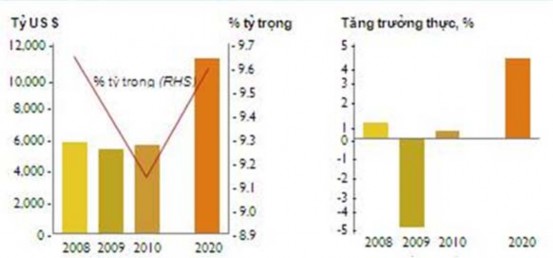
The economic crisis of 2008 - 2009 created strong impacts in many aspects, especially restructuring the world economy, requiring countries and territories to adapt to new trends. The GDP of the global Tourism and Travel industry decreased by 4.8% in 2009 and this caused the loss of nearly 5 million jobs -
or an estimated US$5.6 billion by the end of 2010. All regions faced significant contractions in arrivals, spending and Travel & Tourism GDP, and Travel & Tourism Investment fell by over 12%.
By 2011, the public debt crisis in the US and some European countries (Greece, Italy...) had a negative impact on the tourism industry.
Chart 2.1: World tourism industry GDP
(Source: Ministry of Culture - Sports - Tourism of Vietnam)
However, according to the World Tourism Organization (UNWTO), in 2011, the number of tourists in the world increased by 4-5% compared to 2010 (In 2010, the world had 940 million international visitors, an increase of 7% compared to 2009 and tourism revenue reached 919 billion USD). International tourists to the Asia-Pacific region in 2010 reached nearly 204 million visitors, an increase of 13% compared to 2009; growth was twice that of the world's tourist source. In 2011, our country's socio-economic situation took place in the context of the world economy still not escaping the crisis and recession. However, our country's tourism industry still attracted nearly 6 million international visitors, served 30 million domestic visitors, total revenue from tourism reached about 130 trillion VND, the corresponding growth rate compared to 2010 was 19%; 7.14% and 30%.
This is a good opportunity for Ky Nghi Viet travel company to develop products and services to meet the travel needs of international visitors.
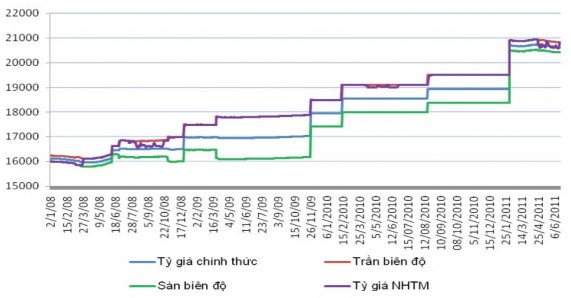
According to the General Statistics Office, the USD/VND exchange rate in 2011 increased by 8.47% compared to 2010, which is beneficial for Vietnamese international tourism businesses, because the amount of revenue is converted into Vietnamese currency more. Ky Nghi Viet Travel Company mainly organizes tourism programs for foreign guests, so it is more profitable.
Chart 2.2. VND/USD exchange rate by day and range, 2009 - 2011
(Source: State Bank, Vietcombank 2011)
In the country, inflation is high (in 2011, the inflation rate reached 18.58%) and the currency is devalued, but this issue does not greatly affect the tourism industry because: The devaluation of the VND means that foreign tourists will save money when paying in USD in the Vietnamese market. However, currently, travel agencies all list prices in USD, so the increase in exchange rate does not greatly affect the profits of travel agencies.
Mr. Mathias Tewes, representative of TUI travel agency (Germany), commented: "The devaluation of the Dong is an opportunity for the Vietnamese tourism industry to attract foreign visitors because visitors will save costs when paying in USD in the Vietnamese market." Specifically, previously, on average, a foreign visitor spent 80 USD/day for services in Vietnam (according to statistics of the tourism industry), with the same services if paying in VND, according to the new exchange rate, visitors only need to spend about 75 USD/day and this will attract international visitors to Vietnam.
Table 2.2. Total revenue from tourists in the period 2009 - 2011
Year
2008 | 2009 | 2010 | 2011 | |
Total tourism revenue (trillion VND) | 60.0 | 68.0 | 96.0 | 130 |
Increase from last year | - | 13.3 | 41.2 | 30 |
(Source: Ministry of Culture, Sports and Tourism; General Department of Tourism) Legal and political factors
Vietnam is a country with a stable political situation, creating favorable conditions for the development of the tourism industry. According to Ms. Dominique Pasteur and Mr. Luis Anné - French tourists said: "Currently, some countries are threatened by terrorism.
But Vietnam is not. We can wander around every corner of Hanoi without fear of being mugged, robbed or kidnapped..." ( excerpt from the article What do tourists say about Vietnam on the website http://xavietnam.blogspot.com ).
From 2005 to present, the Ministry of Culture, Sports and Tourism has issued Circulars 88 and 89/2008/TT-BVHTTDL guiding Decree 92/2007/ND-CP, detailing the implementation of a number of articles of the Law on Tourism on accommodation establishments, travel businesses, branches and representative offices of foreign travel businesses in Vietnam, tourism guidance and tourism promotion. The correct implementation of this Circular has helped control and protect travel businesses. Up to now, the country has about 960 international travel businesses.
The government issued Decree 47/2007/ND-CP on administrative sanctions in the tourism sector. Local tourism associations established Travel Clubs to overcome the situation of tour price dumping and unfair competition, announced and requested localities to strictly handle acts of price gouging and forcing customers in service business, strictly control the quality of tourism products and services... Thanks to that, the tourism business of Vietnamese travel companies has improved the reputation and quality of tours.
Social factors
The difficulties that travel businesses in particular and the tourism industry in general have borne are that the world GDP has decreased by 2.1% in real terms, with developed economies - the main source of demand for the Travel and Tourism Industry - being hit the hardest. Households have cut back on leisure travel plans, replacing them with shorter, lower-spending trips and domestic travel for longer, more expensive trips, and companies have cut budgets for business travel.
Table 2.3. Tourism spending of people in other countries and Vietnam
Travel spending of people in other countries and Vietnam
Argentina : 6% Australia : 10% Brazil : 4% Canada : 9% China: 5% Russia: 6% Saudi Arabia: 3% South Africa: 4% Türkiye: 2% | Croatia : 9% Egypt : 3% Ethiopia : 1% Finland : 10% France : 9% India : 2% Japan: 8% Vietnam: 5% USA: 9% |
(Source: Forbes) | |
Another difficulty that causes the unsustainable development of the tourism industry is: the living standards of the majority of the population are still low, civilized lifestyle, lack of strict legal awareness and other issues such as traffic safety, food hygiene and safety... are difficulties for the development of a quality tourism industry.
However, as society develops, people's income and working conditions are also improved and enhanced, the need for cultural exchange increases, and there are more opportunities to travel domestically and abroad, creating opportunities for the tourism industry to develop.
In addition, the tourism industry creates more and more jobs for society (an additional 30-40 thousand direct jobs each year). Regarding human resources, TTCI (Travel and Tourism Competitiveness Index ) rates Vietnam at a poor average level (ranked 82/133), but its ability to provide high-quality labor is quite good (ranked 40th)... Regarding natural resources, TTCI confirms that Vietnam has potential in terms of the number of world heritages (ranked 23rd).
Natural factors
Vietnam with its rich tourism resources including world heritages (Phong Nha - Ke Bang National Park, Hue Monuments Complex, Hoi An Ancient Town, Ho Dynasty Citadel, Doctoral Steles of the Temple of Literature, My Son Sanctuary, Ha Long Bay, etc.), rich historical traditions (Ca Tru, Hue Royal Court Music, etc.), traditional craft villages and festivals, beautiful natural landscapes and the diversity of ethnic cultures, Vietnam has recently emerged and become an attractive and safe destination for international tourists.
Once again affirming the position of Vietnamese tourism, in 2004, Vietnam Tourism was ranked 7th in the world in terms of growth in the number of visitors among 174 countries by the World Travel and Tourism Council; Vietnam was ranked in the top 10 destinations in the world.
However, the large increase in tourists, while the preservation of landscapes and environment in tourist areas and spots has not received due attention, combined with the development of other economic activities and deforestation, has caused negative impacts on the tourism environment.
Technical infrastructure factors
To develop tourism, first of all, technical infrastructure must be good. Especially for the development of international tourism, there must be 5 types of means of transport: air, road, rail, sea and river.
Although our country is investing in upgrading many transport works, the synchronization and modernity of tourism and related infrastructure have not yet met the requirements of a modern and integrated service industry. Based on table 2.4, it can be seen that Vietnam's infrastructure is ranked average compared to other countries in the ASEAN region.
Table 2.4. Infrastructure of Vietnam and some countries in the ASEAN region
Note : Measurements are based on a five-point scale with five being the highest.
Infrastructure
Singapore | Thailand | Vietnam | Myanmar | Laos | Cambodia | |
Airport | 4.9 | 3.1 | 1.9 | 1.6 | 1.5 | 1.6 |
Seaport | 4.9 | 2.5 | 2.0 | 1.5 | 1.5 | |
Transport system | 4.6 | 1.6 | 1.9 | 1.6 | 1.5 | 1.8 |
(Source: The Strait Times (1997a))
Up to now, our country's roads, railways, seaways and rivers transporting international tourists are not large (about 10 - 20%).
Due to poor infrastructure conditions, Vietnam tourism only ranks 5th in ASEAN (after Singapore, Malaysia, Thailand and Indonesia).
According to the Travel and Tourism Competitiveness Index (TTCI 2011), Vietnam is assessed as follows: In the legal framework index group, Vietnam is ranked 92/133 among all ranked countries and economies, 20/27 Asia-Pacific countries. With the business environment and infrastructure index group, Vietnam is ranked 85/113 and 16/27. Road quality (102nd). Aviation infrastructure quality (84th), international air transport network (91st). Tourism infrastructure has not been invested properly (109th), with the number of hotel rooms reaching a poor average level (85th).
International factor
The factor closely related to tourism and closely linked to tourism is international cooperation in tourism to enhance regional and world integration. Along with the globalization trend, with its geographical location, our country has the opportunity to develop tourism through regional development cooperation ASEAN+3, ASEANTA, East-West Economic Corridor, Greater Mekong Subregion cooperation... ASEAN countries, China, Japan, and Korea are all major tourist markets for Vietnam tourism. Therefore, strengthening regional, international, bilateral and multilateral cooperation and exchanges creates opportunities not only to attract international visitors, but also to facilitate connections with destinations in the region, extend the travel itinerary of visitors, promote regional tourism development; continue to improve and modernize immigration procedures.
The Asia Pacific Economic Cooperation (APEC) Forum – the APEC Tourism Working Group (TWG) met twice in 2009 – in Singapore during April and in Peru in October. Other topics discussed at the TWG in Peru included tourism policies for climate change; the value of carbon offset schemes; investment in meetings, incentives, conferences and exhibitions (MICE) tourism – 2010 was announced at the Japan MICE Year – and Pacific air connectivity…
The APEC community comprises 21 governments of the Pacific Rim economic hub extending from the Russian Federation to Japan in the Northwest, down the east coast of Asia including China and Vietnam, and the ASEAN countries, Papua New Guinea, Australia, Chile, Peru and Mexico to the United States, and Canada in the Northwest. The APEC Tourism Working Group includes officials from tourism ministries and national tourism organizations (NTOs).
2.2.2. Establish an external factor evaluation (EFE) matrix
The factors used to establish the EFE matrix include: Inflation, exchange rate, Vietnam's infrastructure, threats from terrorism - violence in some countries, developed tourism market, Vietnam has rich tourism resources, Vietnam's political situation is stable, the quality of restaurants - hotels is getting better, Vietnam is a member of APEC, the Vietnamese government is interested in developing domestic tourism.
To establish the EFE matrix, it is necessary to first determine the importance of the selected factors by determining the impact of each factor on the entire tourism industry and the impact of these factors on Viet Holiday Company.
Basis for weighting external environmental factors: Based on the analysis of macro-environmental factors analyzed above.
Factor 1 and Factor 2 (High Inflation; Impact of Exchange Rates):
Impact on the industry: In 2011, the inflation rate reached 18.58% and the currency depreciated, however, this issue did not greatly affect the tourism industry because: The devaluation of the VND means that foreign tourists will save money when paying in USD in the Vietnamese market. However, currently, all travel agencies list prices in USD, so the increase in exchange rate does not greatly affect the profits of travel agencies. Score 2.
Impact on the company: 2011 revenue of Viet Holiday Travel Company 4, 72
% compared to 2010 (See table 2.1). And compared to 2 famous domestic travel companies (SaiGon Tourist and Fiditour), the revenue of Ky Nghi Viet Company from