
Manager
Absenteeism, lateness, transfers, discipline and complaints, labor disputes to find out existing problems in the enterprise and remedies.
Maybe you are interested!
-

 Solutions to improve human resource management activities at Can Tho Tourism Joint Stock Company - 13
 -
 Solutions to improve human resource management activities at Can Tho Tourism Joint Stock Company - 11
 -
 Human resource management at Electricity Corporation of Lao PDR - Theory, practice and solutions - 2
 -
 Applying Some Key Experiences in Human Resource Development for Marine Resources and Environment Management of Korea to Human Resource Development
 -
 Current situation and solutions to contribute to improving human resource management activities at Novotel Ha Long Bay Hotel - 2
Production City
Human resources city
TP Marketing
Financial City
Attract - select
- Human resource planning
- Job analysis
- Multiple choice
- Interview.
Training & Development
- Career orientation
- Training & coaching
- Training and improving the qualifications of leaders and professional staff
Labor compensation
- Evaluate employee performance
- Salary, bonus and welfare management
- Rewards and discipline
Labor relations
- Signing labor agreement
- Resolve complaints
- Labor safety
- Medical, canteen
- Social
Documents, administration
- Documents
- Keep records and documents.
Source: Tran Kim Dung, 2006: 30
Figure 1.4: Organizational structure and functions of the human resources department
1.4.2. Human resource planning:
The human resource planning process needs to be carried out in close connection with the process of planning and implementing business strategies and policies.
Typically the planning process is carried out through the following steps:
- Analyze the environment, determine goals and strategies for the business.
- Analyze the current status of human resource management in the enterprise.
- Forecast workload (for long-term and medium-term goals and plans) or determine workload (for short-term goals and plans).
- Forecast human resource needs (for long-term and medium-term goals and plans) or determine human resource needs (for short-term goals and plans).
- Analyze the relationship between supply and demand of human resources, the ability to adjust and propose policies, plans and implementation programs to help businesses adapt to new needs and improve the efficiency of human resource use.
- Implement the company's human resource management policies, plans and programs.
- Check and evaluate the implementation status.
Policy
Supply and demand analysis, adjustment ability
Plan, program
The human resource planning process is shown in the following figure:
Forecasting, job analysis
Analysis of current status of human resource management
Analyze the environment, choose goals, determine strategies
Forecast and determine human resource needs
Perform:
- Attract
- Training & Development
- Compensation & Incentives
- Labor relations
Check and evaluate the actual situation
Source: Tran Kim Dung, 2006: 45
Figure 1.5: Human resource planning process
1.4.3. Job analysis
- Job analysis is important and is the most basic tool in every stage of human resource management. Without it, labor productivity will be low, employees will step on each other's work, no one knows clearly their responsibilities and authority, salaries and promotions will be arbitrary, training will be difficult. The purpose of job analysis is to answer the following questions: What jobs do employees perform? When is the job completed? Job
Where is the job done? How do employees do it? Why is it done? What qualifications are needed to do it?
- Job analysis provides managers with a summary of a particular job's duties and responsibilities, its relationships to other jobs, the knowledge and skills required, and the working conditions.
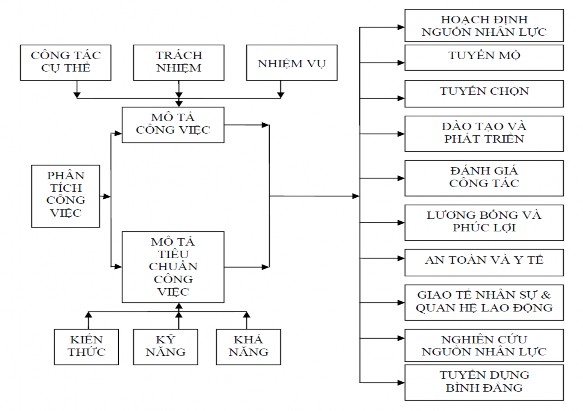
Source: Nguyen Huu Than, 2007: 93
Figure 1.6: Job analysis diagram
Job analysis is the process of determining the characteristics of a job and the conditions under which it is performed. Job analysis can be formal or informal. In the informal type, the manager needs only knowledge of the job and decides how and what kind of workers can perform the job. Small businesses often use this method. The formal type requires a committee consisting of the director and below and the analysts. In summary, job analysis will give the company the following advantages:
- Ensure greater success in staff placement, transfer and promotion.
- Eliminate many pay inequalities by clearly defining job duties and responsibilities.
- Create more incentive for work through arranging reward levels.
- Save time and effort by standardizing work and thereby helping managers have a basis for planning and dividing work schedules.
- Reduce the number of people who need to be replaced due to lack of understanding of the job or their qualifications.
- Create a basis for management and employees to understand each other better.
1.4.4. Recruitment and selection of personnel
Recruitment is the process of identifying and attracting a number of candidates who want to work and who feel satisfied in the working relationship at the company. In this process, the exchange of information is essential. For candidates, they need specific information about the company such as information about the job, promotion opportunities, salary and benefits and policies directly related to employees. For the company, they need information from candidates about their ability, experience, ethics and size that can meet the company's job requirements. Providing information by the company is an activity to attract talent. Collecting information about candidates is an activity to analyze the labor supply according to the company's human resource needs.
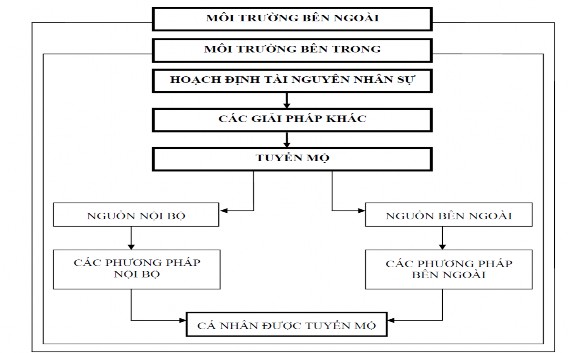
Source: Nguyen Huu Than, 2007: 155
Figure 1.7: Recruitment process
Selection is the process of screening candidates obtained after the recruitment process according to specific standards, suitable for the company's job requirements and deciding to use them. Job requirements are specifically determined through the job analysis process and are expressed through the job description and job specification table.
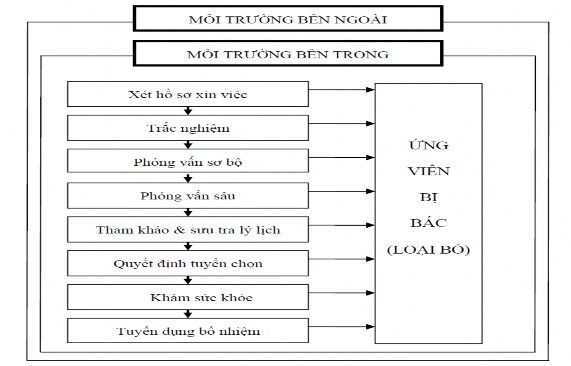
Source: Nguyen Huu Than, 2007: 186
Figure 1.8: Employee selection process
1.4.5- Human resource training
Human resource training is an activity to comprehensively improve the capacity of the company's human resources, ensuring the best fit for current jobs and meeting future changes. Competent personnel must have sufficient criteria for the necessary skills for the job, adaptability, experience and ethics.
- Training for new employees: For newly recruited employees, although after the selection process their working capacity is suitable for the job requirements. However, this suitability is only at a relative level. When analyzing the job, we know the skills needed for each specific job, and newly recruited employees rarely have all the required skills. Therefore, they still need to be trained in some additional skills, to avoid mistakes in the work process right from the beginning and affect their work efficiency.
- Training and retraining for current staff: In the development trend, to survive, companies must constantly improve, innovate and enhance the company's operational efficiency. Therefore, the company needs to have training and retraining programs for the team.
staff, supplementing them with knowledge and skills to be able to use and exploit improved and innovative technologies while improving their ability to adapt to changes in the working process. This is the process of increasing the quality of the workforce to ensure human resources from within the company. The training process goes through steps such as analyzing environmental factors to clearly identify training needs, setting specific goals for the program and training subjects, choosing appropriate training methods, implementing the training program and finally evaluating the training program. How did the results of the program meet the set needs? Through the Training and Development Process diagram, it shows that the changing external and internal environment has prompted the company to clearly identify the need for training and development.
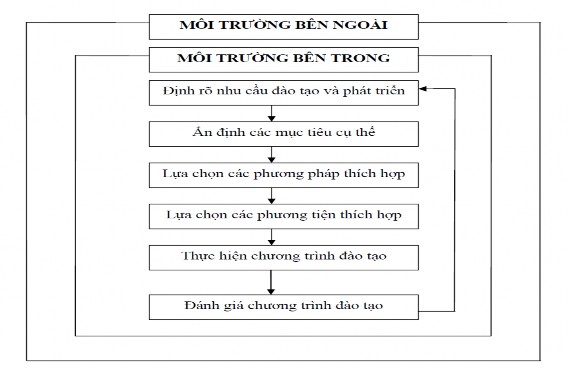
Source: Nguyen Huu Than, 2007: 286
Figure 1.9: Training and development process
1.4.6. Performance evaluation
Evaluating employee performance is the key to providing the company with a basis for planning, recruiting - selecting, developing human resources as well as compensation, career development and personnel relations.
* The purpose of employee evaluation is: to provide feedback to employees on their performance level compared to standard standards and other employees, to help employees adjust and correct mistakes in the work process, to stimulate and motivate employees through terms of evaluation, recognition and support, to provide information as a basis for training, salary, rewards, employee transfers, organizational structure improvements, etc. to develop understanding of the company through discussions about opportunities and career planning, to enhance good relationships between superiors and subordinates.
Businesses often apply many different evaluation methods. However, most businesses often conduct evaluation in the following order:
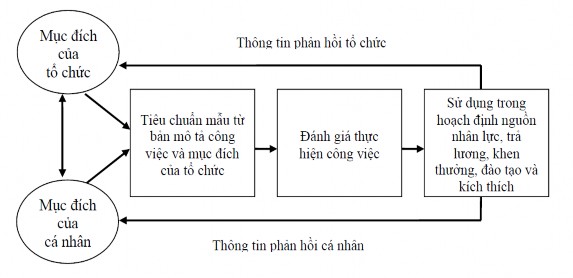
Source: Tran Kim Dung, 2006: 238
Figure 1.10: Employee performance evaluation system
- Identify the basic requirements to be assessed: The first step in the assessment process is for leaders to identify the areas, skills, and outcomes to be assessed and how these relate to the achievement of the company's goals. Typically, these requirements can be derived from the job description and include both behavioral standards and performance standards.
- Choosing the appropriate evaluation method: In reality, there are many different methods of evaluating job performance and no method is considered the best for all organizations. Even within a business,