
In the family, meals are increasingly improved. Items such as: mobile phones, televisions, motorbikes, rice cookers, gas stoves, etc. are commonly used. Many families also have refrigerators, water heaters, washing machines, air conditioners, etc., which improve the quality of life.
Many young men and women of the DQC ethnic group have left agriculture to work in companies, factories, and enterprises in neighboring communes and in the inner city of Hanoi. Many children of the DQC ethnic group have passed the entrance exams to universities, colleges, and vocational high schools. After graduating, they have stable jobs in their hometowns or in big cities.
International integration taking place in Ba Vi also brings many career opportunities for young people. The number of Dao youth going to work abroad is increasing. They do jobs such as sewing, newspaper printing, leather shoes, etc. in countries such as Japan, Korea, Russia, etc. Especially from 2010 to now, the phenomenon of going to China to work illegally is very common. According to statistics of the People's Committee of Ba Vi commune, up to June 2014, the whole commune had 231 people going to China to work illegally.
1.4.4. Cultural characteristics
Maybe you are interested!
-
 Conversion Rituals of Cantonese Chinese in Ho Chi Minh City Today - 27
 -
 Conversion Rituals of Cantonese Chinese in Ho Chi Minh City Today - 1
 -
 Worship Rituals and Festival Activities
 -
 Changing Customs and Rituals in Childbirth and Child-rearing
 -
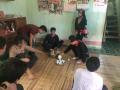 Life cycle rituals of the Dao Quan Chet people in Ba Vi district, Hanoi city - 26
1.4.4.1. Characteristics of material culture
- Housing
The traditional house of the DQC people is mainly a half-floor, half-ground house, suitable for the relatively steep terrain on Ba Vi mountain. The house usually has 3 rooms and 2 wings, a house with many people can have 5 rooms and 2 wings. The house is made of thatch, bamboo, reed, cogon grass, etc., which are available in the forest. The house-building tools are simple such as: axe, knife, chisel, saw, plane. The house of the DQC people has 2 to 3 doors, few windows, 2 to 3 kitchens, and clear regulations on where to store belongings and where family members can rest.
The altar is placed in the direction of the house on the ground, this room is adjacent to the kitchen and is separated by a partition. This is where the rituals of the DQC people take place, including the NLVĐ. The male head of the family usually sleeps in the room near the altar. Women in the family, especially the daughter-in-law, often avoid going through the altar room. The utensils
in the family is placed in the main kitchen for convenience. Usually on the floor, one room is the son's bedroom, next to it is the water trough, bathroom, the remaining room is the guest's resting place. Between the two rooms there is a door to the floor through the stairs.
- Skin
Women's daily clothing includes a headscarf, ao dai, a brassiere, belt, pants, and leggings.
The head scarf (mù goòng dia) has no decorative patterns. When worn, the scarf covers the entire hair, the square corners form two sharp horns in front, the right horn tilts upwards. When working, DQC women only wear the mù goòng dia , but when there is a family funeral or ceremony, they tie another scarf (goòng treo) with embroidered patterns in the middle and at both ends. The treo is tied backwards from under the chin and gathered at the top of the head, revealing the decoration at the tip of the scarf. On the wedding day, the bride has an additional scarf with beads and colorful wool.
The Ao Dai (Xia Luy region) has two separate front panels without buttons, and when worn, the two panels are crossed. The Ao Dai is embroidered with patterns such as: dragon bones, pig cages, trees, swastikas, birds, eight-pointed stars, etc. On normal days, women pull both the front and back panels of the Ao Dai up to their belts. On the wedding day, the bride wears two pants, two shirts, and the Ao Dai flaps are left hanging down.
Pants (Xia Hau region): indigo, long past the knee, narrow legs, tight to the calf. Pants are cut like a lame leg, with a waistband or a continuous waistband with a drawstring on the outside. Later, the pants were improved into pants with a drawstring or elastic band. There are embroidered patterns under the legs. The decorative patterns are embroidered separately and attached to the hem.
DQC women mainly use bronze and silver jewelry, very little gold or precious stone jewelry. Jewelry includes necklaces, bracelets, anklets, rings, earrings, and especially a set of relics with two bone hairpins. When wearing the relics, people put the two hairpins on their belts.
The daily clothing of DQC men includes a shirt (front and back),
pants (mieng chang hau) and headscarf (goong thong) . Men's shirt is a blouse.
Like Kinh men, it has 4 panels, indigo. The shirt has 3 pockets, 1 on the left chest and 2 on the front flaps. The pants are lame, with a white waistband made of silk or bamboo fabric. Later, white pants were only used on holidays, on normal days they wore brown or blue pants.
- Cuisine
Because they live in an area with relatively favorable natural conditions, the DQC people have long known how to exploit natural products and exchange goods with other ethnic groups such as bitter bamboo shoots, vegetables and wild animals. In addition, they also produce swidden fields with foods such as corn, potatoes, cassava, reeds, beans, peanuts, squash, etc. to serve their daily needs. The Dao people usually eat two main meals a day, morning and evening, and they have a snack at noon (because they often have to go far away to work in the fields, so they often eat breakfast and pack rice for lunch). On normal days, they rarely eat meat, only when there is a family party or a holiday does the food portion change. To store food, the Dao people also know how to dry, pickle, salt, etc.
Regarding drinks, the DQC people use medicinal plants to make daily drinks that are good for the body. They make their own wine to drink on holidays, weddings, and festivals. The wine is made from yeast leaves with special recipes. Men smoke tobacco and cigarettes, while women often chew betel.
1.4.4.2. Spiritual and cultural characteristics
The DQC follow animism. They believe that all things have souls. When a physical entity dies or is destroyed, the soul turns into a ghost called a mien . People divide all ghosts and gods into two types: good and bad. The good type includes gods of fortune, ancestors, Ban Vuong, Than Nong, Tho Cong, Tho Dia,... The bad type includes river ghosts, stream ghosts, mountain ghosts, forest ghosts, tree ghosts,... people who die abnormally: die young, die of illness, die from falling from a tree, die by being hacked, die by drowning,...
In addition, the DQC people also worship their ancestors (see Appendix 2.3), Ban Vuong. During the process of living together with the Kinh and Muong people in Ba Vi, they were influenced by the worship of Tan Vien Son Thanh. They worship Thanh Tan and some people with merit.
Ba Vi land was established at the village temple. Each village has its own temple, the temple can change when there is a new village chief.
The DQC people in Ba Vi have a rich spiritual life expressed in the system of rituals. In addition to the NLVĐ which will be presented in detail in the thesis, the DQC people also have many other rituals during the year.
First is the ritual of worshiping the gods of agriculture, livestock and many other gods such as the land god, the forest god, etc., organized by the whole community or just the ancestor's house. The common ritual of the community is usually held at the village temple. Every year, the DQC people hold a ceremony at the village temple 5 times on the following days: January 3 (the first ceremony of the year, praying for the gods to bless the villagers with a prosperous business); March 3 (the opening ceremony of the harvest season for the whole village, praying for the gods to bless the villagers with a favorable business and a bountiful harvest); June 6 (a ceremony to pray for crops to be protected from pests, wild animals, rats, etc.); August 2 (praying for the rice plants to bloom well and avoid storms); early December (the ceremony to close the village to celebrate the Lunar New Year).
Every year, families also organize many rituals: in March, they celebrate Thanh Minh festival with the purpose of giving money to ancestors to repair new houses; in May, they celebrate Tet and the Full Moon festival in July with the purpose of praying for good crops. The DQC people celebrate the Full Moon festival in July from the beginning of July to July 13, absolutely not on July 14 and 15 because they believe that is the day of ghosts. In August, they celebrate the New Rice festival to offer the first bowl of rice to their ancestors and gods, thanking them for giving them a bountiful harvest. At the end of the year, starting from December 5 to December 28 and 29, is the time when families hold a year-end ceremony, to thank gods and ancestors for their protection throughout the year. Every family prepares a grand feast to invite relatives and neighbors to attend the New Year's Eve meal. This is the biggest New Year's celebration for the DQC people in Ba Vi.
In addition to the above festivals, the village's ancestors also organize vegetarian ceremonies (tam dang) and dance festivals (nhiang cham dao) to thank Ban Vuong and the ancestors of the family. Dance festivals are a special ritual in the worship of the DQC people in particular and the nation in general.
Dao in general. The origin of the ritual comes from the sea crossing to Vietnam to find a way to live of the descendants of 12 Dao families (see appendix 2.1). The purpose of Tet Nhay is to express gratitude to ancestors, Ban Vuong who saved their lives at sea in the past; to train soldiers to protect the lives of the family and clan; to pray for ancestors to bless and protect all members of the clan to be healthy and to have more and more prosperous business. Tet Nhay is held for 2 days and 2 nights. In addition to the ritual, Tet Nhay represents a joyful atmosphere with dances that are repeated throughout the ceremony: tam nguyen an ham - opening dance, dao dance (dance to bring soldiers into generals), phat nuong dance (dance to have a good harvest), catching turtles, sword dance, flag dance. Although this is a ritual of a family or clan, it attracts the participation of a large number of the community. The dances combined with songs and musical instruments create a joyful atmosphere, echoing throughout the village.
Chapter 1 Summary
Up to now, there have been many research works on the Dao people's NLVĐ with many different approaches such as ethnology, anthropology, cultural studies, etc. However, with the DQC group in Ba Vi, the issue of NLVĐ has not received due attention. In particular, the study of NLVĐ from a cultural perspective to find the true meaning behind cultural practices has not been met by any work. This is a gap that needs to be seriously researched.
Through analyzing the concepts related to the topic, the researcher has a scientific basis to determine and limit the object, scope and research categories of the thesis. NLVĐ is understood as the rituals associated with each individual from birth to death.
In the thesis, the PhD student applies three theories: Anorld van Gennep's theory of conversion rituals to identify conversion rituals in NLVĐ, analyze the pre-threshold, threshold and post-threshold manifestations of each ritual. Applying Radcliffe-Brown and Bronislaw Malinowski's functional theory to analyze the ways in which rituals affect society, find out the psychological functions,
social functions and cultural and educational functions of the NLVĐ. Cultural exchange theory to see the cultural transformation of the DQC people in Ba Vi in the context of cultural exchange with neighboring ethnic groups.
The DQC people in Ba Vi originated from China. Through the stories that are still passed down, it can be confirmed that they migrated to Vietnam by sea, to provinces such as Hoa Binh, Phu Tho, Tuyen Quang, Yen Bai, Quang Ninh, etc. The DQC people in Ba Vi mainly come from Hoa Binh and Phu Tho. They have lived in the Ba Vi mountainous area for about 5-6 generations.
Before the 1960s, they lived a nomadic life on Ba Vi Mountain. After the Party and State's movement to move down the mountain in the early 1960s, the DQC settled down at the foot of Ba Vi Mountain. Here, they lived in concentrated communities in 3 villages: Hop Nhat, Hop Son and Yen Son. They adapted to the new environment, built their lives and developed an increasingly strong community.
Ba Vi Commune, Ba Vi District, after many changes in administrative boundaries, was re-merged into Hanoi in August 2008. Under the impact of industrialization, modernization and urbanization, the life of the DQC people here has changed continuously. Material culture has changed dramatically in a trend closer to Kinh culture. However, spiritual culture, especially the ritual system including NLVĐ, is still well preserved to this day.
Chapter 2
TRADITIONAL LIFE CYCLE CEREMONY OF THE DAO QUAN CHET PEOPLE IN BA VI
2.1. Rituals and how to organize ceremonies
2.1.1. Rituals related to childbirth
The Dao people in Ba Vi believe that getting married and having children is a criterion to affirm the maturity of a man. The standard for women, when they become wives, is to give birth and become mothers. That is also the wish of those who have built a family. They believe that only by giving birth can they have someone to continue their ancestors and have a place to rely on in old age. However, the child must be born on the basis of a legal marriage, recognized by the community. People who have few children are often very worried about having to live alone without children to take care of them when they are old and weak. Therefore, they often find ways to buy or adopt children. In tradition, when the public health system is still limited, there are many dangers for the mother and the child. Therefore, in addition to folk knowledge (most importantly herbal medicine), the DQC people attach great importance to rituals during this period. The ritual helps them believe that ancestors and gods will protect and bless the mother and fetus to be healthy and safe.
2.1.1.1. Rituals during pregnancy
When a woman is about 5 to 6 months pregnant, the family holds a ceremony to inform the ancestors with the hope of being protected and blessed. The offerings include: a chicken, a bottle of wine, incense (made of the bark of the tung tree , contained in a small bowl). The family can invite a shaman or perform the ceremony themselves. During the ceremony, the family promises that if the mother and baby are safe, they will perform a ceremony to repay the ancestors with a pig. The reason they have to perform the ceremony is because in the past there were no medical facilities, pregnant women had to endure many dangers that could affect the lives of both mother and child. Therefore, in addition to traditional medicine, they believe in supernatural forces, first of all, grandparents and ancestors, praying for luck, health, and a smooth birth. Near the due date, many families also prepare an offering to pray to their ancestors to bless the pregnant woman with a safe delivery. The offerings include chicken and wine.
During pregnancy, if the pregnant woman is healthy, the family does not need to perform any other rituals. If the pregnant woman is continuously sick without a known cause and cannot be cured by traditional medicine, they invite a shaman to perform a divination ceremony. Through the ritual, the shaman finds out the types of ghosts that cause the illness. According to the shaman's instructions, the family prepares offerings such as chicken or pig, wine, rice, some paper money, and paper charms. The shaman uses his magic, ghost soldiers, and spells to drive evil spirits out of the pregnant woman.
2.1.1.2. Rituals when giving birth
During childbirth, if the pregnant woman has difficulty giving birth, people will hold a ceremony to worship various ghosts, first of all, the " mien doa" which is the ghost of women of the previous generation who died after giving birth, for fear that the ghosts of those people will come to disturb them. If she has not given birth yet, they will pray to the ancestors' ghosts, with a pair of scissors on the altar table with the belief that during pregnancy, the woman will put a needle in her clothes or leave it on the bed, so they will pray to the ancestors to use scissors to cut the placenta out of the mother's internal organs so that the fetus can come out. If she has not given birth yet, they will set up a ceremony to worship the Jade Emperor on the porch. The offerings include a bowl of rice, a cup of water, wine, incense, money or a silver bracelet, then pray to the Jade Emperor to help the pregnant woman. Throughout the time from childhood to adulthood, especially during pregnancy, if she has committed something that has not been forgiven, such as cursing her parents, having conflicts with her siblings or neighbors, cutting trees or cutting bamboo, offending ghosts and gods, etc., they will pray to the Jade Emperor for help, and when the pregnant woman gives birth, they will make a ceremony to thank him. Of all the above ghosts, if you pray to a ghost that sees a woman giving birth, three days after giving birth you must sacrifice a chicken to thank that ghost.
Many families whose ancestors were in the medical profession also pray for the mother in labor with spells. People take a broom that has just been threshing rice, place it near the ancestral altar, light incense, pour wine and pray for the ancestors' blessing. Then bring the broom into the mother's room and chant a few sentences, the general idea is that rice saves life, giving birth is thanks to rice and living is also thanks to rice, pray for rice's blessing, then hold your breath and pretend to sweep the mother from head to toe and continue sweeping from there to the main door 3 times, then put the broom on a chair for the mother to sit on. When the baby is born, the broom must be quickly put away and after three days, a ceremony must be held to thank the ancestors for blessing the mother in labor to give birth safely.