
Based on the theory of FDI that has been put forward by many economists and has been relatively consistent over the past few decades, combined with the practice of economic globalization since the early 1990s until now, and with its characteristics in interaction with FDI flows, it can be seen that globalization first of all: (1) Improve the global investment environment including the institutional system, legal corridors related to FDI at bilateral and multilateral levels, at national, regional and global scales; investment and production activities, research and development, science and technology transfer of TNCs and activities of major economies...; (2) Expand the global market for goods and services; (3) Adjust the correlation of comparative advantages between input factors of production in the originating country and the investment receiving country (or between factors that play the role of push and pull) such as capital - technology - labor and natural resources.
Thus, through the Investment Environment, Market and Resource Factors, the globalization process has impacted the movement of FDI flows, the value and structure of FDI globally in general and in each economy in particular. However, and conversely, the movement of FDI flows creates conditions for the movement and adjustment of comparative advantages between production factors, the transformation of the investment environment and the acceleration of the free trade process. Therefore, it can be said that the relationship between the globalization process and the movement of world FDI flows is an organic relationship, an interaction between science and technology, the development of the global free market, the activities of TNCs and economies with the input factors of the production process globally, in each region and country. In summary, globalization impacts FDI flows according to the mechanism described in Figure 1.2. below:
Liberalization trend
Science and technology
TNC
National and regional economies
WTO, IMF, WB
FDI environment (National and international legal corridor system, bilateral and multilateral investment agreements ...)
Domestic production factors (human resources, resources...)
Domestic and international markets (Through WTO accession, FTAs, BTAs...)
FDI value
FDI structure
Source: Author
Figure 1.2. The impact mechanism of globalization on FDI flows
The above model reflects the impact of globalization on the movement of FDI flows in the world in the past two decades. The increased value of FDI and the structural shift towards the service sector are the results of an improved international investment environment, an expanded market for goods and services, and the interaction between resource factors. In the specific conditions of each economy, the position and role of each of the above factors will be different and will inevitably lead to different values and structures of FDI . Any change in the above factors can lead to changes in the value and structure of FDI flows. Thus, the above factors are also tools through which policy makers can indirectly influence FDI flows.
In other words, to master the FDI flow, ensure the desired FDI attraction value and structure, policy makers need to effectively use these tools - that is, use legal tools, market tools and resources in a reasonable proportion to attract an optimal FDI value and structure. Regarding this part, the author will have the opportunity to analyze more thoroughly at the end of chapters two and three of the thesis.
1.2.2. Impact of global investment environment on FDI flow movement
The global FDI environment is not only a system of legal regulations in the fields of trade, investment, human resources, etc. at the multilateral and bilateral levels, at the regional and national scale, but also includes the activities of TNCs and of major economies.
1.2.2.1. Impact of the trend of international investment liberalization
First of all, the legal environment for international investment and trade activities in the process of economic globalization is adjusted in a more liberal direction. In this trend, many new global economic, trade and financial institutions are formed, inherited from some organizations that were previously only regional in nature, or their influence is expanded, their scope and functions of operation are adjusted to suit the new situation of globalization. The negotiation rounds of the World Trade Organization (WTO) aimed at reaching multilateral agreements in different fields of economic activities, the adjustments in the mechanisms and methods of operation of the World Bank (WB) and the International Monetary Fund (IMF), the expanded scale and higher connectivity of global stock markets, multilateral and bilateral trade and investment agreements, etc. are clear manifestations of this trend. In addition, the investment and trade policies of each individual country, cooperation agreements in a number of important service areas such as communications, transportation, payments, e-commerce, etc. also create conditions for world trade and investment to become freer, markets to become more interconnected, more competitive and more interdependent.
The trend of trade and investment liberalization is also associated with the trend of privatization, liberalization, decentralization and deregulation (some authors call it deregulation). According to this trend, private organizations and companies will gradually escape the constraints of laws, rules, regulations and political will of governments. Resources such as capital, technology, labor, etc. of the private sector are mobilized, circulated, and transferred under the impact of the law of supply and demand of the market mechanism, reaching beyond the borders of a country, contributing to further promoting the global free trade regime . The consequence of the liberalization trend is the deeper and broader interdependence between economies in the process of providing input factors for production such as capital, technology, raw materials, fuel, and human resources; in the process of management, division of labor and in product distribution, market division, etc. In other words, globalization leads to the unification of input factors of production and the unification of the market for goods and services.
The most obvious manifestation of the trend of liberalization of legal regulations on trade and investment can be observed since the early 1990s - the time when the Soviet Union and the Eastern bloc collapsed. The continuous and accelerated process of liberalization, privatization and deregulation has created the premise for countries to adjust their investment attraction policies. From 1991 to the end of 2005, more than 100 countries have adjusted regulations related to investment attraction, creating more favorable conditions for foreign investors. The number of regulations related to FDI and the activities of TNCs as well as the number of economies issuing these regulations has increased steadily every year, with the proportion of more favorable regulations being the majority. In 2004 alone, the number of legal documents and national measures affecting FDI and the activities of TNCs reached a record high of 271, issued by 102 countries; In 2005, there were 205 documents issued by 93 countries. 87% of these measures were to create more favorable conditions for FDI and TNCs (Table 1.1).
Table 1.1. Changes in national regulatory regulations, 1991-2005
Item
91 | 92 | 93 | 94 | 95 | 96 | 97 | 98 | 1999 | 2000 | 2001 | 2002 | 2003 | 2004 | 2005 | |
Country Number | 35 | 43 | 57 | 49 | 64 | 65 | 76 | 60 | 63 | 69 | 71 | 70 | 82 | 102 | 93 |
Number of changes | 82 | 79 | 102 | 110 | 112 | 114 | 151 | 145 | 140 | 150 | 208 | 248 | 244 | 271 | 205 |
More convenient | 80 | 79 | 101 | 108 | 106 | 98 | 135 | 136 | 131 | 147 | 194 | 236 | 220 | 235 | 164 |
More difficult | 2 | - | 1 | 2 | 6 | 16 | 16 | 9 | 9 | 3 | 14 | 12 | 24 | 36 | 41 |
Maybe you are interested!
-
 Research Projects Related to Globalization, Impact of Globalization on Personality, Lifestyle, and Ethics of Vietnamese People
 -
 Theory on the Impact of International Trade on Employment
 -
 The impact of foreign culture on the business activities of Vietnamese enterprises and the direction of absorbing international cultural values combined with traditional values to enhance competitiveness in the integration period - 13
 -
 Theoretical and Practical Basis of International Trade Relations in the Context of Globalization and International Economic Integration
 -
 The impact of economic globalization on foreign direct investment flows into Vietnam - 2
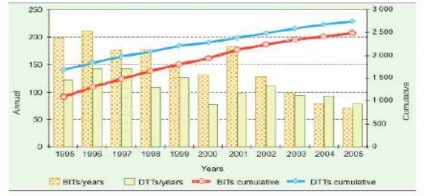
Source: UNCTAD. World Investment Report 2006 The number of bilateral investment treaties (BITs) and double taxation treaties (DTTs) has also increased rapidly over the years. By the end of 2005, there were 2,495 BITs, 70% of which had been implemented. It is noteworthy that many countries continue to renegotiate BITs with the aim of further liberalizing the FDI regime, with 85 BITs being renegotiated and signed by the end of 2004. Regarding DTTs, by the end of 2005, there were 2,758 signed agreements, of which 39% were signed between developed and developing economies; 29% between developed countries and the number
The remainder is among developing countries (Figures 1.3 . and 1.4.) [95] .
It is noteworthy that the first DTT was signed between Southern countries (mainly developing countries) in 1948, but the number of DTTs between these countries only increased sharply from the mid-1990s, with 156 DTTs signed in the period from 1995 to 1999, and 89 DTTs from 2000 to the end of 2005.
Source: UNCTAD. World Investment Report 2006
Figure 1.3. Number of BITs and DTTs, 1990 - 2005
among developing countries
between developing and developed countries
between developing countries and SEE and CIS countries between developed countries
between developed countries and SEE and CIS countries between SEE and CIS countries
Source: UNCTAD. World Investment Report 2005
Figure 1.4. Total BITs by country group, as of 2004
As 10 new countries joined the EU on 1 May 2004, the BITs previously concluded between these countries were also added to the number of BITs between developed countries.
These figures show that economic globalization has taken place at a deeper and broader level in all regions of the world in the past two decades. In addition to BITs and DTTs, many international documents related to investment contained in regional and inter-regional economic and trade agreements, etc., have also been adopted by many countries with the aim of opening up to FDI and making national regulations more consistent with international regulations (Figure 1.5).
The above favorable FDI environment has promoted investment flows not only among developed countries but also between developed and developing countries and between
On the contrary, it is the FDI inflows to transition economies, such as Central and Eastern Europe, and some developing economies that have contributed to further promoting the privatization trend in these economies.
Year
Cumulative
Source: UNCTAD. World Investment Report 2005
Figure 1.5. Number of International Investment Agreements other than BITs and DTTs, 1957 -2004
In addition to creating a favorable investment environment, many countries have also actively improved their trade regulations in their efforts to negotiate to join the WTO. With the increasing number of WTO members, countries' trade policies have also been gradually adjusted in a more liberal direction. Regarding trade institutions, in addition to the WTO playing the role of a global institution on trade, countries have also formed their own free trade areas to increase regional competitiveness. The clearest manifestation of this process is the emergence of a series of bilateral or multilateral free trade area agreements (FTAs). NAFTA in North America, AFTA in Asia, the trade agreement between ASEAN and China, etc. are typical examples of this trend. In addition, a Multilateral Agreement on Investment (MAI) within the scope of regulation
The WTO has also been taken into account by some developed economies. In the context of these developments, the WTO has an even more important role to play in designing a more unified and liberalized global trade architecture. Such developments will inevitably lead to more favorable conditions for international investment.
It is noteworthy that in the above trend of trade and investment liberalization, although
Traditional protectionist barriers such as tariffs and customs unions are gradually disappearing.
Although tariffs have been removed , non - tariff barriers to trade have become increasingly diverse and widely used. The fact that developed countries are favoring the application of labor , hygiene and product safety standards or linking trade to political and social conditions is one of the typical manifestations of measures to restrict free trade , and is considered by some economies as a safety valve for their trade balance . The trend of regionalization and protectionism by non - tariff barriers seems to contradict the trend of globalization and trade liberalization , but in fact it is a derivative product of globalization and trade liberalization - when the process of competition and market competition becomes more fierce and intense .
1.2.2.2. Impact of transnational corporations
When it comes to the movement of production factors such as capital, labor and technology, the role of transnational corporations (TNCs) cannot be ignored. In other words, TNCs are the driving force of globalization. In the 1960s, there were about 7,000 TNCs in the world. This number increased to 37,000 in 1990, 57,000 in 1996, about 65,000 parent TNCs and 850,000 in 2002, and by the end of 2005 there were 77,000 parent TNCs and at least 770,000 affiliates. Total global FDI reached 7 trillion USD in 2001, of which TNCs accounted for 3.5 trillion with a total turnover of 18.5 trillion USD. TNCs' total affiliates accounted for about 11% of world GDP in 2001, compared with 7% in 1990. [96] These figures show that TNCs own a large value of factors of production and have