
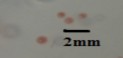
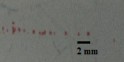
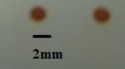
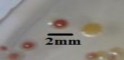
Table 3.1. Isolation results of VKTQH colonies from oil-polluted water samples in Vietnam's coastal areas
STT
Colony symbol | Colony image | Morphology, color, colony size | Substrate source | Isolated source | |
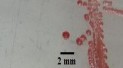
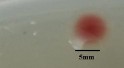
1. | DQ41 (DD4) |
| Colonies are round, convex, shiny, have clear edges, no nucleus, dark red, 1 - 1.5mm in diameter. | Toluene | Oil contaminated water samples in Quang Ngai sea area |
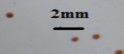
2. | DQ42 |
| Colonies are round, convex, with inner edges, spreading, purple, 1mm in diameter. | Toluene | Oil contaminated water samples in Quang Ngai sea area |
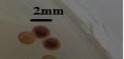
3. | DQ51 |
| Colonies are round, smooth, shiny, with flat edges, purple in color, 0.5 mm in diameter. | Toluene | Oil contaminated water samples in Quang Ngai sea area |
4. | DQ52 |
| Colonies are round, smooth, shiny, with clear edges, purple in color, diameter < 0.5mm | Toluene | Oil contaminated water samples in Quang Ngai sea area |
5. | DQ81 |
| Colonies are round, convex, smooth, with inner and flat edges, with nuclei, and red in color. bold, diameter 2 - 2.5 mm | Naphthalene | Oil contaminated water samples in Quang Ngai sea area |
6. | DQ82 |
| Colonies are round, convex, shiny, nucleated, with legs, brick red, diameter 1.5 mm | Naphthalene | Oil contaminated water samples in Quang Ngai sea area |
7. | FO1 |
| Colonies are round, convex, smooth, shiny, with jagged edges, purple, 1 mm in diameter. | Diesel | Oil contaminated water samples in Vung Tau sea area |
8. | FO2 |
| Colonies are round, smooth, with jagged edges, light red, diameter < 0.5 mm | Diesel | Oil contaminated water samples in Vung Tau sea area |





Maybe you are interested!
-
 Results of Isolation and Purification of Stevioside
 -
 Economic group model - operations of Vietnam Oil and Gas Group in the period 2006 - 2008 and development trends - 1
 -
 Initial Results and Comments
 -
 Completing the organization of accounting for revenue, sales costs and determining business results at Hai Phong Paint Joint Stock Company - 1
 -
 Results of Testing Cronbach's Alpha Coefficient of Independent Variable
STT
Colony symbol | Colony image | Morphology, color, colony size | Substrate source | Isolated source | |
9. | DD3 |
| Colonies are round, shiny, with clear edges, with nuclei, light red, 1 mm in diameter. | Phenol | Oil contaminated mud sample in Quang Ngai sea area |
10. | DD4 |
| Colonies are round, tiny, light red. | Phenol | Oil contaminated mud sample in Quang Ngai sea area |
11. | PY2 |
| Colonies are nucleated, convex, round, shiny surface, yellow-brown, diameter 0.8-1.2 mm. | Pyrene | Nha Trang Stone Bridge Port - Khanh Hoa |
12. | PY6 |
| Colonies have darker brown nuclei, scalloped edges, yellowish brown, 1.5 mm in diameter. | Pyrene | Nha Trang Stone Bridge Port - Khanh Hoa |
13. | PY9 |
| Colonies are pale pink, nucleated, with clear margins, 1-2 mm in diameter. | Pyrene | Nha Trang Stone Bridge Port - Khanh Hoa |
14. | LC1 |
| Colonies are round, convex, smooth, shiny, light red, with clear edges, 2-2.5 mm in diameter. | Anthracene | Nha Trang Fishing Village – Khanh Hoa |
15. | LC5 |
| Pale pink colonies, red nucleus, slimy, with edges, 5 mm in diameter. | Anthracene | Nha Trang Fishing Village – Khanh Hoa |

3.1.2. Selection of VKTQH strains capable of forming biofilms and decomposing petroleum hydrocarbons
3.1.2.1. Evaluation of growth and biofilm formation ability of purple photosynthetic bacteria strains
After being isolated and purified, the VKTQH strains, along with 17 VKTQH strains in the collection selected according to method 2.2.1.4 of chapter 2, were cultured in DSMZ 27 medium to evaluate their growth and biofilm formation abilities. Table 3.2 presents the results of determining the growth ability of 32 VKTQH strains isolated after 7 days of culture:
Table 3.2. Growth ability of VKTQH strains
STT
Strain symbol | ∆OD 800 | |
1. | FO2 | 1.291 ±0.01 |
2. | DQ52 | 1.283 ±0.012 |
3. | DQ41 (DD4) | 1.257 ±0.01 |
4. | DQ42 | 1.25 ±0.02 |
5. | DD3 | 1.228 ±0.03 |
6. | DD4 | 1.222 ±0.01 |
7. | DQ51 | 1.21 ±0.02 |
8. | DQ82 | 1.19 ±0.012 |
9. | FO1 | 1.163 ±0.01 |
10. | DQ81 | 1.162 ±0.018 |
11. | DG211 | 0.99±0.06 |
12. | QP21 | 0.99 ± 0.02 |
13. | DG217 | 0.98±0.01 |
14. | DG114 | 0.97±0.038 |
15. | DG12 | 0.97±0.024 |
STT
Strain symbol | ∆OD 800 | |
16. | PY6 | 0.97±0.023 |
17. | LACM2I2 | 0.96±0.01 |
18. | NMS412 | 0.95±0.023 |
19. | A 3 II 3 | 0.94±0.026 |
20. | PY2 | 0.93±0.03 |
21. | DG218 | 0.91±0.05 |
22. | LC1 | 0.90±0.01 |
23. | MI1 | 0.87±0.04 |
24. | DG213 | 0.84±0.018 |
25. | NMS25 | 0.82±0.02 |
26. | VH | 0.82±0.01 |
27. | LC5 | 0.78±0.03 |
28. | DG214 | 0.77±0.011 |
29. | NMS411 | 0.76±0.01 |
30. | PY9 | 0.74±0.01 |
31. | HQP304 | 0.73±0.03 |
32. | LACM1 | 0.71±0.01 |
The results showed that all 32 strains of VKTQH grew well on DSMZ 27 medium, of which 10 strains with symbols FO2, DQ52, DQ41, DQ42, DD3, DD4, DQ52, DQ82, FO1, DQ81 grew best (∆OD 800 >1).
In parallel with the experiment to determine the growth ability of 32 VKTQH strains, we conducted an experiment to evaluate the ability to form biofilm.
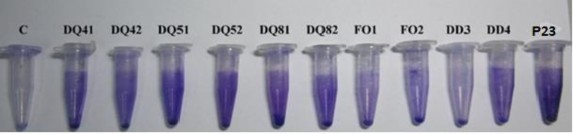
Figure 3.3. Biofilm formation ability based on crystal violet capture ability of biofilm formed by VKTQH strains
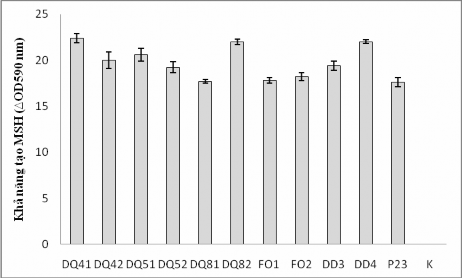
Figure 3.4 . Biofilm formation ability of VKTQH strains degrading petroleum hydrocarbons and Acinetobacter calcoaceticus P23 (K: negative control)
The biofilm formation results of 32 VKTQH strains were compared with the positive control strain P23 [124] and showed that 10 strains, namely FO2, DQ52, DQ41, DQ42, DD3, DD4, DQ52, DQ82, FO1, DQ81, formed better biofilms than the positive control strain P23 with an OD 600 value of 17.6 (Figures 3.3 and 3.4). Of these, four VKTQH strains, including DQ41, DQ51, DD4 and DQ82, had strong biofilm formation ability, with OD 600 values ranging from 20.6 to 22.4 and continuing to increase after 7 days of culture (Figures 3.3 and 3.4). Therefore, we selected these 10 strains to conduct further studies.
3.1.2.2. Ability to utilize petroleum hydrocarbons of photosynthetic purple bacteria strains
Experiment to evaluate the growth ability on petroleum hydrocarbon sources of 10 VKTQH strains with good biofilm formation ability. Specifically, the experiment
was carried out by replacing acetate in the composition of DSMZ 27 medium with various substrates, including diesel oil, toluene, naphthalene, phenol and pyrene.
(i) Growth ability of 10 VKTQH strains on diesel oil
The results showed that all 10 strains of VKTQH were recorded to have the ability to grow well in the environment supplemented with diesel substrate at a concentration of 4 - 8% (Figure 3.5, Figure 3.6), most notably the 3 strains DQ41, FO2 and DD4.
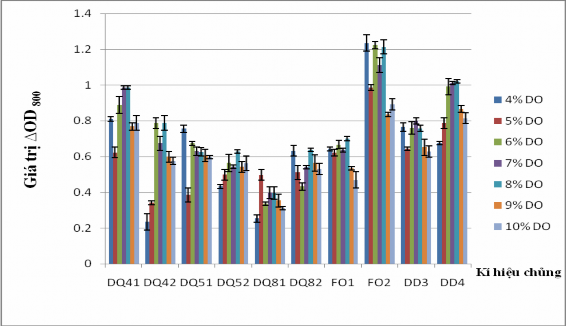
Figure 3.5. Growth ability of 10 VKTQH strains after 7 days of culture at different concentrations of diesel oil
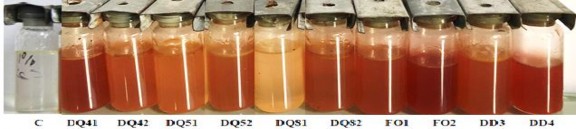
Figure 3.6. Culture solution of 10 strains of VKTQH in 10% diesel oil after 7 days. Specifically, based on the color of the suspension and measurement of the optical absorption of the solution
Cell suspension at 800 nm wavelength, selected VKTQH strains all had
Ability to grow on diesel oil medium with concentration from 4 - 10% (v/v), best in the range of 4 - 8% (v/v), slow growth at oil concentration of 9 ÷ 10%.
(ii) Growth ability of 10 VKTQH strains on toluene
Toluene is a member of the BTEX group (including benzene, toluene, ethylbenzene and xylene), a common group of pollutants in industrial emissions and wastewater from glue, solvent and dye factories [57]. The ability to use toluene is also considered one of the important criteria when studying the characteristics of 10 VKTQH strains in this thesis.
Based on the optical absorbance of cell suspensions grown in medium supplemented with toluene at different concentrations for 7 days measured at 800 nm wavelength (Figure 3.7) and the color of the suspension (Figure 3.8), we found that at a concentration of 150 ppm, strains FO2 and DQ52 grew the best (∆OD 800 > 1), at a concentration of 200 ppm, strains DQ41, DD4, DQ52 and FO2 grew strongly (∆OD 800 > 1), at a concentration of 250 ppm, strains DQ41, FO2 and DD4 grew strongly (∆OD 800 > 1), at a concentration of 300 ppm, the growth of all 10 strains was reduced, especially the 3 strains DQ52, DQ81 and DD82 (∆OD 800 < 0.8). The three strains DQ41, FO2 and DD4 could still grow quite well (0.9 <∆OD 800 <1.0).
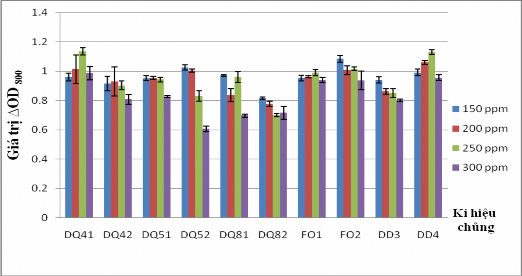
Figure 3.7. Growth ability of 10 VKTQH strains at different toluene concentrations after 7 days of culture
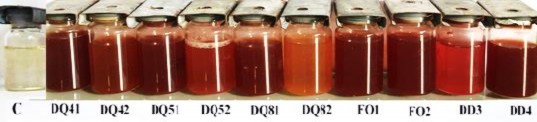
Figure 3.8. Culture of 10 strains of VKTQH at 250 ppm toluene after 7 days
In fact, the toxicity level of toluene in aquatic environment is shown to be ≥ 50 ppm [136], so the toluene concentration of 200 ppm is a high concentration, inhibiting many organisms. Therefore, the 4 strains DQ41, DD4, DQ52 and FO2 were selected by us as strains with the ability to grow well on toluene.
(iii) Growth ability of 10 VKTQH strains on phenol
Ten strains of VKTQH were cultured in DSMZ 27 medium supplemented with phenol at concentrations of 150, 200, 250 and 300 ppm as the sole carbon and energy source. After 7 days of culture, the growth ability of the strains is shown in Figure 3.9 and Figure 3.10.
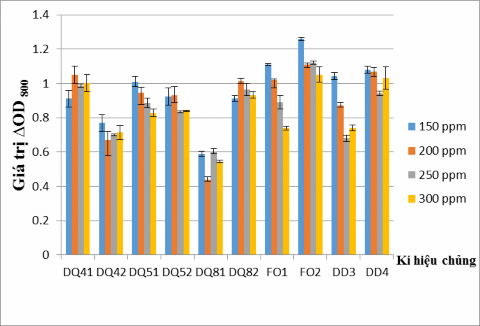
Figure 3.9. Growth ability of 10 VKTQH strains after 7 days of culture at different phenol concentrations
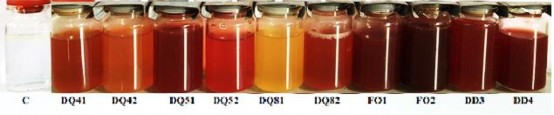
Figure 3.10. Culture of 10 strains of VKTQH at 150 ppm phenol after 7 days Based on the optical absorbance of the cell suspension at 800 nm wavelength
color of suspension (Figure 3.9) and color of suspension (Figure 3.10) they
I found that at a concentration of 150 ppm, most strains of VKTQH were able to produce