
82
Lack of close cooperation in work, with 24 - 33% of the responses still at a weak level, and awareness of compliance with regulations and labor discipline is still the weakest point, accounting for 33.03% of the weak level. Because some restaurant employees are manual laborers who do not implement labor protection, or the implementation of labor safety and hygiene of the enterprise, or there are some university-educated tour guides who have accepted to work as sitting guides, assisting foreign tour guides in violating the Law on Tourism, in order to deal with inspections by competent authorities in Vietnam. These actions not only affect work efficiency and labor productivity, but also create a negative image, losing the spirit of patriotism, sovereignty, and fine traditions of the Vietnamese people.
- Regarding the level of dedication to work : Looking at chart 3.6, it shows that most of the laborers in tourism enterprises in Da Nang city are currently aware of cultivating professional ethics and when asked for their opinions on this, the majority of laborers said that they achieved average, good, and excellent levels, ranging from 62.4% to 81.76%. In particular, laborers also found that diligence and hard work are outstanding characteristics, so the rate of evaluation from average or higher is 81.76%; high sense of responsibility for work is 80.60% of the rate of evaluation from average or higher; loyalty and attachment to the enterprise is 67.67%; enthusiasm, dynamism, trying to overcome difficulties to do well the assigned work is 77.59%; passion for the profession, interest in the job is 74.14%. It can be said that this is one of the advantages for Da Nang city to build timely incentive and treatment policies to develop human resources, especially high-quality human resources.
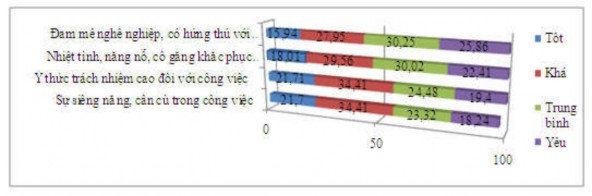
Figure 3.6. Results of assessing the level of dedication to work of human resources at tourism businesses in Da Nang city, 2017 Source: Author's survey results
83
- Regarding the ability to adapt flexibly at work : Through chart 3.7, the results of the survey of laborers in tourism enterprises in Da Nang city on the ability to adapt flexibly at work showed that about 66.52% of opinions assessed the ability to adapt flexibly at work as average or higher. In particular, the ability to accept change, job transfer (66.52% of opinions); the ability to adapt to new jobs (65.82% of opinions); the ability to grasp and access market information (62.56% of opinions); the ability to be ready to move, change the environment (69.05%); the ability to cope with risks at work (63.63%). Thus, some skills of workers are still weak, especially the ability to grasp and access market information; the ability to cope with risks at work has a weak level of over 35%.
100%
90%
80%
70%
60%
50%
40%
30%
20%
10%
0%
Weak
33.48
34.18
30.95
36.56
30.02
30.02
28.41
27.4
24.01
12.47
23.33
12.47
Medium
Rather
13.39
24.25
13.39
23.7
12.34
Good
Ability to accept change, job transfer
Likeability
Ability year
corresponding to the job of capturing market information
Readiness Ability to respond to risks
new
school
change in work environment
do
30.02
28.41
24.94
Figure 3.7. Results of assessing the ability to adapt flexibly to work of human resources in tourism businesses in Da Nang city, 2017 Source: Author's survey results
In general, the human resources of tourism enterprises in the city have been increased in both physical and mental strength in recent times, especially in terms of tourism professional qualifications, foreign language proficiency, knowledge, skills and attitudes, which have gradually improved to meet the basic requirements for the needs of each job position of tourism enterprises in Da Nang city.
3.2.3. Current status of tourism human resource structure
3.2.3.1. Human resource structure by professional qualifications
Currently, to meet the industrialization, modernization and international integration of tourism, human resources must meet the Vietnam Tourism Occupational Standards (VTOS), through which tourism enterprises can evaluate the effectiveness of their human resources according to the level of each assigned job position. Results of the 2017 survey on human resources in tourism enterprises in Da Nang city according to tourism occupational standards
84
According to Vietnam (VTOS), the number of human resources trained with VTOS certificates reached 38.75% (all 5 levels) of the total existing human resources, specifically for each field as follows:
Table 3.6. Human resources at accommodation businesses in Da Nang city trained with VTOS certificate in 2017
Unit: %
Each position
VTOS vocational level | Do not have | |||||
Proof only 1 | Proof only 2 | Proof only 3 | Literature equal to 4 | Diploma high-class | ||
Board of Directors/Hotel Management | 8.15 | 7.30 | 4.49 | 10.67 | 13.20 | 69.38 |
Front desk manager/supervisor | 3.0 | 10.73 | 12.45 | 15.88 | 2.15 | 57.94 |
Receptionist | 18.09 | 20.06 | 4.68 | 1.98 | 0.73 | 55.02 |
Housekeeping Department Manager/Supervisor | 3.51 | 10.53 | 12.28 | 12.28 | 2.46 | 61.40 |
Room attendant | 28.78 | 10.57 | 4.22 | 1.46 | 0.84 | 54.97 |
Chef/Kitchen Manager | 4.03 | 10.74 | 12.42 | 14.43 | 3.36 | 58.39 |
Kitchen assistant | 26.66 | 11.55 | 5.16 | 1.23 | 0.61 | 55.41 |
Restaurant Manager/Supervisor | 0 | 0 | 20.64 | 17.43 | 1.38 | 60.55 |
Restaurant/bar staff | 16.08 | 26.67 | 3.10 | 1.5 | 0 | 52.65 |
Maybe you are interested!
-

 Identify Rating Levels and Rating Scales
zt2i3t4l5ee
zt2a3gstourism,quan lan,quang ninh,ecology,ecotourism,minh chau,van don,geography,geographical basis,tourism development,science
zt2a3ge
zc2o3n4t5e6n7ts
of the islanders. Therefore, this indicator will be divided into two sub-indicators:
a1. Natural tourism attractiveness a2. Cultural tourism attractiveness
b. Tourist capacity
The two island communes in Quan Lan have different capacities to receive tourists. Minh Chau Commune is home to many standard hotels and resorts, attracting high-income domestic and international tourists. Meanwhile, Quan Lan Commune has many motels mainly built and operated by local people, so the scale and quality are not high, and will be suitable for ordinary tourists such as students.
c. Time of exploitation of Quan Lan Island Commune:
Quan Lan tourism is seasonal due to weather and climate conditions and festivals only take place on certain days of the year, specifically in spring. In Quan Lan commune, the period from April to June and from September to November is considered the best time to visit Quan Lan because the cultural tourism activities are mainly associated with festivals taking place during this time.
Minh Chau island commune:
Tourism exploitation time is all year round, because this is a place with a number of tourist attractions with diverse ecosystems such as Bai Tu Long National Park Research Center, Tram forest, Turtle Laying Beach, so besides coming to the beach for tourism and vacation in the summer, Minh Chau will attract research groups to come for tourism combined with research at other times of the year.
d. Sustainability
The sustainability of ecotourism sites in Quan Lan and Minh Chau communes depends on the sensitivity of the ecosystems to climate changes.
landscape. In general, these tourist destinations have a fairly high level of sustainability, because they are natural ecosystems, planned and protected. However, if a large number of tourists gather at certain times, it can exceed the carrying capacity and affect the sustainability of the environment (polluted beaches, damaged trees, animals moving away from their habitats, etc.), then the sustainability of the above ecosystems (natural ecosystems, human ecosystems) will also be affected and become less sustainable.
e. Location and accessibility
Both island communes have ports to take tourists to visit from Van Don wharf:
- Quan Lan – Van Don traffic route:
Phuc Thinh – Viet Anh high-speed boat and Quang Minh high-speed boat, depart at 8am and 2pm from Van Don to Quan Lan, and at 7am and 1pm from Quan Lan to Van Don. There are also wooden boats departing at 7am and 1pm.
- Van Don - Minh Chau traffic route:
Chung Huong high-speed train, Minh Chau train, morning 7:30 and afternoon 13:30 from Van Don to Minh Chau, morning 6:30 and afternoon 13:00 from Minh Chau to Van Don.
f. Infrastructure
Despite receiving investment attention, the issue of infrastructure and technical facilities for tourism on Quan Lan Island is still an issue that needs to be resolved because it has a direct impact on the implementation of ecotourism activities. The minimum conditions for serving tourists such as accommodation, electricity, water, communication, especially medical services, and security work need to be given top priority. Ecotourism spots in Minh Chau commune are assessed to have better infrastructure and technical facilities for tourism because there are quite complete and synchronous conditions for serving tourists, meeting many needs of domestic and foreign tourists.
3.2.1.4. Determine assessment levels and assessment scales
Corresponding to the levels of each criterion, the index is the score of those levels in the order of 4, 3, 2, 1 decreasing according to the standard of each level: very attractive (4), attractive (3), average (2), less attractive (1).
3.2.1.5. Determining the coefficients of the criteria
For the assessment of DLST in the two communes of Quan Lan and Minh Chau islands, the students added evaluation coefficients to show the importance of the criteria and indicators as follows:
Coefficient 3 with criteria: Attractiveness, Exploitation time. These are the 2 most important criteria for attracting tourists to tourism in general and eco-tourism in particular, so they have the highest coefficient.
Coefficient 2 with criteria: Capacity, Infrastructure, Location and accessibility . Because the assessment area is an island commune of Van Don district, the above criteria are selected by the author with appropriate coefficients at the average level.
Coefficient 1 with criteria: Sustainability. Quan Lan has natural and human-made ecotourism sites, with high biodiversity and little impact from local human factors. Most of the ecotourism sites are still wild, so they are highly sustainable.
3.2.1.6. Results of DLST assessment on Quan Lan island
a. Assessment of the potential for natural tourism development
For Minh Chau commune:
+ Natural tourism attractiveness is determined to be very attractive (4 points) and the most important coefficient (coefficient 3), so the score of the Attractiveness criterion is 4 x 3 = 12.
+ Capacity is determined as average (2 points) and the coefficient is quite important (coefficient 2), then the score of Capacity criterion is 2 x 2 = 4.
+ Exploitation time is long (4 points), the most important coefficient (coefficient 3) so the score of the Exploitation time criterion is 4 x 3 = 12.
+ Sustainability is determined as sustainable (4 points), the important coefficient is the average coefficient (coefficient 1), so the score of the Sustainability criterion is 4 x 1 = 4 points
+ Location and accessibility are determined to be quite favorable (2 points), the coefficient is quite important (coefficient 2), the criterion score is 2 x 2 = 4 points.
+ Infrastructure is assessed as good (3 points), the coefficient is quite important (coefficient 2), then the score of the Infrastructure criterion is 3 x 2 = 6 points.
The total score for evaluating DLST in Minh Chau commune according to 6 evaluation criteria is determined as: 12 + 4 + 12 + 4 + 4 + 6 = 42 points
Similar assessment for Quan Lan commune, we have the following table:
Table 3.3: Assessment of the potential for natural ecotourism development in Quan Lan and Minh Chau communes
Attractiveness of self-tourismof course
Capacity
Mining time
Sustainability
Location and accessibility
Infrastructure
Result
Point
DarkMulti
Point
DarkMulti
Point
DarkMulti
Point
DarkMulti
Point
DarkMulti
Point
DarkMulti
CommuneMinh Chau
12
12
4
8
12
12
4
4
4
8
6
8
42/52
Quan CommuneLan
6
12
6
8
9
12
4
4
4
8
4
8
33/52
b. Assessment of the potential for humanistic tourism development
For Quan Lan commune:
+ The attractiveness of human tourism is determined to be very attractive (4 points) and the most important coefficient (coefficient 3), so the score of the Attractiveness criterion is 4 x 3 = 12.
+ Capacity is determined to be large (3 points) and the coefficient is quite important (coefficient 2), then the score of the Capacity criterion is 3 x 2 = 6.
+ Mining time is average (3 points), the most important coefficient (coefficient 3) so the score of the Mining time criterion is 3 x 3 = 9.
+ Sustainability is determined as sustainable (4 points), the important coefficient is the average coefficient (coefficient 1), so the score of the Sustainability criterion is 4 x 1 = 4 points.
+ Location and accessibility are determined to be quite favorable (2 points), the coefficient is quite important (coefficient 2), the criterion score is 2 x 2 = 4 points.
+ Infrastructure is rated as average (2 points), the coefficient is quite important (coefficient 2), then the score of the Infrastructure criterion is 2 x 2 = 4 points.
The total score for evaluating DLST in Quan Lan commune according to 6 evaluation criteria is determined as: 12 + 6 + 6 + 4 + 4 + 4 = 36 points.
Similar assessment with Minh Chau commune we have the following table:
Table 3.4: Assessment of the potential for developing humanistic eco-tourism in Quan Lan and Minh Chau communes
Attractiveness of human tourismliterature
Capacity
Mining time
Sustainability
Location and accessibility
Infrastructure
Result
Point
DarkMulti
Point
DarkMulti
Point
DarkMulti
Point
DarkMulti
Point
DarkMulti
Point
DarkMulti
Quan CommuneLan
12
12
6
8
9
12
4
4
4
8
4
8
39/52
Minh CommuneChau
6
12
4
8
12
12
4
4
4
8
6
8
36/52
Basically, both Minh Chau and Quan Lan localities have quite favorable conditions for developing ecotourism. However, Quan Lan commune has more advantages to develop ecotourism in a humanistic direction, because this is an area with many famous historical relics such as Quan Lan Communal House, Quan Lan Pagoda, Temple worshiping the hero Tran Khanh Du, ... along with local festivals held annually such as the wind praying ceremony (March 15), Quan Lan festival (June 10-19); due to its location near the port and long exploitation time, the beaches in Quan Lan commune (especially Quan Lan beach) are no longer hygienic and clean to ensure the needs of tourists coming to relax and swim; this is also an area with many beautiful landscapes such as Got Beo wind pass, Ong Phong head, Voi Voi cave, but the ability to access these places is still very limited (dirt hill road, lots of gravel and rocks), especially during rainy and windy times; In addition, other natural resources such as mangrove forests and sea worms have not been really exploited for tourism purposes and ecotourism development. On the contrary, Minh Chau commune has more advantages in developing ecotourism in the direction of natural tourism, this is an area with diverse ecosystems such as at Rua De Beach, Bai Tu Long National Park Conservation Center...; Minh Chau beach is highly appreciated for its natural beauty and cleanliness, ranked in the top ten most beautiful beaches in Vietnam; Minh Chau commune is also home to Tram forest with a large area and a purity of up to 90%, suitable for building bridges through the forest (a very effective type of natural ecotourism currently applied by many countries) for tourists to sightsee, as well as for the purpose of studying and researching.
Figure 3.1: Thenmala Forest Bridge (India) Source: https://www.thenmalaecotourism.com/(August 21, 2019)
3.2.2. Using SWOT matrix to evaluate Quan Lan island tourism
General assessment of current tourism activities of Quan Lan island is shown through the following SWOT matrix:
Table 3.5: SWOT matrix evaluating tourism activities on Quan Lan island
Internal agent
Strengths- There is a lot of potential for tourism development, especially natural ecotourism and humanistic ecotourism.- The unskilled labor force is relatively abundant.- resource environmentunpolluted, still
Weaknesses- Poorly developed infrastructure, especially traffic routes to tourist destinations on the island.- The team of professional staff is still weak.- Tourism products in general
quite wild, originalintact
general and DLST in particularalone is monotonous.
External agents
Opportunity- Tourism is a key industry in the socio-economic development strategy of the province and Van Don economic zone.- Quan Lan was selected as a pilot area for eco-tourism development within the framework of the green growth project between Quang Ninh province and the Japanese organization JICA.- The flow of tourists and especially ecotourism in the world tends toincreasing
Challenge- Weather and climate change abnormally.- Competition in tourism products is increasingly fierce, especially with other localities in the province such as Ha Long, Mong Cai...- Awareness of tourists, especially domestic tourists, about ecotourism and nature conservation is not high.
Through summary analysis using SWOT matrix we see that:
To exploit strengths and take advantage of opportunities, it is necessary to:
- Diversify products and service types (build more tourism routes aimed at specific needs of tourists: experiential tourism immersed in nature, spiritual cultural tourism...)
- Effective exploitation of resources and differentiated products (natural resources and human resources)
div.maincontent .p { color: black; font-family:"Times New Roman", serif; font-style: normal; font-weight: normal; text-decoration: none; font-size: 14pt; margin:0pt; } div.maincontent p { color: black; font-family:"Times New Roman", serif; font-style: normal; font-weight: normal; text-decoration: none; font-size: 14pt; margin:0pt; } div.maincontent .s1 { color: black; font-family:"Times New Roman", serif; font-style: normal; font-weight: normal; text-decoration: none; font-size: 13pt; } div.maincontent .s2 { color: black; font-family:"Times New Roman", serif; font-style: normal; font-weight: normal; text-decoration: none; font-size: 13pt; } div.maincontent .s3 { color: #0D0D0D; font-family:"Times New Roman", serif; font-style: normal; font-weight: bold; text-decoration: none; font-size: 14pt; } div.maincontent .s4 { color: black; font-family:"Times New Roman", serif; font-style: italic; font-weight: normal; text-decoration: none; font-size: 14pt; } div.maincontent .s5 { color: black; font-family:"Times New Roman", serif; font-style: italic; font-weight: bold; text-decoration: none; font-size: 14pt; } div.maincontent .s6 { color: black; font-family:"Times New Roman", serif; font-style: italic; font-weight: normal; text-decoration: none; font-size: 14pt; vertical-align: -3pt; } div.maincontent .s7 { color: black; font-family:"Times New Roman", serif; font-style: italic; font-weight: normal; text-decoration: none; font-size: 14pt; vertical-align: -2pt; } div.maincontent .s8 { color: black; font-family:"Times New Roman", serif; font-style: italic; font-weight: normal; text-decoration: none; font-size: 14pt; vertical-align: -1pt; } div.maincontent .s9 { color: black; font-family:"Times New Roman", serif; font-style: normal; font-weight: normal; text-decoration: none; font-size: 14pt; } div.maincontent .s10 { color: black; font-family:"Times New Roman", serif; font-style: normal; font-weight: bold; text-decoration: none; font-size: 14pt; } div.maincontent .s11 { color: black; font-family:"Times New Roman", serif; font-style: normal; font-weight: normal; text-decoration: none; font-size: 14pt; } div.maincontent .s12 { color: black; font-family:Symbol, serif; font-style: normal; font-weight: normal; text-decoration: none; font-size: 14pt; } div.maincontent .s13 { color: black; font-family:Wingdings; font-style: normal; font-weight: normal; text-decoration: none; font-size: 14pt; } div.maincontent .s14 { color: black; font-family:"Times New Roman", serif; font-style: normal; font-weight: normal; text-decoration: none; font-size: 9pt; vertical-align: 5pt; } div.maincontent .s15 { color: black; font-family:"Times New Roman", serif; font-style: normal; font-weight: normal; text-decoration: none; font-size: 9pt; vertical-align: 5pt; } div.maincontent .s16 { color: black; font-family:Cambria, serif; font-style: italic; font-weight: normal; text-decoration: none; font-size: 14pt; } div.maincontent .s17 { color: #080808; font-family:"Times New Roman", serif; font-style: normal; font-weight: bold; text-decoration: none; font-size: 14pt; } div.maincontent .s18 { color: #080808; font-family:"Times New Roman", serif; font-style: normal; font-weight: normal; text-decoration: none; font-size: 14pt; } div.maincontent .s19 { color: black; font-family:"Times New Roman", serif; font-style: normal; font-weight: normal; text-decoration: none; font-size: 11pt; } div.maincontent .s20 { color: black; font-family:"Times New Roman", serif; font-style: normal; font-weight: normal; text-decoration: none; font-size: 10pt; } div.maincontent .s21 { color: black; font-family:"Times New Roman", serif; font-style: normal; font-weight: bold; text-decoration: none; font-size: 11pt; } div.maincontent .s22 { color: black; font-family:"Times New Roman", serif; font-style: normal; font-weight: normal; text-decoration: none; font-size: 11pt; } div.maincontent .s23 { color: black; font-family:"Times New Roman", serif; font-style: italic; font-weight: normal; text-decoration: none; font-size: 14pt; } div.maincontent .s24 { color: #212121; font-family:"Times New Roman", serif; font-style: normal; font-weight: normal; tex
Identify Rating Levels and Rating Scales
zt2i3t4l5ee
zt2a3gstourism,quan lan,quang ninh,ecology,ecotourism,minh chau,van don,geography,geographical basis,tourism development,science
zt2a3ge
zc2o3n4t5e6n7ts
of the islanders. Therefore, this indicator will be divided into two sub-indicators:
a1. Natural tourism attractiveness a2. Cultural tourism attractiveness
b. Tourist capacity
The two island communes in Quan Lan have different capacities to receive tourists. Minh Chau Commune is home to many standard hotels and resorts, attracting high-income domestic and international tourists. Meanwhile, Quan Lan Commune has many motels mainly built and operated by local people, so the scale and quality are not high, and will be suitable for ordinary tourists such as students.
c. Time of exploitation of Quan Lan Island Commune:
Quan Lan tourism is seasonal due to weather and climate conditions and festivals only take place on certain days of the year, specifically in spring. In Quan Lan commune, the period from April to June and from September to November is considered the best time to visit Quan Lan because the cultural tourism activities are mainly associated with festivals taking place during this time.
Minh Chau island commune:
Tourism exploitation time is all year round, because this is a place with a number of tourist attractions with diverse ecosystems such as Bai Tu Long National Park Research Center, Tram forest, Turtle Laying Beach, so besides coming to the beach for tourism and vacation in the summer, Minh Chau will attract research groups to come for tourism combined with research at other times of the year.
d. Sustainability
The sustainability of ecotourism sites in Quan Lan and Minh Chau communes depends on the sensitivity of the ecosystems to climate changes.
landscape. In general, these tourist destinations have a fairly high level of sustainability, because they are natural ecosystems, planned and protected. However, if a large number of tourists gather at certain times, it can exceed the carrying capacity and affect the sustainability of the environment (polluted beaches, damaged trees, animals moving away from their habitats, etc.), then the sustainability of the above ecosystems (natural ecosystems, human ecosystems) will also be affected and become less sustainable.
e. Location and accessibility
Both island communes have ports to take tourists to visit from Van Don wharf:
- Quan Lan – Van Don traffic route:
Phuc Thinh – Viet Anh high-speed boat and Quang Minh high-speed boat, depart at 8am and 2pm from Van Don to Quan Lan, and at 7am and 1pm from Quan Lan to Van Don. There are also wooden boats departing at 7am and 1pm.
- Van Don - Minh Chau traffic route:
Chung Huong high-speed train, Minh Chau train, morning 7:30 and afternoon 13:30 from Van Don to Minh Chau, morning 6:30 and afternoon 13:00 from Minh Chau to Van Don.
f. Infrastructure
Despite receiving investment attention, the issue of infrastructure and technical facilities for tourism on Quan Lan Island is still an issue that needs to be resolved because it has a direct impact on the implementation of ecotourism activities. The minimum conditions for serving tourists such as accommodation, electricity, water, communication, especially medical services, and security work need to be given top priority. Ecotourism spots in Minh Chau commune are assessed to have better infrastructure and technical facilities for tourism because there are quite complete and synchronous conditions for serving tourists, meeting many needs of domestic and foreign tourists.
3.2.1.4. Determine assessment levels and assessment scales
Corresponding to the levels of each criterion, the index is the score of those levels in the order of 4, 3, 2, 1 decreasing according to the standard of each level: very attractive (4), attractive (3), average (2), less attractive (1).
3.2.1.5. Determining the coefficients of the criteria
For the assessment of DLST in the two communes of Quan Lan and Minh Chau islands, the students added evaluation coefficients to show the importance of the criteria and indicators as follows:
Coefficient 3 with criteria: Attractiveness, Exploitation time. These are the 2 most important criteria for attracting tourists to tourism in general and eco-tourism in particular, so they have the highest coefficient.
Coefficient 2 with criteria: Capacity, Infrastructure, Location and accessibility . Because the assessment area is an island commune of Van Don district, the above criteria are selected by the author with appropriate coefficients at the average level.
Coefficient 1 with criteria: Sustainability. Quan Lan has natural and human-made ecotourism sites, with high biodiversity and little impact from local human factors. Most of the ecotourism sites are still wild, so they are highly sustainable.
3.2.1.6. Results of DLST assessment on Quan Lan island
a. Assessment of the potential for natural tourism development
For Minh Chau commune:
+ Natural tourism attractiveness is determined to be very attractive (4 points) and the most important coefficient (coefficient 3), so the score of the Attractiveness criterion is 4 x 3 = 12.
+ Capacity is determined as average (2 points) and the coefficient is quite important (coefficient 2), then the score of Capacity criterion is 2 x 2 = 4.
+ Exploitation time is long (4 points), the most important coefficient (coefficient 3) so the score of the Exploitation time criterion is 4 x 3 = 12.
+ Sustainability is determined as sustainable (4 points), the important coefficient is the average coefficient (coefficient 1), so the score of the Sustainability criterion is 4 x 1 = 4 points
+ Location and accessibility are determined to be quite favorable (2 points), the coefficient is quite important (coefficient 2), the criterion score is 2 x 2 = 4 points.
+ Infrastructure is assessed as good (3 points), the coefficient is quite important (coefficient 2), then the score of the Infrastructure criterion is 3 x 2 = 6 points.
The total score for evaluating DLST in Minh Chau commune according to 6 evaluation criteria is determined as: 12 + 4 + 12 + 4 + 4 + 6 = 42 points
Similar assessment for Quan Lan commune, we have the following table:
Table 3.3: Assessment of the potential for natural ecotourism development in Quan Lan and Minh Chau communes
Attractiveness of self-tourismof course
Capacity
Mining time
Sustainability
Location and accessibility
Infrastructure
Result
Point
DarkMulti
Point
DarkMulti
Point
DarkMulti
Point
DarkMulti
Point
DarkMulti
Point
DarkMulti
CommuneMinh Chau
12
12
4
8
12
12
4
4
4
8
6
8
42/52
Quan CommuneLan
6
12
6
8
9
12
4
4
4
8
4
8
33/52
b. Assessment of the potential for humanistic tourism development
For Quan Lan commune:
+ The attractiveness of human tourism is determined to be very attractive (4 points) and the most important coefficient (coefficient 3), so the score of the Attractiveness criterion is 4 x 3 = 12.
+ Capacity is determined to be large (3 points) and the coefficient is quite important (coefficient 2), then the score of the Capacity criterion is 3 x 2 = 6.
+ Mining time is average (3 points), the most important coefficient (coefficient 3) so the score of the Mining time criterion is 3 x 3 = 9.
+ Sustainability is determined as sustainable (4 points), the important coefficient is the average coefficient (coefficient 1), so the score of the Sustainability criterion is 4 x 1 = 4 points.
+ Location and accessibility are determined to be quite favorable (2 points), the coefficient is quite important (coefficient 2), the criterion score is 2 x 2 = 4 points.
+ Infrastructure is rated as average (2 points), the coefficient is quite important (coefficient 2), then the score of the Infrastructure criterion is 2 x 2 = 4 points.
The total score for evaluating DLST in Quan Lan commune according to 6 evaluation criteria is determined as: 12 + 6 + 6 + 4 + 4 + 4 = 36 points.
Similar assessment with Minh Chau commune we have the following table:
Table 3.4: Assessment of the potential for developing humanistic eco-tourism in Quan Lan and Minh Chau communes
Attractiveness of human tourismliterature
Capacity
Mining time
Sustainability
Location and accessibility
Infrastructure
Result
Point
DarkMulti
Point
DarkMulti
Point
DarkMulti
Point
DarkMulti
Point
DarkMulti
Point
DarkMulti
Quan CommuneLan
12
12
6
8
9
12
4
4
4
8
4
8
39/52
Minh CommuneChau
6
12
4
8
12
12
4
4
4
8
6
8
36/52
Basically, both Minh Chau and Quan Lan localities have quite favorable conditions for developing ecotourism. However, Quan Lan commune has more advantages to develop ecotourism in a humanistic direction, because this is an area with many famous historical relics such as Quan Lan Communal House, Quan Lan Pagoda, Temple worshiping the hero Tran Khanh Du, ... along with local festivals held annually such as the wind praying ceremony (March 15), Quan Lan festival (June 10-19); due to its location near the port and long exploitation time, the beaches in Quan Lan commune (especially Quan Lan beach) are no longer hygienic and clean to ensure the needs of tourists coming to relax and swim; this is also an area with many beautiful landscapes such as Got Beo wind pass, Ong Phong head, Voi Voi cave, but the ability to access these places is still very limited (dirt hill road, lots of gravel and rocks), especially during rainy and windy times; In addition, other natural resources such as mangrove forests and sea worms have not been really exploited for tourism purposes and ecotourism development. On the contrary, Minh Chau commune has more advantages in developing ecotourism in the direction of natural tourism, this is an area with diverse ecosystems such as at Rua De Beach, Bai Tu Long National Park Conservation Center...; Minh Chau beach is highly appreciated for its natural beauty and cleanliness, ranked in the top ten most beautiful beaches in Vietnam; Minh Chau commune is also home to Tram forest with a large area and a purity of up to 90%, suitable for building bridges through the forest (a very effective type of natural ecotourism currently applied by many countries) for tourists to sightsee, as well as for the purpose of studying and researching.
Figure 3.1: Thenmala Forest Bridge (India) Source: https://www.thenmalaecotourism.com/(August 21, 2019)
3.2.2. Using SWOT matrix to evaluate Quan Lan island tourism
General assessment of current tourism activities of Quan Lan island is shown through the following SWOT matrix:
Table 3.5: SWOT matrix evaluating tourism activities on Quan Lan island
Internal agent
Strengths- There is a lot of potential for tourism development, especially natural ecotourism and humanistic ecotourism.- The unskilled labor force is relatively abundant.- resource environmentunpolluted, still
Weaknesses- Poorly developed infrastructure, especially traffic routes to tourist destinations on the island.- The team of professional staff is still weak.- Tourism products in general
quite wild, originalintact
general and DLST in particularalone is monotonous.
External agents
Opportunity- Tourism is a key industry in the socio-economic development strategy of the province and Van Don economic zone.- Quan Lan was selected as a pilot area for eco-tourism development within the framework of the green growth project between Quang Ninh province and the Japanese organization JICA.- The flow of tourists and especially ecotourism in the world tends toincreasing
Challenge- Weather and climate change abnormally.- Competition in tourism products is increasingly fierce, especially with other localities in the province such as Ha Long, Mong Cai...- Awareness of tourists, especially domestic tourists, about ecotourism and nature conservation is not high.
Through summary analysis using SWOT matrix we see that:
To exploit strengths and take advantage of opportunities, it is necessary to:
- Diversify products and service types (build more tourism routes aimed at specific needs of tourists: experiential tourism immersed in nature, spiritual cultural tourism...)
- Effective exploitation of resources and differentiated products (natural resources and human resources)
div.maincontent .p { color: black; font-family:"Times New Roman", serif; font-style: normal; font-weight: normal; text-decoration: none; font-size: 14pt; margin:0pt; } div.maincontent p { color: black; font-family:"Times New Roman", serif; font-style: normal; font-weight: normal; text-decoration: none; font-size: 14pt; margin:0pt; } div.maincontent .s1 { color: black; font-family:"Times New Roman", serif; font-style: normal; font-weight: normal; text-decoration: none; font-size: 13pt; } div.maincontent .s2 { color: black; font-family:"Times New Roman", serif; font-style: normal; font-weight: normal; text-decoration: none; font-size: 13pt; } div.maincontent .s3 { color: #0D0D0D; font-family:"Times New Roman", serif; font-style: normal; font-weight: bold; text-decoration: none; font-size: 14pt; } div.maincontent .s4 { color: black; font-family:"Times New Roman", serif; font-style: italic; font-weight: normal; text-decoration: none; font-size: 14pt; } div.maincontent .s5 { color: black; font-family:"Times New Roman", serif; font-style: italic; font-weight: bold; text-decoration: none; font-size: 14pt; } div.maincontent .s6 { color: black; font-family:"Times New Roman", serif; font-style: italic; font-weight: normal; text-decoration: none; font-size: 14pt; vertical-align: -3pt; } div.maincontent .s7 { color: black; font-family:"Times New Roman", serif; font-style: italic; font-weight: normal; text-decoration: none; font-size: 14pt; vertical-align: -2pt; } div.maincontent .s8 { color: black; font-family:"Times New Roman", serif; font-style: italic; font-weight: normal; text-decoration: none; font-size: 14pt; vertical-align: -1pt; } div.maincontent .s9 { color: black; font-family:"Times New Roman", serif; font-style: normal; font-weight: normal; text-decoration: none; font-size: 14pt; } div.maincontent .s10 { color: black; font-family:"Times New Roman", serif; font-style: normal; font-weight: bold; text-decoration: none; font-size: 14pt; } div.maincontent .s11 { color: black; font-family:"Times New Roman", serif; font-style: normal; font-weight: normal; text-decoration: none; font-size: 14pt; } div.maincontent .s12 { color: black; font-family:Symbol, serif; font-style: normal; font-weight: normal; text-decoration: none; font-size: 14pt; } div.maincontent .s13 { color: black; font-family:Wingdings; font-style: normal; font-weight: normal; text-decoration: none; font-size: 14pt; } div.maincontent .s14 { color: black; font-family:"Times New Roman", serif; font-style: normal; font-weight: normal; text-decoration: none; font-size: 9pt; vertical-align: 5pt; } div.maincontent .s15 { color: black; font-family:"Times New Roman", serif; font-style: normal; font-weight: normal; text-decoration: none; font-size: 9pt; vertical-align: 5pt; } div.maincontent .s16 { color: black; font-family:Cambria, serif; font-style: italic; font-weight: normal; text-decoration: none; font-size: 14pt; } div.maincontent .s17 { color: #080808; font-family:"Times New Roman", serif; font-style: normal; font-weight: bold; text-decoration: none; font-size: 14pt; } div.maincontent .s18 { color: #080808; font-family:"Times New Roman", serif; font-style: normal; font-weight: normal; text-decoration: none; font-size: 14pt; } div.maincontent .s19 { color: black; font-family:"Times New Roman", serif; font-style: normal; font-weight: normal; text-decoration: none; font-size: 11pt; } div.maincontent .s20 { color: black; font-family:"Times New Roman", serif; font-style: normal; font-weight: normal; text-decoration: none; font-size: 10pt; } div.maincontent .s21 { color: black; font-family:"Times New Roman", serif; font-style: normal; font-weight: bold; text-decoration: none; font-size: 11pt; } div.maincontent .s22 { color: black; font-family:"Times New Roman", serif; font-style: normal; font-weight: normal; text-decoration: none; font-size: 11pt; } div.maincontent .s23 { color: black; font-family:"Times New Roman", serif; font-style: italic; font-weight: normal; text-decoration: none; font-size: 14pt; } div.maincontent .s24 { color: #212121; font-family:"Times New Roman", serif; font-style: normal; font-weight: normal; tex -
 Survey Results on the Current Situation of Human Resources Training at Indochina Petroleum Transportation Joint Stock Company
 -
 Results of Training Tourism Human Resources in Thua Thien Hue Province
 -
 Research Results on the Implementation of Training and Development Policies for Human Resources in the Diplomatic Sector
 -
 Criteria for Evaluating the Quality of Human Resources in Enterprises.
Source: Survey results [80]
- For the accommodation sector, the number of employees with VTOS certificates is about 30 - 47%, this is the sector with the highest VTOS level currently in tourism enterprises in the city and compared to 2013, this rate has increased nearly 4 times (in 2013 it was only 7.18%). Looking at the data in Table 3.6, it shows that employees in all positions directly serving guests (hotel managers, supervisors and staff of the reception, housekeeping, kitchen, restaurant) with VTOS certificates (including all 5 levels of qualifications) account for about 30 - 45%. In particular, for hotel management positions, department heads and supervisors, the proportion of employees holding high-level VTOS certificates (level 3, level 4 and senior level) is much larger than for lower positions, specifically, up to 13.2% of hotel directors/managers have advanced VTOS certificates, while this proportion for other department heads or supervisors is only about 2.5% - 3.5%.
- For the restaurant and catering sector with KDL services: Looking at table 3.7, it can be seen that the rate of workers in some main job positions in restaurants with VTOS certificates is not large, about 26.49%, but compared to 2013, this rate is much higher (in 2013 it only reached 10.6%), this rate is mainly concentrated in restaurants with
85
large-scale coastal and city center restaurants (Apsara restaurant, Khong gian xua, Con Ca Map ...). In which, the proportion of employees in positions directly serving guests and kitchen with VTOS certificates is quite low, 19.5% and 22% respectively; this proportion is mainly in front desk supervisors, restaurant managers reaching from 32.0% - 37.66%. Thus, the proportion of employees in the front desk department with high-level VTOS qualifications is much lower than that in the department directly serving guests and kitchen. This also reflects the current reality that most service staff are seasonal employees, part-time students, interns, workers in some positions only need to graduate from high school, this is the group that accounts for a large proportion of the labor structure in restaurants serving tourist areas.
Table 3.7. Human resources in restaurants in Da Nang city trained with VTOS certificate in 2017
Unit: %
VTOS vocational level | Do not have | |||||
Proof only 1 | Proof only 2 | Proof only 3 | By 4 | Equal high-class | ||
Restaurant Management | 0.81 | 3.23 | 5.65 | 9.68 | 13.71 | 66.94 |
Front desk manager/supervisor | 1.30 | 5.19 | 3.90 | 19.48 | 7.79 | 62.34 |
Receptionist | 9.15 | 7.93 | 3.66 | 10.98 | - | 68.29 |
Manage/Supervise the direct department customer service | 1.40 | 5.14 | 0.47 | 7.48 | 2.34 | 83.18 |
Staff directly serving customers | 6.71 | 9.49 | 0.35 | 2.20 | 3.47 | 77.78 |
Chef/Kitchen Manager | - | 3.76 | 3.01 | 10.53 | 0.75 | 81.95 |
Kitchen assistant | 11.68 | 7.69 | 1.14 | 5.41 | - | 74.07 |
Source: Survey results [80]
- For tourism , according to the survey results in chart 3.8, the rate of employees working at travel agencies with VTOS certificates is lower than in the accommodation and restaurant sector, only about 32.1%, an increase of nearly 5 times compared to 2013 (in 2013 it was only 6.85%). In terms of each position, the position of director/manager and manager/supervisor of the operations department with VTOS certificates at a high level is 18.8%, higher than the position of staff and tour guides at 6.49%. This result reflects the current reality for travel agencies in Da Nang city, which is that the majority are small-scale, the tour guide team is hired under contract, so stability is not high, and is often lacking during the peak tourist season of the year. This is one of the difficulties in training and fostering human resources for travel companies in the city today.
86
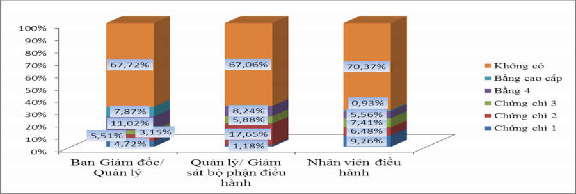
Chart 3.8. Human resources at travel agencies in Da Nang city trained with VTOS certificate in 2017
Source: Survey results [80]
In general, NLDLs who have been trained and granted VTOS certificates are supported by the "Environmentally and Socially Responsible Tourism Capacity Development Program" funded by the European Union for the Vietnam National Administration of Tourism, the Ministry of Culture, Sports and Tourism, and tourism departments, including Da Nang city. In fact, the application of the VTOS occupational standards in assessing the professional expertise of employees in tourism enterprises in the city is not yet widely applied. According to the author's survey results when contacting tourism enterprise managers about the application of VTOS occupational standards, some enterprises do not clearly understand this set of standards. Some tourism enterprises know about the occupational standards but think that it is difficult to apply them in their enterprises and that in order to apply this set of standards, it is necessary to add more specific criteria for each job position.
3.2.3.2. Tourism human resources by gender
Tourism is a special industry, the labor is complex, so the work of each position of the tourism industry has different characteristics. From the data in Table 3.8, it can be seen that in 2017, the proportion of female workers working in tourism enterprises was higher than that of men, with 14,651 workers accounting for 50.43% and 14,451 male workers, accounting for 49.66%. In 2011, the proportion of male workers was higher than that of female workers, the proportion of male workers was 54.36% and that of female workers was 45.64%. Thus, in the period 2011 - 2017, the labor force working in tourism enterprises by gender tended to shift towards increasing the proportion of female workers and decreasing the proportion of male workers, ensuring balance between job positions. In which, the two fields of accommodation and restaurants have a higher proportion of female workers than male workers, these are the two fields with the number of NLDL accounting for the majority of the total direct labor force in the tourism industry. For the field of accommodation and restaurants, the trend of increasing the proportion of female workers, as of the end of 2017, the number of female workers in hotels (workers in the reception department,
87
The number of female employees in the housekeeping, sales - marketing, customer care and restaurant department is mostly female (60%), while the number of male employees in the kitchen, technical, restaurant management and event staff is mostly male) is 9,402 people, accounting for 54.24% (in 2011 there were 2,947 people, accounting for 44.90%); the restaurant has 3,733 female employees (female employees take on the positions of receptionist/cashier (87.8%), sales/marketing staff (73.47%), other department managers (80.33%)), accounting for 52.28% (in 2011 there were 2,269 people, accounting for 47.72%). As for the tourism sector, tour guides tend to increase the proportion of male workers higher than female workers, specifically: male tour guides in 2017 were 2,353 people, accounting for 73.00% of the total number of tour guides in the city, higher than in 2011 with 408 people, accounting for 72.86%; the annual labor rate in the tourism sector in 2017 was 759 people, accounting for 54.02%, higher than in 2011 with only 379 people, accounting for 47.61%. This result has shown the true nature of the work of tour guides, tour operators often have to endure great psychological pressure, there is no fixed time frame to serve on holidays and Tet during the time the business signs a contract with the tourist area, so it is more suitable for men than women. In particular, international tour guides and international travel agents often have to travel far and move a lot for a long time, which will put great pressure on women aged 30 and over. Some job positions such as receptionists, waiters - bar waiters, room attendants, staff in health care services, spas, chefs, sales... require dexterity, softness, gentleness, meticulousness and attention to appearance, so the proportion of female workers is often higher than that of male workers. In general, the proportion of workers in terms of gender has an insignificant difference, which shows that currently, for tour guides, there is no distinction between male and female genders, but depending on the nature of the work to perform better, gradually eliminating the social prejudice that working in the tourism sector is not good, especially the housekeeping and massage departments in hotels and restaurants...
Table 3.8. Human resources by gender in tourism businesses in Da Nang city from 2011 - 2017
Tourism sectors
2011 | 2017 | |||||||
Male | Female | Male | Female | |||||
SL | TL | SL | TL | SL | TL | SL | TL | |
Accommodation | 3,617 | 55.10 | 2,947 | 44.9 | 7932 | 45.76 | 9402 | 54.24 |
Restaurant | 2,486 | 52.28 | 2,269 | 47.72 | 3407 | 47.72 | 3733 | 52.28 |
Travel | 379 | 47.61 | 417 | 52.39 | 759 | 54.02 | 646 | 45.98 |
Tour guide | 408 | 72.86 | 152 | 27.14 | 2353 | 73.00 | 870 | 27.00 |
Total | 6,890 | 54.36 | 5,785 | 45.64 | 14,451 | 49.66 | 14,651 | 50.34 |
Source: Data synthesis [76], [80]
88
3.2.3.3. Tourism human resources by age
Table 3.9. Tourism human resources by age in Da Nang city from 2011-2017
Unit: Percentage - %
TT
Human Resources Group | Under 25 years old | 25 - 45 years old | 46 - 60 years old | ||||
2011 | 2017 | 2011 | 2017 | 2011 | 2017 | ||
1 | Accommodation | 29.2 | 23.7 | 54.8 | 61.21 | 16.0 | 15.09 |
2 | Restaurant | 46.0 | 45.93 | 42.0 | 42.40 | 12.0 | 11.59 |
3 | Travel | 11.30 | 12.30 | 78.0 | 79.85 | 10.70 | 7.85 |
4 | Tour guide | 10.7 | 8.68 | 54.4 | 55.87 | 34.90 | 35.45 |
Total | 33.58 | 27.12 | 51.55 | 56.71 | 14.87 | 16.17 | |
Source: Author's synthesis [76], [80]
From Table 3.9, it can be seen that the number of employees of tourism enterprises in the fields of restaurants, accommodation, travel, and tour guides aged 45 and under has a decreasing trend but still accounts for a high proportion in 2017, accounting for 83.83% (85.13% in 2011), and the age group from 46 to 60 has an increasing rate from 14.87% in 2011 to 16.77% in 2017. For employees in jobs that are not subject to pressure in terms of work intensity during the year but often serve customers during peak hours of the day, during the season, employees are required to be proactive in terms of time, quick-witted and have high psychological endurance. Thus, during the period of 2011 - 2017, there was a fluctuation in the age of employees in each field to suit the specific nature of the job. For the restaurant sector, there is always a workforce with the highest proportion of young people under 25 years old, accounting for 45.93% (2017), the lowest is the workforce aged 45 - 60, accounting for 11.59% (2017), mainly managers. For tour guides, the lowest proportion is about 8.68% (2017), which is the age of young people under 25 years old, and the age of 45 - 60 has the highest proportion of 35.45%. The age structure of tour guides reflects the characteristics of tour guides, in addition to health, they need experience, understanding of economics, politics, culture, society, and higher professional qualifications, so the workforce is often older than in the restaurant and accommodation sectors. The human resources of travel and accommodation enterprises are mainly between the ages of 25 - 45. In 2017, travel accounted for 79.85%, accommodation accounted for 61.21%. The group aged 46 - 60 has a lower rate of 7.85%, mainly managers, because in addition to health, expertise requires experience and flexibility.
89
Only with activity and determination can these jobs be undertaken. In general, the human resources of tourism enterprises in Da Nang city are young, which is a factor suitable for the nature of modern and integrated human resources work today.
3.2.3.4. Tourism human resources by geography
Looking at the data in chart 3.9, it shows that the majority of human resources in tourism enterprises are local people, but compared to 2011, the proportion of local people tends to decrease from 72.12% in 2011 to 69.50% in 2017. This also means that human resources from other localities tend to increase from 27.88% in 2011 to 30.50% in 2017. Through this result, it shows that the city's policies to attract, support and offer incentives such as social housing support, social insurance, temporary residence registration, temporary absence... regardless of whether the subject is local or non-local to attract NLCLC for tourism are quite timely and correct, especially at the time of hot tourism development like today. In general, the number of local workers has gradually affirmed their professional capacity, ensuring to meet the requirements of tourism enterprises in the city such as hotels, restaurants, tourist attractions, shopping centers serving tourism.
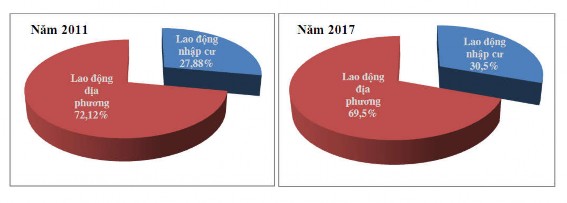
Chart 3.9. Human resources by geography in tourism businesses in Da Nang city from 2011 - 2017
Source: Survey results [76], [80]
In summary, the number of human resources in tourism enterprises in Da Nang city has increased in recent years, the quality has been improved, the basic structure ensures rationality in terms of professional qualifications, gender, age, regardless of geographical area, contributing to the successful implementation of the strategy "Tourism is a key economic sector" set out by the city.