
- Decision No. 1440/QD-TTg dated October 6, 2008 of the Prime Minister approving the Planning of solid waste treatment areas in three key economic regions of the North, Central and South until 2020;
- Circular No. 121/2008/TT-BTC dated December 12, 2008 of the Ministry of Finance guiding incentive mechanisms and financial support for investment activities in solid waste management;
- Decree No. 04/2009/ND-CP dated January 14, 2009 of the Government on incentives and support for environmental protection activities;
- Circular No. 08/2009/TT-BTNMT dated July 15, 2009 of the Ministry of Natural Resources and Environment on Regulations on management and environmental protection of economic zones, high-tech zones, industrial parks and industrial clusters.
- Circular No. 48/2011/TT-BTNMT dated December 28, 2011 of the Ministry of Natural Resources and Environment on amending and supplementing a number of articles of Circular No. 08/2009/TT-BTNMT dated July 15, 2009 of the Ministry of Natural Resources and Environment on Regulations on management and environmental protection of economic zones, high-tech zones, industrial parks and industrial clusters.
Maybe you are interested!
-

 Research Objects, Scope, Contents and Methods
 -
 The Thesis Uses Some Of The Following Research Methods
 -
 Research Objects and Scope
 -
 Current Status and Research Methods of Cracked Basement Rock
 -
 Research on alternative methods of processed feed in rearing black snakehead fish (Channa striata) - 9
- Decision No. 2149/QD-TTg dated December 17, 2009 of the Prime Minister approving the Strategy on integrated solid waste management to 2025.
- QCVN 07:2009/BTNMT on hazardous waste threshold.
- QCVN 02:2008/BTNMT- National technical regulation on emissions from medical solid waste incinerators;
- QCVN 30: 2010/BTMT- National technical regulation on emissions from industrial waste incinerators.
- QCVN 41:2011/BTNMT- National technical regulation on co-treatment of hazardous waste in cement kilns;
- Decision No. 798/QD-TTg dated May 25, 2011 of the Prime Minister approving the Solid Waste Treatment Investment Program for the 2011-2020 period.
- Decision No. 170/QD-TTg dated February 8, 2012 of the Prime Minister on the Master Plan for the hazardous medical solid waste treatment system until 2025.
1.5. Overview of Da Nang city
Da Nang City - an administrative unit directly under the Central Government - includes 6 inner-city districts, 1 suburban district and 1 island district with a total area of 1,256.22 km 2 , of which, inner-city districts cover an area of 213.05 km 2 , suburban districts cover an area of 1,042.48 km 2 , population of 930,000 people (December 2008 data).
Da Nang is located in a typical tropical monsoon climate zone, with high temperatures and little variation. Each year there are two distinct seasons: the rainy season lasts from August to December and the dry season from January to July, with occasional cold spells in winter, but they are not severe and do not last long.
The average annual temperature is about 25.9 0 C; highest in June, July, August, average from 28 - 30 0 C; lowest in December, January, February, average from 18 - 23 0 C. Particularly in the Ba Na mountain forest area at an altitude of nearly 1,500m, the average temperature is about 20 0 C.
Average air humidity is 83.4%; highest in October and November, averaging 85.67 - 87.67%; lowest in June and July, averaging 76.67 - 77.33%. Average annual rainfall is 2,504.57 mm/year; highest in October and November, averaging 550 - 1,000 mm/month; lowest in January, February, March, April, averaging 23 - 40 mm/month.
The terrain of Da Nang city has both plains and mountains. The high and steep mountains are concentrated in the West and Northwest. From here, many mountain ranges run out to the sea, and some low hills are interspersed with narrow coastal plains.
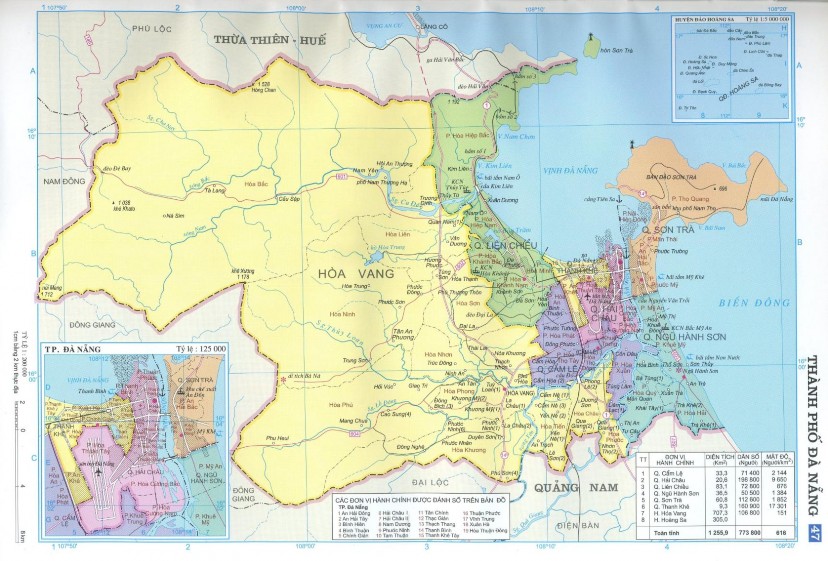
Figure 1.2. Administrative map of Da Nang city
CHAPTER 2: RESEARCH SUBJECTS AND METHODS
2.1. Research subjects
Situation of solid waste generation in Da Nang city (source of solid waste generation, composition and volume of solid waste);
Solid waste management situation in Da Nang city (collection, transportation, storage and treatment of solid waste, legal documents related to solid waste management in Da Nang city);
2.2. Research content
- Synthesize documents related to the situation of generation and management of CTR in Da Nang city;
- Conduct a survey of Da Nang city ;
situation of generation and management of solid waste in
- Assess and forecast the development of solid waste generation in Da Nang city by 2020;
- Assess the current status of waste classification, collection, transportation and treatment in Da Nang city;
- Assess the shortcomings and deficiencies in policies and laws in solid waste management activities (collection, transportation, storage and treatment), propose useful solutions to effectively and closely manage solid waste management activities in Da Nang city.
2.3. Research method
- Inheritance method: Using information and data on the situation of waste generation and management in our country in general and in Da Nang city in particular to serve the research of the thesis;
- Investigation and field survey method: Conductfield investigation .
economic situation
generation, treatment and management of solid waste in Da Nang city; work directly with the Da Nang City Environmental Protection Department and the Da Nang City Urban Environment Company;
- Synthesis and statistical method: synthesize and evaluate the situation of generation, treatment and management of solid waste in Da Nang city.
- Analysis and evaluation method: Based on the information and data that have been compiled, conduct an assessment and analysis of the existing issues in terms of mechanisms and policies of solid waste management in Da Nang city, thereby proposing orientations for solid waste management in Da Nang city to ensure sustainable development;
- Expert method: Currently, in general assessment work, the expert method is considered an important and effective method. This method mobilizes the experience and knowledge of interdisciplinary expert groups in the research field, thereby providing results that are highly practical and scientific, avoiding duplication with existing studies. The research results of the thesis have been consulted with scientists and managers to obtain correct conclusions and recommendations that are suitable to reality.
- Method of forecasting solid waste generation:
Forecasting the situation of CTR generation is actually the work of estimating and predicting the probability of changes in environmental parameters during the process of being affected by economic development. The data of factors affecting the situation of CTR generation mentioned in the thesis are often built on the basis of available data in the past based on the data that has been synthesized and compiled from previous years. Therefore, the forecasting work in this thesis will also use the method of "Analysis of the past and Forecast of the future" including the work of reviewing data on the status, quantity and composition of CTR and the trend of environmental changes in the past to forecast the situation of CTR generation in Da Nang city in the future. In which, 2010 is chosen as the basis for forecasting the situation of waste generation in Da Nang city until 2020, specifically:
+ The amount of CTR generated in the future can be established based on the current amount of CTR combined with the development trend according to economic growth, increasing living standards, urbanization rate and population growth rate of each region:
Domestic CTR = Domestic CTR o (1+k 11 ) i .(1+k 12 ) i. (1+k 13 ) i . .., in which: Domestic CTR o (tons/year): amount of domestic CTR in year 0-year set as milestone Domestic CTR i (tons/year): amount of domestic CTR in year i
K 11 (%): average population growth rate from year (0-i)
K 12 (%): average per capita household CTR generation rate from year (0-i)
K 12 =f(x 1 , x 2 , x 3 , x 4 ,...x n ) is a function that depends on population size, urban population ratio, non-agricultural labor ratio, population density; socio-economic conditions, including economic structure (industry, handicrafts, services); economic growth rate; natural conditions and environmental status.
K 13 (%): average rate of reduction in household solid waste generation per capita from year (0-i) due to improved public awareness and management capacity, environmental protection.
+ The quantity and composition of industrial solid waste from industrial establishments and industrial clusters will be forecasted according to the industrial development speed, planning and development plan of each type of industry.
The amount of industrial waste generated in the future can be established based on the current amount of industrial waste combined with the trend of increasing industrial area use, increasing GDP in industry and concern for environmental issues, as well as tightening environmental protection work in Da Nang city.
Industrial CTR = Industrial CTR0 (1+k 31 ) i . (1-k 32 ) i , where
Industrial CTR 0 (tons/year): amount of industrial CTR at year 0 - the year chosen as the benchmark
Industrial CTR (tons/year): amount of industrial CTR in year i
K 31 (%): coefficient taking into account the growth rate of industrial area usage, the average increase in GDP in industry from year (0-i)
K 32 (%): coefficient when considering the tightening of environmental protection work of the province in industrial parks.
+ The number of hazardous CTRs from medical facilities, hospitals and medical centers will be forecasted based on the number of hospital beds, growth rate, and scale of each medical facility.
+ The amount of conventional medical waste generated in the future can also be established based on the current amount of medical waste combined with the development trend of increasing hospital beds, increasing living standards and increasing use of high-tech treatments (increasing number of tests, therapies and number of surgeries), increasing use of disposable medical equipment such as plastic syringes, plastic gloves... of each hospital as follows:
CTRYT i = CTRYT 0 (1+ k21 ) i . (1+ k22 ) i , in which CTRYT 0 (tons/year): CTRYT volume in year 0-year selected as benchmark CTRYT i (tons/year): CTRYT volume in year i
K 21 (%): average growth rate of hospital beds from year (0-i)
K 22 (%): average rate of generation of hazardous waste per hospital bed from year 0-i
K 22 is f(x 1 , x 2 , x 3 , x 4 ,...x n ) which is a function that depends on the size of the hospital, the increase in the standard of living and the increase in the use of high-tech treatments (increased number of tests, therapies and number of surgeries). The increase in the use of disposable medical devices such as plastic syringes, plastic gloves...
The amount of hazardous waste can be calculated as a percentage of total waste as follows:
Hazardous waste i = TL i . Hazardous waste i (tons/year), in which
TL i (%): the rate of hazardous medical waste generated in the future, which can be established based on the current rate of hazardous medical waste combined with the trend of increasing use of high-tech treatment methods (increasing number of tests, therapies and number of surgeries), increasing use of disposable medical equipment such as plastic syringes, plastic gloves..., the capacity of medical staff in waste classification according to Decision No. 43/2007/QD-BYT of the Ministry of Health of each hospital as follows:
in there:
TL i =TL 0 (1+k 23 ) i . (1-k 24 ) i
K 23 (%): average rate of increase in hazardous CTR from year 0-i due to change in treatment method
K 24 (%): rate of reduction in generation of hazardous waste due to improvement of capacity of health workers in waste classification.
The level of CTR generation per hospital bed in cities is greater than in towns, and in urban areas is greater than in rural areas. When planning, the standard for CTR generation is often taken as follows:
2010: T=1.8-2.0kg/bed.day
Period 2010-2020: T=2.0-2.2kg/bed/person.