
- Identify possible deviations from the intended content. Specific cases should be considered to assess the nature of the deviation.
- Identify corrective actions to get the content back to its intended state.
- Note that this is a very sophisticated art of communication. Therefore, leaders must combine both knowledge of communication and experience in life.
6.5.2 Reception
Receiving guests is a very common type of human communication and also takes up about 10 to 15% of the time. Managers have many types of guests to receive, to receive superiors for inspection, to receive subordinates to reflect opinions, to receive job applicants, to receive customers. Each type of reception has its own purpose. Regardless of the type, the business must achieve its purpose and please the guests. To do so, the reception location must be spacious, respectful, not cramped. The time to receive guests must be moderate, not too short but not too long, there must be a schedule. The way of treating in communication must be polite, in accordance with the rituals and customs, traditions appropriate to each object. Note that when receiving guests who are foreigners, ethnic groups, and religions, they must receive them according to the correct procedures, in accordance with the rituals and styles of each region.
Maybe you are interested!
-
 Identify Rating Levels and Rating Scales
zt2i3t4l5ee
zt2a3gstourism,quan lan,quang ninh,ecology,ecotourism,minh chau,van don,geography,geographical basis,tourism development,science
zt2a3ge
zc2o3n4t5e6n7ts
of the islanders. Therefore, this indicator will be divided into two sub-indicators:
a1. Natural tourism attractiveness a2. Cultural tourism attractiveness
b. Tourist capacity
The two island communes in Quan Lan have different capacities to receive tourists. Minh Chau Commune is home to many standard hotels and resorts, attracting high-income domestic and international tourists. Meanwhile, Quan Lan Commune has many motels mainly built and operated by local people, so the scale and quality are not high, and will be suitable for ordinary tourists such as students.
c. Time of exploitation of Quan Lan Island Commune:
Quan Lan tourism is seasonal due to weather and climate conditions and festivals only take place on certain days of the year, specifically in spring. In Quan Lan commune, the period from April to June and from September to November is considered the best time to visit Quan Lan because the cultural tourism activities are mainly associated with festivals taking place during this time.
Minh Chau island commune:
Tourism exploitation time is all year round, because this is a place with a number of tourist attractions with diverse ecosystems such as Bai Tu Long National Park Research Center, Tram forest, Turtle Laying Beach, so besides coming to the beach for tourism and vacation in the summer, Minh Chau will attract research groups to come for tourism combined with research at other times of the year.
d. Sustainability
The sustainability of ecotourism sites in Quan Lan and Minh Chau communes depends on the sensitivity of the ecosystems to climate changes.
landscape. In general, these tourist destinations have a fairly high level of sustainability, because they are natural ecosystems, planned and protected. However, if a large number of tourists gather at certain times, it can exceed the carrying capacity and affect the sustainability of the environment (polluted beaches, damaged trees, animals moving away from their habitats, etc.), then the sustainability of the above ecosystems (natural ecosystems, human ecosystems) will also be affected and become less sustainable.
e. Location and accessibility
Both island communes have ports to take tourists to visit from Van Don wharf:
- Quan Lan – Van Don traffic route:
Phuc Thinh – Viet Anh high-speed boat and Quang Minh high-speed boat, depart at 8am and 2pm from Van Don to Quan Lan, and at 7am and 1pm from Quan Lan to Van Don. There are also wooden boats departing at 7am and 1pm.
- Van Don - Minh Chau traffic route:
Chung Huong high-speed train, Minh Chau train, morning 7:30 and afternoon 13:30 from Van Don to Minh Chau, morning 6:30 and afternoon 13:00 from Minh Chau to Van Don.
f. Infrastructure
Despite receiving investment attention, the issue of infrastructure and technical facilities for tourism on Quan Lan Island is still an issue that needs to be resolved because it has a direct impact on the implementation of ecotourism activities. The minimum conditions for serving tourists such as accommodation, electricity, water, communication, especially medical services, and security work need to be given top priority. Ecotourism spots in Minh Chau commune are assessed to have better infrastructure and technical facilities for tourism because there are quite complete and synchronous conditions for serving tourists, meeting many needs of domestic and foreign tourists.
3.2.1.4. Determine assessment levels and assessment scales
Corresponding to the levels of each criterion, the index is the score of those levels in the order of 4, 3, 2, 1 decreasing according to the standard of each level: very attractive (4), attractive (3), average (2), less attractive (1).
3.2.1.5. Determining the coefficients of the criteria
For the assessment of DLST in the two communes of Quan Lan and Minh Chau islands, the students added evaluation coefficients to show the importance of the criteria and indicators as follows:
Coefficient 3 with criteria: Attractiveness, Exploitation time. These are the 2 most important criteria for attracting tourists to tourism in general and eco-tourism in particular, so they have the highest coefficient.
Coefficient 2 with criteria: Capacity, Infrastructure, Location and accessibility . Because the assessment area is an island commune of Van Don district, the above criteria are selected by the author with appropriate coefficients at the average level.
Coefficient 1 with criteria: Sustainability. Quan Lan has natural and human-made ecotourism sites, with high biodiversity and little impact from local human factors. Most of the ecotourism sites are still wild, so they are highly sustainable.
3.2.1.6. Results of DLST assessment on Quan Lan island
a. Assessment of the potential for natural tourism development
For Minh Chau commune:
+ Natural tourism attractiveness is determined to be very attractive (4 points) and the most important coefficient (coefficient 3), so the score of the Attractiveness criterion is 4 x 3 = 12.
+ Capacity is determined as average (2 points) and the coefficient is quite important (coefficient 2), then the score of Capacity criterion is 2 x 2 = 4.
+ Exploitation time is long (4 points), the most important coefficient (coefficient 3) so the score of the Exploitation time criterion is 4 x 3 = 12.
+ Sustainability is determined as sustainable (4 points), the important coefficient is the average coefficient (coefficient 1), so the score of the Sustainability criterion is 4 x 1 = 4 points
+ Location and accessibility are determined to be quite favorable (2 points), the coefficient is quite important (coefficient 2), the criterion score is 2 x 2 = 4 points.
+ Infrastructure is assessed as good (3 points), the coefficient is quite important (coefficient 2), then the score of the Infrastructure criterion is 3 x 2 = 6 points.
The total score for evaluating DLST in Minh Chau commune according to 6 evaluation criteria is determined as: 12 + 4 + 12 + 4 + 4 + 6 = 42 points
Similar assessment for Quan Lan commune, we have the following table:
Table 3.3: Assessment of the potential for natural ecotourism development in Quan Lan and Minh Chau communes
Attractiveness of self-tourismof course
Capacity
Mining time
Sustainability
Location and accessibility
Infrastructure
Result
Point
DarkMulti
Point
DarkMulti
Point
DarkMulti
Point
DarkMulti
Point
DarkMulti
Point
DarkMulti
CommuneMinh Chau
12
12
4
8
12
12
4
4
4
8
6
8
42/52
Quan CommuneLan
6
12
6
8
9
12
4
4
4
8
4
8
33/52
b. Assessment of the potential for humanistic tourism development
For Quan Lan commune:
+ The attractiveness of human tourism is determined to be very attractive (4 points) and the most important coefficient (coefficient 3), so the score of the Attractiveness criterion is 4 x 3 = 12.
+ Capacity is determined to be large (3 points) and the coefficient is quite important (coefficient 2), then the score of the Capacity criterion is 3 x 2 = 6.
+ Mining time is average (3 points), the most important coefficient (coefficient 3) so the score of the Mining time criterion is 3 x 3 = 9.
+ Sustainability is determined as sustainable (4 points), the important coefficient is the average coefficient (coefficient 1), so the score of the Sustainability criterion is 4 x 1 = 4 points.
+ Location and accessibility are determined to be quite favorable (2 points), the coefficient is quite important (coefficient 2), the criterion score is 2 x 2 = 4 points.
+ Infrastructure is rated as average (2 points), the coefficient is quite important (coefficient 2), then the score of the Infrastructure criterion is 2 x 2 = 4 points.
The total score for evaluating DLST in Quan Lan commune according to 6 evaluation criteria is determined as: 12 + 6 + 6 + 4 + 4 + 4 = 36 points.
Similar assessment with Minh Chau commune we have the following table:
Table 3.4: Assessment of the potential for developing humanistic eco-tourism in Quan Lan and Minh Chau communes
Attractiveness of human tourismliterature
Capacity
Mining time
Sustainability
Location and accessibility
Infrastructure
Result
Point
DarkMulti
Point
DarkMulti
Point
DarkMulti
Point
DarkMulti
Point
DarkMulti
Point
DarkMulti
Quan CommuneLan
12
12
6
8
9
12
4
4
4
8
4
8
39/52
Minh CommuneChau
6
12
4
8
12
12
4
4
4
8
6
8
36/52
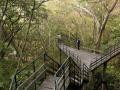
Basically, both Minh Chau and Quan Lan localities have quite favorable conditions for developing ecotourism. However, Quan Lan commune has more advantages to develop ecotourism in a humanistic direction, because this is an area with many famous historical relics such as Quan Lan Communal House, Quan Lan Pagoda, Temple worshiping the hero Tran Khanh Du, ... along with local festivals held annually such as the wind praying ceremony (March 15), Quan Lan festival (June 10-19); due to its location near the port and long exploitation time, the beaches in Quan Lan commune (especially Quan Lan beach) are no longer hygienic and clean to ensure the needs of tourists coming to relax and swim; this is also an area with many beautiful landscapes such as Got Beo wind pass, Ong Phong head, Voi Voi cave, but the ability to access these places is still very limited (dirt hill road, lots of gravel and rocks), especially during rainy and windy times; In addition, other natural resources such as mangrove forests and sea worms have not been really exploited for tourism purposes and ecotourism development. On the contrary, Minh Chau commune has more advantages in developing ecotourism in the direction of natural tourism, this is an area with diverse ecosystems such as at Rua De Beach, Bai Tu Long National Park Conservation Center...; Minh Chau beach is highly appreciated for its natural beauty and cleanliness, ranked in the top ten most beautiful beaches in Vietnam; Minh Chau commune is also home to Tram forest with a large area and a purity of up to 90%, suitable for building bridges through the forest (a very effective type of natural ecotourism currently applied by many countries) for tourists to sightsee, as well as for the purpose of studying and researching.
Figure 3.1: Thenmala Forest Bridge (India) Source: https://www.thenmalaecotourism.com/(August 21, 2019)
3.2.2. Using SWOT matrix to evaluate Quan Lan island tourism
General assessment of current tourism activities of Quan Lan island is shown through the following SWOT matrix:
Table 3.5: SWOT matrix evaluating tourism activities on Quan Lan island
Internal agent
Strengths- There is a lot of potential for tourism development, especially natural ecotourism and humanistic ecotourism.- The unskilled labor force is relatively abundant.- resource environmentunpolluted, still
Weaknesses- Poorly developed infrastructure, especially traffic routes to tourist destinations on the island.- The team of professional staff is still weak.- Tourism products in general
quite wild, originalintact
general and DLST in particularalone is monotonous.
External agents
Opportunity- Tourism is a key industry in the socio-economic development strategy of the province and Van Don economic zone.- Quan Lan was selected as a pilot area for eco-tourism development within the framework of the green growth project between Quang Ninh province and the Japanese organization JICA.- The flow of tourists and especially ecotourism in the world tends toincreasing
Challenge- Weather and climate change abnormally.- Competition in tourism products is increasingly fierce, especially with other localities in the province such as Ha Long, Mong Cai...- Awareness of tourists, especially domestic tourists, about ecotourism and nature conservation is not high.
Through summary analysis using SWOT matrix we see that:
To exploit strengths and take advantage of opportunities, it is necessary to:
- Diversify products and service types (build more tourism routes aimed at specific needs of tourists: experiential tourism immersed in nature, spiritual cultural tourism...)
- Effective exploitation of resources and differentiated products (natural resources and human resources)
div.maincontent .p { color: black; font-family:"Times New Roman", serif; font-style: normal; font-weight: normal; text-decoration: none; font-size: 14pt; margin:0pt; } div.maincontent p { color: black; font-family:"Times New Roman", serif; font-style: normal; font-weight: normal; text-decoration: none; font-size: 14pt; margin:0pt; } div.maincontent .s1 { color: black; font-family:"Times New Roman", serif; font-style: normal; font-weight: normal; text-decoration: none; font-size: 13pt; } div.maincontent .s2 { color: black; font-family:"Times New Roman", serif; font-style: normal; font-weight: normal; text-decoration: none; font-size: 13pt; } div.maincontent .s3 { color: #0D0D0D; font-family:"Times New Roman", serif; font-style: normal; font-weight: bold; text-decoration: none; font-size: 14pt; } div.maincontent .s4 { color: black; font-family:"Times New Roman", serif; font-style: italic; font-weight: normal; text-decoration: none; font-size: 14pt; } div.maincontent .s5 { color: black; font-family:"Times New Roman", serif; font-style: italic; font-weight: bold; text-decoration: none; font-size: 14pt; } div.maincontent .s6 { color: black; font-family:"Times New Roman", serif; font-style: italic; font-weight: normal; text-decoration: none; font-size: 14pt; vertical-align: -3pt; } div.maincontent .s7 { color: black; font-family:"Times New Roman", serif; font-style: italic; font-weight: normal; text-decoration: none; font-size: 14pt; vertical-align: -2pt; } div.maincontent .s8 { color: black; font-family:"Times New Roman", serif; font-style: italic; font-weight: normal; text-decoration: none; font-size: 14pt; vertical-align: -1pt; } div.maincontent .s9 { color: black; font-family:"Times New Roman", serif; font-style: normal; font-weight: normal; text-decoration: none; font-size: 14pt; } div.maincontent .s10 { color: black; font-family:"Times New Roman", serif; font-style: normal; font-weight: bold; text-decoration: none; font-size: 14pt; } div.maincontent .s11 { color: black; font-family:"Times New Roman", serif; font-style: normal; font-weight: normal; text-decoration: none; font-size: 14pt; } div.maincontent .s12 { color: black; font-family:Symbol, serif; font-style: normal; font-weight: normal; text-decoration: none; font-size: 14pt; } div.maincontent .s13 { color: black; font-family:Wingdings; font-style: normal; font-weight: normal; text-decoration: none; font-size: 14pt; } div.maincontent .s14 { color: black; font-family:"Times New Roman", serif; font-style: normal; font-weight: normal; text-decoration: none; font-size: 9pt; vertical-align: 5pt; } div.maincontent .s15 { color: black; font-family:"Times New Roman", serif; font-style: normal; font-weight: normal; text-decoration: none; font-size: 9pt; vertical-align: 5pt; } div.maincontent .s16 { color: black; font-family:Cambria, serif; font-style: italic; font-weight: normal; text-decoration: none; font-size: 14pt; } div.maincontent .s17 { color: #080808; font-family:"Times New Roman", serif; font-style: normal; font-weight: bold; text-decoration: none; font-size: 14pt; } div.maincontent .s18 { color: #080808; font-family:"Times New Roman", serif; font-style: normal; font-weight: normal; text-decoration: none; font-size: 14pt; } div.maincontent .s19 { color: black; font-family:"Times New Roman", serif; font-style: normal; font-weight: normal; text-decoration: none; font-size: 11pt; } div.maincontent .s20 { color: black; font-family:"Times New Roman", serif; font-style: normal; font-weight: normal; text-decoration: none; font-size: 10pt; } div.maincontent .s21 { color: black; font-family:"Times New Roman", serif; font-style: normal; font-weight: bold; text-decoration: none; font-size: 11pt; } div.maincontent .s22 { color: black; font-family:"Times New Roman", serif; font-style: normal; font-weight: normal; text-decoration: none; font-size: 11pt; } div.maincontent .s23 { color: black; font-family:"Times New Roman", serif; font-style: italic; font-weight: normal; text-decoration: none; font-size: 14pt; } div.maincontent .s24 { color: #212121; font-family:"Times New Roman", serif; font-style: normal; font-weight: normal; tex
Identify Rating Levels and Rating Scales
zt2i3t4l5ee
zt2a3gstourism,quan lan,quang ninh,ecology,ecotourism,minh chau,van don,geography,geographical basis,tourism development,science
zt2a3ge
zc2o3n4t5e6n7ts
of the islanders. Therefore, this indicator will be divided into two sub-indicators:
a1. Natural tourism attractiveness a2. Cultural tourism attractiveness
b. Tourist capacity
The two island communes in Quan Lan have different capacities to receive tourists. Minh Chau Commune is home to many standard hotels and resorts, attracting high-income domestic and international tourists. Meanwhile, Quan Lan Commune has many motels mainly built and operated by local people, so the scale and quality are not high, and will be suitable for ordinary tourists such as students.
c. Time of exploitation of Quan Lan Island Commune:
Quan Lan tourism is seasonal due to weather and climate conditions and festivals only take place on certain days of the year, specifically in spring. In Quan Lan commune, the period from April to June and from September to November is considered the best time to visit Quan Lan because the cultural tourism activities are mainly associated with festivals taking place during this time.
Minh Chau island commune:
Tourism exploitation time is all year round, because this is a place with a number of tourist attractions with diverse ecosystems such as Bai Tu Long National Park Research Center, Tram forest, Turtle Laying Beach, so besides coming to the beach for tourism and vacation in the summer, Minh Chau will attract research groups to come for tourism combined with research at other times of the year.
d. Sustainability
The sustainability of ecotourism sites in Quan Lan and Minh Chau communes depends on the sensitivity of the ecosystems to climate changes.
landscape. In general, these tourist destinations have a fairly high level of sustainability, because they are natural ecosystems, planned and protected. However, if a large number of tourists gather at certain times, it can exceed the carrying capacity and affect the sustainability of the environment (polluted beaches, damaged trees, animals moving away from their habitats, etc.), then the sustainability of the above ecosystems (natural ecosystems, human ecosystems) will also be affected and become less sustainable.
e. Location and accessibility
Both island communes have ports to take tourists to visit from Van Don wharf:
- Quan Lan – Van Don traffic route:
Phuc Thinh – Viet Anh high-speed boat and Quang Minh high-speed boat, depart at 8am and 2pm from Van Don to Quan Lan, and at 7am and 1pm from Quan Lan to Van Don. There are also wooden boats departing at 7am and 1pm.
- Van Don - Minh Chau traffic route:
Chung Huong high-speed train, Minh Chau train, morning 7:30 and afternoon 13:30 from Van Don to Minh Chau, morning 6:30 and afternoon 13:00 from Minh Chau to Van Don.
f. Infrastructure
Despite receiving investment attention, the issue of infrastructure and technical facilities for tourism on Quan Lan Island is still an issue that needs to be resolved because it has a direct impact on the implementation of ecotourism activities. The minimum conditions for serving tourists such as accommodation, electricity, water, communication, especially medical services, and security work need to be given top priority. Ecotourism spots in Minh Chau commune are assessed to have better infrastructure and technical facilities for tourism because there are quite complete and synchronous conditions for serving tourists, meeting many needs of domestic and foreign tourists.
3.2.1.4. Determine assessment levels and assessment scales
Corresponding to the levels of each criterion, the index is the score of those levels in the order of 4, 3, 2, 1 decreasing according to the standard of each level: very attractive (4), attractive (3), average (2), less attractive (1).
3.2.1.5. Determining the coefficients of the criteria
For the assessment of DLST in the two communes of Quan Lan and Minh Chau islands, the students added evaluation coefficients to show the importance of the criteria and indicators as follows:
Coefficient 3 with criteria: Attractiveness, Exploitation time. These are the 2 most important criteria for attracting tourists to tourism in general and eco-tourism in particular, so they have the highest coefficient.
Coefficient 2 with criteria: Capacity, Infrastructure, Location and accessibility . Because the assessment area is an island commune of Van Don district, the above criteria are selected by the author with appropriate coefficients at the average level.
Coefficient 1 with criteria: Sustainability. Quan Lan has natural and human-made ecotourism sites, with high biodiversity and little impact from local human factors. Most of the ecotourism sites are still wild, so they are highly sustainable.
3.2.1.6. Results of DLST assessment on Quan Lan island
a. Assessment of the potential for natural tourism development
For Minh Chau commune:
+ Natural tourism attractiveness is determined to be very attractive (4 points) and the most important coefficient (coefficient 3), so the score of the Attractiveness criterion is 4 x 3 = 12.
+ Capacity is determined as average (2 points) and the coefficient is quite important (coefficient 2), then the score of Capacity criterion is 2 x 2 = 4.
+ Exploitation time is long (4 points), the most important coefficient (coefficient 3) so the score of the Exploitation time criterion is 4 x 3 = 12.
+ Sustainability is determined as sustainable (4 points), the important coefficient is the average coefficient (coefficient 1), so the score of the Sustainability criterion is 4 x 1 = 4 points
+ Location and accessibility are determined to be quite favorable (2 points), the coefficient is quite important (coefficient 2), the criterion score is 2 x 2 = 4 points.
+ Infrastructure is assessed as good (3 points), the coefficient is quite important (coefficient 2), then the score of the Infrastructure criterion is 3 x 2 = 6 points.
The total score for evaluating DLST in Minh Chau commune according to 6 evaluation criteria is determined as: 12 + 4 + 12 + 4 + 4 + 6 = 42 points
Similar assessment for Quan Lan commune, we have the following table:
Table 3.3: Assessment of the potential for natural ecotourism development in Quan Lan and Minh Chau communes
Attractiveness of self-tourismof course
Capacity
Mining time
Sustainability
Location and accessibility
Infrastructure
Result
Point
DarkMulti
Point
DarkMulti
Point
DarkMulti
Point
DarkMulti
Point
DarkMulti
Point
DarkMulti
CommuneMinh Chau
12
12
4
8
12
12
4
4
4
8
6
8
42/52
Quan CommuneLan
6
12
6
8
9
12
4
4
4
8
4
8
33/52
b. Assessment of the potential for humanistic tourism development
For Quan Lan commune:
+ The attractiveness of human tourism is determined to be very attractive (4 points) and the most important coefficient (coefficient 3), so the score of the Attractiveness criterion is 4 x 3 = 12.
+ Capacity is determined to be large (3 points) and the coefficient is quite important (coefficient 2), then the score of the Capacity criterion is 3 x 2 = 6.
+ Mining time is average (3 points), the most important coefficient (coefficient 3) so the score of the Mining time criterion is 3 x 3 = 9.
+ Sustainability is determined as sustainable (4 points), the important coefficient is the average coefficient (coefficient 1), so the score of the Sustainability criterion is 4 x 1 = 4 points.
+ Location and accessibility are determined to be quite favorable (2 points), the coefficient is quite important (coefficient 2), the criterion score is 2 x 2 = 4 points.
+ Infrastructure is rated as average (2 points), the coefficient is quite important (coefficient 2), then the score of the Infrastructure criterion is 2 x 2 = 4 points.
The total score for evaluating DLST in Quan Lan commune according to 6 evaluation criteria is determined as: 12 + 6 + 6 + 4 + 4 + 4 = 36 points.
Similar assessment with Minh Chau commune we have the following table:
Table 3.4: Assessment of the potential for developing humanistic eco-tourism in Quan Lan and Minh Chau communes
Attractiveness of human tourismliterature
Capacity
Mining time
Sustainability
Location and accessibility
Infrastructure
Result
Point
DarkMulti
Point
DarkMulti
Point
DarkMulti
Point
DarkMulti
Point
DarkMulti
Point
DarkMulti
Quan CommuneLan
12
12
6
8
9
12
4
4
4
8
4
8
39/52
Minh CommuneChau
6
12
4
8
12
12
4
4
4
8
6
8
36/52
Basically, both Minh Chau and Quan Lan localities have quite favorable conditions for developing ecotourism. However, Quan Lan commune has more advantages to develop ecotourism in a humanistic direction, because this is an area with many famous historical relics such as Quan Lan Communal House, Quan Lan Pagoda, Temple worshiping the hero Tran Khanh Du, ... along with local festivals held annually such as the wind praying ceremony (March 15), Quan Lan festival (June 10-19); due to its location near the port and long exploitation time, the beaches in Quan Lan commune (especially Quan Lan beach) are no longer hygienic and clean to ensure the needs of tourists coming to relax and swim; this is also an area with many beautiful landscapes such as Got Beo wind pass, Ong Phong head, Voi Voi cave, but the ability to access these places is still very limited (dirt hill road, lots of gravel and rocks), especially during rainy and windy times; In addition, other natural resources such as mangrove forests and sea worms have not been really exploited for tourism purposes and ecotourism development. On the contrary, Minh Chau commune has more advantages in developing ecotourism in the direction of natural tourism, this is an area with diverse ecosystems such as at Rua De Beach, Bai Tu Long National Park Conservation Center...; Minh Chau beach is highly appreciated for its natural beauty and cleanliness, ranked in the top ten most beautiful beaches in Vietnam; Minh Chau commune is also home to Tram forest with a large area and a purity of up to 90%, suitable for building bridges through the forest (a very effective type of natural ecotourism currently applied by many countries) for tourists to sightsee, as well as for the purpose of studying and researching.
Figure 3.1: Thenmala Forest Bridge (India) Source: https://www.thenmalaecotourism.com/(August 21, 2019)
3.2.2. Using SWOT matrix to evaluate Quan Lan island tourism
General assessment of current tourism activities of Quan Lan island is shown through the following SWOT matrix:
Table 3.5: SWOT matrix evaluating tourism activities on Quan Lan island
Internal agent
Strengths- There is a lot of potential for tourism development, especially natural ecotourism and humanistic ecotourism.- The unskilled labor force is relatively abundant.- resource environmentunpolluted, still
Weaknesses- Poorly developed infrastructure, especially traffic routes to tourist destinations on the island.- The team of professional staff is still weak.- Tourism products in general
quite wild, originalintact
general and DLST in particularalone is monotonous.
External agents
Opportunity- Tourism is a key industry in the socio-economic development strategy of the province and Van Don economic zone.- Quan Lan was selected as a pilot area for eco-tourism development within the framework of the green growth project between Quang Ninh province and the Japanese organization JICA.- The flow of tourists and especially ecotourism in the world tends toincreasing
Challenge- Weather and climate change abnormally.- Competition in tourism products is increasingly fierce, especially with other localities in the province such as Ha Long, Mong Cai...- Awareness of tourists, especially domestic tourists, about ecotourism and nature conservation is not high.
Through summary analysis using SWOT matrix we see that:
To exploit strengths and take advantage of opportunities, it is necessary to:
- Diversify products and service types (build more tourism routes aimed at specific needs of tourists: experiential tourism immersed in nature, spiritual cultural tourism...)
- Effective exploitation of resources and differentiated products (natural resources and human resources)
div.maincontent .p { color: black; font-family:"Times New Roman", serif; font-style: normal; font-weight: normal; text-decoration: none; font-size: 14pt; margin:0pt; } div.maincontent p { color: black; font-family:"Times New Roman", serif; font-style: normal; font-weight: normal; text-decoration: none; font-size: 14pt; margin:0pt; } div.maincontent .s1 { color: black; font-family:"Times New Roman", serif; font-style: normal; font-weight: normal; text-decoration: none; font-size: 13pt; } div.maincontent .s2 { color: black; font-family:"Times New Roman", serif; font-style: normal; font-weight: normal; text-decoration: none; font-size: 13pt; } div.maincontent .s3 { color: #0D0D0D; font-family:"Times New Roman", serif; font-style: normal; font-weight: bold; text-decoration: none; font-size: 14pt; } div.maincontent .s4 { color: black; font-family:"Times New Roman", serif; font-style: italic; font-weight: normal; text-decoration: none; font-size: 14pt; } div.maincontent .s5 { color: black; font-family:"Times New Roman", serif; font-style: italic; font-weight: bold; text-decoration: none; font-size: 14pt; } div.maincontent .s6 { color: black; font-family:"Times New Roman", serif; font-style: italic; font-weight: normal; text-decoration: none; font-size: 14pt; vertical-align: -3pt; } div.maincontent .s7 { color: black; font-family:"Times New Roman", serif; font-style: italic; font-weight: normal; text-decoration: none; font-size: 14pt; vertical-align: -2pt; } div.maincontent .s8 { color: black; font-family:"Times New Roman", serif; font-style: italic; font-weight: normal; text-decoration: none; font-size: 14pt; vertical-align: -1pt; } div.maincontent .s9 { color: black; font-family:"Times New Roman", serif; font-style: normal; font-weight: normal; text-decoration: none; font-size: 14pt; } div.maincontent .s10 { color: black; font-family:"Times New Roman", serif; font-style: normal; font-weight: bold; text-decoration: none; font-size: 14pt; } div.maincontent .s11 { color: black; font-family:"Times New Roman", serif; font-style: normal; font-weight: normal; text-decoration: none; font-size: 14pt; } div.maincontent .s12 { color: black; font-family:Symbol, serif; font-style: normal; font-weight: normal; text-decoration: none; font-size: 14pt; } div.maincontent .s13 { color: black; font-family:Wingdings; font-style: normal; font-weight: normal; text-decoration: none; font-size: 14pt; } div.maincontent .s14 { color: black; font-family:"Times New Roman", serif; font-style: normal; font-weight: normal; text-decoration: none; font-size: 9pt; vertical-align: 5pt; } div.maincontent .s15 { color: black; font-family:"Times New Roman", serif; font-style: normal; font-weight: normal; text-decoration: none; font-size: 9pt; vertical-align: 5pt; } div.maincontent .s16 { color: black; font-family:Cambria, serif; font-style: italic; font-weight: normal; text-decoration: none; font-size: 14pt; } div.maincontent .s17 { color: #080808; font-family:"Times New Roman", serif; font-style: normal; font-weight: bold; text-decoration: none; font-size: 14pt; } div.maincontent .s18 { color: #080808; font-family:"Times New Roman", serif; font-style: normal; font-weight: normal; text-decoration: none; font-size: 14pt; } div.maincontent .s19 { color: black; font-family:"Times New Roman", serif; font-style: normal; font-weight: normal; text-decoration: none; font-size: 11pt; } div.maincontent .s20 { color: black; font-family:"Times New Roman", serif; font-style: normal; font-weight: normal; text-decoration: none; font-size: 10pt; } div.maincontent .s21 { color: black; font-family:"Times New Roman", serif; font-style: normal; font-weight: bold; text-decoration: none; font-size: 11pt; } div.maincontent .s22 { color: black; font-family:"Times New Roman", serif; font-style: normal; font-weight: normal; text-decoration: none; font-size: 11pt; } div.maincontent .s23 { color: black; font-family:"Times New Roman", serif; font-style: italic; font-weight: normal; text-decoration: none; font-size: 14pt; } div.maincontent .s24 { color: #212121; font-family:"Times New Roman", serif; font-style: normal; font-weight: normal; tex -
 Developing human resources for Ho Chi Minh City's tourism industry in the period 2013-2020 - 2
 -
 Exploiting human tourism resources to develop tourism in Ho Chi Minh City - 29
 -
 Research on some solutions to improve the quality of human resources at Khanh An Preschool Education Equipment Production and Trading Company Limited - 1
 -
 Solutions to Mobilize Investment Resources for Tourism Human Resource Development
Indirect communication via telephone, email, fax. This is an advanced form of communication, which has shortened the space and time in communication. It helps people around the world get closer to each other. Particularly in business administration, it helps managers maintain relationships, contact each other very easily, and saves costs, shortening many cumbersome procedures, especially in international exchanges. Since then, signing economic contracts has been innovated, improved and convenient. Therefore, managers need to take advantage of this form. We need to learn this new way of communication in a scientific and artistic way. For example, the art of talking on the phone is similar to talking to someone in front of you. When speaking, you need to pay attention to expressing your feelings with elegant, thoughtful, respectful and intimate words. Your voice also needs to attract the listener's attention and be convincing.
CHAPTER 6 SUMMARY

- Human resource communication;
- Position in human resources communication;
- Factors governing human resource communication;
- Basic principles of human resource communication;
- Some common forms of human resource communication.
QUESTIONS, DISCUSSION SITUATIONS CHAPTER 6 Question 1: What does the person in human communication include?
A. Parents
B. Adults
C. Children
D. All of the above
Question 2: Which of the following factors is not an element of human resource communication?
A. Purpose of communication.
B. Communication content:
C. Means of communication:
D. Communication context
E. Communication channels
F. Communication
G. Communication results
Sentence 3: One of the principles of interpersonal communication is: 'Respect others and everyone as you respect and love yourself'.
A. True B. False.
Case Study 1: Divide into groups and practice communicating in a hypothetical conference following the principles of human communication
CHAPTER 7: THE ART OF PERSONNEL NEGOTIATION
Introduction to Chapter 7
This chapter helps learners understand the nature of human resource negotiation and the benefits it brings.
Target
Present the nature of personnel negotiations and the decisive factors in personnel negotiations.
Present the art of human resource negotiation.
Carry out personnel negotiation steps.
TEACHING AND LEARNING METHODS CHAPTER 7
- For teachers: use active teaching methods (lecture, question and answer, problem-based teaching); ask students to do discussion questions and exercises in chapter 7 (individually or in groups).
- For learners: actively read the textbook (chapter 7) before class; complete all discussion questions and case studies of chapter 7 individually or in groups and submit them to the teacher on time.
CONDITIONS FOR IMPLEMENTATION OF CHAPTER 7
- Specialized classrooms/workshops: No
- Equipment: Projectors and other teaching equipment
- Learning materials, tools, and supplies: Course curriculum, textbooks, reference materials, lesson plans, movies, and related documents.
- Other conditions: None
CHAPTER 7 REVIEW AND REVIEW
- Content:
Knowledge: Test and evaluate all content stated in the knowledge objectives
Skills: Review and evaluate all content stated in the skill objective
Autonomy and responsibility: During the learning process, learners need to:
+ Study the lesson before coming to class
+ Prepare full learning materials.
+ Participate in full course duration.
+ Serious in learning process.
- Method:
Regular check points: none
Periodic theory test: 01 test
CHAPTER 7 CONTENTS

THE NATURE OF PERSONNEL NEGOTIATION.
7.1.1 The nature of personnel negotiations
In practice, individuals and organizations always use exchanges to reach certain agreements. The more social relations develop, the more closely the rights and obligations of individuals and social groups are assigned to each other. Social conflicts and collisions are also increasingly developing. In the conditions of strong scientific and technological development today, in the conditions of increasingly narrow specialization, the activities of each individual, the relative independence in their lives are increasingly reduced. The interpersonal nature of life is increasing. Therefore, the lives of each individual are always bound together, influencing each other in a unified system of groups and society. Society is increasingly civilized, loosening traditional social repressions to create for each individual to reach for higher freedom. Therefore, the increasing unity and increasing freedom have led to strong social movements in collisions and conflicts. To counteract those strong trends of collision and conflict, people always tend to compromise with each other to create peace and stability in life. Personnel negotiation is a form of communication used to create agreements between two or more parties to reach agreement on the rights and obligations between the parties in the daily life of individuals or organizations. The nature of negotiation is the compromises of two or more parties to agree on the rights and obligations between the parties. In other words, negotiation is a compromise to reach a common voice in social collisions and conflicts or in association and cultivation. Negotiation plays a very important role in society. It is used to achieve the following factors: achieving agreement in relationships to ensure benefits between the parties; achieving agreement on rights and obligations in economic and social exchanges; achieving agreement in perception, common views to unify actions; reducing collisions and conflicts in society.
7.1.2 Classification of personnel negotiations
a. Classification by politics
Political negotiation is a political compromise between parties, social groups, formal and informal groups to achieve common social conventions of a group or many groups or to achieve an arrangement of social roles and positions of parties, social groups, or to achieve a common consensus in coordinating actions. Thus, politically, there are the following types of negotiation:
Political Party negotiations aim to create common conventions in society or coordinate activities or arrange roles and positions between Political Parties.
Social team negotiation aims to create common team conventions or coordinate the actions of a team or teams.
b. Classification by economy
Economic negotiation is an agreement between parties to achieve unity in economic links, unity of action, exchange of products or services, and resolution of disagreements on economic interests between groups of people. Economic negotiation has the following types: negotiation to sign labor contracts, contract work, negotiation to sign collective labor agreements...
c. Classification by foreign affairs work
Foreign negotiations are agreements between businesses or economic organizations or social groups to arrange official relations, coordinate activities between parties or exchange views and attitudes between parties to reach a common voice in related activities. Foreign negotiations include the following types: negotiation of emulation agreements between businesses, negotiation of unification of views and attitudes between parties in coordinating related activities (negotiation with localities in maintaining social order and safety, solving employment for local people...)
d. Classification by social activities
Social negotiation is an agreement between individuals or social groups to settle social conflicts and collisions between individuals or groups to reach a common voice. Social negotiation usually requires a mediator to guide the parties to reach a common agreement. Social negotiation is often called social reconciliation, including: reconciliation between members of society; reconciliation between groups; marital reconciliation...
7.1.3 Principles of personnel negotiation
When negotiating, the parties must adhere to the following general principles in order to reach consensus.
Principle of respect for common law: Law is a unified social convention set by the state to regulate the common activities of individuals and organizations to achieve social unity towards the implementation of the common set goals. Therefore, law is the fundamental basis for regulating social activities and interests to achieve common unity to create stability and social development. The parties in the negotiation must absolutely comply with the law and consider the law as the basis of the agreements, so the agreements are not allowed to go against the provisions of the law.
Principle of respecting the regulations of the parties: The regulations of the parties are legal documents that aim to establish unity of action in organizations to achieve common interests in the organization. In negotiations, the agreements must not violate or go against the regulations of the organization to avoid cases of taking advantage or disrupting the organization. If the agreements violate or go against the regulations of the organization, the organization needs to review the reasonableness of the regulations. If the regulations are too outdated, they can be changed to suit the new conditions. If the regulations are still valid for the organization, the agreements must be abolished and not signed. If the regulations change, they must be changed before reaching an agreement on the agreements. It is absolutely not allowed to agree on the agreement first and then amend the regulations later.
Principle of ensuring the interests of the parties: The interests of the parties are the basis for striving to ensure the existence and development of organizations and individuals, interests are the goals of organizations and individuals. The greater the interests, the stronger the organizations and individuals and vice versa. In negotiations, ensuring the interests of the parties is the top goal of the agreements. Therefore, in negotiations to ensure the interests of the parties, we need to fight against the following tendencies: Abusing power to gain great benefits for oneself and leaving small benefits for the other party; using financial, technical or monopoly power to oppress the other party to damage their interests; cheating to appropriate the other party's interests.
Principle of ensuring legal status and civil rights for the parties: The legal status or civil rights of the parties have been recognized by law and considered as the legal status of an organization or individual in society, subject to the control of social law, having obligations and rights in society and being guaranteed by society for their activities. Legal status or civil rights is the fundamental basis for the activities of organizations and individuals, the basis for organizations and individuals to affirm their roles in society. Agreements in negotiations must not violate the legal status or civil rights of the parties and must respect and create conditions for the parties to promote that legal status and civil rights in society. Agreements in negotiations must not be allowed to harm legal status and civil rights according to the following two trends:
Restricting the legal status or citizenship of one or both parties for example
not allowing relations with third parties or limiting the scope of relations of the legal entity.
A claim that exceeds the legal capacity or citizenship of one or both parties, such as a claim that interferes with the legal capacity of a third party.
Principle of equality and democracy in personnel negotiations: The parties in the negotiation all have legal status or citizenship status. Therefore, respect for legal status and citizenship status will be the basis for ensuring equality and democracy for the parties in the negotiation. In the negotiation, the parties must create conditions for each other to have equal roles, equal voices and voluntary agreement on issues. The following phenomena that deprive the parties of equality and democracy in negotiations are strictly prohibited: relying on one's own strength to impose agreements on the parties; not allowing free expression of will; having the nature of oppressing the other party with certain powers.

DECISIVE FACTORS IN PERSONNEL NEGOTIATIONS.
7.2.1 Background
Context is the conditions and circumstances of the parties to the negotiation. The parties to the negotiation must clearly understand their own conditions and circumstances and those of the other party in order to have a basis for making an agreement that is acceptable to all parties. Conditions and circumstances are expressed in the following contents:
- First, what is the need to negotiate? Needs are what must be satisfied in the process of existence and development of individuals and organizations. The person going to negotiate must answer a series of questions about the following needs:
+ What are the needs that need to be satisfied in negotiation?
+ How much is the demand?
+ What is the level of demand?
+ When do you need to satisfy the crossbow?
+ Where to satisfy needs?
After clearly identifying the necessary needs, it is necessary to determine the goals to be achieved in the negotiation to serve as a basis for the negotiation process not to deviate from the set goals.
- Second, identify the possible action frameworks of the parties to serve as the basis for the agreement. Action frameworks are the limits of the elements that we need to ensure it to achieve the goals of the parties. Those action frameworks
The rewards are: the framework of action of laws and policies (limits of laws and policies of agreements), the framework of acceptable quantity, the framework of acceptable quality and price, the framework of responsibilities and obligations of the parties in performing the agreements.
- Third, determine the necessary conditions for successful negotiations such as: space, time, circumstances, individuals to negotiate. Sending individuals to negotiate requires understanding their individual psychological characteristics. We must fully assess the psychological characteristics that individuals need to have for negotiations such as: being sensitive to uncertain conditions of the situation, having quick, flexible, and accurate reactions to the environment, being calm, knowing how to control oneself, being decisive but knowing how to make concessions when necessary, being friendly, cheerful, humorous in diplomacy, and having pedagogical and psychological knowledge. For the opponent, we need to understand who the person we need to negotiate with is, what their psychological characteristics are, and what their personal history is like. This is extremely necessary information for us to have diplomatic policies as well as solutions to influence psychology to achieve effectiveness in the negotiation process.
To achieve the above context content assessment, organizations need to have a system to collect and process information regularly and systematically, especially to collect and process information of partners in relations with us. To create a favorable negotiation context for themselves, organizations need to pay attention to some of the following psychological factors:
- First is to create a first impression: the first impression is the psychological image of the overall appearance, speech, gestures, manners, eyes, smiles, attitudes, clothing... after the first contact. The first impression greatly influences the psychological factor in negotiation. Therefore, creating an open and friendly first impression will be the basis for success in negotiation.
- Second is social prejudice: Social prejudice is an existing attitude towards the subject in the negotiation. To create social prejudice, we need to send out information that views us in a good way. Creating good prejudices about us towards the other party will be the basis for the negotiation process later.
- Third is to create a social psychological atmosphere in negotiation: The social psychological atmosphere in negotiation is the mood in the relationship and exchange of the parties. It depends greatly on the mental state of the parties, the attitudes and feelings of the parties towards each other.
7.2.2 Time of negotiation
Time in negotiation is a process that has a beginning, development and end.