
one of the most attractive tourist destinations for domestic and foreign tourists, an old resort city in our country. Dalat is famous for its lakes, flowers, waterfalls and pine forests.
The tourist attractions of Da Lat are Cu Hill, Xuan Huong Lake, Suoi Vang Lake, Da Lat Flower Park and other tourist attractions such as Lang Biang Peak, Than Tho Lake, Cam Ly Waterfall, Prenn Waterfall, Love Valley, Dream Hill, Golden Valley (near Dan Kia Lake), Tuyen Lam Lake, Tran Le Xuan Villa Area ... are all impressive destinations for tourists. Popular tourist programs in Da Lat include outdoor and sports tours; Ecotourism tours, research on sports hunting tours; Cultural and festival tours such as sightseeing, learning about cultural customs and festival activities of ethnic minority communities residing in Lam Dong province. Attending buffalo stabbing festivals, gong performances, folk music, visiting Ga - K'long village to learn about the traditional brocade weaving of the K'ho people, visiting the traditional hand embroidery village at Da Lat Historical Museum ...
Along with the growth of national tourism, Lam Dong tourism has recently developed significantly, shown through the following aspects:
- The number of tourists and tourism revenue of the province is the highest compared to other provinces in the Central Highlands region. Infrastructure such as transportation, electricity, telecommunications are developed, tourism facilities and techniques, travel activities, and other tourism services meet the needs of tourists.
Maybe you are interested!
-
 Overview of Tourism Development Issues in Vietnam's National Parks
 -
 Evaluating the Development Potential of Ornamental Flower Craft Villages in Thu Duc District in the Direction of Tourism Associated with Environmental Protection
 -
 Conditions and Potential for Tourism Development in Sam Son Town Sam Son
 -
 Overview of the Development Situation of Vietnam's Tourism Industry
 -
 Hai Duong Tourism - Potential, current situation and development solutions - 9
- The province's typical tourism types have created an attraction for tourists, especially resort tourism; tourism promotion and propaganda work, introducing a tourist destination with new characteristics (Flower Festival) every year, has created a good impression in the hearts of tourists about a Da Lat that is changing every day to satisfy tourists.
- Abundant workforce, gradually standardized and supplemented promptly
In recent years, training and development of tourism human resources have been regularly organized to meet the development requirements of each period. Diverse forms of training and development have contributed to timely supplementing local tourism human resources.
- State management of tourism has made much progress. The Department of Culture, Sports and Tourism of Lam Dong province has advised the Provincial People's Committee to carry out many tasks related to the management of tourism business activities in the area. Develop and implement plans, programs and tourism development programs in accordance with the approved sectoral planning and socio-economic development planning of the province. Effectively implement the work of preventing social evils in the area, specialized management work has gradually become orderly, creating favorable conditions for tourism development.
To achieve the above results, in recent times Lam Dong has focused on implementing the following solutions:
Firstly, perfecting the organization of the industry, arranging and rotating civil servants of the Department and of enterprises according to specialized management levels strong enough to promote the strength of the whole industry to develop tourism activities.
Second, promote the role of state management of tourism activities for all subjects, belonging to all economic sectors operating in tourism services and business activities in the whole province; the tourism industry strengthens coordination with all levels and sectors to create synchronous changes in tourism activities. Continue administrative reform, creating favorable conditions for economic sectors to participate in investing in tourism development. Stabilize the apparatus in a streamlined direction, promote computerization in state management activities, promptly resolve difficulties and problems of tourism enterprises, create cohesion and cooperation for the goal of tourism development. Promote and improve the effectiveness of the Board of Directors.
State direction on provincial tourism and Lam Dong Provincial Tourism Association.
Third, organize to collect opinions from a large number of civil servants in the industry and local people to build the image and symbol of Lam Dong tourism.
Fourth, invest in developing a number of detailed plans in key tourist areas to serve as a basis for investment and calling for investment from domestic and foreign economic sectors.
Fifth, strengthen inter-sectoral and inter-regional coordination (with Ho Chi Minh City, the Central Highlands and South Central Coast provinces) in implementing planning, industry management, tourism promotion and environmental protection.
1.4.3. Lessons learned for Dak Nong province
From the experience of perfecting state management of tourism activities in the above localities, some lessons can be drawn for Dak Nong province as follows:
Firstly, it is necessary to build a long-term, reasonable master plan for tourism development; have strategies, plans and policies to exploit the potential to promote tourism development. In many provinces and cities in the country in general and the Central Highlands in particular, tourism has become an important economic sector or a spearhead economic sector, promoting local socio-economic development. Provinces and cities have master plans, strategies, plans and policies to mobilize domestic and foreign resources to develop tourism. Master plans, strategies, plans and policies for tourism development are built in a very synchronous, unified manner and have specific goals for each development stage. At the same time, these provinces and cities are also very interested in investing in developing infrastructure, material and technical facilities for tourism.
Second, due to the increasingly rich and diverse needs of tourists,
Localities need to diversify tourism products, and at the same time create unique, local tourism products to attract tourists.
Third, do a good job of tourism promotion and propaganda. The purpose of tourism promotion and propaganda is to introduce, form and orient tourists' needs for local tourism products. There needs to be linkage and cooperation between localities, regions and businesses to develop tourism. In the context of Vietnam being a member of the World Trade Organization (WTO), the tourism industry faces fierce competition. Therefore, linkage and cooperation in tourism for mutual development is more necessary than ever. Linkage and cooperation are of particular importance in forming tours and tourist routes and in implementing investment promotion, tourism promotion, etc. to attract tourists, especially international tourists.
Fifth, pay attention to training and developing human resources for the local tourism industry and regularly consolidate, improve and enhance the management and operation capacity of advisory and state management agencies on tourism to promote their role and perform their functions well, including state management of tourism activities, regularly organize seminars or exchanges with localities to learn and exchange experiences in managing and operating tourism activities.
Sixth, regularly carry out inspection and supervision of tourism activities, protect tourism resources, natural environment and tourism society. Tourism development is posing more and more problems that cannot be ignored, for example, the situation of causing damage to the environment, natural tourism resources, even encroaching on cultural and historical works and leading to the development of a number of social evils or the situation of deliberately violating the law by a number of organizations and individuals doing tourism business.
This shows that it is necessary to strengthen inspection and supervision to promptly prevent violations of the law in tourism business, while at the same time doing a good job of protecting tourism resources, the natural environment and the social environment of tourism.
Seventh, issue a strict management mechanism for tourist areas and spots; tourist areas and spots need to ensure the best service quality, friendliness, openness, professionalism of the team directly working on tourism and the attitude of local people; ensure an open, attractive, civilized, polite tourism environment, creating trust, attractiveness and attracting tourists.
Chapter 1 Summary
Tourism is not only a highly effective economic sector but also contributes to improving people's knowledge, restoring health, educating patriotism, solidarity, etc. In recent years, the Vietnamese tourism industry has affirmed its important role and position in the national economy. In addition to the achieved results, in the current context, the tourism industry is facing difficulties and challenges that require State management.
In chapter 1, studying the scientific basis of state management of tourism, the thesis has presented a number of concepts of tourism "from different approaches and research angles, bringing about different understandings and interpretations of tourism", as well as the concept of state management of tourism. The author goes into depth to clarify the necessity of state management of tourism, the function of state management of tourism, the contents of state management of tourism activities of provincial authorities and the factors that influence the effectiveness of state management of tourism activities in the provinces. Initially, creating a scientific basis for state management of tourism for the author's research work in the context of the practical situation of state management of tourism in his locality. Along with that is the learning and absorbing of experiences in state management of tourism in provinces and cities that have done a good job of state management of tourism activities, from which the author has drawn valuable lessons to apply to local tourism development and put into the thesis so that the thesis becomes a useful source of information for managers and scientists who are interested in tourism in general and state management of tourism at the provincial level in particular.
Chapter 2
CURRENT STATE OF STATE MANAGEMENT OF TOURISM IN DAK NONG PROVINCE
2.1. Overview of tourism development potential of Dak Nong province
2.1.1. Natural conditions and tourism resources of Dak Nong province
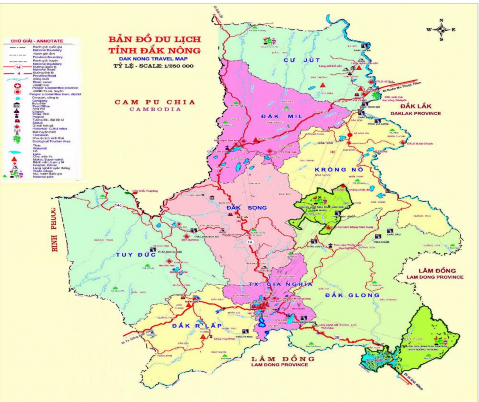
Tourist map of Dak Nong province (Source: Dak Nong Province Investment Promotion Center)
2.1.1.1. Natural conditions
- Geographical location: Dak Nong province is located at the southwestern gateway of the Central Highlands, separated from the old Dak Lak province (January 1, 2004), the North and Northeast border Dak Lak province, 125 km from Buon Ma Thuot city, the East and Southeast border Lam Dong province, 170 km from Da Lat city (Lam Dong) and 190 km from Phan Thiet city (Binh Thuan).
East; South and Southwest border Binh Phuoc province, West border the Kingdom of Cambodia. Dak Nong is located in the Vietnam - Laos - Cambodia development triangle, has a strategic position as a bridge and an important trade hub between the Central Highlands provinces with the southern key economic zone and the South Central Coast region. Dak Nong has national highways 14, 14c, 28 running through it connecting Dak Nong with major tourist centers of the country such as Ho Chi Minh City, Da Lat, Binh Thuan, 2 border gates Bu Prang and Dak Per connecting with neighboring country Cambodia to form inter-regional and national tours, routes, and tourist destinations [47].
- Terrain: The province has a natural area of 6,514 km2, population of over
560,000 people, with 08 districts and towns including Cu Jut, Dak Mil, Krong No, Dak Song, Dak R'lap, Dak G'Long, Tuy Duc and Gia Nghia town.
Dak Nong province is located at an average altitude of 600 - 800m above sea level, with diverse and rich terrain, interspersed between valleys, plateaus and high mountains. High mountainous terrain is located in Dak R'lap, Dak Mil and Gia Nghia districts. Plateau terrain is distributed in Dak G'long, Dak Song districts, and part of Dak Mil district. Low terrain, valleys are distributed along the Sepepok River, located in Cu Jut and Krong No districts [47].
* Climate: Dak Nong's climate is temperate and cool, with the characteristics of a tropical monsoon plateau and is divided into two distinct seasons: rainy season and dry season. The rainy season starts from April to the end of October, accounting for 90% of the annual rainfall. The dry season is from November to April of the following year. The average annual temperature is 23 degrees Celsius, the average air humidity is 84%. The average rainfall is 2,656 mm/year. The total number of sunny hours per year is 2,198 hours/year [47].