- What products does petroleum distillation produce? Products What are the applications of this? | |||
Natural gas of course | - Where is natural gas found and how is it extracted? - What are the applications of natural gas? | ||
Fuel | -What is fuel? What fuels are popular in life? What are the reserves of those fuels in our country? - How to use fuel efficiently? | ||
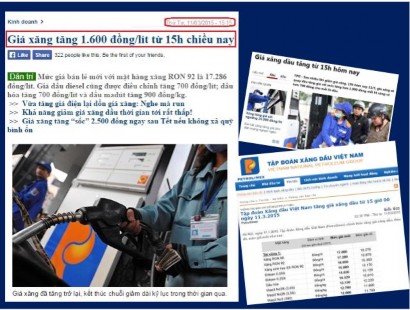
IV. Teaching methods and techniques - Teaching methods: projects, discussions. - Teaching techniques: 5W1H, tablecloth. V. Preparation of teachers and students 1. Teacher - Side board, blue and red markers, magnets. - Petroleum sample, glass cup, water, glass rod. - Sample set: Products processed from petroleum, alcohol, firewood, coal. 2. Students - Read the new lessons in advance: Lesson 40 - Petroleum and natural gas, Lesson 41 - Fuel - Prepare at home in groups: carry out the project "Natural fuels - an important source of energy for humans". VI. Teaching process Activity 1 : Warm up (5 minutes) - The teacher lets students observe images of several newspapers in Vietnam simultaneously reporting on the increase (or decrease) in gasoline prices.
From there, the teacher asked the question: + Why is the increase in gasoline and oil prices getting so much attention? + How to use fuel effectively, especially when human demand is increasing while fuel reserves are decreasing? | |||
Maybe you are interested!
-

 Organizing chemistry teaching according to an integrated approach to develop the ability to apply knowledge and skills for secondary school students - 36
 -
 Current Status of Teaching Chemistry in High Schools According to the Orientation of Developing Students' Capacity
 -
 Organizing physical education teaching activities at People's Security College I in the current reform period - 14
 -
 Internship report at Vietnam Institute of Industrial Chemistry - 1
 -
 Organizing Capacity Training to Develop School Education Programs According to the New General Education Program for Management and Teaching Staff
- Students answer (maybe correctly or not). At the end of the lesson, the teacher can return to the original question.
Analysis of NL development through activities
Activity 1 when implemented aims to develop: TC1: Students discover problems:
- Gasoline and oil are fuels that are of great concern because they have many effects on human life.
TC2: Students ask questions for the problem:
- Besides gasoline and oil, what other fuels are there?
- How to use fuel economically and effectively?
TC3: Students collect information from available knowledge and identify knowledge and skills related to the problem to find answers to the problem, for example:
- Alcohol, firewood, coal, gas… are all fuels.
- Fuel burns completely, takes advantage of heat, saves fuel, avoids waste.
- Choose fuel that suits your needs, avoid environmental pollution
Activity 2 : Learn about the concept of fuel (15 minutes)
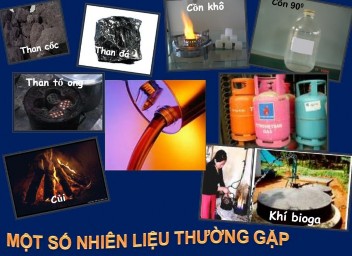
- The teacher asks students to work individually to name fuels using the "brainstorming" technique.
- The teacher asks groups of students to do the alcohol burning experiment and complete the study sheet.
STUDY SHEET 1. Conduct the experiment according to the following instructions and state the phenomenon: - Take 5ml of alcohol and put it in a porcelain bowl and light it with a match. Observed phenomenon ……………………………………………..………….. 2. Answer the following questions: a) Why should we not touch the ceramic base or mouth of the alcohol lamp right after burning alcohol? b) Why does the ceramic base or mouth of the alcohol lamp get hot? |
c) Fuels such as alcohol, coal, firewood, gas... are called fuels because when burned The same phenomenon occurs. So what is fuel? | ||
- Student group representative reports, other students comment. - The teacher concludes the concept of fuel and asks individual students to answer the questions: + When using electricity for lighting and cooking, is electricity a type of fuel? ? Why? + What is fuel used for? Analysis of NL development through activities Activity 2 when implemented aims to develop TC1, TC2, TC3: TC1: Students discover problems: - Firewood, alcohol, coal, and gas all give off heat and light when burned. - Electricity is not fuel. - Fuel provides energy for human life and production activities. TC2: Students ask questions for the problem: - What is fuel? - Why is electricity not fuel? TC3: Students collect information from available knowledge and identify knowledge and skills related to the problem to find answers to the problem. - Fuels are combustible substances that, when burned, release heat and light. - Electricity is a form of energy, not matter, so electricity is not fuel. Activity 3: Orientation for preparing the project «Natural fuel sources» (15 minutes) - Teachers organize for students to carry out the project "Natural fuels - an important source of energy for humans". Problem statement: Natural fuel sources play an important role in human life and production. A workshop was held between representatives of the Ministry of Natural Resources and Environment and scientists and engineers of factories to come up with ways to exploit and use natural fuel sources reasonably, while protecting the sacred sovereignty of the sea and islands of the Fatherland. - The teacher divides the class into 4 groups. - Teachers can use the 5W1H technique to generate ideas about project topics. What: Natural fuel sources include coal, gas, gasoline, ethanol, firewood, straw, etc. When: Research the present and propose solutions for the future. Where: In Vietnam Why: So that Vietnam can develop sustainably. Who: 9th grade student. How: Learn about solid, liquid, and gaseous fuels and propose solutions for economical, efficient, and safe fuel use. - Students discuss and carry out project tasks: | ||
Number of members | Main role | Mission |
7-8 | Content Group | - Search and gather information. |
2-3 | Technical Team | - Come up with presentation design ideas |
2 | Presentation group | - Present products and ideas of the group |
The whole group | Experts | - Answer your group's questions |
Role play | Mission | Product expected | ||||
Engineer of Vietnam National Coal and Mineral Industries Group | - Name some types of coal that the Group is exploiting. - Present the characteristics, applications, distribution in Vietnam, current exploitation methods of those fuels, and propose measures for their use. Use coal economically, effectively and safely. | Power point presentation | ||||
Engineer of Dung Quat Oil Refinery | - Name some liquid fuels. - Present the characteristics, applications, and distribution in Vietnam, state how to exploit these fuels today, and propose measures to use gasoline and oil economically, effectively, and safely. all | Power point presentation | ||||
Engineer of PetroVietnam Gas Corporation | - Name some gas fuels. - Present the characteristics, applications, distribution in Vietnam, state how to exploit these fuels today, propose measures to use gas stoves economically, effectively, and safely. all | Power point presentation | ||||
Information Specialist of the Ministry of Natural Resources and Environment | Propose specific actions that 9th grade students can do to use fuel safely and effectively. | Painting/Poster | ||||
- Teacher guides students to assign tasks in groups: - Teachers prescribe product submission time, reporting time, and evaluation criteria. + Product submission time: 1 week from project implementation. + Group presentation time: no more than 3 minutes. + Evaluation form according to criteria: | ||||||
The criteria | Level 3 | Level 2 | Level 1 | |||
Report content | Meet the requirements, with specific analysis and illustrative examples. painting, with expansion. | Meets requirements, no analysis, illustrative examples painting | Basic requirements not met. | |||
Report format | Beautiful, clear, no major errors describe | Obviously, there are spelling mistakes. | Still monotonous, unclear, still spelling error | ||
Presentation skills | Speak loudly, clearly, confidently, and communicate with others. listener | Speak loudly and clearly, no communication with the listener. | Speak softly, not interacting with the listener | ||
Answer the question | Answer all correctly questions | Correct answer above 50% questions | Correct answer below 50% questions | ||
Analyze the development of human resources through activity 3 when implementing to develop TC1, TC2, TC3, TC4, TC5: TC1: Students discover the problem: - Each type of fuel has different heat characteristics, applications, distribution and uses. - Need to use fuel economically and effectively. TC2: Students ask questions about the problem: - What are the characteristics of coal, gasoline, oil and gas? - In what areas are coal, gasoline, oil and gas used? - In which areas of Vietnam are coal, gasoline, oil and gas found? - How do people exploit coal, gasoline, oil and gas today? - What should be done to use coal, gasoline, oil and gas economically, effectively and safely? TC3: Students collect information from available knowledge and identify knowledge and skills related to the problem to find answers to the problem, for example: - Stop the motorbike for more than 25 seconds and turn off the engine. - CO2 concentration in the air increases, climate change is becoming more and more obvious, the number of storms and strong tornadoes increases, many heat waves, cold spells... TC4: Students make a plan to implement problem solving: Students assign tasks to each member. TC5: Students choose options to solve the problem: Students build the structure, logic, and content of the presentation. Activity 3 : Conducting the project workshop "Natural fuel sources" (30 minutes) - The teacher organizes for groups of students to report. - Students comment and can ask more questions for their group. - Students evaluate other groups based on the criteria assessment form. - In the presentation of student groups, if the formation process of coal, oil and gas has not been presented, the teacher can add it. | |||||
- The teacher summarizes the project, concludes the knowledge, and asks students to develop the following mind map:
Teachers can ask individual students to answer the following questions in each content area:
+ What types of fuel are there? For example?
+ What are the applications of each type of fuel?
+ Compare the calorific value of fuels? Explain why gases are more easily combusted than liquids and solids?
+ List the measures that you and your family have been taking to use fuel economically and efficiently?
Analysis of NL development through activities
Activity 4 when implemented to develop TC6, TC7, TC8, TC9, TC10:
TC6: Students carry out problem solving plans: Students carry out assigned tasks.
TC7: Students draw conclusions and adjust problem solving plans when necessary: Students exchange, discuss and reach agreement in groups.
Students state the conclusion of the problem: shown through the project product.
TC8,9: Students propose solutions to similar and new problems: demonstrated through project products.
TC10: Students have appropriate behavior and attitude when solving problems: demonstrated through project products and answering teacher's questions.
Activity 4 : Discussion on project development «Natural fuel sources» (10 minutes)
- The teacher performs the tablecloth technique and asks the groups to discuss the following question for 3 minutes:
+ Is fuel good or bad? Give examples and analyze to prove your opinion.
+ In your opinion, what should people do to promote the beneficial aspects and limit the harmful aspects of fuel?
- Students in groups present, other students comment.
- The teacher summarizes and can introduce more when fossil fuel sources are gradually depleted, people need to find and use new fuel sources (eg H2 gas ) , improve existing fuels (eg replace RON92 gasoline with E5 gasoline, E10 gasoline) to be more environmentally friendly and high efficiency.
Analysis of NL development through activities Activity 4 when implemented aims to develop TC1, TC2, TC3, TC8, TC9, TC10: TC1: Students discover problems: - Fuel is both beneficial and harmful. - Need to use fuel economically and efficiently. - Need to find new fuel sources or improve existing fuels. TC2: Students ask questions for the problem: - In what situations is fuel beneficial and fuel harmful? - What are fossil fuels, biofuels, and "green" fuels? TC3: Students collect information from available knowledge and identify knowledge and skills related to the problem to find answers to the problem, for example: - Burning fuel provides energy for daily activities and human production activities. This is an advantage. - Fossil fuels when burned create a large amount of CO2 . The concentration of CO2 in the air increases, climate change is becoming more and more obvious, the number of storms and strong tornadoes increases, many heat waves, cold spells... - The process of exploiting, storing and transporting some types of fuel has many potential risks such as: oil spills, mine explosions, gas station fires... - People are researching new fuel sources, using raw materials efficiently, improving engines to consume less fuel... TC8,9: Students propose solutions to similar and new problems: Students propose measures to promote the beneficial aspects and limit the harmful aspects of fuel. TC10: Students have appropriate behavior and attitude when solving problems: demonstrated through answers Teacher's questions | ||
Activity 5 : Practice - Application (15 minutes) - The teacher asks students to do the following exercises: 1. Which of the following cases uses fuel more efficiently and safely?
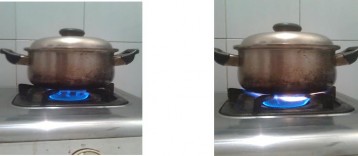
1 vs 2 | ||