
Contents include:
Introduction.
Chapter 1. Overview of optical properties of ferromagnetic nanoparticles.
Chapter 2. Experimental methods.
Maybe you are interested!
-
 Test Results of Optimal Mode Effect on Mechanical Properties
 -
 Assessment of surface water resources in Dong Nai river basin to serve sustainable development goals in the context of climate change - 2
 -
 Research on combining nano additives to enhance the physical and technical properties of natural rubber materials and some of its blends - 2
 -
 Procedure for Disassembling and Assembling the Engine Face (Toyota 1Nz-Fe Engine)
 -
 Research on the application of smartphone utility software to evaluate traffic noise and road surface iri index - 14
Chapter 3. Experiment and discussion of results. .
Conclusion.
List of published studies.
References.
The main results of the thesis can be summarized as follows:
1. Successfully fabricated colloidal solution containing nano-sized Fe 3 O 4 particles and nano colloidal solution CaFe x Mn 1-x O 3 (x= 0.025)
2. Successfully fabricated a weak magnetic field using a ferrite coil with current
controllable, to create magnetic field < 500 Gauss.
3. Study the fluorescence properties of Fe 3 O 4 and CaFe x Mn 1-x O 3 colloidal solutions .
4. Use a number of theoretical models and methods to explain the obtained physical results and effects.
Measurements were performed on the MS-257 Spectrometer of Oriel-Newport/ USA, at the laboratory of the Department of Quantum Optics - Faculty of Physics - University of Science - VNU.
The experimental results showed that (1) there was strong fluorescence in the two solutions mentioned above; (2) the fluorescence decrease was significant in both cases.
CHAPTER 1
OVERVIEW OF OPTICAL PROPERTIES OF FERROMAGNETIC NANOPARTICLES
1.1. Optical-Magnetic Effects in Magnetic Nano Solutions.
Ferrofluid nanosolutions are complex and their complexity depends on factors such as the interaction between magnetic moments, the applied magnetic field gradient, attractive van der Waals forces and repulsive forces, namely steric or ionic [3,4,9] . In general, concentrated ferrofluids impede the propagation of light. Therefore, the solution is usually diluted. When an optically isotropic ferrofluid is diluted and placed in a magnetic field, it usually exhibits optical anisotropy. The solution behaves as a uniaxial substance with the optical axis corresponding to the direction of the applied external magnetic field. In general, the optical axis can be parallel, perpendicular or rotated at a certain angle to the magnetic field axis. The direction of the optical axis can also vary with temperature since there is always thermal motion in the fluid with certain characteristic average values at certain temperatures. Therefore, when light passes through a nanomagnetic solution, the solution may exhibit linear double refraction or linear dichroism or both. In addition to the uniaxial optical anisotropy, the nanomagnetic solution also depends on the magnetic dipole moment of the nanoparticles [4,10] . When an electromagnetic scattering beam passes through a solution, part of the energy is lost and the remaining part is transmitted through the solution. The lost energy may be absorbed by the solution and the remaining part is scattered. The absorbed and scattered energy of course depends on the nature of the scattering material, as well as the wavelength of the scattered light in the solution ( ).
When an external magnetic field is applied, the size distribution causes the number of scattered particles to meet resonance conditions. These resonances can generate standing waves and cause a delay in the transmitted light [3] .
In the case of scattering particles that are spherical magnetic particles scattering in a homogeneous medium, the intensity and polarization state of the scattered rays depend on the size, the dielectric constant related to the charge ( = s / m ), and the magnetization.
permeability is related to magnetism (µ = µ s / µ m ), the subscripts “s” and “m” represent the scattering particles and the solution. Usually, the solution is considered to be a free or non-absorbing isotropic dielectric with µ m = µ 0 , which leads to the real refractive index:
m 0
m m (1.1)
The real refractive index of the scattered particles will be:
m m s / m m
(1.2)
In which: µ = µ' + iµ” and = ' + i ” are the complex permeability and complex dielectric constant, respectively.
Using the Mie formula, the scattering intensities of the two polarization components will be
To be:
I ( 2 / 4 2 r 2 ) S 2 sin 2
(1.3)
1 1
2 2 2 2 2
I 2 ( / 4 r ) S 2 cos
(1.4)
Where r is the distance between the scattering particles to the observation position, is the angle between the charge vector of the incident wave and the scattering surface. I 1 and I 2 are the intensities of the two orthogonal polarization states, corresponding to the two cases where the charge vector is perpendicular and parallel to the scattering surface.
For small particles, applying the Legendre polynomial we have:
4
2 1
(1.5)
We have = 0, I 1 (0 0 ) = 0 and I 2 (0 0 ) = 0, then the intensity of the scattered light has a value of 0.
This condition is difficult to satisfy (at least at optical frequencies) for magnetic scattering particles coated with a non-magnetic colloidal solution and an isotropic dielectric. The condition for observing scattering is not changed when the scattering particles are dispersed in a ferrofluid. Under the influence of a magnetic field, the ferrofluid exhibits anisotropy and the solution becomes
birefringence. Therefore, the condition for zero scattering will be different between the perpendicular and parallel polarization states.
The diffraction pattern affected by the magnetic field and the attenuation caused by the magnetic field of a magnetic solution containing micron-sized magnetite particles are shown in the paper [9] . The diffraction pattern as well as the attenuation of the scattered light intensity change with increasing applied magnetic field values. The diffraction pattern disappears at the critical magnetic field. The disappearance of Fraunhoffer diffraction occurs when magnetic spherical particles are scattered in a solution containing magnetic particles. This property is valid for the phenomenon of zero scattering by magnetic spherical particles [9] .
Figures 1.1 and 1.2 depict the diffraction patterns of 3µm magnetic particles scattered in a magnetic nanosolution for the charge vector E of the incident light perpendicular and parallel to the vector H of the applied magnetic field, respectively. The diffraction pattern exhibits isotropic scattering dependent on the micron-sized magnetic particles for H = 0. As the magnetic field increases, the diffraction pattern in both polarization states is modulated.
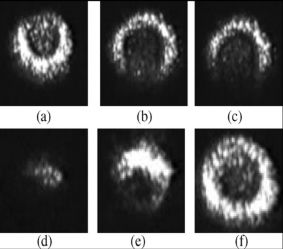
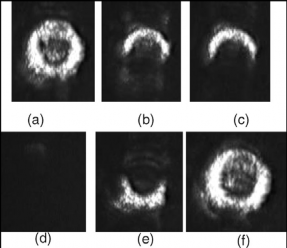
Figure 1.1. Diffraction pattern when E // H, 3µm magnetic spherical particles scattered in magnetic nano solution (density 28%); (a) H=0G, (b) H=30G, (c) H=60G, (d) H=100G, (e) H=200G, (f) H=500G.
Figure 1.2. Diffraction pattern when E H, 3µm magnetic spheres scattered in magnetic nano solution (density 28%); (b) H=30G, (c) H=60G, (d) H=100G, (e) H=200G, (f)
H=500G. Scattering reaches an unobserved value at H=100G (d)
When E is perpendicular to H, we observe the scattering phenomenon reaching zero value at the critical magnetic field value ~100G. Meanwhile, this phenomenon is not observed for the case where E is parallel to H [9] .
Without an applied magnetic field, the sample is isotropic and there is no magnetization or modulation and no change in light intensity. However, under the action of an external magnetic field, the magnetic moment is oriented in the direction of the applied magnetic field and the optical axis is aligned in the direction of the external magnetic field, thus generating a change in light intensity. This light transmission condition is governed by:
I I 0(cot 1 / )
(1.6)
Here:
H
/ kT
(1.7)
I 0 is the intensity of the incident light
k and T are the Boltzmann constant and absolute temperature
μ is the magnetic moment of the particle
H is the applied magnetic field.
Consider a magnetic nanosolution diluted to the point where it allows monochromatic light to pass through it. In this case, the light transmission can be assumed to be governed by the independent scattering of the individual magnetic particles. As a consequence of the fundamental annihilation formula, the transmitted light is determined by the scattering matrices [S(0,φ)] of the individual particles [4,10].
To describe the intensity and polarization of the light beam scattered from a single particle in the (θ, φ) direction in the most convenient way, a scattering matrix is used. In the forward-propagating light field (θ = 0, φ = 0), where θ is the polarization angle and φ is the azimuthal angle. When a large number of randomly oriented particles are considered together (e.g. colloids) the light transmission properties of the medium can be obtained by adding the [S(0)] matrix elements of the individual particles. Under the influence of an applied external magnetic field, the nanomagnetic solution exhibits a uniaxial optical anisotropy with the optical axis along
direction of the applied magnetic field. The optical anisotropy and the non-diagonalization conditions of the scattering matrix appear, the sums over all particles in each unit mass will be zero. The factors S 1 (0) and S 2 (0) are calculated from scattering theory. When the size of the individual magnetic particles is small enough compared to the wavelength of the incident light, Rayleigh scattering theory is applied to the individual particles. The suppression of light through the colloid can be measured by the suppression factor, i.e. the optical density of the medium. The suppression factor is described by the following formula:
ln(1 Δ I)
Q C F
1 I 0
(1.8)
F
In there:
C 0 C 0
CF is the cancellation part of the system under the applied magnetic field .
C 0 is the vanishing part of the system in the absence of an external magnetic field.
Δ I is the change in transmitted light intensity
I 0 is the intensity of transmitted light in the absence of a magnetic field. The ratio Q F is expressed by one of two values Q R or Q L :
Q ( Q )
3( 1 2 ) .[ L ( ) 1]
LL
( 2 )
( Q )
1 2
3( 1 )
(1.9)
L (
2 )
1 2
Q ( Q )
3( 1 2 )
.[ L ( ) 1]
(1.10)
RR
2( 2 )
( Q R )
(
1 2
3( 2 )
2 )
1 2
Then Q L and QR are the cancellation parameters corresponding to the magnetic field directions parallel and perpendicular to the vector E direction of the incident light. ( Q L ) and ( Q L ) are the vanishing parameters at infinite magnetic field.
L ( ) (coth 1 )
(1.11)
1 and 2 are the components of the optical polarization tensor for spherical particles along the two axes. From the above two formulas:
Q Q ( Q Q )
⎡3 L ( ) 1 ⎤
(1.12)
LRLR
⎢ ⎣2 ⎥ ⎦
For the Rayleigh dipole theory, the correlation ( Q L -1)=2(1- Q R ) also holds.
given [4,5,10]
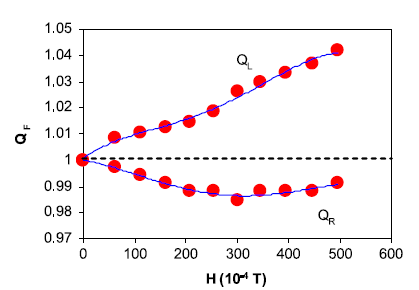
Figure 1.3. Optical-magnetic attenuation of light in ferromagnetic nanosolution; Q L is the extinction parameter in the longitudinal polarization state; Q R is the extinction parameter in the transverse polarization state; The solid line is fitted according to formulas (1.9) and (1.10) [4]
Figure 1.4(A) shows the diffraction pattern produced by a single fiber and observed in a magnetic nanofluid. When a laser beam is passed through the magnetic nanofluid placed in a magnetic field, it produces the diffraction pattern shown in Figure 1.4(B) . This pattern differs from the diffraction pattern produced by a fiber because the individual fringes do not separate from the structure where they are later clearly distinguished. The observed pattern clearly shows that the magnetic particles will form into chains in an external magnetic field. The diffraction pattern from a chain depicts a linear sequence of fringes like
lines that we observe with a single fiber. The intensity of light in these fringes decreases with distance from the central slit. The positions of the maxima are calculated by the formula:
sin n
n ( / d )
(1.13)
In which n is the diffraction angle, n=0, ±1, ±2, ... are the diffraction orders, d is the chain diameter [3,11].
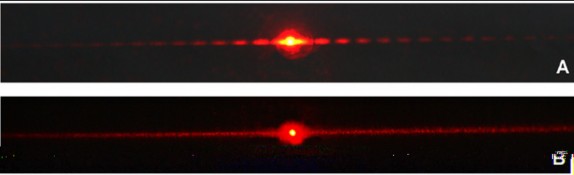
Figure 1.4. Diffraction patterns from a single fiber (A) and chains aggregated in a magnetic nanosolution when an external magnetic field is applied (B) [11]
The diffraction pattern persists for more than an hour after the magnetic field is turned off, especially for magnetic fields stronger than 0.2 T. This observation indicates that the chain structure remains stable over long periods of time and may therefore also have interesting applications in optical storage devices. This long-term stability can be explained by the effect of dipole-dipole attraction between the particles as well as the electrostatic repulsion due to the electrochemical double layer. The key condition for this stability is due to the natural modification of the Derjaguin-Landau-Verwey Overbeek (DLVO) theory:
U(h) = dU / dh = 0 (1.14)
Where U is the interaction energy of magnetic nanoparticles with diameter d separated by thickness h:
kh
M 2 d 6
U A DLVO de
D 0
72 ( h d ) 3
(1.15)
A DLVO is the electrochemical constant used in DLVO theory.