
Manage and implement the Trade Promotion Program, under which enterprises (including FDI enterprises) are supported for export-oriented trade promotion programs and in the domestic market.
- For export-oriented trade promotion
+ Support 50% of commercial information costs, up to 700,000 VND/enterprise;
+ Support 50% of export propaganda costs, maximum 25,000,000 VND/propaganda topic;
+ Support 50% of domestic and foreign expert costs to consult on product development, improve product quality, develop exports, and penetrate foreign markets;
+ Support 70% of costs for organizing and participating in fairs and exhibitions abroad, up to a maximum of 100,000,000 VND/enterprise;
+ Support 50% of the cost of organizing export-oriented exhibitions in the province, maximum 02 booths/enterprise;
+ Support 80% of the costs of propaganda, promotion and inviting customers to trade when organizing fairs and exhibitions, up to 30,000,000 VND/enterprise;
+ Support 70% of costs (1 person per enterprise) for trade promotion activities that have been implemented and are effective in expanding export markets, up to 50,000,000 VND/enterprise.
- For domestic trade promotion:
+ Support 50% of costs for organizing and participating in fairs and exhibitions with no more than 02 booths/01 enterprise;
+ Support 70% of the cost of investigation, survey, and domestic market research, not exceeding 700,000 VND/enterprise;
+ Support 50% of export propaganda costs, not exceeding 15,000,000 VND/propaganda topic;
+ Support 100% of training costs, short-term training on business skills, organizing retail networks; support participation in short-term specialized training courses
for businesses operating in specific industries; training in domestic market development skills for host units; cooperating with organizations and individuals to research and develop domestic market development programs.
The trade promotion support policy clearly demonstrates the local government’s interest in market expansion and customer search activities of businesses and investors. However, for large businesses and investors, this trade promotion funding support is quite modest compared to production and business costs.
3.2.4.9. Local government
a. Economic development policy
According to the Master Plan for Socio-Economic Development of Quang Nam Province to 2020, with a vision to 2030, Quang Nam Province aims to restructure its economy so that by 2020, the agriculture, forestry and fishery sector will account for only about 10% of production value and 38.0% of the labor force in the province, while the non-agricultural sector will account for about 90% of production value and 62% of the labor force. The province's development orientation to 2030 is to "strongly develop advanced technology, high-quality services, high-tech agriculture and a safe and sustainable environment". From there, the Provincial Government has identified breakthroughs in economic development policies in the coming time as follows:
- Focus on developing the province's advantageous dynamic industry clusters, ensuring competitiveness and sustainable economic growth associated with urban centers, especially in forming the eastern development poles of the province.
- Invest in a complete infrastructure network with full airport and seaport infrastructure; synchronize connections between industrial clusters, urban centers and raw material areas to move towards sustainable industrial development.
- Continue to build Chu Lai Open Economic Zone according to the model of a comprehensive economic zone, including industrial parks and export processing zones. Taking the open mechanism as a breakthrough idea throughout and considering adjustments to adapt to the global market.
- Promoting the potential value of cultural relics and scenic spots in the area
The province is working to develop tourism and services into a spearhead economic sector, through urban-rural linkages, linkages of tourism products in the Central Key Economic Zone and the whole country.
To implement the breakthroughs in this economic policy, Quang Nam province needs to mobilize resources from investors, especially foreign investors, to quickly access large capital sources, advanced technology and management. Therefore, in the past years and in the coming time, Quang Nam province will continue to have stronger policies and measures to attract foreign investment to realize the province's socio-economic development plan to 2020 and vision to 2030.
b. Direction and management activities
In recent years, the direction and management activities to create a transparent and convenient investment environment for enterprises have been the key tasks of all levels of government in Quang Nam province. Regarding institutions, the Provincial People's Committee issued Decision No. 3766/QD-UBND dated December 4, 2013 on the Regulations on coordination of the "one-stop shop" mechanism in handling investment procedures in the province and Decision No. 37/QD-UBND dated January 6, 2016 of the Quang Nam Provincial People's Committee on the Regulations on the order of implementing investment projects in Quang Nam province to specify the steps of handling administrative procedures for investors. Regarding organizational structure, the Provincial People's Committee has established public administrative centers in Tam Ky city, Hoi An city and Dien Ban town to better support businesses and people in administrative procedures. The efforts of the local government have been clearly reflected in the results of the Provincial Competitiveness Index published annually by the Vietnam Chamber of Commerce and Industry and the United States Agency for International Development (USAID) based on the results of a survey of the business community. In the past 3 years, Quang Nam province has always been one of the 10 provinces and cities with the highest Provincial Competitiveness Index among 63 provinces and cities nationwide.
Table 3.12. Indicators for assessing the capacity of local governments
2012 | 2013 | 2014 | 2015 | 2016 | 2017 | ||
Competitiveness Provincial level (PCI) | Value | 60.27 | 58.76 | 59.97 | 61.06 | 61.17 | 65.41 |
Ranking | 15 | 27 | 14 | 8 | 10 | 7 | |
Administrative reform Provincial level (PAR Index) | Value | 78.16 | 73.11 | 81.29 | 84.43 | 72.88 | 73.27 |
Ranking | 29 | 52 | 35 | 38 | 32 | 52 | |
Public administration and management efficiency province (PAPI) | Value | 37.51 | 37.80 | 36.40 | 36.53 | 35.99 | 37.08 |
Ranking | 17 | 16 | 33 | 20 | 30 | 27 | |
Ready for development and application of information and communication technology (ICT Index) | Value | 0.41 | 0.35 | 0.39 | 0.47 | 0.44 | 0.36 |
Ranking | 35 | 42 | 45 | 25 | 30 | 40 |
Maybe you are interested!
-
 Identify Rating Levels and Rating Scales
zt2i3t4l5ee
zt2a3gstourism,quan lan,quang ninh,ecology,ecotourism,minh chau,van don,geography,geographical basis,tourism development,science
zt2a3ge
zc2o3n4t5e6n7ts
of the islanders. Therefore, this indicator will be divided into two sub-indicators:
a1. Natural tourism attractiveness a2. Cultural tourism attractiveness
b. Tourist capacity
The two island communes in Quan Lan have different capacities to receive tourists. Minh Chau Commune is home to many standard hotels and resorts, attracting high-income domestic and international tourists. Meanwhile, Quan Lan Commune has many motels mainly built and operated by local people, so the scale and quality are not high, and will be suitable for ordinary tourists such as students.
c. Time of exploitation of Quan Lan Island Commune:
Quan Lan tourism is seasonal due to weather and climate conditions and festivals only take place on certain days of the year, specifically in spring. In Quan Lan commune, the period from April to June and from September to November is considered the best time to visit Quan Lan because the cultural tourism activities are mainly associated with festivals taking place during this time.
Minh Chau island commune:
Tourism exploitation time is all year round, because this is a place with a number of tourist attractions with diverse ecosystems such as Bai Tu Long National Park Research Center, Tram forest, Turtle Laying Beach, so besides coming to the beach for tourism and vacation in the summer, Minh Chau will attract research groups to come for tourism combined with research at other times of the year.
d. Sustainability
The sustainability of ecotourism sites in Quan Lan and Minh Chau communes depends on the sensitivity of the ecosystems to climate changes.
landscape. In general, these tourist destinations have a fairly high level of sustainability, because they are natural ecosystems, planned and protected. However, if a large number of tourists gather at certain times, it can exceed the carrying capacity and affect the sustainability of the environment (polluted beaches, damaged trees, animals moving away from their habitats, etc.), then the sustainability of the above ecosystems (natural ecosystems, human ecosystems) will also be affected and become less sustainable.
e. Location and accessibility
Both island communes have ports to take tourists to visit from Van Don wharf:
- Quan Lan – Van Don traffic route:
Phuc Thinh – Viet Anh high-speed boat and Quang Minh high-speed boat, depart at 8am and 2pm from Van Don to Quan Lan, and at 7am and 1pm from Quan Lan to Van Don. There are also wooden boats departing at 7am and 1pm.
- Van Don - Minh Chau traffic route:
Chung Huong high-speed train, Minh Chau train, morning 7:30 and afternoon 13:30 from Van Don to Minh Chau, morning 6:30 and afternoon 13:00 from Minh Chau to Van Don.
f. Infrastructure
Despite receiving investment attention, the issue of infrastructure and technical facilities for tourism on Quan Lan Island is still an issue that needs to be resolved because it has a direct impact on the implementation of ecotourism activities. The minimum conditions for serving tourists such as accommodation, electricity, water, communication, especially medical services, and security work need to be given top priority. Ecotourism spots in Minh Chau commune are assessed to have better infrastructure and technical facilities for tourism because there are quite complete and synchronous conditions for serving tourists, meeting many needs of domestic and foreign tourists.
3.2.1.4. Determine assessment levels and assessment scales
Corresponding to the levels of each criterion, the index is the score of those levels in the order of 4, 3, 2, 1 decreasing according to the standard of each level: very attractive (4), attractive (3), average (2), less attractive (1).
3.2.1.5. Determining the coefficients of the criteria
For the assessment of DLST in the two communes of Quan Lan and Minh Chau islands, the students added evaluation coefficients to show the importance of the criteria and indicators as follows:
Coefficient 3 with criteria: Attractiveness, Exploitation time. These are the 2 most important criteria for attracting tourists to tourism in general and eco-tourism in particular, so they have the highest coefficient.
Coefficient 2 with criteria: Capacity, Infrastructure, Location and accessibility . Because the assessment area is an island commune of Van Don district, the above criteria are selected by the author with appropriate coefficients at the average level.
Coefficient 1 with criteria: Sustainability. Quan Lan has natural and human-made ecotourism sites, with high biodiversity and little impact from local human factors. Most of the ecotourism sites are still wild, so they are highly sustainable.
3.2.1.6. Results of DLST assessment on Quan Lan island
a. Assessment of the potential for natural tourism development
For Minh Chau commune:
+ Natural tourism attractiveness is determined to be very attractive (4 points) and the most important coefficient (coefficient 3), so the score of the Attractiveness criterion is 4 x 3 = 12.
+ Capacity is determined as average (2 points) and the coefficient is quite important (coefficient 2), then the score of Capacity criterion is 2 x 2 = 4.
+ Exploitation time is long (4 points), the most important coefficient (coefficient 3) so the score of the Exploitation time criterion is 4 x 3 = 12.
+ Sustainability is determined as sustainable (4 points), the important coefficient is the average coefficient (coefficient 1), so the score of the Sustainability criterion is 4 x 1 = 4 points
+ Location and accessibility are determined to be quite favorable (2 points), the coefficient is quite important (coefficient 2), the criterion score is 2 x 2 = 4 points.
+ Infrastructure is assessed as good (3 points), the coefficient is quite important (coefficient 2), then the score of the Infrastructure criterion is 3 x 2 = 6 points.
The total score for evaluating DLST in Minh Chau commune according to 6 evaluation criteria is determined as: 12 + 4 + 12 + 4 + 4 + 6 = 42 points
Similar assessment for Quan Lan commune, we have the following table:
Table 3.3: Assessment of the potential for natural ecotourism development in Quan Lan and Minh Chau communes
Attractiveness of self-tourismof course
Capacity
Mining time
Sustainability
Location and accessibility
Infrastructure
Result
Point
DarkMulti
Point
DarkMulti
Point
DarkMulti
Point
DarkMulti
Point
DarkMulti
Point
DarkMulti
CommuneMinh Chau
12
12
4
8
12
12
4
4
4
8
6
8
42/52
Quan CommuneLan
6
12
6
8
9
12
4
4
4
8
4
8
33/52
b. Assessment of the potential for humanistic tourism development
For Quan Lan commune:
+ The attractiveness of human tourism is determined to be very attractive (4 points) and the most important coefficient (coefficient 3), so the score of the Attractiveness criterion is 4 x 3 = 12.
+ Capacity is determined to be large (3 points) and the coefficient is quite important (coefficient 2), then the score of the Capacity criterion is 3 x 2 = 6.
+ Mining time is average (3 points), the most important coefficient (coefficient 3) so the score of the Mining time criterion is 3 x 3 = 9.
+ Sustainability is determined as sustainable (4 points), the important coefficient is the average coefficient (coefficient 1), so the score of the Sustainability criterion is 4 x 1 = 4 points.
+ Location and accessibility are determined to be quite favorable (2 points), the coefficient is quite important (coefficient 2), the criterion score is 2 x 2 = 4 points.
+ Infrastructure is rated as average (2 points), the coefficient is quite important (coefficient 2), then the score of the Infrastructure criterion is 2 x 2 = 4 points.
The total score for evaluating DLST in Quan Lan commune according to 6 evaluation criteria is determined as: 12 + 6 + 6 + 4 + 4 + 4 = 36 points.
Similar assessment with Minh Chau commune we have the following table:
Table 3.4: Assessment of the potential for developing humanistic eco-tourism in Quan Lan and Minh Chau communes
Attractiveness of human tourismliterature
Capacity
Mining time
Sustainability
Location and accessibility
Infrastructure
Result
Point
DarkMulti
Point
DarkMulti
Point
DarkMulti
Point
DarkMulti
Point
DarkMulti
Point
DarkMulti
Quan CommuneLan
12
12
6
8
9
12
4
4
4
8
4
8
39/52
Minh CommuneChau
6
12
4
8
12
12
4
4
4
8
6
8
36/52
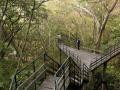
Basically, both Minh Chau and Quan Lan localities have quite favorable conditions for developing ecotourism. However, Quan Lan commune has more advantages to develop ecotourism in a humanistic direction, because this is an area with many famous historical relics such as Quan Lan Communal House, Quan Lan Pagoda, Temple worshiping the hero Tran Khanh Du, ... along with local festivals held annually such as the wind praying ceremony (March 15), Quan Lan festival (June 10-19); due to its location near the port and long exploitation time, the beaches in Quan Lan commune (especially Quan Lan beach) are no longer hygienic and clean to ensure the needs of tourists coming to relax and swim; this is also an area with many beautiful landscapes such as Got Beo wind pass, Ong Phong head, Voi Voi cave, but the ability to access these places is still very limited (dirt hill road, lots of gravel and rocks), especially during rainy and windy times; In addition, other natural resources such as mangrove forests and sea worms have not been really exploited for tourism purposes and ecotourism development. On the contrary, Minh Chau commune has more advantages in developing ecotourism in the direction of natural tourism, this is an area with diverse ecosystems such as at Rua De Beach, Bai Tu Long National Park Conservation Center...; Minh Chau beach is highly appreciated for its natural beauty and cleanliness, ranked in the top ten most beautiful beaches in Vietnam; Minh Chau commune is also home to Tram forest with a large area and a purity of up to 90%, suitable for building bridges through the forest (a very effective type of natural ecotourism currently applied by many countries) for tourists to sightsee, as well as for the purpose of studying and researching.
Figure 3.1: Thenmala Forest Bridge (India) Source: https://www.thenmalaecotourism.com/(August 21, 2019)
3.2.2. Using SWOT matrix to evaluate Quan Lan island tourism
General assessment of current tourism activities of Quan Lan island is shown through the following SWOT matrix:
Table 3.5: SWOT matrix evaluating tourism activities on Quan Lan island
Internal agent
Strengths- There is a lot of potential for tourism development, especially natural ecotourism and humanistic ecotourism.- The unskilled labor force is relatively abundant.- resource environmentunpolluted, still
Weaknesses- Poorly developed infrastructure, especially traffic routes to tourist destinations on the island.- The team of professional staff is still weak.- Tourism products in general
quite wild, originalintact
general and DLST in particularalone is monotonous.
External agents
Opportunity- Tourism is a key industry in the socio-economic development strategy of the province and Van Don economic zone.- Quan Lan was selected as a pilot area for eco-tourism development within the framework of the green growth project between Quang Ninh province and the Japanese organization JICA.- The flow of tourists and especially ecotourism in the world tends toincreasing
Challenge- Weather and climate change abnormally.- Competition in tourism products is increasingly fierce, especially with other localities in the province such as Ha Long, Mong Cai...- Awareness of tourists, especially domestic tourists, about ecotourism and nature conservation is not high.
Through summary analysis using SWOT matrix we see that:
To exploit strengths and take advantage of opportunities, it is necessary to:
- Diversify products and service types (build more tourism routes aimed at specific needs of tourists: experiential tourism immersed in nature, spiritual cultural tourism...)
- Effective exploitation of resources and differentiated products (natural resources and human resources)
div.maincontent .p { color: black; font-family:"Times New Roman", serif; font-style: normal; font-weight: normal; text-decoration: none; font-size: 14pt; margin:0pt; } div.maincontent p { color: black; font-family:"Times New Roman", serif; font-style: normal; font-weight: normal; text-decoration: none; font-size: 14pt; margin:0pt; } div.maincontent .s1 { color: black; font-family:"Times New Roman", serif; font-style: normal; font-weight: normal; text-decoration: none; font-size: 13pt; } div.maincontent .s2 { color: black; font-family:"Times New Roman", serif; font-style: normal; font-weight: normal; text-decoration: none; font-size: 13pt; } div.maincontent .s3 { color: #0D0D0D; font-family:"Times New Roman", serif; font-style: normal; font-weight: bold; text-decoration: none; font-size: 14pt; } div.maincontent .s4 { color: black; font-family:"Times New Roman", serif; font-style: italic; font-weight: normal; text-decoration: none; font-size: 14pt; } div.maincontent .s5 { color: black; font-family:"Times New Roman", serif; font-style: italic; font-weight: bold; text-decoration: none; font-size: 14pt; } div.maincontent .s6 { color: black; font-family:"Times New Roman", serif; font-style: italic; font-weight: normal; text-decoration: none; font-size: 14pt; vertical-align: -3pt; } div.maincontent .s7 { color: black; font-family:"Times New Roman", serif; font-style: italic; font-weight: normal; text-decoration: none; font-size: 14pt; vertical-align: -2pt; } div.maincontent .s8 { color: black; font-family:"Times New Roman", serif; font-style: italic; font-weight: normal; text-decoration: none; font-size: 14pt; vertical-align: -1pt; } div.maincontent .s9 { color: black; font-family:"Times New Roman", serif; font-style: normal; font-weight: normal; text-decoration: none; font-size: 14pt; } div.maincontent .s10 { color: black; font-family:"Times New Roman", serif; font-style: normal; font-weight: bold; text-decoration: none; font-size: 14pt; } div.maincontent .s11 { color: black; font-family:"Times New Roman", serif; font-style: normal; font-weight: normal; text-decoration: none; font-size: 14pt; } div.maincontent .s12 { color: black; font-family:Symbol, serif; font-style: normal; font-weight: normal; text-decoration: none; font-size: 14pt; } div.maincontent .s13 { color: black; font-family:Wingdings; font-style: normal; font-weight: normal; text-decoration: none; font-size: 14pt; } div.maincontent .s14 { color: black; font-family:"Times New Roman", serif; font-style: normal; font-weight: normal; text-decoration: none; font-size: 9pt; vertical-align: 5pt; } div.maincontent .s15 { color: black; font-family:"Times New Roman", serif; font-style: normal; font-weight: normal; text-decoration: none; font-size: 9pt; vertical-align: 5pt; } div.maincontent .s16 { color: black; font-family:Cambria, serif; font-style: italic; font-weight: normal; text-decoration: none; font-size: 14pt; } div.maincontent .s17 { color: #080808; font-family:"Times New Roman", serif; font-style: normal; font-weight: bold; text-decoration: none; font-size: 14pt; } div.maincontent .s18 { color: #080808; font-family:"Times New Roman", serif; font-style: normal; font-weight: normal; text-decoration: none; font-size: 14pt; } div.maincontent .s19 { color: black; font-family:"Times New Roman", serif; font-style: normal; font-weight: normal; text-decoration: none; font-size: 11pt; } div.maincontent .s20 { color: black; font-family:"Times New Roman", serif; font-style: normal; font-weight: normal; text-decoration: none; font-size: 10pt; } div.maincontent .s21 { color: black; font-family:"Times New Roman", serif; font-style: normal; font-weight: bold; text-decoration: none; font-size: 11pt; } div.maincontent .s22 { color: black; font-family:"Times New Roman", serif; font-style: normal; font-weight: normal; text-decoration: none; font-size: 11pt; } div.maincontent .s23 { color: black; font-family:"Times New Roman", serif; font-style: italic; font-weight: normal; text-decoration: none; font-size: 14pt; } div.maincontent .s24 { color: #212121; font-family:"Times New Roman", serif; font-style: normal; font-weight: normal; tex
Identify Rating Levels and Rating Scales
zt2i3t4l5ee
zt2a3gstourism,quan lan,quang ninh,ecology,ecotourism,minh chau,van don,geography,geographical basis,tourism development,science
zt2a3ge
zc2o3n4t5e6n7ts
of the islanders. Therefore, this indicator will be divided into two sub-indicators:
a1. Natural tourism attractiveness a2. Cultural tourism attractiveness
b. Tourist capacity
The two island communes in Quan Lan have different capacities to receive tourists. Minh Chau Commune is home to many standard hotels and resorts, attracting high-income domestic and international tourists. Meanwhile, Quan Lan Commune has many motels mainly built and operated by local people, so the scale and quality are not high, and will be suitable for ordinary tourists such as students.
c. Time of exploitation of Quan Lan Island Commune:
Quan Lan tourism is seasonal due to weather and climate conditions and festivals only take place on certain days of the year, specifically in spring. In Quan Lan commune, the period from April to June and from September to November is considered the best time to visit Quan Lan because the cultural tourism activities are mainly associated with festivals taking place during this time.
Minh Chau island commune:
Tourism exploitation time is all year round, because this is a place with a number of tourist attractions with diverse ecosystems such as Bai Tu Long National Park Research Center, Tram forest, Turtle Laying Beach, so besides coming to the beach for tourism and vacation in the summer, Minh Chau will attract research groups to come for tourism combined with research at other times of the year.
d. Sustainability
The sustainability of ecotourism sites in Quan Lan and Minh Chau communes depends on the sensitivity of the ecosystems to climate changes.
landscape. In general, these tourist destinations have a fairly high level of sustainability, because they are natural ecosystems, planned and protected. However, if a large number of tourists gather at certain times, it can exceed the carrying capacity and affect the sustainability of the environment (polluted beaches, damaged trees, animals moving away from their habitats, etc.), then the sustainability of the above ecosystems (natural ecosystems, human ecosystems) will also be affected and become less sustainable.
e. Location and accessibility
Both island communes have ports to take tourists to visit from Van Don wharf:
- Quan Lan – Van Don traffic route:
Phuc Thinh – Viet Anh high-speed boat and Quang Minh high-speed boat, depart at 8am and 2pm from Van Don to Quan Lan, and at 7am and 1pm from Quan Lan to Van Don. There are also wooden boats departing at 7am and 1pm.
- Van Don - Minh Chau traffic route:
Chung Huong high-speed train, Minh Chau train, morning 7:30 and afternoon 13:30 from Van Don to Minh Chau, morning 6:30 and afternoon 13:00 from Minh Chau to Van Don.
f. Infrastructure
Despite receiving investment attention, the issue of infrastructure and technical facilities for tourism on Quan Lan Island is still an issue that needs to be resolved because it has a direct impact on the implementation of ecotourism activities. The minimum conditions for serving tourists such as accommodation, electricity, water, communication, especially medical services, and security work need to be given top priority. Ecotourism spots in Minh Chau commune are assessed to have better infrastructure and technical facilities for tourism because there are quite complete and synchronous conditions for serving tourists, meeting many needs of domestic and foreign tourists.
3.2.1.4. Determine assessment levels and assessment scales
Corresponding to the levels of each criterion, the index is the score of those levels in the order of 4, 3, 2, 1 decreasing according to the standard of each level: very attractive (4), attractive (3), average (2), less attractive (1).
3.2.1.5. Determining the coefficients of the criteria
For the assessment of DLST in the two communes of Quan Lan and Minh Chau islands, the students added evaluation coefficients to show the importance of the criteria and indicators as follows:
Coefficient 3 with criteria: Attractiveness, Exploitation time. These are the 2 most important criteria for attracting tourists to tourism in general and eco-tourism in particular, so they have the highest coefficient.
Coefficient 2 with criteria: Capacity, Infrastructure, Location and accessibility . Because the assessment area is an island commune of Van Don district, the above criteria are selected by the author with appropriate coefficients at the average level.
Coefficient 1 with criteria: Sustainability. Quan Lan has natural and human-made ecotourism sites, with high biodiversity and little impact from local human factors. Most of the ecotourism sites are still wild, so they are highly sustainable.
3.2.1.6. Results of DLST assessment on Quan Lan island
a. Assessment of the potential for natural tourism development
For Minh Chau commune:
+ Natural tourism attractiveness is determined to be very attractive (4 points) and the most important coefficient (coefficient 3), so the score of the Attractiveness criterion is 4 x 3 = 12.
+ Capacity is determined as average (2 points) and the coefficient is quite important (coefficient 2), then the score of Capacity criterion is 2 x 2 = 4.
+ Exploitation time is long (4 points), the most important coefficient (coefficient 3) so the score of the Exploitation time criterion is 4 x 3 = 12.
+ Sustainability is determined as sustainable (4 points), the important coefficient is the average coefficient (coefficient 1), so the score of the Sustainability criterion is 4 x 1 = 4 points
+ Location and accessibility are determined to be quite favorable (2 points), the coefficient is quite important (coefficient 2), the criterion score is 2 x 2 = 4 points.
+ Infrastructure is assessed as good (3 points), the coefficient is quite important (coefficient 2), then the score of the Infrastructure criterion is 3 x 2 = 6 points.
The total score for evaluating DLST in Minh Chau commune according to 6 evaluation criteria is determined as: 12 + 4 + 12 + 4 + 4 + 6 = 42 points
Similar assessment for Quan Lan commune, we have the following table:
Table 3.3: Assessment of the potential for natural ecotourism development in Quan Lan and Minh Chau communes
Attractiveness of self-tourismof course
Capacity
Mining time
Sustainability
Location and accessibility
Infrastructure
Result
Point
DarkMulti
Point
DarkMulti
Point
DarkMulti
Point
DarkMulti
Point
DarkMulti
Point
DarkMulti
CommuneMinh Chau
12
12
4
8
12
12
4
4
4
8
6
8
42/52
Quan CommuneLan
6
12
6
8
9
12
4
4
4
8
4
8
33/52
b. Assessment of the potential for humanistic tourism development
For Quan Lan commune:
+ The attractiveness of human tourism is determined to be very attractive (4 points) and the most important coefficient (coefficient 3), so the score of the Attractiveness criterion is 4 x 3 = 12.
+ Capacity is determined to be large (3 points) and the coefficient is quite important (coefficient 2), then the score of the Capacity criterion is 3 x 2 = 6.
+ Mining time is average (3 points), the most important coefficient (coefficient 3) so the score of the Mining time criterion is 3 x 3 = 9.
+ Sustainability is determined as sustainable (4 points), the important coefficient is the average coefficient (coefficient 1), so the score of the Sustainability criterion is 4 x 1 = 4 points.
+ Location and accessibility are determined to be quite favorable (2 points), the coefficient is quite important (coefficient 2), the criterion score is 2 x 2 = 4 points.
+ Infrastructure is rated as average (2 points), the coefficient is quite important (coefficient 2), then the score of the Infrastructure criterion is 2 x 2 = 4 points.
The total score for evaluating DLST in Quan Lan commune according to 6 evaluation criteria is determined as: 12 + 6 + 6 + 4 + 4 + 4 = 36 points.
Similar assessment with Minh Chau commune we have the following table:
Table 3.4: Assessment of the potential for developing humanistic eco-tourism in Quan Lan and Minh Chau communes
Attractiveness of human tourismliterature
Capacity
Mining time
Sustainability
Location and accessibility
Infrastructure
Result
Point
DarkMulti
Point
DarkMulti
Point
DarkMulti
Point
DarkMulti
Point
DarkMulti
Point
DarkMulti
Quan CommuneLan
12
12
6
8
9
12
4
4
4
8
4
8
39/52
Minh CommuneChau
6
12
4
8
12
12
4
4
4
8
6
8
36/52
Basically, both Minh Chau and Quan Lan localities have quite favorable conditions for developing ecotourism. However, Quan Lan commune has more advantages to develop ecotourism in a humanistic direction, because this is an area with many famous historical relics such as Quan Lan Communal House, Quan Lan Pagoda, Temple worshiping the hero Tran Khanh Du, ... along with local festivals held annually such as the wind praying ceremony (March 15), Quan Lan festival (June 10-19); due to its location near the port and long exploitation time, the beaches in Quan Lan commune (especially Quan Lan beach) are no longer hygienic and clean to ensure the needs of tourists coming to relax and swim; this is also an area with many beautiful landscapes such as Got Beo wind pass, Ong Phong head, Voi Voi cave, but the ability to access these places is still very limited (dirt hill road, lots of gravel and rocks), especially during rainy and windy times; In addition, other natural resources such as mangrove forests and sea worms have not been really exploited for tourism purposes and ecotourism development. On the contrary, Minh Chau commune has more advantages in developing ecotourism in the direction of natural tourism, this is an area with diverse ecosystems such as at Rua De Beach, Bai Tu Long National Park Conservation Center...; Minh Chau beach is highly appreciated for its natural beauty and cleanliness, ranked in the top ten most beautiful beaches in Vietnam; Minh Chau commune is also home to Tram forest with a large area and a purity of up to 90%, suitable for building bridges through the forest (a very effective type of natural ecotourism currently applied by many countries) for tourists to sightsee, as well as for the purpose of studying and researching.
Figure 3.1: Thenmala Forest Bridge (India) Source: https://www.thenmalaecotourism.com/(August 21, 2019)
3.2.2. Using SWOT matrix to evaluate Quan Lan island tourism
General assessment of current tourism activities of Quan Lan island is shown through the following SWOT matrix:
Table 3.5: SWOT matrix evaluating tourism activities on Quan Lan island
Internal agent
Strengths- There is a lot of potential for tourism development, especially natural ecotourism and humanistic ecotourism.- The unskilled labor force is relatively abundant.- resource environmentunpolluted, still
Weaknesses- Poorly developed infrastructure, especially traffic routes to tourist destinations on the island.- The team of professional staff is still weak.- Tourism products in general
quite wild, originalintact
general and DLST in particularalone is monotonous.
External agents
Opportunity- Tourism is a key industry in the socio-economic development strategy of the province and Van Don economic zone.- Quan Lan was selected as a pilot area for eco-tourism development within the framework of the green growth project between Quang Ninh province and the Japanese organization JICA.- The flow of tourists and especially ecotourism in the world tends toincreasing
Challenge- Weather and climate change abnormally.- Competition in tourism products is increasingly fierce, especially with other localities in the province such as Ha Long, Mong Cai...- Awareness of tourists, especially domestic tourists, about ecotourism and nature conservation is not high.
Through summary analysis using SWOT matrix we see that:
To exploit strengths and take advantage of opportunities, it is necessary to:
- Diversify products and service types (build more tourism routes aimed at specific needs of tourists: experiential tourism immersed in nature, spiritual cultural tourism...)
- Effective exploitation of resources and differentiated products (natural resources and human resources)
div.maincontent .p { color: black; font-family:"Times New Roman", serif; font-style: normal; font-weight: normal; text-decoration: none; font-size: 14pt; margin:0pt; } div.maincontent p { color: black; font-family:"Times New Roman", serif; font-style: normal; font-weight: normal; text-decoration: none; font-size: 14pt; margin:0pt; } div.maincontent .s1 { color: black; font-family:"Times New Roman", serif; font-style: normal; font-weight: normal; text-decoration: none; font-size: 13pt; } div.maincontent .s2 { color: black; font-family:"Times New Roman", serif; font-style: normal; font-weight: normal; text-decoration: none; font-size: 13pt; } div.maincontent .s3 { color: #0D0D0D; font-family:"Times New Roman", serif; font-style: normal; font-weight: bold; text-decoration: none; font-size: 14pt; } div.maincontent .s4 { color: black; font-family:"Times New Roman", serif; font-style: italic; font-weight: normal; text-decoration: none; font-size: 14pt; } div.maincontent .s5 { color: black; font-family:"Times New Roman", serif; font-style: italic; font-weight: bold; text-decoration: none; font-size: 14pt; } div.maincontent .s6 { color: black; font-family:"Times New Roman", serif; font-style: italic; font-weight: normal; text-decoration: none; font-size: 14pt; vertical-align: -3pt; } div.maincontent .s7 { color: black; font-family:"Times New Roman", serif; font-style: italic; font-weight: normal; text-decoration: none; font-size: 14pt; vertical-align: -2pt; } div.maincontent .s8 { color: black; font-family:"Times New Roman", serif; font-style: italic; font-weight: normal; text-decoration: none; font-size: 14pt; vertical-align: -1pt; } div.maincontent .s9 { color: black; font-family:"Times New Roman", serif; font-style: normal; font-weight: normal; text-decoration: none; font-size: 14pt; } div.maincontent .s10 { color: black; font-family:"Times New Roman", serif; font-style: normal; font-weight: bold; text-decoration: none; font-size: 14pt; } div.maincontent .s11 { color: black; font-family:"Times New Roman", serif; font-style: normal; font-weight: normal; text-decoration: none; font-size: 14pt; } div.maincontent .s12 { color: black; font-family:Symbol, serif; font-style: normal; font-weight: normal; text-decoration: none; font-size: 14pt; } div.maincontent .s13 { color: black; font-family:Wingdings; font-style: normal; font-weight: normal; text-decoration: none; font-size: 14pt; } div.maincontent .s14 { color: black; font-family:"Times New Roman", serif; font-style: normal; font-weight: normal; text-decoration: none; font-size: 9pt; vertical-align: 5pt; } div.maincontent .s15 { color: black; font-family:"Times New Roman", serif; font-style: normal; font-weight: normal; text-decoration: none; font-size: 9pt; vertical-align: 5pt; } div.maincontent .s16 { color: black; font-family:Cambria, serif; font-style: italic; font-weight: normal; text-decoration: none; font-size: 14pt; } div.maincontent .s17 { color: #080808; font-family:"Times New Roman", serif; font-style: normal; font-weight: bold; text-decoration: none; font-size: 14pt; } div.maincontent .s18 { color: #080808; font-family:"Times New Roman", serif; font-style: normal; font-weight: normal; text-decoration: none; font-size: 14pt; } div.maincontent .s19 { color: black; font-family:"Times New Roman", serif; font-style: normal; font-weight: normal; text-decoration: none; font-size: 11pt; } div.maincontent .s20 { color: black; font-family:"Times New Roman", serif; font-style: normal; font-weight: normal; text-decoration: none; font-size: 10pt; } div.maincontent .s21 { color: black; font-family:"Times New Roman", serif; font-style: normal; font-weight: bold; text-decoration: none; font-size: 11pt; } div.maincontent .s22 { color: black; font-family:"Times New Roman", serif; font-style: normal; font-weight: normal; text-decoration: none; font-size: 11pt; } div.maincontent .s23 { color: black; font-family:"Times New Roman", serif; font-style: italic; font-weight: normal; text-decoration: none; font-size: 14pt; } div.maincontent .s24 { color: #212121; font-family:"Times New Roman", serif; font-style: normal; font-weight: normal; tex -
 Applying Local Marketing in Bac Ninh Tourism Development - 2
 -
 Recommendations for Local Government and Mass Organizations
 -
 Local Marketing Model To Develop Ben Tre Tourism
 -
 Local marketing to attract foreign direct investment FDI in Quang Nam province - 2
Source: Provincial Competitiveness Index 2017
Although highly appreciated by the business community in the provincial competitiveness index, Quang Nam province's ranking is only average in the indexes announced by organizations and state management agencies. Specifically, for the Provincial Administrative Reform Index (PAR Index) announced by the Ministry of Home Affairs, in the past 5 years, Quang Nam province has ranked above 30. Quang Nam province's ranking in the Provincial Governance and Public Administration Performance Index (PAPI) announced by the Vietnam Union of Science and Technology Associations and the United Nations Development Program (UNDP) also fluctuates mainly between 20 and 30. According to the assessment of the Ministry of Information and Communications, the readiness level for the development and application of information and communication technology of the Quang Nam provincial government also has many limitations.
c. Relations with the business community
To promptly grasp information and feedback from the business community and investors in the province, the Provincial People's Committee has established two communication channels: regular meetings with businesses on the 5th of every month according to Decision No. 2707/QD-UBND dated September 5, 2014 and an electronic information page with the domain name www.htdn.ipaquangnam.gov.vn according to Decision No. 1185/QD-UBND dated September 6, 2014.
4 years 2015. The maximum time limit for businesses to respond on the portal is 5 days for questions with only 1 responding agency and 7 days for questions with 2 or more responding agencies.
Table 3.13. Enterprises' assessment of resolving problems and difficulties in 2017
Enterprises receive feedback from provincial authorities after reporting
difficulties, obstacles (%)
Proportion | 98 | |
Order | 6 | |
Difficulties and obstacles of enterprises are promptly resolved through business dialogue (%) | Proportion | 74 |
Ranking | 12 | |
Business satisfied with the response/solution of Provincial government agency (%) | Proportion | 82 |
Order | 12 |
Source: Provincial Competitiveness Index 2017
The results of regular communication between the government and businesses and investors to resolve problems and difficulties arising in the process of doing business and investing in Quang Nam province are reflected in the results of the 2017 provincial competitiveness index survey (these indicators were added in 2017 to assess the dynamism of the provincial government). When asked about the response of the provincial government after reflecting on difficulties and problems, up to 98% of businesses received feedback and 74% said that their problems and difficulties were resolved through dialogue. The rate of businesses satisfied with the response and resolution of the provincial government is also quite high (82%). These statistics show that the communication channels of the provincial government with the business community have had a positive effect.
In addition to contacting and promptly resolving problems and difficulties of enterprises and investors, the Provincial People's Committee annually organizes training sessions to guide enterprises and investors in learning about laws, policies and project implementation after being granted investment certificates.
d. Dynamic and creative
The dynamism and creativity of local governments are reflected in their application.
flexible within the legal framework to create a favorable business and investment environment for enterprises and investors in the area. Quang Nam Provincial Government has studied the Government's preferential policies in various fields to systematize and promulgate a series of policies on investment incentives in the fields of industry (Decision No. 15/2015/QD-UBND dated June 4, 2015); agriculture (Decision No. 27/2016/QD-UBND dated December 8, 2016 and Decision No. 35/2012/QD-UBND dated December 21, 2012); support in labor training (Decision No. 09/2011/QD-UBND). The dynamism and creativity of local authorities are also reflected in solutions to newly arising problems, typically the solution of applying information technology to make land clearance activities transparent so that people can access them publicly, limiting negative situations in compensation work. With the software system for managing compensation and land clearance, people can directly look up information related to land area, compensation prices and respond to competent authorities with questions and complaints for timely resolution.
Table 3.14. Index of dynamism assessment of Quang Nam provincial government
2013 | 2014 | 2015 | 2016 | 2017 | |
Value | 6.14 | 4.78 | 5.13 | 5.55 | 6.63 |
Ranking | 20 | 26 | 14 | 8 | 7 |
Source: Provincial Competitiveness Index The results of the provincial competitiveness survey over the years show that the dynamism of the Quang Nam provincial government is increasingly high. In 2014, Quang Nam province ranked 26th out of 63 provinces and cities nationwide in terms of government dynamism, but by 2015, it had made significant progress to 14th place and this index continued to increase in the next 2 years. In 2017, Quang Nam province reached 7th place nationwide -
The best performance of the provincial government's dynamism ever.
3.2.4.10. Other activities
a. Supporting industry
Currently, the supporting industry in Quang Nam province only develops well for the automobile mechanical industry. Chu Lai - Truong Automobile Mechanical Industrial Park
Hai is one of the country's auto gas centers with 8 factories producing spare parts, including a mechanical processing factory and each year 2-3 more factories producing components are put into operation to produce localized components. In addition to financial capacity, Truong Hai Auto Corporation also has the advantage of developing supporting industries, which is a fairly high localization rate of products for passenger cars (52%) and tourist cars (46%); the current localization rate of tourist cars is only 16.2% but the enterprise is cooperating with Hyundai (Korea) to increase it to 40% to meet the origin requirements to enjoy preferential tariffs when exporting to ASEAN countries. The second largest industry in Quang Nam after the auto mechanical industry is textiles and garments, which is currently mainly processing for foreign enterprises, and supporting industries are almost undeveloped.
The development of supporting industries in Quang Nam still faces difficulties due to the technological level of enterprises in the province. The research results of the scientific project "Evaluation of the technological level of 6 key industrial groups in Quang Nam" published by the Institute for Science and Technology Evaluation (Ministry of Science and Technology) show that the supporting industries of the 4 industries of automobile manufacturing, forest product processing, mechanical processing, textiles and footwear are ranked average.
– advanced and the remaining two industries are construction materials production and food production technology with only average technology level. The value of investment in production technology accounts for only 0.56% of GDP.
b. Public
Regarding the cooperation of the people in site clearance, opinions collected through interviews with leaders and experts of departments and branches show that most people have a cooperative attitude with the local government in site clearance when there is an investment project because it is an opportunity for people to have income (from compensation for site clearance, business opportunities), jobs and decent infrastructure for life. However, in the past, there were also some households that have not really cooperated with the local government and investors in site clearance such as the project to upgrade and expand DT 607 road, the main road connecting
Chu Lai - Truong Hai Automobile Mechanical Industrial Park to Tam Anh Industrial Park and land clearance projects in the Southeast region. When there was information about land clearance compensation, taking advantage of weaknesses in the current management of the local government, some households deliberately encroached on more land area, planted more trees, built more houses and other works with the purpose of receiving more compensation or after handing over the land for a while, they encroached again (Trinh Dung, 2017a, 2017b). Violations by a small number of people due to subjective or objective reasons are also factors that hinder project implementation and can discourage investors. As of May 10, 2018, Quang Nam province has only disbursed 960/3,579 billion VND for projects in the province, reaching 27% of the plan, 3% lower than the same period last year and the main reason is the congestion in site clearance.
Regarding the attitude of the people around the investment location, the general characteristics of Quang Nam people are friendly and hospitable, so in addition to the advantages of natural resources and culture, investors in the tourism and real estate sectors are quite impressed with the culture of the people. In the ancient town of Hoi An, the strong development of homestay tourism is one of the clear evidences of the friendliness and hospitality of the people. The positive characteristics of local culture will be an opportunity for Quang Nam province to attract many foreign investors not only in the tourism and urban sectors but also in other economic sectors such as industry and agriculture.
Regarding the attitude of the people in conflicts with investors, in recent times, the people of Quang Nam province have expressed their views and opposition to investors and investment projects that cause environmental pollution or negatively affect the lives of the people. Some typical incidents leading to the people's reactions are:
Some enterprises in Bac Chu Lai Industrial Park use stormwater drains to discharge waste, affecting the lives and agricultural production activities of people in Tho Khuong village, Tam Hiep commune, Nui Thanh district.
Heavy trucks running at high speed carrying soil and sand for construction projects