
Vo Minh Canh and colleagues (2020) analyzed the current tourism situation, analyzed the internal and external environment affecting the tourism industry and proposed a strategy for developing supporting tourism activities and services for Can Tho City, along with solutions to implement the strategy. The research results show that Can Tho City has many potentials and advantages for tourism development but still has certain limitations, namely: The city lacks large-scale tourist areas; Entertainment, shopping, and nightlife activities are still monotonous and do not meet the needs of tourists, so their spending and length of stay in Can Tho are still low; Local tourism development mainly exploits existing natural conditions, lacking systematic and long-term investment. From these analyses, the author proposes a strategy for developing supporting tourism activities and services for Can Tho city with key contents, including: Developing night-time economic activities, focusing mainly on entertainment, relaxation, cuisine, music, festivals, and events; Developing professional and systematic tourism shopping services. The proposed groups of solutions to implement the strategy are: Developing a project for developing the night-time economy and Developing more specialized streets, upgrading night markets to serve the shopping needs of tourists.
General assessment: Previous studies have focused on the following contents: analyzing the current status of tourism activities, the current status of local marketing, analyzing the internal and external environment of the locality; from there, proposing local marketing strategies to develop tourism and solutions to implement local marketing strategies. However, these studies only apply the 4Ps, 7Ps of the marketing mix to analyze the current status of local marketing implementation and propose local marketing strategies to develop tourism; or propose local marketing strategies through the use of local marketing strategy tools, including: local image marketing strategy, local characteristics marketing strategy, local infrastructure marketing strategy and local human marketing strategy. Therefore, the overall local marketing strategy has not been fully demonstrated. Inheriting the contents mentioned in previous studies, and at the same time in this study, the author expands the use of 10 local marketing components to analyze the current status of local marketing implementation of Can Tho city tourism. In addition, proposes a local marketing strategy to promote the development of Can Tho city tourism, including: a local marketing strategy mainly with the coordination of 10 local marketing components, and a local marketing strategy supported by the use of 4 local marketing strategies, namely: local image marketing strategy, local characteristic marketing strategy, local infrastructure marketing strategy and local human marketing strategy.
2.2 INTERNATIONAL AND DOMESTIC EXPERIENCE IN APPLYING LOCAL MARKETING TO DEVELOP TOURISM
2.2.1 International experience
 Ruhr Region - Germany
Maybe you are interested!
-
 Experience in Developing Domestic and International Tourist Destination Products and Lessons Applied to Quang Ninh Tourist Destination - Vietnam
 -
 Identify Rating Levels and Rating Scales
zt2i3t4l5ee
zt2a3gstourism,quan lan,quang ninh,ecology,ecotourism,minh chau,van don,geography,geographical basis,tourism development,science
zt2a3ge
zc2o3n4t5e6n7ts
of the islanders. Therefore, this indicator will be divided into two sub-indicators:
a1. Natural tourism attractiveness a2. Cultural tourism attractiveness
b. Tourist capacity
The two island communes in Quan Lan have different capacities to receive tourists. Minh Chau Commune is home to many standard hotels and resorts, attracting high-income domestic and international tourists. Meanwhile, Quan Lan Commune has many motels mainly built and operated by local people, so the scale and quality are not high, and will be suitable for ordinary tourists such as students.
c. Time of exploitation of Quan Lan Island Commune:
Quan Lan tourism is seasonal due to weather and climate conditions and festivals only take place on certain days of the year, specifically in spring. In Quan Lan commune, the period from April to June and from September to November is considered the best time to visit Quan Lan because the cultural tourism activities are mainly associated with festivals taking place during this time.
Minh Chau island commune:
Tourism exploitation time is all year round, because this is a place with a number of tourist attractions with diverse ecosystems such as Bai Tu Long National Park Research Center, Tram forest, Turtle Laying Beach, so besides coming to the beach for tourism and vacation in the summer, Minh Chau will attract research groups to come for tourism combined with research at other times of the year.
d. Sustainability
The sustainability of ecotourism sites in Quan Lan and Minh Chau communes depends on the sensitivity of the ecosystems to climate changes.
landscape. In general, these tourist destinations have a fairly high level of sustainability, because they are natural ecosystems, planned and protected. However, if a large number of tourists gather at certain times, it can exceed the carrying capacity and affect the sustainability of the environment (polluted beaches, damaged trees, animals moving away from their habitats, etc.), then the sustainability of the above ecosystems (natural ecosystems, human ecosystems) will also be affected and become less sustainable.
e. Location and accessibility
Both island communes have ports to take tourists to visit from Van Don wharf:
- Quan Lan – Van Don traffic route:
Phuc Thinh – Viet Anh high-speed boat and Quang Minh high-speed boat, depart at 8am and 2pm from Van Don to Quan Lan, and at 7am and 1pm from Quan Lan to Van Don. There are also wooden boats departing at 7am and 1pm.
- Van Don - Minh Chau traffic route:
Chung Huong high-speed train, Minh Chau train, morning 7:30 and afternoon 13:30 from Van Don to Minh Chau, morning 6:30 and afternoon 13:00 from Minh Chau to Van Don.
f. Infrastructure
Despite receiving investment attention, the issue of infrastructure and technical facilities for tourism on Quan Lan Island is still an issue that needs to be resolved because it has a direct impact on the implementation of ecotourism activities. The minimum conditions for serving tourists such as accommodation, electricity, water, communication, especially medical services, and security work need to be given top priority. Ecotourism spots in Minh Chau commune are assessed to have better infrastructure and technical facilities for tourism because there are quite complete and synchronous conditions for serving tourists, meeting many needs of domestic and foreign tourists.
3.2.1.4. Determine assessment levels and assessment scales
Corresponding to the levels of each criterion, the index is the score of those levels in the order of 4, 3, 2, 1 decreasing according to the standard of each level: very attractive (4), attractive (3), average (2), less attractive (1).
3.2.1.5. Determining the coefficients of the criteria
For the assessment of DLST in the two communes of Quan Lan and Minh Chau islands, the students added evaluation coefficients to show the importance of the criteria and indicators as follows:
Coefficient 3 with criteria: Attractiveness, Exploitation time. These are the 2 most important criteria for attracting tourists to tourism in general and eco-tourism in particular, so they have the highest coefficient.
Coefficient 2 with criteria: Capacity, Infrastructure, Location and accessibility . Because the assessment area is an island commune of Van Don district, the above criteria are selected by the author with appropriate coefficients at the average level.
Coefficient 1 with criteria: Sustainability. Quan Lan has natural and human-made ecotourism sites, with high biodiversity and little impact from local human factors. Most of the ecotourism sites are still wild, so they are highly sustainable.
3.2.1.6. Results of DLST assessment on Quan Lan island
a. Assessment of the potential for natural tourism development
For Minh Chau commune:
+ Natural tourism attractiveness is determined to be very attractive (4 points) and the most important coefficient (coefficient 3), so the score of the Attractiveness criterion is 4 x 3 = 12.
+ Capacity is determined as average (2 points) and the coefficient is quite important (coefficient 2), then the score of Capacity criterion is 2 x 2 = 4.
+ Exploitation time is long (4 points), the most important coefficient (coefficient 3) so the score of the Exploitation time criterion is 4 x 3 = 12.
+ Sustainability is determined as sustainable (4 points), the important coefficient is the average coefficient (coefficient 1), so the score of the Sustainability criterion is 4 x 1 = 4 points
+ Location and accessibility are determined to be quite favorable (2 points), the coefficient is quite important (coefficient 2), the criterion score is 2 x 2 = 4 points.
+ Infrastructure is assessed as good (3 points), the coefficient is quite important (coefficient 2), then the score of the Infrastructure criterion is 3 x 2 = 6 points.
The total score for evaluating DLST in Minh Chau commune according to 6 evaluation criteria is determined as: 12 + 4 + 12 + 4 + 4 + 6 = 42 points
Similar assessment for Quan Lan commune, we have the following table:
Table 3.3: Assessment of the potential for natural ecotourism development in Quan Lan and Minh Chau communes
Attractiveness of self-tourismof course
Capacity
Mining time
Sustainability
Location and accessibility
Infrastructure
Result
Point
DarkMulti
Point
DarkMulti
Point
DarkMulti
Point
DarkMulti
Point
DarkMulti
Point
DarkMulti
CommuneMinh Chau
12
12
4
8
12
12
4
4
4
8
6
8
42/52
Quan CommuneLan
6
12
6
8
9
12
4
4
4
8
4
8
33/52
b. Assessment of the potential for humanistic tourism development
For Quan Lan commune:
+ The attractiveness of human tourism is determined to be very attractive (4 points) and the most important coefficient (coefficient 3), so the score of the Attractiveness criterion is 4 x 3 = 12.
+ Capacity is determined to be large (3 points) and the coefficient is quite important (coefficient 2), then the score of the Capacity criterion is 3 x 2 = 6.
+ Mining time is average (3 points), the most important coefficient (coefficient 3) so the score of the Mining time criterion is 3 x 3 = 9.
+ Sustainability is determined as sustainable (4 points), the important coefficient is the average coefficient (coefficient 1), so the score of the Sustainability criterion is 4 x 1 = 4 points.
+ Location and accessibility are determined to be quite favorable (2 points), the coefficient is quite important (coefficient 2), the criterion score is 2 x 2 = 4 points.
+ Infrastructure is rated as average (2 points), the coefficient is quite important (coefficient 2), then the score of the Infrastructure criterion is 2 x 2 = 4 points.
The total score for evaluating DLST in Quan Lan commune according to 6 evaluation criteria is determined as: 12 + 6 + 6 + 4 + 4 + 4 = 36 points.
Similar assessment with Minh Chau commune we have the following table:
Table 3.4: Assessment of the potential for developing humanistic eco-tourism in Quan Lan and Minh Chau communes
Attractiveness of human tourismliterature
Capacity
Mining time
Sustainability
Location and accessibility
Infrastructure
Result
Point
DarkMulti
Point
DarkMulti
Point
DarkMulti
Point
DarkMulti
Point
DarkMulti
Point
DarkMulti
Quan CommuneLan
12
12
6
8
9
12
4
4
4
8
4
8
39/52
Minh CommuneChau
6
12
4
8
12
12
4
4
4
8
6
8
36/52
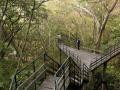
Basically, both Minh Chau and Quan Lan localities have quite favorable conditions for developing ecotourism. However, Quan Lan commune has more advantages to develop ecotourism in a humanistic direction, because this is an area with many famous historical relics such as Quan Lan Communal House, Quan Lan Pagoda, Temple worshiping the hero Tran Khanh Du, ... along with local festivals held annually such as the wind praying ceremony (March 15), Quan Lan festival (June 10-19); due to its location near the port and long exploitation time, the beaches in Quan Lan commune (especially Quan Lan beach) are no longer hygienic and clean to ensure the needs of tourists coming to relax and swim; this is also an area with many beautiful landscapes such as Got Beo wind pass, Ong Phong head, Voi Voi cave, but the ability to access these places is still very limited (dirt hill road, lots of gravel and rocks), especially during rainy and windy times; In addition, other natural resources such as mangrove forests and sea worms have not been really exploited for tourism purposes and ecotourism development. On the contrary, Minh Chau commune has more advantages in developing ecotourism in the direction of natural tourism, this is an area with diverse ecosystems such as at Rua De Beach, Bai Tu Long National Park Conservation Center...; Minh Chau beach is highly appreciated for its natural beauty and cleanliness, ranked in the top ten most beautiful beaches in Vietnam; Minh Chau commune is also home to Tram forest with a large area and a purity of up to 90%, suitable for building bridges through the forest (a very effective type of natural ecotourism currently applied by many countries) for tourists to sightsee, as well as for the purpose of studying and researching.
Figure 3.1: Thenmala Forest Bridge (India) Source: https://www.thenmalaecotourism.com/(August 21, 2019)
3.2.2. Using SWOT matrix to evaluate Quan Lan island tourism
General assessment of current tourism activities of Quan Lan island is shown through the following SWOT matrix:
Table 3.5: SWOT matrix evaluating tourism activities on Quan Lan island
Internal agent
Strengths- There is a lot of potential for tourism development, especially natural ecotourism and humanistic ecotourism.- The unskilled labor force is relatively abundant.- resource environmentunpolluted, still
Weaknesses- Poorly developed infrastructure, especially traffic routes to tourist destinations on the island.- The team of professional staff is still weak.- Tourism products in general
quite wild, originalintact
general and DLST in particularalone is monotonous.
External agents
Opportunity- Tourism is a key industry in the socio-economic development strategy of the province and Van Don economic zone.- Quan Lan was selected as a pilot area for eco-tourism development within the framework of the green growth project between Quang Ninh province and the Japanese organization JICA.- The flow of tourists and especially ecotourism in the world tends toincreasing
Challenge- Weather and climate change abnormally.- Competition in tourism products is increasingly fierce, especially with other localities in the province such as Ha Long, Mong Cai...- Awareness of tourists, especially domestic tourists, about ecotourism and nature conservation is not high.
Through summary analysis using SWOT matrix we see that:
To exploit strengths and take advantage of opportunities, it is necessary to:
- Diversify products and service types (build more tourism routes aimed at specific needs of tourists: experiential tourism immersed in nature, spiritual cultural tourism...)
- Effective exploitation of resources and differentiated products (natural resources and human resources)
div.maincontent .p { color: black; font-family:"Times New Roman", serif; font-style: normal; font-weight: normal; text-decoration: none; font-size: 14pt; margin:0pt; } div.maincontent p { color: black; font-family:"Times New Roman", serif; font-style: normal; font-weight: normal; text-decoration: none; font-size: 14pt; margin:0pt; } div.maincontent .s1 { color: black; font-family:"Times New Roman", serif; font-style: normal; font-weight: normal; text-decoration: none; font-size: 13pt; } div.maincontent .s2 { color: black; font-family:"Times New Roman", serif; font-style: normal; font-weight: normal; text-decoration: none; font-size: 13pt; } div.maincontent .s3 { color: #0D0D0D; font-family:"Times New Roman", serif; font-style: normal; font-weight: bold; text-decoration: none; font-size: 14pt; } div.maincontent .s4 { color: black; font-family:"Times New Roman", serif; font-style: italic; font-weight: normal; text-decoration: none; font-size: 14pt; } div.maincontent .s5 { color: black; font-family:"Times New Roman", serif; font-style: italic; font-weight: bold; text-decoration: none; font-size: 14pt; } div.maincontent .s6 { color: black; font-family:"Times New Roman", serif; font-style: italic; font-weight: normal; text-decoration: none; font-size: 14pt; vertical-align: -3pt; } div.maincontent .s7 { color: black; font-family:"Times New Roman", serif; font-style: italic; font-weight: normal; text-decoration: none; font-size: 14pt; vertical-align: -2pt; } div.maincontent .s8 { color: black; font-family:"Times New Roman", serif; font-style: italic; font-weight: normal; text-decoration: none; font-size: 14pt; vertical-align: -1pt; } div.maincontent .s9 { color: black; font-family:"Times New Roman", serif; font-style: normal; font-weight: normal; text-decoration: none; font-size: 14pt; } div.maincontent .s10 { color: black; font-family:"Times New Roman", serif; font-style: normal; font-weight: bold; text-decoration: none; font-size: 14pt; } div.maincontent .s11 { color: black; font-family:"Times New Roman", serif; font-style: normal; font-weight: normal; text-decoration: none; font-size: 14pt; } div.maincontent .s12 { color: black; font-family:Symbol, serif; font-style: normal; font-weight: normal; text-decoration: none; font-size: 14pt; } div.maincontent .s13 { color: black; font-family:Wingdings; font-style: normal; font-weight: normal; text-decoration: none; font-size: 14pt; } div.maincontent .s14 { color: black; font-family:"Times New Roman", serif; font-style: normal; font-weight: normal; text-decoration: none; font-size: 9pt; vertical-align: 5pt; } div.maincontent .s15 { color: black; font-family:"Times New Roman", serif; font-style: normal; font-weight: normal; text-decoration: none; font-size: 9pt; vertical-align: 5pt; } div.maincontent .s16 { color: black; font-family:Cambria, serif; font-style: italic; font-weight: normal; text-decoration: none; font-size: 14pt; } div.maincontent .s17 { color: #080808; font-family:"Times New Roman", serif; font-style: normal; font-weight: bold; text-decoration: none; font-size: 14pt; } div.maincontent .s18 { color: #080808; font-family:"Times New Roman", serif; font-style: normal; font-weight: normal; text-decoration: none; font-size: 14pt; } div.maincontent .s19 { color: black; font-family:"Times New Roman", serif; font-style: normal; font-weight: normal; text-decoration: none; font-size: 11pt; } div.maincontent .s20 { color: black; font-family:"Times New Roman", serif; font-style: normal; font-weight: normal; text-decoration: none; font-size: 10pt; } div.maincontent .s21 { color: black; font-family:"Times New Roman", serif; font-style: normal; font-weight: bold; text-decoration: none; font-size: 11pt; } div.maincontent .s22 { color: black; font-family:"Times New Roman", serif; font-style: normal; font-weight: normal; text-decoration: none; font-size: 11pt; } div.maincontent .s23 { color: black; font-family:"Times New Roman", serif; font-style: italic; font-weight: normal; text-decoration: none; font-size: 14pt; } div.maincontent .s24 { color: #212121; font-family:"Times New Roman", serif; font-style: normal; font-weight: normal; tex
Identify Rating Levels and Rating Scales
zt2i3t4l5ee
zt2a3gstourism,quan lan,quang ninh,ecology,ecotourism,minh chau,van don,geography,geographical basis,tourism development,science
zt2a3ge
zc2o3n4t5e6n7ts
of the islanders. Therefore, this indicator will be divided into two sub-indicators:
a1. Natural tourism attractiveness a2. Cultural tourism attractiveness
b. Tourist capacity
The two island communes in Quan Lan have different capacities to receive tourists. Minh Chau Commune is home to many standard hotels and resorts, attracting high-income domestic and international tourists. Meanwhile, Quan Lan Commune has many motels mainly built and operated by local people, so the scale and quality are not high, and will be suitable for ordinary tourists such as students.
c. Time of exploitation of Quan Lan Island Commune:
Quan Lan tourism is seasonal due to weather and climate conditions and festivals only take place on certain days of the year, specifically in spring. In Quan Lan commune, the period from April to June and from September to November is considered the best time to visit Quan Lan because the cultural tourism activities are mainly associated with festivals taking place during this time.
Minh Chau island commune:
Tourism exploitation time is all year round, because this is a place with a number of tourist attractions with diverse ecosystems such as Bai Tu Long National Park Research Center, Tram forest, Turtle Laying Beach, so besides coming to the beach for tourism and vacation in the summer, Minh Chau will attract research groups to come for tourism combined with research at other times of the year.
d. Sustainability
The sustainability of ecotourism sites in Quan Lan and Minh Chau communes depends on the sensitivity of the ecosystems to climate changes.
landscape. In general, these tourist destinations have a fairly high level of sustainability, because they are natural ecosystems, planned and protected. However, if a large number of tourists gather at certain times, it can exceed the carrying capacity and affect the sustainability of the environment (polluted beaches, damaged trees, animals moving away from their habitats, etc.), then the sustainability of the above ecosystems (natural ecosystems, human ecosystems) will also be affected and become less sustainable.
e. Location and accessibility
Both island communes have ports to take tourists to visit from Van Don wharf:
- Quan Lan – Van Don traffic route:
Phuc Thinh – Viet Anh high-speed boat and Quang Minh high-speed boat, depart at 8am and 2pm from Van Don to Quan Lan, and at 7am and 1pm from Quan Lan to Van Don. There are also wooden boats departing at 7am and 1pm.
- Van Don - Minh Chau traffic route:
Chung Huong high-speed train, Minh Chau train, morning 7:30 and afternoon 13:30 from Van Don to Minh Chau, morning 6:30 and afternoon 13:00 from Minh Chau to Van Don.
f. Infrastructure
Despite receiving investment attention, the issue of infrastructure and technical facilities for tourism on Quan Lan Island is still an issue that needs to be resolved because it has a direct impact on the implementation of ecotourism activities. The minimum conditions for serving tourists such as accommodation, electricity, water, communication, especially medical services, and security work need to be given top priority. Ecotourism spots in Minh Chau commune are assessed to have better infrastructure and technical facilities for tourism because there are quite complete and synchronous conditions for serving tourists, meeting many needs of domestic and foreign tourists.
3.2.1.4. Determine assessment levels and assessment scales
Corresponding to the levels of each criterion, the index is the score of those levels in the order of 4, 3, 2, 1 decreasing according to the standard of each level: very attractive (4), attractive (3), average (2), less attractive (1).
3.2.1.5. Determining the coefficients of the criteria
For the assessment of DLST in the two communes of Quan Lan and Minh Chau islands, the students added evaluation coefficients to show the importance of the criteria and indicators as follows:
Coefficient 3 with criteria: Attractiveness, Exploitation time. These are the 2 most important criteria for attracting tourists to tourism in general and eco-tourism in particular, so they have the highest coefficient.
Coefficient 2 with criteria: Capacity, Infrastructure, Location and accessibility . Because the assessment area is an island commune of Van Don district, the above criteria are selected by the author with appropriate coefficients at the average level.
Coefficient 1 with criteria: Sustainability. Quan Lan has natural and human-made ecotourism sites, with high biodiversity and little impact from local human factors. Most of the ecotourism sites are still wild, so they are highly sustainable.
3.2.1.6. Results of DLST assessment on Quan Lan island
a. Assessment of the potential for natural tourism development
For Minh Chau commune:
+ Natural tourism attractiveness is determined to be very attractive (4 points) and the most important coefficient (coefficient 3), so the score of the Attractiveness criterion is 4 x 3 = 12.
+ Capacity is determined as average (2 points) and the coefficient is quite important (coefficient 2), then the score of Capacity criterion is 2 x 2 = 4.
+ Exploitation time is long (4 points), the most important coefficient (coefficient 3) so the score of the Exploitation time criterion is 4 x 3 = 12.
+ Sustainability is determined as sustainable (4 points), the important coefficient is the average coefficient (coefficient 1), so the score of the Sustainability criterion is 4 x 1 = 4 points
+ Location and accessibility are determined to be quite favorable (2 points), the coefficient is quite important (coefficient 2), the criterion score is 2 x 2 = 4 points.
+ Infrastructure is assessed as good (3 points), the coefficient is quite important (coefficient 2), then the score of the Infrastructure criterion is 3 x 2 = 6 points.
The total score for evaluating DLST in Minh Chau commune according to 6 evaluation criteria is determined as: 12 + 4 + 12 + 4 + 4 + 6 = 42 points
Similar assessment for Quan Lan commune, we have the following table:
Table 3.3: Assessment of the potential for natural ecotourism development in Quan Lan and Minh Chau communes
Attractiveness of self-tourismof course
Capacity
Mining time
Sustainability
Location and accessibility
Infrastructure
Result
Point
DarkMulti
Point
DarkMulti
Point
DarkMulti
Point
DarkMulti
Point
DarkMulti
Point
DarkMulti
CommuneMinh Chau
12
12
4
8
12
12
4
4
4
8
6
8
42/52
Quan CommuneLan
6
12
6
8
9
12
4
4
4
8
4
8
33/52
b. Assessment of the potential for humanistic tourism development
For Quan Lan commune:
+ The attractiveness of human tourism is determined to be very attractive (4 points) and the most important coefficient (coefficient 3), so the score of the Attractiveness criterion is 4 x 3 = 12.
+ Capacity is determined to be large (3 points) and the coefficient is quite important (coefficient 2), then the score of the Capacity criterion is 3 x 2 = 6.
+ Mining time is average (3 points), the most important coefficient (coefficient 3) so the score of the Mining time criterion is 3 x 3 = 9.
+ Sustainability is determined as sustainable (4 points), the important coefficient is the average coefficient (coefficient 1), so the score of the Sustainability criterion is 4 x 1 = 4 points.
+ Location and accessibility are determined to be quite favorable (2 points), the coefficient is quite important (coefficient 2), the criterion score is 2 x 2 = 4 points.
+ Infrastructure is rated as average (2 points), the coefficient is quite important (coefficient 2), then the score of the Infrastructure criterion is 2 x 2 = 4 points.
The total score for evaluating DLST in Quan Lan commune according to 6 evaluation criteria is determined as: 12 + 6 + 6 + 4 + 4 + 4 = 36 points.
Similar assessment with Minh Chau commune we have the following table:
Table 3.4: Assessment of the potential for developing humanistic eco-tourism in Quan Lan and Minh Chau communes
Attractiveness of human tourismliterature
Capacity
Mining time
Sustainability
Location and accessibility
Infrastructure
Result
Point
DarkMulti
Point
DarkMulti
Point
DarkMulti
Point
DarkMulti
Point
DarkMulti
Point
DarkMulti
Quan CommuneLan
12
12
6
8
9
12
4
4
4
8
4
8
39/52
Minh CommuneChau
6
12
4
8
12
12
4
4
4
8
6
8
36/52
Basically, both Minh Chau and Quan Lan localities have quite favorable conditions for developing ecotourism. However, Quan Lan commune has more advantages to develop ecotourism in a humanistic direction, because this is an area with many famous historical relics such as Quan Lan Communal House, Quan Lan Pagoda, Temple worshiping the hero Tran Khanh Du, ... along with local festivals held annually such as the wind praying ceremony (March 15), Quan Lan festival (June 10-19); due to its location near the port and long exploitation time, the beaches in Quan Lan commune (especially Quan Lan beach) are no longer hygienic and clean to ensure the needs of tourists coming to relax and swim; this is also an area with many beautiful landscapes such as Got Beo wind pass, Ong Phong head, Voi Voi cave, but the ability to access these places is still very limited (dirt hill road, lots of gravel and rocks), especially during rainy and windy times; In addition, other natural resources such as mangrove forests and sea worms have not been really exploited for tourism purposes and ecotourism development. On the contrary, Minh Chau commune has more advantages in developing ecotourism in the direction of natural tourism, this is an area with diverse ecosystems such as at Rua De Beach, Bai Tu Long National Park Conservation Center...; Minh Chau beach is highly appreciated for its natural beauty and cleanliness, ranked in the top ten most beautiful beaches in Vietnam; Minh Chau commune is also home to Tram forest with a large area and a purity of up to 90%, suitable for building bridges through the forest (a very effective type of natural ecotourism currently applied by many countries) for tourists to sightsee, as well as for the purpose of studying and researching.
Figure 3.1: Thenmala Forest Bridge (India) Source: https://www.thenmalaecotourism.com/(August 21, 2019)
3.2.2. Using SWOT matrix to evaluate Quan Lan island tourism
General assessment of current tourism activities of Quan Lan island is shown through the following SWOT matrix:
Table 3.5: SWOT matrix evaluating tourism activities on Quan Lan island
Internal agent
Strengths- There is a lot of potential for tourism development, especially natural ecotourism and humanistic ecotourism.- The unskilled labor force is relatively abundant.- resource environmentunpolluted, still
Weaknesses- Poorly developed infrastructure, especially traffic routes to tourist destinations on the island.- The team of professional staff is still weak.- Tourism products in general
quite wild, originalintact
general and DLST in particularalone is monotonous.
External agents
Opportunity- Tourism is a key industry in the socio-economic development strategy of the province and Van Don economic zone.- Quan Lan was selected as a pilot area for eco-tourism development within the framework of the green growth project between Quang Ninh province and the Japanese organization JICA.- The flow of tourists and especially ecotourism in the world tends toincreasing
Challenge- Weather and climate change abnormally.- Competition in tourism products is increasingly fierce, especially with other localities in the province such as Ha Long, Mong Cai...- Awareness of tourists, especially domestic tourists, about ecotourism and nature conservation is not high.
Through summary analysis using SWOT matrix we see that:
To exploit strengths and take advantage of opportunities, it is necessary to:
- Diversify products and service types (build more tourism routes aimed at specific needs of tourists: experiential tourism immersed in nature, spiritual cultural tourism...)
- Effective exploitation of resources and differentiated products (natural resources and human resources)
div.maincontent .p { color: black; font-family:"Times New Roman", serif; font-style: normal; font-weight: normal; text-decoration: none; font-size: 14pt; margin:0pt; } div.maincontent p { color: black; font-family:"Times New Roman", serif; font-style: normal; font-weight: normal; text-decoration: none; font-size: 14pt; margin:0pt; } div.maincontent .s1 { color: black; font-family:"Times New Roman", serif; font-style: normal; font-weight: normal; text-decoration: none; font-size: 13pt; } div.maincontent .s2 { color: black; font-family:"Times New Roman", serif; font-style: normal; font-weight: normal; text-decoration: none; font-size: 13pt; } div.maincontent .s3 { color: #0D0D0D; font-family:"Times New Roman", serif; font-style: normal; font-weight: bold; text-decoration: none; font-size: 14pt; } div.maincontent .s4 { color: black; font-family:"Times New Roman", serif; font-style: italic; font-weight: normal; text-decoration: none; font-size: 14pt; } div.maincontent .s5 { color: black; font-family:"Times New Roman", serif; font-style: italic; font-weight: bold; text-decoration: none; font-size: 14pt; } div.maincontent .s6 { color: black; font-family:"Times New Roman", serif; font-style: italic; font-weight: normal; text-decoration: none; font-size: 14pt; vertical-align: -3pt; } div.maincontent .s7 { color: black; font-family:"Times New Roman", serif; font-style: italic; font-weight: normal; text-decoration: none; font-size: 14pt; vertical-align: -2pt; } div.maincontent .s8 { color: black; font-family:"Times New Roman", serif; font-style: italic; font-weight: normal; text-decoration: none; font-size: 14pt; vertical-align: -1pt; } div.maincontent .s9 { color: black; font-family:"Times New Roman", serif; font-style: normal; font-weight: normal; text-decoration: none; font-size: 14pt; } div.maincontent .s10 { color: black; font-family:"Times New Roman", serif; font-style: normal; font-weight: bold; text-decoration: none; font-size: 14pt; } div.maincontent .s11 { color: black; font-family:"Times New Roman", serif; font-style: normal; font-weight: normal; text-decoration: none; font-size: 14pt; } div.maincontent .s12 { color: black; font-family:Symbol, serif; font-style: normal; font-weight: normal; text-decoration: none; font-size: 14pt; } div.maincontent .s13 { color: black; font-family:Wingdings; font-style: normal; font-weight: normal; text-decoration: none; font-size: 14pt; } div.maincontent .s14 { color: black; font-family:"Times New Roman", serif; font-style: normal; font-weight: normal; text-decoration: none; font-size: 9pt; vertical-align: 5pt; } div.maincontent .s15 { color: black; font-family:"Times New Roman", serif; font-style: normal; font-weight: normal; text-decoration: none; font-size: 9pt; vertical-align: 5pt; } div.maincontent .s16 { color: black; font-family:Cambria, serif; font-style: italic; font-weight: normal; text-decoration: none; font-size: 14pt; } div.maincontent .s17 { color: #080808; font-family:"Times New Roman", serif; font-style: normal; font-weight: bold; text-decoration: none; font-size: 14pt; } div.maincontent .s18 { color: #080808; font-family:"Times New Roman", serif; font-style: normal; font-weight: normal; text-decoration: none; font-size: 14pt; } div.maincontent .s19 { color: black; font-family:"Times New Roman", serif; font-style: normal; font-weight: normal; text-decoration: none; font-size: 11pt; } div.maincontent .s20 { color: black; font-family:"Times New Roman", serif; font-style: normal; font-weight: normal; text-decoration: none; font-size: 10pt; } div.maincontent .s21 { color: black; font-family:"Times New Roman", serif; font-style: normal; font-weight: bold; text-decoration: none; font-size: 11pt; } div.maincontent .s22 { color: black; font-family:"Times New Roman", serif; font-style: normal; font-weight: normal; text-decoration: none; font-size: 11pt; } div.maincontent .s23 { color: black; font-family:"Times New Roman", serif; font-style: italic; font-weight: normal; text-decoration: none; font-size: 14pt; } div.maincontent .s24 { color: #212121; font-family:"Times New Roman", serif; font-style: normal; font-weight: normal; tex -
 Applying Local Marketing in Bac Ninh Tourism Development - 2
 -
 Legal adjustment on the market of business mergers and acquisitions - International experience and practice in Vietnam - 2
 -
 Bidding of domestic contractors in international construction bidding - 15
Local marketing program
Thuy Duong and Truong Minh (2006) with their article on local marketing in the Ruhr region, Germany, show experiences in applying local marketing to develop the local economy in line with the world's development trends.
The Ruhr region has an area of 4,335 km2 , a population of 5.3 million people, and is one of the largest regions in the state of Nordhein-Westfallen, Germany. Since the 18th century, the Ruhr has become a major industrial area of Germany with coal and steel as its main products. Workers from all over the world have flocked here to meet the labor needs of industries, causing the entire region to become overloaded. In the 1920s, the Ruhr was heavily polluted and unemployment was constant. In the minds of the German people at that time, the Ruhr was like a stain on the map. The Ruhr needed a breath of fresh air, needed to attract good workers, government funding and foreign investment.
In 1985, the first campaign to change the image of the Ruhr, called “Ruhr - a bright spot of Germany”, was widely promoted by the media. The Ruhr abandoned the coal mining industry and focused on new industries, services and tourism with 52 attractive tourist attractions. This campaign was successful in highlighting the completely different image of the Ruhr: unique, surprising and full of choices. By 1992, the Ruhr had developed into a cultural, entertainment and tourist area of Europe. Art exhibitions, concerts and fairs were held with astonishing quantity and quality. Within two years, the domestic and foreign press had named the region “The European Event”. In 2007, the European Union decided to award the city of Essen in the Ruhr the title of “Capital of Culture” thanks to the excellent connection of cultures of the foreign community living here. The regional press unanimously reported that the Ruhr could now be proud of its place on the map of Germany.
Learning experience
- Timely changes in local economic restructuring.
- Promote promotional activities to create a new image of the locality.
- Focus on attracting talent and foreign investment.
- Develop many attractive tourist attractions.
 Helsinki, the capital of Finland
Local marketing program
Rainsito (2003) pointed out the success of the capital city of Helsinki in using local marketing to develop Helsinki into a dynamic economic center in Northern Europe.
The Helsinki Place Marketing Program was launched from January 1, 1998 to December 31, 2000 in cooperation with the local government and many other organizations in Helsinki to attract investment from foreign companies and organizations, and to develop Helsinki into a dynamic, safe and reliable economic center in Northern Europe. A group of strategic planners was established, consisting of three main departments: local positioning and investment consultancy, marketing communications and the department of event, fair and exhibition management.
The consultants were tasked with finding potential client groups who were interested in investing in Helsinki. During the program, they contacted nearly 3,000 companies, mainly from Switzerland, the United States, Germany and Central European countries. The selected companies were active in the fields of information technology, biotechnology, environment and services. In addition, the consultants also carried out promotional activities for the city of Helsinki, such as participating in consulting work and meeting businesses and investors interested in Helsinki at real estate fairs abroad.
The marketing communications department cooperates with specialized magazines of investors to introduce the outstanding features of Helsinki. Magazines from the UK, Germany, the US and Japan have paid special attention to the development and potential of Helsinki. Through the media, Helsinki is known for its political stability, good infrastructure, clean environment, good services, high level of information technology and is a commercial center of Northern Europe. It provides good facilities for direct investment projects, along with added values and a safe access bridge to other markets. The slogans used by Helsinki are: “New economic center of Northern Europe”, “Look far and do business in the central machine of the North”.
The Events, Fairs and Exhibitions Department organizes communication events, engaging many organizations in local marketing programs such as central and local agencies, embassies and foreign enterprises. In addition, they actively participate in many fairs and exhibitions in Europe and the US, creating opportunities to reach people interested in Helsinki.
Helsinki's local marketing program has established international business relationships and networks with many relevant organizations, from central to local levels, businesses, consultants, journalists and large corporations. Therefore, local marketing activities have been carried out in a very synchronous and effective manner. Businesses appreciate the Helsinki government's support for their business and look forward to continuing cooperation and development.
Learning experience
- Establish a strategic planning team for local marketing activities.
- Coordinate local entities to participate in implementation
- Focus on international cooperation and linkage to attract investment.
- Strengthen promotional activities.
 Singapore
Local marketing program to develop tourism
Chye and Lionel Yeo (2015) pointed out that Singapore's success in tourism development is due to Singapore always knowing how to create new and attractive things to attract tourists. Singapore's tourism industry focuses on developing BTMICE tourism. In 2015, Singapore welcomed about 17 million tourists and earned nearly 30 billion SGD. Most of this revenue comes from BTMICE tourism technology. Singapore's success in tourism technology lies in the government's macro-strategic vision and the synchronous coordination between organizations, companies and the awareness of each citizen. The two largest centers serving Singapore's conference and exhibition activities are Suntec Singapore and Singapore EXPO. Suntec Singapore is known as the "convention city of Asia" because it not only serves conferences and exhibitions but also includes many other services. This is a block of five buildings
built like a cluster of five fingers on the left hand, in the middle of which is the world's largest fountain. Suntec Singapore is 75,000 m2 for meeting activities, 5,200 hotel rooms, 1,000 shops, 300 restaurants and a world-class performing arts center. Singapore EXPO includes six exhibition areas, each 10,000 m2 , with ten large halls and nine meeting rooms, this is one of the leading convention exhibition centers in the region. Not satisfied with the achievements, Singapore continues to invest in infrastructure as well as promote efforts around the world to serve the development goals of BTMICE in the future.
In addition, Singapore is also known as an international shopping center. High-rise buildings all have several floors below as supermarkets. Hotels also have supermarkets. Below the very spacious International Conference Areas are also attached to supermarkets selling branded goods; and there are also small markets selling discounted goods. The sellers are always cheerful and polite. There are places to exchange money everywhere, so it is very convenient for tourists to shop. Singapore is also famous for its world-class education and health care systems. Singaporean students learn English from primary school, textbooks at all levels are based on the curriculum of advanced countries, so the knowledge taught is always updated and modern. The National University of Singapore and Nanyang Polytechnic are the most prestigious schools in Singapore. In addition, Singapore also organizes training cooperation with many famous universities abroad. In recent years, Singapore has emerged as a medical treatment center that attracts a large number of foreigners. This strength has helped Singapore effectively exploit the type of study and medical tourism.
Learning experience
- Tourism development is one of the pillars of the economy.
- Coordinate local entities to participate in tourism implementation.
- Diverse types of tourism.
- Focus on developing BTMICE tourism which is specific to Singapore's tourism industry.
- Develop entertainment services.
- Developing technical facilities and infrastructure for tourism.
 Thailand
Local marketing program to develop tourism
Luu Thanh Duc Hai (2009) shows that the success in tourism development in Thailand is due to the Government's very methodical planning and orientation for tourism development. The Thai Government always has a very thorough market research strategy and has appropriate approaches depending on each market. The Thai tourism industry sets revenue criteria, not the number of tourists. Therefore, promotional activities aim to encourage tourists to spend more money, shop more vigorously and promote Thailand as a shopping and relaxation center with slogans such as: "Visit Thailand", "Stunning Thailand", "Earthly happiness", "Unforgettable Thailand". In addition, Thailand focuses on developing diverse types of tourism, such as: cultural tourism, eco-tourism, MICE tourism, medical tourism, agricultural tourism, shopping tourism; at the same time
develop “no-price” tours in the low season, expand the transport network, restore traditional values to organize special events and introduce new tourist destinations, encourage foreign investment in tourism, develop human resources, develop a network of representative offices in key markets, create a clear, suitable and long-term brand image. Along with that is the commitment of the Government in terms of organization, finance, policy and strong, active participation of businesses and communities.
Learning experience
- Carefully research the tourism market before planning.
- Develop diverse types of tourism.
- Build "no price" tours in low season.
- Develop a network of representative offices in key markets.
- Strengthen tourism promotion activities.
- Encourage foreign investment in tourism.
- Human resource development.
- Coordinate local entities to participate in tourism implementation.
- Building image and brand for Thai tourism.
 Malaysia
Local marketing program to develop tourism
Viet Ha (2013) pointed out the experiences in attracting international visitors that Malaysia has successfully applied, which are: exploiting three outstanding features to create uniqueness and attractiveness for tourism development. First, Malaysia is a multi-ethnic country, the blend of many different cultures creates a very unique cultural identity. With more than 60% of the population following Islam, Malaysia's Islamic culture brings interesting experiences to tourists. Besides, Malaysia also has a unique culinary culture and many attractive destinations. Tourists can freely explore the true beauty of Asia from luxurious cities, tropical forests to high mountains, pristine plateaus, beautiful beaches. In particular, the highlight of Malaysian tourism is diverse, world-class tourism products with competitive prices. Highlights are resort tourism, entertainment, adventure sports, shopping locations. Malaysia also promotes the development of new tourism products, such as medical tourism, educational tourism and MICE tourism to attract a large number of tourists from all over the world.
Learning experience
- Diverse tourism products.
- Focus on developing new tourism products.
- Develop entertainment services.
- Competitive price.
2.2.2 Domestic experience
 Hanoi
Hanoi
Local marketing program to develop tourism
Hanoi, a thousand-year-old city with a rich cultural and historical tradition, was awarded the title “City for Peace” by Unesco in 1999. This is a beautiful image that Hanoi has used for marketing through many activities, such as: organizing the contest “Hanoi your rendezvous” for foreigners and overseas Vietnamese, an international painting contest for peace, a music and dance festival “Echoes of the City for Peace”, an international culinary festival for female staff of international organizations working in Hanoi.
Hanoi has many attractive destinations that attract tourists, such as: a rich system of museums, pagodas, traditional craft villages, the beauty and peace of Hoan Kiem Lake, the simple bustle of the Old Quarter with 36 streets. Many street names begin with the word "Hang", the most famous are Hang Gai with silk fabrics and silver products, Hang Quat with offerings and clothes, Hang Ma with cellophane products, and Lan Ong with herbal products. Every street is noisy and bustling with the scene of buying, selling, and working like a miniature craft village. These outstanding features are the focus of Hanoi's local promotion campaigns.
According to Ha Van Hoi and Vu Quang Ket (2010), to develop tourism, the city government has issued priority policies for investment in infrastructure development of key tourist sites and areas; tax support policies for souvenir production; policies to encourage economic sectors to participate in tourism business investment, especially investment in developing modern entertainment areas and theme parks. Increase financial support and socialize tourism promotion activities. Focus resources on investment in developing specific tourism products at national tourist sites, national tourist sites and key tourist sites and areas. Improve service quality, diversify tourism products associated with developing a network of agents, travel offices, and developing human resources.
Learning experience
- Building local image.
- Strengthen tourism promotion activities.
- Building technical facilities and tourism infrastructure systems.
- Develop policies related to tourism development investment, policies for businesses and local residents participating in tourism activities.
- Diversify types of tourism and improve service quality.
- Develop a network of agents and travel offices.
- Human resource development.
 Ho Chi Minh City
Local marketing program to develop tourism
According to Ho Duc Hung and colleagues (2005), in the local marketing strategy for tourism development in Ho Chi Minh City, the City People's Committee has coordinated with agencies, departments, and businesses to actively implement many tourism promotion activities in Asia and Europe. Information and images of the city's tourism are introduced to tourists through mass media and many businesses' own websites. Some businesses have also established representative offices abroad. Coordination between state management agencies and businesses, between the city's tourism industry and related departments, as well as with neighboring localities is increasingly synchronous.
Learning experience
- Develop a network of agents and travel offices.
- Strengthen tourism promotion activities.
- Cooperate with other localities to develop tourism.
- Coordinate local entities to participate in tourism implementation.
 Vinh Long
Local marketing program to develop tourism
According to Nguyen Van Hien and colleagues (2015), in the local marketing strategy for tourism development in Vinh Long province, the province has had practical programs and activities to bring the image, people, resources, and outstanding characteristics of the locality to tourists. The province has built typical tours of the South, in which tourists can access local people's homes and learn about their daily lives.