
It is necessary to create an open canopy so that light can penetrate inside the canopy. The canopy creation work must be done from the beginning and the branches must be monitored and pruned annually. In gardens lacking light, not only do diseases develop such as leaf spot disease... but many types of branch borers develop because adults prefer shady places to lay eggs.
+ Intercropping
Reasonable intercropping is a short-term solution to feed the long-term, or even when intercropping between fruit trees, it will help disperse hosts such as orange stink bugs will be dispersed in orange gardens mixed with longan. Mealybugs are dispersed in mango gardens mixed with custard apples, leafminers rarely develop when grapefruit is intercropped with longan, . . .
+ Balanced and adequate fertilization
Balanced and adequate fertilization will help plants grow healthy, increase their resistance to pests and other harsh environmental conditions. Timely fertilization will help buds and fruits grow more concentrated, making pest control easier.
Maybe you are interested!
-
 Important Pests on Taro
 -
 Unanimous Awareness of the Important Role of Fdi.
 -
 Character System - An Important Element In Theme Development
 -
 Developing craft village tourism in Thai Nguyen specialty tea regions - 15
 -
 The Important Position And The Level Of Impact Of Risk Control In VAT Refund Management Of Tan Uyen Regional Tax Department
+ Fruit bag
+ Garden cleaning: clean up plant debris, fallen fruit, cut off diseased branches and leaves to reduce the source of spread.
3. Practice
3.1. Purpose - requirements
Help students distinguish damage symptoms and recognize the morphology of some common pests on fruit trees: longan, mango, and citrus trees.
3.2. Materials
Insect sample:
- Leaf miner, Citrus aphid, Green stink bug, Thrips, Citrus aphid, Various types of aphids and bugs that harm citrus trees
- Fruit flies, Mealybugs, Leaf cutters, Hair clippers, Mango leafhoppers
- Longan leaf vein borer, stink bug, fruit stem borer Handheld magnifying glass, stereo magnifying glass
A4 paper, pencil, sharpie. 70 0 alcohol , Javen water, blotting paper
3.3. Practice
With the guidance of the instructor, each student practices observing the damage symptoms and morphological characteristics of pests.
3.4. Report
Record the characteristic features to identify each pest species.
SUGGESTED QUESTIONS
1. When the mango tree begins to bloom, what cultivation techniques should be used to care for the mango tree to protect the flowers and young fruit from harmful insects?
2. When young mango trees are newly planted in the first 1-3 years, what pests should be taken care of to help the tree grow quickly and bear good fruit?
Introduce:
CHAPTER 3
INSECTS THAT HARMFUL VEGETABLE PLANTS
The content of the article focuses on the composition, harmful symptoms, morphological characteristics and control measures of some major pests on legumes, crucifers and cucurbits.
Target:
Knowledge:
+ Present the composition of important insect pests on vegetable crops.
+ Describe the morphological characteristics and harmful symptoms of pests on legumes, vegetables, squash and melons.
+ Present the conditions affecting the development and harmful habits of important species on vegetable crops.
Skill:
+ Identify the morphological characteristics and damage symptoms of pests on legumes, vegetables, squash and melons.
+ Survey of pest density in the field.
+ Synthesize, analyze, evaluate and propose appropriate solutions to control insect damage on legumes, vegetables and melons.
Self-control and responsibility: self-study spirit, scientific and creative working methods.
1. Morphological characteristics and damage
1.1. Important insect pests on legumes
a) Stem borer Ophiomyia phaseoli Tryon
There are two common species of bean stem borers in the family Agromyzidae, order Diptera:
- Melanagromyza sojae (Zehntner)
- Ophiomyza phaseoli (Tryon)
* Distribution and hosts
M. sojae is found in India, Indonesia, Japan, Australia and is present on many host plants such as Glycine max , Cajanus indicus , Indigofera suffruticosa , Phaseolus calcaratus , in which Glycine soja species is damaged from 70-100%.
O. phaseoli is distributed over a large area in Asia, Australia and Europe, including Hawaii, Japan, Egypt and Israel. The flies occur on most bean varieties.
like Phaseolus calcaratus, P. vulgaris, P. lanatus ...
In Vietnam, both species of flies appear on beans, but the
M. sojae is a common pest of soybeans, while O. phaseoli attacks most other legumes.
* Biological and ecological characteristics
+ Melanagromyza sojae Zehntner
The adult is a small fly, 1.6 to 2.0 mm long, with a shiny black abdomen that is slightly greenish, red eyes, and the forehead between the two compound eyes is not raised. The female adult has a blade-shaped ovipositor at the end of the abdomen. The adult's life span is 35 to 38 days, and a female fly lays about 200 eggs.
Eggs are glossy white, oval, 0.3-0.4 mm long, 0.10-0.15 mm wide and hatch within 2-4 days.
The larvae have a long, slender body, when fully grown, they are 2.5-4 mm long, slightly yellowish white, with a black hook on the head, two pointed, long, dark brown breathing tubes at the end of the abdomen, and 6 breathing holes around them. The larvae have 3 instars that develop in 8-10 days.
Pupae are oval, 2-2.4 mm long, 0.7-1.0 mm wide, yellow when newly formed, later turning brown, with 2 sharp, dark brown breathing tubes at the end of the tail. Pupae duration is 7-9 days.
+ Ophiomyza phaseoli Tryon
The adult is very similar to M. sojae but differs in that the forehead between the two compound eyes is slightly raised.
Eggs are 0.25 - 0.30 mm long, 0.10 - 0.15 mm wide, incubation period is 2 - 4 days.
The larvae have two forked terminal abdominal breathing tubes and six breathing holes concentrated at the end. The larvae develop in 7-10 days.
Pupae are similar to those of the above species, developing within 7-13 days.
* Living habits and harmful ways
+ Melanagromyza sojae (Zehntner)
Flies are very active during the day, often landing on the surface of young leaves to feed and lay eggs. Flies appear in bean fields as soon as the plants have the first two young leaves. Female flies use their ovipositors to cut oval holes on the surface of the leaves so that the sap can flow out and feed. On soybeans, flies mainly feed on the upper surface of the leaves and lay eggs in some punctures on the underside of the leaf blade, near the veins. The holes made by flies to lay eggs are usually oval, short, about 0.17 mm long and about 0.11 mm wide.
Eggs are laid shallowly on the leaf surface, sometimes exposed above the leaf surface, each puncture only lays 1-2 eggs, located just below the epidermis. The punctures used to feed on the secreted sap are usually on the upper leaf surface, 1 to 1.5 mm long and about 0.05 mm wide.
The newly hatched maggots bore straight into the main vein through the stem, destroying the central pillar of the stem, from the tip to the base and down to the root collar, then turn their heads back up to bore towards the tip until they are fully grown. The maggots pupate anywhere inside the bean stem. Before pupating, the larvae bore a hole through the bean stem, leaving only a thin membrane for the adult to fly out later. The pupa can form above or below the hole because the larvae have already bitten, with their heads facing the hole. The pupa location varies depending on the growth stage of the bean plant:
- On old bean plants, pupae are usually located in the middle part of the stem.
- On young bean plants, maggots gradually eat down to the base until they are strong enough and pupate right there, only a few pupate at the top and leaf stalks.
Flies that damage seedlings will kill them 15-30 days after sowing. If the plant is damaged after that time, the entire plant will not die, but only the branches attacked by flies will die, the plant will only have reduced growth. The young stem often attacks the top, causing the top buds to be damaged and many lower axillary buds to grow to replace them.
Flies usually appear more in the dry season than in the rainy season. Late-planted bean fields are damaged a lot because the flies accumulate density from previous generations. In a soybean crop, there are usually 2-3 generations of stem borer flies:
- Batch 1: appears when the bean has the first two single leaves.
- 2nd batch: 1 month old beans, about to bloom.
- 3rd batch: the tree has young fruit, the density at this time decreases because the tree no longer has young leaves.
In the fields, there are always some natural enemies that develop and harm flies. The most common are two species of wasps belonging to the Chalcididae family and one species belonging to the Cynipidae family, the parasitic rate of these two species on bean stem borers sometimes reaches 90%. Fire ants are also a significant natural enemy of flies and often enter the borers to eat maggots.
+ Ophiomyia phaseoli Tryon
Adults feed on the upper surface of the leaves and the bites are concentrated near the base of the main veins, circular in shape. Female flies choose some bites to lay eggs in. The eggs are laid on the upper surface of the leaves and lie in the leaf parenchyma, between the two epidermal layers of the upper and lower surfaces of the leaves. After hatching, the larvae bore zigzag lines on the lower surface of the leaves for about 2 days, then bore into the nearest vein, through the epidermis of the petiole, down to the stem bark and continue.
The flies bore down to the base, damaging the stem below the epidermis, just above the root collar. The flies pupate between the skin and wood of the bean stem, just below the soil surface.
- On young bean plants, maggots damage the base and some can bore into the taproot of the bean plant and pupate in the stem epidermis, near the base or on the ground.
- On old bean plants, maggots damage branches and pupate on leaf stalks. The areas of the plant where maggots are present cause the pupae to swell, rot, or dry out and crack.
If there are many maggots present on a plant, due to competition for food, the maggots may bore deep into the bean stem.
b) Smooth green caterpillar Spodoptera exigua Hubner
Noctuidae - Lepidoptera
* Distribution and hosts
The smooth armyworm is reported to occur in southern Asia and Africa, southern and central Europe, Australia and South America.
In Vietnam, especially in the Mekong Delta, since 1981, the worm has been the main pest on soybeans, green beans, onions, chili peppers and some other short-term crops.
* Morphological and biological characteristics
The adult is a moth, grayish-white, 7-10 mm long, 20-25 mm wide. The head is gray, with many hairs, 2 large compound eyes, black, thread-shaped antennae, 5-6 mm long. The thorax is reddish-brown, covered with a layer of ash-gray powder with a metallic sheen. The forewings are grayish-brown, elongated, triangular, the wing corners are slightly rounded, with many veins. About 1/3 of the wing from the base of the wing, near the front edge there is a pale round spot, in the middle of the spot there is a small black spot, next to it there is a larger orange-yellow spot. The upper edge of the wing has a discontinuous black stripe running from the beginning to the end of the wing, the edge of the wing has a row of black dots, the end of the edge of the wing is a white vein. The hindwing is a membranous wing, grayish-white, the veins towards the outer edge of the wing are darker, followed by a dark brown border, the outermost is a white feather edge. Both male and female moths have a tuft of hair at the end of their abdomen, but on females this tuft of hair is longer.
The lifespan of a moth is 5 - 10 days and a female moth can lay 300 - 400 eggs within 3 - 5 days, peaking on the third night after emergence (average 128 eggs/day/individual).
Eggs are spherical, 0.4 - 0.5 mm in diameter, green to yellow when newly laid, then turn opaque white, about to hatch there is a black dot on the eggshell, which is the eye of the worm. Eggs are laid in nests, covered with ivory-white fur. Time
Egg incubation period is 2 - 4 days.
The caterpillars are 5 - 6 years old, developing in 10 - 19 days. The back of the caterpillar is green and smooth, so it is also called " Smooth Green Caterpillar" . The caterpillars change color a lot during the development stage of the caterpillar. In general, the caterpillars have the following colors:
There are 5 stripes on the back, 2 stripes on each side are very large and dark; running from the first segment of the thorax to the last segment of the abdomen; 1 stripe in the middle of the back is black and white, also running from the first segment of the thorax to the last segment of the abdomen but not continuously; next are 2 small and faint stripes located evenly spaced and on both sides of the stripe in the middle of the back. These stripes become more obvious as the worm ages. The belly has a different color from the back, usually pink or light blue and has 2 white streaks on both sides of the belly. Details for each worm age are as follows:
- Instar 1: the worm's body is green or yellow-green, the head is shiny black, has a lot of hair, the belly is light yellow. On the back there are many large light brown dots, each dot has a long brown hair, the body is 1.2 - 1.5 mm long, the head is usually wider than the body and the stripes on the body are not clear. The development time of the worm at this instar is from 2 - 5 days.
- From the age of 2, the color of the body of the worm begins to show clearly. The abdomen is yellow-green, the segments on the body are clearly distinguished. The worm's body has 3 faint white stripes, 1 stripe in the middle of the back and 2 stripes on both sides of the body, all 3 stripes above run from the first segment to the last segment of the abdomen. At this age, the worm has an average body size of 0.45x3.7mm. The development time of the 2nd instar worm is from 2 to 4 days.
- At age 3, when the caterpillar first molts, it is yellow-green, then turns green. The head is light yellow and shiny; still has many hairs. The spots on the caterpillar's body gradually become smaller, the hairs are shorter. Development time is 2 - 3 days.
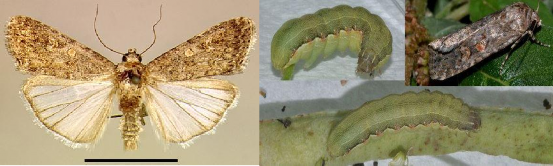
Figure 3.1: Adults and larvae of smooth green caterpillar
* Living habits and harmful ways
Adults are nocturnal moths. The second night after emergence, adults begin to mate and lay eggs a few hours later.
Eggs are laid in clusters, covered with ivory-white hairs, on the upper surface of leaves, near the leaf stalks, each cluster contains about 20 - 40 eggs. The egg clusters are arranged in blocks with 2 layers. Eggs usually hatch during the day.
After hatching, the worms live in groups around the egg nest, eating the chlorophyll of the leaves into small holes, leaving the white epidermis. At the end of the first instar, the worms begin to disperse to neighboring leaves. The second instar larvae eat holes in the leaves and have the habit of spinning silk and dropping to the ground when disturbed. At the third instar, the worms are most destructive, biting leaves into large holes; the worms also hang on the flower clusters of soybean plants and eat the newly emerged petals. In fields with high density, the worms eat the leaves with the main veins and stems exposed, and even the young fruit. A fourth instar worm can eat a bean leaf in one day. At the older instar, when disturbed, the worms do not spin silk and hide like the younger instar larvae, but often shrink and fall to the ground or the leaves below to hide.
In addition to soybeans and green beans, worms also cause a lot of damage to green onions and chili peppers grown intercropped or rotated with soybeans; worms cause damage mainly in the winter-spring and spring-summer crops.
- On soybeans and mung beans, worms can cause damage from when the bean plants are young until they flower and bear fruit. Worms can eat away leaves, young shoots, flowers and young fruit.
- On green onions, the moth lays eggs on the outside of the onion stalk. The larvae hatch and burrow inside the onion stalk, eating the chlorophyll parenchyma, leaving the white outer epidermis. When severely damaged, the onion leaves turn yellow and droop.
- On chili plants, worms destroy young shoots, leaves, flowers and fruits. On chili fruits, worms often eat the top of the fruit, where it meets the flower calyx, or make holes in the middle of the fruit; fruits eaten by worms often rot and fall off early.
Figure 3.2: Damage symptoms caused by smooth green caterpillar
* Natural enemies of green caterpillars
Although there are quite a lot of harmful insects, there are many species in nature.