
February 2 | 25 | ... |
Maybe you are interested!
-
 Impact of Financial Market Development on Enterprise Capital Structure by National Institutional Quality
 -
 The impact of financial market development on the capital structure of listed enterprises in the ASEAN Economic Community - 28
 -
 The impact of financial structure on the performance of commercial banks - 1
 -
 Ranking the Level of Impact of Factors on Financial Statements
 -
 The impact of financial market development on the capital structure of listed enterprises in the ASEAN Economic Community - 2
Figure 19: US federal interest rate from 2000 to March 2008. [56] Source: According to the US Federal Reserve: http://www.federalreserve.gov/
* Comment : From the causes leading to the crisis in the US real estate market, we can see more clearly the close relationship between the real estate market and the financial market, especially in today's era of globalization, when the global market is closely connected with each other. Therefore, the fluctuations in the real estate market in recent times have not only left serious consequences for the US financial market in particular but will certainly have a significant impact on the world financial market in general.
IV. Consequences of the US housing bubble and its impact on the world financial market
1. Consequences of the US housing bubble
The US real estate credit crisis has left serious consequences. Rising interest rates create a debt repayment burden for low-income people, and the risk of subprime loans affects the fastest. Unable to repay their debts, a series of home buyers were foreclosed and their properties were sold. Cleveland (Ohio) was the first city to ignite the crisis that spread across the US. About 1/10 of the houses in Cleveland were repossessed for auction. According to RealtyTraac Inc., a company specializing in monitoring the credit mortgage market, the number of foreclosures due to homeowners' inability to pay their debts in January 2008 increased by 57% compared to the same period in 2007. Nationwide, a total of 233,001 home owners received foreclosure notices compared to 148,425 in January 2007. Immigrants with dreams of buying a house returned empty-handed. In February 2007, the mortgage industry under
The mortgage collapse led to a wave of foreclosures, with 1.3 million homes lost, up 79% from 2006. [15]
At the same time, more than 70 mortgage lenders in the United States have ceased operations or are awaiting sale. A series of the largest subprime mortgage lenders in the United States have announced losses, put themselves up for sale, or filed for bankruptcy. On April 2, 2007, New Century Financial filed for bankruptcy. Then on August 6, 2007, American Home Mortgage, once among the top 10 largest mortgage lenders in the United States, followed. Two companies, Aegis (headquartered in Houston) and National City (in Cleveland), simultaneously announced that they would stop accepting new loan requests. On August 16, 2007, Countrywide Financial Corporation, the largest mortgage lender in the United States, admitted that it was in trouble and said it needed $11.5 billion in support to maintain operations and avoid bankruptcy. [16] .
Two giant financial groups: Merrill Lynch and City Group Inc. had to accept tens of billions of dollars in emergency foreign investment. Merrill Lynch lost 7.9 billion dollars in the third quarter of 2007 and had to seek external capital to continue operating. In the fourth quarter of 2007, City Group's bad debt reached 49 billion dollars [17] .
It is estimated that the debt of major banks in 2007 could reach tens of billions of USD, with Citibank leading the way with nearly 90 billion USD, followed by JP Morgan Chase and Bank of America with 80 and 60 billion.
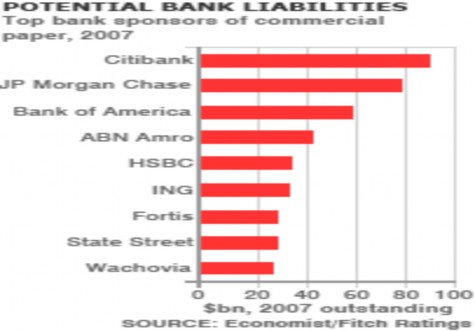
Figure 20: Estimated debt of banks in 2007. [53]
Source: http://www.clickngomortgages.co.uk/news/bad-credit-mortgages-take- down-wall-street/
The credit crisis has also forced Wall Street banks to cut about 34,000 jobs between June 2006 and March 2008, and could increase to 90,000 jobs over the next two years. City Group has laid off 1.7% of its workforce, Lehman has laid off 18%, Morgan Stanley 6.25% and Merrill Lynch 4.5%. However, this number is not expected to stop in the near future. [21]
The impact of the crisis caused strong fluctuations in the bond, stock and derivatives markets. The market value of companies in the first months of 2008 fell 19.2%, equivalent to 2.3 trillion USD compared to October 2007. Some stocks fell sharply. Bear Stearns shares fell more than 90% in value, equivalent to 16.7 billion USD. Other stocks also fell sharply due to investors' concerns about bad debts. National City shares lost 76%, equivalent to 12.4 billion USD.
USD. Bond underwriter Ambac Financial lost 75%, equivalent to 5.24 billion USD, and real estate lender Countrywide Financial lost 70.74%, equivalent to 7.88 billion USD. Of the 25 companies whose market value decreased in the S&P index, 16 were in the financial industry. However, in addition to financial stocks, many other types of stocks have also been declining due to the crisis, including telecommunications, technology and healthcare stocks. [22]
The Fed's continued interest rate cut on March 18, 2008, to 2.25%, had some effect on the stock market. During the trading week ending March 20, 2008, the Dow Jones Industrial Average rose 3.4% to 12,361.32 points. The Nasdaq also rose 2.1% to 2,258.11 points. The S&P 500 rose 3.2% to close at 1,329.51 points. However, George Shipp, an investment expert at Scott & Stringfellow, said that investors were still not really satisfied with the developments in the financial market. [19]
Investment banks that held risky bond packages but had not yet transferred them to the market had to announce losses of up to tens of billions of dollars, such as Citi Group (21 billion USD), Merrill Lynch (25 billion USD), UBS (18 billion USD), Morgan Stanley (10 billion USD), JP Morgan (2.2 billion USD), Bear Stearns (2 billion USD), Lehman Brothers (1.5 billion USD), Goldman Sachs (1.3 billion USD). [20]
Following the effects on the financial markets, the housing market crisis had a heavy impact on the entire US economy. The deficit in the balance of payments reached $811 billion in 2006, equivalent to 6% of GDP. In 2007, the depreciation of the US dollar reduced the deficit by $734 billion but it remained very high. The GDP growth rate for the whole year of 2007 was only 2.2% compared to 3.3% in 2006. This was the slowest GDP growth rate since
2002. The main reason for the slow GDP growth was the sharp decrease in spending and investment in the real estate sector, and the volume of goods produced by factories and enterprises. The risk of recession in the US economy also seriously affected the labor market. In the week ending February 23, 2008, the number of US workers applying for unemployment benefits jumped to 370,000 compared to the expected 350,000. By February 16, 2008, the US had about 2.81 million unemployed workers. In March 2008, the Conference Board (CB) research organization said that the US consumer confidence index (CCI) fell to 64.5 points, compared to 76.4 points in February 2008. [21]
2. Impact on the world financial market
The world financial market was also shaken by the impact of the US real estate credit crisis. People were afraid of bank losses in the US real estate market so they rushed to withdraw money, putting banks in urgent situations. Credit institutions confirmed that losses had reached 295 billion USD and 10% of that loss was from German banks. However, the IMF predicted that the loss could reach 945 billion USD. In Germany, most banks have admitted losses due to investments in the US market. The German Development Bank announced a loss of 6.18 billion Euros in the 2007 financial year. Germany's largest bank, Deutsche Bank, also admitted a loss of 2.5 billion Euros in the first quarter of 2008. In Japan, the profits of the six largest banks fell more than 40 percent in the fiscal year that ended in March 2008 due to losses in the U.S. subprime mortgage market. The banks' profits fell to 1.5 trillion yen from 2.8 trillion yen a year earlier. In Switzerland, UBS suffered a loss of $37 billion. UBS replaced almost all of its management. In China, BOC Bank of China set aside $1.295 billion.
USD to offset the investment in the US secondary market of about 282 million USD to cover related investment costs. [22]. The European Central Bank (ECB) has continuously injected money into the market to stabilize investor sentiment after the damage of the US real estate credit storm, with 130 billion Euros in mid-December 2007 and about 75 billion Euros in the first 3 months of 2008, and is expected to inject another 150 billion Euros in the coming time. [23]
The secondary crisis has had a strong impact on the world stock market with 5 trillion USD wiped out of the market in just the first 3 weeks of January 2008. The FED's continuous cutting of interest rates to 2.25% and pumping 260 billion USD into the banking system still does not seem to improve the situation. The world stock market on March 31, 2008 was still very gloomy with declines in most markets. In particular, the biggest decline was in the Japanese market, the Nikkei 225 index fell 294.93 points, equivalent to 2.3
%. Hong Kong's Hang Seng Index also fell 436.75 points, or 1.88%. Smaller declines were also seen in a number of major markets around the world, with the New York S&P 500 down 0.8%. Britain's FTSE 100 Index fell 0.43%. Germany's DAX C40 Index fell 1.46%.
TT
Market (Index) | Closing Index | +/- Change | % Change | |
1 | USA (DJI) | 12,216.40 | -86.06 | -0.70 |
2 | US (NASDAQ 100) | 1,767.57 | -10.32 | -0.58 |
3 | New York (S&P 500) | 1,315.22 | -10.54 | -0.80 |
4 | UK (FTSE 100) | 5,692.88 | -24.59 | -0.43 |
5 | Germany (DAX C40) | 6,464.43 | -95.47 | -1.46 |
6
France (CAC 40) | 4,657.09 | -38.83 | -0.83 | |
7 | Japan (NIKKEI 225) | -12,525.54 | -294.93 | -2.30 |
8 | Hong Kong (Hang Seng) | 22,849.20 | -436.75 | -1.88 |
9 | Shanghai (SSE B) | 256.00 | -5.49 | -2.10 |
10 | Korea (KOSPI) | 1,703.99 | 2.16 | 0.13 |
11 | Singapore (STI) | 3,007.36 | -24.54 | -0.81 |
12 | Thailand (SETI) | 817.03 | -8.14 | -0.99 |
Figure 21: Stock indexes on some markets on March 31, 2008. [21] Source: http://www.fpts.com.vn/VN/Tin-tuc/Quoc-te/2008/03/3B9B5EF5/
*Comment : The crisis in the US real estate market, which was mainly caused by the credit crisis in the secondary housing market, has left extremely serious consequences with the collapse of the subprime mortgage lending system across the US, banks are reeling from huge amounts of bad debt, foreclosures and foreclosures are happening everywhere, and Americans are being pushed into homelessness. The stock market has also fallen into a serious decline. The US economy is facing the risk of a "Second Great Depression ". However, this is no longer a problem of the US alone, but this storm of crisis has spread and become a credit crisis worldwide. The world financial market has witnessed gloomy moments in all major markets. This has prompted not only the US Federal Reserve but also central banks of other countries to coordinate to come up with truly effective measures to prevent the crisis from spreading and
risk of recession worldwide. Although Vietnam's financial and monetary market has not been significantly affected by the crisis, however, if the global credit crisis continues to intensify, forcing central banks of countries to intervene, it will affect the world interest rate level and then affect Vietnam. Therefore, policy makers need to closely monitor this development to make appropriate moves, especially in the context of Vietnam's real estate market always being in a state of instability and Vietnam's stock market still on the decline and domestic inflation rising as it is now.