
The fringes will spread out beautifully. On their shoulders they wear a scarf called phaa khit .
The Phu Thai women's festival costumes are also quite elaborate and beautiful, also made of silk. Silk is a precious material used exclusively to make costumes for festivals or major events in the lives of the Phu Thai people. The shirt is designed with long sleeves, the waist is slightly tied to create elegance. The indigo shirt is woven with more colors and decorative motifs than everyday clothes. The neckline, body and sleeves are colorful. The scarf is woven larger than the everyday scarf, with more prominent colors. The skirt is sewn from 3 pieces of fabric to form a piece of fabric from 1.6 to 2m wide and about 1m long. The fabric is then folded in half and the ends are sewn together to form a tube. The wide waist will be folded with a string to form a tube and then fixed with a metal belt with some small bells on the waist.
The belt, although not elaborately decorated, is a distinguishing feature of Phu Thai girls and is also taken care of when wearing it to participate in festivals. The belt of the skirt is called ho la - euh of the festival costume, a red cloth, the belt is called ho khao and is made from undyed woven yarn. The prominent colors such as black, orange, yellow, blue are woven together to create color effects in shapes such as diamonds, octagons. Some women in noble and wealthy families have belts that are not just ordinary cloth but are also covered in gold or silver to highlight the waist.
An important part is the moi yau costume . The female shaman has her own costume and it is passed down through many generations of shamans. The shaman's costume is indigo, traditionally similar to the traditional costume of the Phu Thai people. The long dress consists of 4 panels and is tied at the waist with a red cloth. The blouse
Maybe you are interested!
-
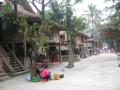
 Some Pictures of the Transformation of Traditional Culture of Thai People in Mai Chau
 -
 Exploiting the Buckwheat Flower Festival in Ha Giang to serve tourism development - 4
 -
 Hoang Hoa Tham in the Folk Festival
 -
 Current Status of Exploiting Tran Temple Festival, Thai Binh to Serve Tourism Development.
 -
 Tourism Development Situation in Laos
The shaman's robe has buttons running from the collar down to the knees. Inside, the shaman wears a white collared shirt. The skirt reaches the ankles, with white horizontal stripes woven alternately with indigo. The blouse is worn on the outside, highlighted by red diamond-shaped woven lines. The two sides of the robe are woven with ancient mantras in the primitive Phu Thai language. The moi yau wears a square-shaped hat. Along the top of the hat are attached small bells. The bells will ring when the moi yau moves and create rhythmic tones according to the posture when performing moi yau's worship rituals.
2.2.3. Offerings
The Bun Khoun Khoan Khao Festival is an agricultural festival with strong Buddhist and animist influences, so the offerings are delicious specialties, created from the farming or fishing process such as crispy fried Mekong River fish, papaya salad, home-grown tobacco and rice wine. The more abundant the offerings, the more they demonstrate their gratitude and appreciation to the god for a bountiful harvest.
Traditional offerings at least include boiled chicken, wine, tobacco pipes, red and black sticky rice representing the pieces of Khosop, salty and sweet foods, candies, candles, flowers, coins and a live chicken to perform the sacrificial ritual. The offerings are contained in a woven basket made of palm leaves, a type of basket used to summon spirits, to be brought to the festival site. The offerings carry two meanings. First, the offerings are the results of the farmers' agricultural labor, reflecting the thinking and level of development of humans from the time they knew how to plant, then knew how to process them into products, to show their sincerity and respect for the goddess. Second, candles, flowers and coins act as a means of communication to request the gods to return to real life, opening the door between the real world and the spiritual world.
Candles, flowers and coins are indispensable offerings in festivals to perform spiritual rituals. Among them, lighting candles is an ancient religious ritual of primitive Buddhism, mentioned and passed down in sermons. Buddha taught that all living beings have good nature, but are blinded by secret desires. When worshiping Buddha, one must show one's sincerity, using candles to offer to Buddha to show one's true heart and good intentions, to show respect, and to offer Buddha pure and good things [39, p.49]. Or another theory in Buddhism has also recorded that real life in the mundane world is a dark place, like a dark house. Living beings who want to escape from suffering must develop a mind, cultivate themselves and accumulate virtue, as well as use a bright lamp to dispel the darkness of suffering. In the Vietnamese Sutra of Giving Lamps and Merits, it is written: Believing in Buddha, Dharma and Sangha, offering candles and lamps will bring boundless blessings. After the Buddha entered nirvana, he used candles to make offerings at pagodas and stupas, and in this life he had three types of pure mind. When he died, because this good mind was not lost, he had three types of wisdom. After death, he was reborn in the heavenly horn [4, p. 702]. In the beliefs of the Phu Thai people, candles also play another role: lighting the way, opening the golden path to ask the gods to return to bless and bestow health, happiness and peace to his descendants.
This is the difference in spiritual rituals between Phu Thai people in particular, Lao people in general and Vietnamese Buddhists. According to the author's observation, Vietnamese people in the family with the custom of worshipping ancestors or performing rituals in traditional festivals, the indispensable ritual is incense offering. The incense offering ritual has become a long-standing custom of Vietnamese people and they believe that when the incense is lit, it will become an invisible bridge connecting the two visible and invisible worlds together. Moreover, they are quite meticulous in choosing the number of incense sticks to light because of the concept of numbers. For example, the number 1 represents sincerity; the number 2 is for
lit when visiting the dead; number 3 symbolizes the Three Jewels - Three Realms - Three Times - Three Non-outflow Studies of Buddhism; number 5 symbolizes the 5 directions of heaven and earth, 5 directions of gods and the theory of feng shui with the five elements: Metal, Wood, Water, Fire, Earth; Numbers 7 and 9 symbolize the soul of a person and are considered "nam that, nu cuu", meaning that men have 7 souls and women have 9 souls [3]. This does not mean that Vietnamese people do not use candles, but candles are usually only lit with incense or displayed in Buddhist festivals. Candles are not often used or considered the main offering in traditional festivals of Vietnamese people.
Offerings are especially important and meaningful in creating a continuous link between the spirit world and the real world. Therefore, offerings must be selected from the newest and best quality to be offered. The offerings must be prepared by women, symbolizing the role of Phu Thai women in relation to spiritual relationships and real relationships. This is affirmed by the traditions and customs of the Phu Thai people when worshiping the rice goddess Khosop; women play the central role in the organization of relatives, from the custom of the youngest daughter staying with her parents when they are old, inheriting the property of their parents, the Phu Thai shaman is also a woman... to the rituals performed at home with the participation of all female members of the family.
2.2.4. Festival space decoration
The festival is held in a large, flat space. The entrance to the festival is woven from leaves and straw to form a large arch. Before 1986, the gate was decorated with local flowers and paper balls made from colorful paper and attached together. The arch is woven entirely by hand and has no words or emblems. It is built high and prominently to signal to the villagers that the festival is about to take place.
The main space of the festival stands out with three rice towers placed in the center. This rice is harvested and dried in the fields by Phu Thai people. When the time for the festival is set, they will bring rice and paddy from the fields and pile them up in the khau lanes . After the festival ends, this rice will be brought back to the family for daily use until the next harvest. The amount of rice contributed to the festival is voluntary and there is no management or quota from the village chief.
After the rice towers have been built, the climbing baskets containing the offerings will be placed in the four corners of the Khau basket as a mark. Nine ca thongs - a type of item skillfully woven from coconut leaves by the Phu Thai people - will be used to hold flowers, offerings and displayed around the Pha Khouan in the main ceremony area. Pha Khouan is a general term for large flower towers displayed at Lao festivals and events (for example, at weddings, there must always be two Pha Khouans symbolizing the couple). Pha Khouan is made by the skillful hands of Phu Thai women. They use native flowers such as marigolds, banana leaves, and local flowers to make Pha Khouan . In the offering tray, flowers have an important meaning because they have a special attraction for the kwan , reflecting the richness of the local flora, and are also associated with aesthetic value and are present in Lao folk culture. The flower arrangement to create Pha Khouan is done intentionally, giving the overall impression of perfect order, forming a flower tower of high aesthetic value.
Flowers and offerings in the original festival were placed in a basket made of fresh banana flowers. However, to increase the solemnity and to show the development and wealth of the community, a silver tray was replaced. This Khouan pha is placed solemnly on a large silver tray containing raw sticky rice. Boiled chicken eggs called kwan eggs will be placed on the tray. These eggs symbolize life and rebirth. Other offerings include ripe bananas, meat,
Sticky rice and sweets will be arranged alternately. Pha khouan has a pyramidal structure, formed by folding banana leaves, on top is a candle made from beeswax, called thien xay which means victory candle, symbolizing victory over bad luck. The threads will be tied on bamboo sticks and placed around Pha khouan in layers. Such a giant offering tray will be placed on a carpet woven by the skillful hands of Phu Thai women in the area called Phaa la-euh.
The main ceremony area features Pha Khouan in the center, with offerings sorted and arranged around Pha Khouan . Rice wine is poured into many small cups arranged in a circle. Coins are scattered next to the rice wine cups. The ceremony space is hastily arranged in the morning before the moi yau and monks conduct the main rituals (usually at 9am).
2.3. Main rituals
The next morning, after the preparations for decorating the festival space were completed, when the sun rose behind the rice tower, the celebrant and the people participated in the sacred worship rituals. The main ceremony in the Khoun Khoan Khao festival of the Phu Thai people includes three main rituals:
2.3.1. God-inviting ceremony
The celebrant or the person who presides over the ceremony is called quan cham, who will invite the gods who control the fields to use the offerings prepared in the ca thong , and at the same time ask the gods to continue to protect the crops of the people next year to have a better harvest. Although they admit that their beliefs are very diverse, there are festivals that will have the participation of two parallel rituals, the original ritual of the Phu Thai people and the Buddhist ritual. However, during this period, the celebrant is usually the moi yau. The original Bun Khoun Khoan Khao ceremony only had the moi yau as the celebrant. After the Phu Thai people settled in Laos, along with the religious exchange and the influence of Buddhism, the monks
Monks are allowed to participate in the Phu Thai festival, but the number is very limited, only one or two monks. Although monks participate, the person who directly contacts the gods is only the moi yau who can perform it.
This ritual of communicating with the gods of the moi yau is called lam phi or lam seon . The moi yau will read, light candles and recite prayers to the gods before Pha Khuoan. The moi yau will drink rice wine and sprinkle it on the ground around the lam khau area. The people participating will clasp their hands in front of their chests, silently following the movements of the moi yau. The only sound besides the moi yau's prayers is the khen be. The khen be is considered the sound that transmits the moi yau's prayers to the gods, inviting the goddess Khosop and the gods to the real world to enjoy the fruits of the people's offerings, bestowing blessings and blessing the people with a bountiful harvest in the coming year.
2.3.2. Sacrificial ceremony
Sacrifice is the offering of food, objects, or the lives of animals or humans to a higher purpose, especially to gods, as an act of support or worship [13, p. 132]. Among them, animal sacrifice or the ritual killing of animals is a part of the common beliefs of many ethnic groups, including the Phu Thai. It is practiced as a means to appease a deity or gods, or to change the course of nature. For example, in the spiritual life of the Takheung people, sacrifice serves the interests of two groups of entities: the “house” and the “village”. In the village group, sacrifice is performed once a year, in different ways. Some places choose pigs for sacrifice, while in villages where life is prosperous, buffaloes are chosen as sacrifices. In the house group, sacrifices are performed on four different occasions: Sacrifice to the house god when a member
Sick members in the house; Sacrifice after a period of time when lightning strikes the house or rice field; Sacrifice at weddings and sacrifice at funerals.
Another meaning of sacrificial rituals is to serve a social or economic function in cultures, where the edible parts of the sacrificed animal would be distributed to the participants of the sacrificial ceremony to eat. In ancient history, animal sacrifice appeared in most cultures, from the Jews to the Greeks and Romans such as the Lustratio purification ritual, the religious sacrifice of sheep, bulls, male calves and geese, other animals were not allowed to be sacrificed [17]. In modern society, sacrificial rituals are still maintained in many countries. In Vietnam, there is a typical buffalo fighting festival in Do Son, Hai Phong, the winning buffalo will be honored as "Mr. Buffalo", then butchered and sold to visitors. Visitors who buy the meat of Mr. Buffalo will be considered lucky and healthy. In Laos, buffalo is also the animal chosen as a sacrificial animal in the rituals of the Rmeet (Lamet) people - a Mon - Khmer ethnic group in Northern Laos, also for worship and sale to local people and visitors after the ritual ends. A common point in choosing sacrificial animals is that they are animals associated with farming life such as cows, buffaloes, pigs, chickens, etc. because these rituals are an indispensable part of agricultural rituals. The Phu Thai people chose chickens as sacrificial animals in the ritual, with the first purpose of appeasing the wrath of the goddess Khosop and other gods when their crops encountered natural disasters such as drought, or also to thank the gods for protecting the crops. The chicken chosen for sacrifice must be a large enough rooster, with a red comb, sharp spurs, shiny feathers, and bright eyes. The chicken will be fed the best rice for three days before the ritual. In the morning when the ceremony begins, the chicken will be tied to a stake near the rice towers.