
and 70% in 2015; however, whether it brings practical results or not requires not only good coordination of departments and organizations but also the participation of the whole community. We are aiming to build a mechanism of "training according to market needs".
Regarding the weaknesses in the field of vocational training, Ms. To Thi Ngoc Chau said: "It is urgent to build a list of occupations that are suitable for the new period and prepare for international integration, first of all to have a team of workers with regional qualifications. Especially, priority is given to immediately building a list of occupations where the country has strengths such as a young workforce, a large number of participants, and a short training time to immediately solve employment for young people". [11]
In evaluating the vocational training system, we need to rely on standards. Through standards to evaluate the criteria of teacher standards, program standards, textbooks, facilities, and teaching equipment. According to Ms. To Thi Ngoc Chau, "Currently, we are still building so there are no standards, so the investment and planning are arbitrary and not based on international standards and practices, so it is impossible to say whether the level of investment or development is good or bad. Therefore, the assessment is arbitrary, leading to "eating and measuring" and creating loopholes for profiteers. The current management staff system is not suitable for the requirements of a General Department of Vocational Training. There are too many economic staff and staff in other fields and professions, but there is a lack of staff with vocational training experience and technical knowledge. Therefore, currently, the development strategy clearly shows weaknesses that cannot keep up with the development of technology, and cannot meet the training of high-tech human resources, which is shown in the following aspects: There are no convincing measures to increase investment in facilities for vocational training, the investment is ineffective due to lack of standards and planning. The investment process is shown in the spirit of asking for and giving rather than strengthening weaknesses and breakthroughs, so the investment is ineffective. "[11]
Assessing the investment in equipment and construction of facilities, Ms. To Thi Ngoc Chau assessed: "Although the implementation of the target program has a good purpose, due to lack of measures and lack of technical knowledge, the equipment is
Maybe you are interested!
-
 Human resource development of Vietnam Electricity Group - 3
 -
 Human resource development of Vietnam Electricity Group - 13
 -
 Human resource development of Vietnam Electricity Group - 31
 -
 Analysis of current situation and proposed solutions to improve the management of official development assistance loan projects from the World Bank of Vietnam Electricity Group - 11
 -
 Identify Rating Levels and Rating Scales
zt2i3t4l5ee
zt2a3gstourism,quan lan,quang ninh,ecology,ecotourism,minh chau,van don,geography,geographical basis,tourism development,science
zt2a3ge
zc2o3n4t5e6n7ts
of the islanders. Therefore, this indicator will be divided into two sub-indicators:
a1. Natural tourism attractiveness a2. Cultural tourism attractiveness
b. Tourist capacity
The two island communes in Quan Lan have different capacities to receive tourists. Minh Chau Commune is home to many standard hotels and resorts, attracting high-income domestic and international tourists. Meanwhile, Quan Lan Commune has many motels mainly built and operated by local people, so the scale and quality are not high, and will be suitable for ordinary tourists such as students.
c. Time of exploitation of Quan Lan Island Commune:
Quan Lan tourism is seasonal due to weather and climate conditions and festivals only take place on certain days of the year, specifically in spring. In Quan Lan commune, the period from April to June and from September to November is considered the best time to visit Quan Lan because the cultural tourism activities are mainly associated with festivals taking place during this time.
Minh Chau island commune:
Tourism exploitation time is all year round, because this is a place with a number of tourist attractions with diverse ecosystems such as Bai Tu Long National Park Research Center, Tram forest, Turtle Laying Beach, so besides coming to the beach for tourism and vacation in the summer, Minh Chau will attract research groups to come for tourism combined with research at other times of the year.
d. Sustainability
The sustainability of ecotourism sites in Quan Lan and Minh Chau communes depends on the sensitivity of the ecosystems to climate changes.
landscape. In general, these tourist destinations have a fairly high level of sustainability, because they are natural ecosystems, planned and protected. However, if a large number of tourists gather at certain times, it can exceed the carrying capacity and affect the sustainability of the environment (polluted beaches, damaged trees, animals moving away from their habitats, etc.), then the sustainability of the above ecosystems (natural ecosystems, human ecosystems) will also be affected and become less sustainable.
e. Location and accessibility
Both island communes have ports to take tourists to visit from Van Don wharf:
- Quan Lan – Van Don traffic route:
Phuc Thinh – Viet Anh high-speed boat and Quang Minh high-speed boat, depart at 8am and 2pm from Van Don to Quan Lan, and at 7am and 1pm from Quan Lan to Van Don. There are also wooden boats departing at 7am and 1pm.
- Van Don - Minh Chau traffic route:
Chung Huong high-speed train, Minh Chau train, morning 7:30 and afternoon 13:30 from Van Don to Minh Chau, morning 6:30 and afternoon 13:00 from Minh Chau to Van Don.
f. Infrastructure
Despite receiving investment attention, the issue of infrastructure and technical facilities for tourism on Quan Lan Island is still an issue that needs to be resolved because it has a direct impact on the implementation of ecotourism activities. The minimum conditions for serving tourists such as accommodation, electricity, water, communication, especially medical services, and security work need to be given top priority. Ecotourism spots in Minh Chau commune are assessed to have better infrastructure and technical facilities for tourism because there are quite complete and synchronous conditions for serving tourists, meeting many needs of domestic and foreign tourists.
3.2.1.4. Determine assessment levels and assessment scales
Corresponding to the levels of each criterion, the index is the score of those levels in the order of 4, 3, 2, 1 decreasing according to the standard of each level: very attractive (4), attractive (3), average (2), less attractive (1).
3.2.1.5. Determining the coefficients of the criteria
For the assessment of DLST in the two communes of Quan Lan and Minh Chau islands, the students added evaluation coefficients to show the importance of the criteria and indicators as follows:
Coefficient 3 with criteria: Attractiveness, Exploitation time. These are the 2 most important criteria for attracting tourists to tourism in general and eco-tourism in particular, so they have the highest coefficient.
Coefficient 2 with criteria: Capacity, Infrastructure, Location and accessibility . Because the assessment area is an island commune of Van Don district, the above criteria are selected by the author with appropriate coefficients at the average level.
Coefficient 1 with criteria: Sustainability. Quan Lan has natural and human-made ecotourism sites, with high biodiversity and little impact from local human factors. Most of the ecotourism sites are still wild, so they are highly sustainable.
3.2.1.6. Results of DLST assessment on Quan Lan island
a. Assessment of the potential for natural tourism development
For Minh Chau commune:
+ Natural tourism attractiveness is determined to be very attractive (4 points) and the most important coefficient (coefficient 3), so the score of the Attractiveness criterion is 4 x 3 = 12.
+ Capacity is determined as average (2 points) and the coefficient is quite important (coefficient 2), then the score of Capacity criterion is 2 x 2 = 4.
+ Exploitation time is long (4 points), the most important coefficient (coefficient 3) so the score of the Exploitation time criterion is 4 x 3 = 12.
+ Sustainability is determined as sustainable (4 points), the important coefficient is the average coefficient (coefficient 1), so the score of the Sustainability criterion is 4 x 1 = 4 points
+ Location and accessibility are determined to be quite favorable (2 points), the coefficient is quite important (coefficient 2), the criterion score is 2 x 2 = 4 points.
+ Infrastructure is assessed as good (3 points), the coefficient is quite important (coefficient 2), then the score of the Infrastructure criterion is 3 x 2 = 6 points.
The total score for evaluating DLST in Minh Chau commune according to 6 evaluation criteria is determined as: 12 + 4 + 12 + 4 + 4 + 6 = 42 points
Similar assessment for Quan Lan commune, we have the following table:
Table 3.3: Assessment of the potential for natural ecotourism development in Quan Lan and Minh Chau communes
Attractiveness of self-tourismof course
Capacity
Mining time
Sustainability
Location and accessibility
Infrastructure
Result
Point
DarkMulti
Point
DarkMulti
Point
DarkMulti
Point
DarkMulti
Point
DarkMulti
Point
DarkMulti
CommuneMinh Chau
12
12
4
8
12
12
4
4
4
8
6
8
42/52
Quan CommuneLan
6
12
6
8
9
12
4
4
4
8
4
8
33/52
b. Assessment of the potential for humanistic tourism development
For Quan Lan commune:
+ The attractiveness of human tourism is determined to be very attractive (4 points) and the most important coefficient (coefficient 3), so the score of the Attractiveness criterion is 4 x 3 = 12.
+ Capacity is determined to be large (3 points) and the coefficient is quite important (coefficient 2), then the score of the Capacity criterion is 3 x 2 = 6.
+ Mining time is average (3 points), the most important coefficient (coefficient 3) so the score of the Mining time criterion is 3 x 3 = 9.
+ Sustainability is determined as sustainable (4 points), the important coefficient is the average coefficient (coefficient 1), so the score of the Sustainability criterion is 4 x 1 = 4 points.
+ Location and accessibility are determined to be quite favorable (2 points), the coefficient is quite important (coefficient 2), the criterion score is 2 x 2 = 4 points.
+ Infrastructure is rated as average (2 points), the coefficient is quite important (coefficient 2), then the score of the Infrastructure criterion is 2 x 2 = 4 points.
The total score for evaluating DLST in Quan Lan commune according to 6 evaluation criteria is determined as: 12 + 6 + 6 + 4 + 4 + 4 = 36 points.
Similar assessment with Minh Chau commune we have the following table:
Table 3.4: Assessment of the potential for developing humanistic eco-tourism in Quan Lan and Minh Chau communes
Attractiveness of human tourismliterature
Capacity
Mining time
Sustainability
Location and accessibility
Infrastructure
Result
Point
DarkMulti
Point
DarkMulti
Point
DarkMulti
Point
DarkMulti
Point
DarkMulti
Point
DarkMulti
Quan CommuneLan
12
12
6
8
9
12
4
4
4
8
4
8
39/52
Minh CommuneChau
6
12
4
8
12
12
4
4
4
8
6
8
36/52
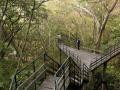
Basically, both Minh Chau and Quan Lan localities have quite favorable conditions for developing ecotourism. However, Quan Lan commune has more advantages to develop ecotourism in a humanistic direction, because this is an area with many famous historical relics such as Quan Lan Communal House, Quan Lan Pagoda, Temple worshiping the hero Tran Khanh Du, ... along with local festivals held annually such as the wind praying ceremony (March 15), Quan Lan festival (June 10-19); due to its location near the port and long exploitation time, the beaches in Quan Lan commune (especially Quan Lan beach) are no longer hygienic and clean to ensure the needs of tourists coming to relax and swim; this is also an area with many beautiful landscapes such as Got Beo wind pass, Ong Phong head, Voi Voi cave, but the ability to access these places is still very limited (dirt hill road, lots of gravel and rocks), especially during rainy and windy times; In addition, other natural resources such as mangrove forests and sea worms have not been really exploited for tourism purposes and ecotourism development. On the contrary, Minh Chau commune has more advantages in developing ecotourism in the direction of natural tourism, this is an area with diverse ecosystems such as at Rua De Beach, Bai Tu Long National Park Conservation Center...; Minh Chau beach is highly appreciated for its natural beauty and cleanliness, ranked in the top ten most beautiful beaches in Vietnam; Minh Chau commune is also home to Tram forest with a large area and a purity of up to 90%, suitable for building bridges through the forest (a very effective type of natural ecotourism currently applied by many countries) for tourists to sightsee, as well as for the purpose of studying and researching.
Figure 3.1: Thenmala Forest Bridge (India) Source: https://www.thenmalaecotourism.com/(August 21, 2019)
3.2.2. Using SWOT matrix to evaluate Quan Lan island tourism
General assessment of current tourism activities of Quan Lan island is shown through the following SWOT matrix:
Table 3.5: SWOT matrix evaluating tourism activities on Quan Lan island
Internal agent
Strengths- There is a lot of potential for tourism development, especially natural ecotourism and humanistic ecotourism.- The unskilled labor force is relatively abundant.- resource environmentunpolluted, still
Weaknesses- Poorly developed infrastructure, especially traffic routes to tourist destinations on the island.- The team of professional staff is still weak.- Tourism products in general
quite wild, originalintact
general and DLST in particularalone is monotonous.
External agents
Opportunity- Tourism is a key industry in the socio-economic development strategy of the province and Van Don economic zone.- Quan Lan was selected as a pilot area for eco-tourism development within the framework of the green growth project between Quang Ninh province and the Japanese organization JICA.- The flow of tourists and especially ecotourism in the world tends toincreasing
Challenge- Weather and climate change abnormally.- Competition in tourism products is increasingly fierce, especially with other localities in the province such as Ha Long, Mong Cai...- Awareness of tourists, especially domestic tourists, about ecotourism and nature conservation is not high.
Through summary analysis using SWOT matrix we see that:
To exploit strengths and take advantage of opportunities, it is necessary to:
- Diversify products and service types (build more tourism routes aimed at specific needs of tourists: experiential tourism immersed in nature, spiritual cultural tourism...)
- Effective exploitation of resources and differentiated products (natural resources and human resources)
div.maincontent .p { color: black; font-family:"Times New Roman", serif; font-style: normal; font-weight: normal; text-decoration: none; font-size: 14pt; margin:0pt; } div.maincontent p { color: black; font-family:"Times New Roman", serif; font-style: normal; font-weight: normal; text-decoration: none; font-size: 14pt; margin:0pt; } div.maincontent .s1 { color: black; font-family:"Times New Roman", serif; font-style: normal; font-weight: normal; text-decoration: none; font-size: 13pt; } div.maincontent .s2 { color: black; font-family:"Times New Roman", serif; font-style: normal; font-weight: normal; text-decoration: none; font-size: 13pt; } div.maincontent .s3 { color: #0D0D0D; font-family:"Times New Roman", serif; font-style: normal; font-weight: bold; text-decoration: none; font-size: 14pt; } div.maincontent .s4 { color: black; font-family:"Times New Roman", serif; font-style: italic; font-weight: normal; text-decoration: none; font-size: 14pt; } div.maincontent .s5 { color: black; font-family:"Times New Roman", serif; font-style: italic; font-weight: bold; text-decoration: none; font-size: 14pt; } div.maincontent .s6 { color: black; font-family:"Times New Roman", serif; font-style: italic; font-weight: normal; text-decoration: none; font-size: 14pt; vertical-align: -3pt; } div.maincontent .s7 { color: black; font-family:"Times New Roman", serif; font-style: italic; font-weight: normal; text-decoration: none; font-size: 14pt; vertical-align: -2pt; } div.maincontent .s8 { color: black; font-family:"Times New Roman", serif; font-style: italic; font-weight: normal; text-decoration: none; font-size: 14pt; vertical-align: -1pt; } div.maincontent .s9 { color: black; font-family:"Times New Roman", serif; font-style: normal; font-weight: normal; text-decoration: none; font-size: 14pt; } div.maincontent .s10 { color: black; font-family:"Times New Roman", serif; font-style: normal; font-weight: bold; text-decoration: none; font-size: 14pt; } div.maincontent .s11 { color: black; font-family:"Times New Roman", serif; font-style: normal; font-weight: normal; text-decoration: none; font-size: 14pt; } div.maincontent .s12 { color: black; font-family:Symbol, serif; font-style: normal; font-weight: normal; text-decoration: none; font-size: 14pt; } div.maincontent .s13 { color: black; font-family:Wingdings; font-style: normal; font-weight: normal; text-decoration: none; font-size: 14pt; } div.maincontent .s14 { color: black; font-family:"Times New Roman", serif; font-style: normal; font-weight: normal; text-decoration: none; font-size: 9pt; vertical-align: 5pt; } div.maincontent .s15 { color: black; font-family:"Times New Roman", serif; font-style: normal; font-weight: normal; text-decoration: none; font-size: 9pt; vertical-align: 5pt; } div.maincontent .s16 { color: black; font-family:Cambria, serif; font-style: italic; font-weight: normal; text-decoration: none; font-size: 14pt; } div.maincontent .s17 { color: #080808; font-family:"Times New Roman", serif; font-style: normal; font-weight: bold; text-decoration: none; font-size: 14pt; } div.maincontent .s18 { color: #080808; font-family:"Times New Roman", serif; font-style: normal; font-weight: normal; text-decoration: none; font-size: 14pt; } div.maincontent .s19 { color: black; font-family:"Times New Roman", serif; font-style: normal; font-weight: normal; text-decoration: none; font-size: 11pt; } div.maincontent .s20 { color: black; font-family:"Times New Roman", serif; font-style: normal; font-weight: normal; text-decoration: none; font-size: 10pt; } div.maincontent .s21 { color: black; font-family:"Times New Roman", serif; font-style: normal; font-weight: bold; text-decoration: none; font-size: 11pt; } div.maincontent .s22 { color: black; font-family:"Times New Roman", serif; font-style: normal; font-weight: normal; text-decoration: none; font-size: 11pt; } div.maincontent .s23 { color: black; font-family:"Times New Roman", serif; font-style: italic; font-weight: normal; text-decoration: none; font-size: 14pt; } div.maincontent .s24 { color: #212121; font-family:"Times New Roman", serif; font-style: normal; font-weight: normal; tex
Identify Rating Levels and Rating Scales
zt2i3t4l5ee
zt2a3gstourism,quan lan,quang ninh,ecology,ecotourism,minh chau,van don,geography,geographical basis,tourism development,science
zt2a3ge
zc2o3n4t5e6n7ts
of the islanders. Therefore, this indicator will be divided into two sub-indicators:
a1. Natural tourism attractiveness a2. Cultural tourism attractiveness
b. Tourist capacity
The two island communes in Quan Lan have different capacities to receive tourists. Minh Chau Commune is home to many standard hotels and resorts, attracting high-income domestic and international tourists. Meanwhile, Quan Lan Commune has many motels mainly built and operated by local people, so the scale and quality are not high, and will be suitable for ordinary tourists such as students.
c. Time of exploitation of Quan Lan Island Commune:
Quan Lan tourism is seasonal due to weather and climate conditions and festivals only take place on certain days of the year, specifically in spring. In Quan Lan commune, the period from April to June and from September to November is considered the best time to visit Quan Lan because the cultural tourism activities are mainly associated with festivals taking place during this time.
Minh Chau island commune:
Tourism exploitation time is all year round, because this is a place with a number of tourist attractions with diverse ecosystems such as Bai Tu Long National Park Research Center, Tram forest, Turtle Laying Beach, so besides coming to the beach for tourism and vacation in the summer, Minh Chau will attract research groups to come for tourism combined with research at other times of the year.
d. Sustainability
The sustainability of ecotourism sites in Quan Lan and Minh Chau communes depends on the sensitivity of the ecosystems to climate changes.
landscape. In general, these tourist destinations have a fairly high level of sustainability, because they are natural ecosystems, planned and protected. However, if a large number of tourists gather at certain times, it can exceed the carrying capacity and affect the sustainability of the environment (polluted beaches, damaged trees, animals moving away from their habitats, etc.), then the sustainability of the above ecosystems (natural ecosystems, human ecosystems) will also be affected and become less sustainable.
e. Location and accessibility
Both island communes have ports to take tourists to visit from Van Don wharf:
- Quan Lan – Van Don traffic route:
Phuc Thinh – Viet Anh high-speed boat and Quang Minh high-speed boat, depart at 8am and 2pm from Van Don to Quan Lan, and at 7am and 1pm from Quan Lan to Van Don. There are also wooden boats departing at 7am and 1pm.
- Van Don - Minh Chau traffic route:
Chung Huong high-speed train, Minh Chau train, morning 7:30 and afternoon 13:30 from Van Don to Minh Chau, morning 6:30 and afternoon 13:00 from Minh Chau to Van Don.
f. Infrastructure
Despite receiving investment attention, the issue of infrastructure and technical facilities for tourism on Quan Lan Island is still an issue that needs to be resolved because it has a direct impact on the implementation of ecotourism activities. The minimum conditions for serving tourists such as accommodation, electricity, water, communication, especially medical services, and security work need to be given top priority. Ecotourism spots in Minh Chau commune are assessed to have better infrastructure and technical facilities for tourism because there are quite complete and synchronous conditions for serving tourists, meeting many needs of domestic and foreign tourists.
3.2.1.4. Determine assessment levels and assessment scales
Corresponding to the levels of each criterion, the index is the score of those levels in the order of 4, 3, 2, 1 decreasing according to the standard of each level: very attractive (4), attractive (3), average (2), less attractive (1).
3.2.1.5. Determining the coefficients of the criteria
For the assessment of DLST in the two communes of Quan Lan and Minh Chau islands, the students added evaluation coefficients to show the importance of the criteria and indicators as follows:
Coefficient 3 with criteria: Attractiveness, Exploitation time. These are the 2 most important criteria for attracting tourists to tourism in general and eco-tourism in particular, so they have the highest coefficient.
Coefficient 2 with criteria: Capacity, Infrastructure, Location and accessibility . Because the assessment area is an island commune of Van Don district, the above criteria are selected by the author with appropriate coefficients at the average level.
Coefficient 1 with criteria: Sustainability. Quan Lan has natural and human-made ecotourism sites, with high biodiversity and little impact from local human factors. Most of the ecotourism sites are still wild, so they are highly sustainable.
3.2.1.6. Results of DLST assessment on Quan Lan island
a. Assessment of the potential for natural tourism development
For Minh Chau commune:
+ Natural tourism attractiveness is determined to be very attractive (4 points) and the most important coefficient (coefficient 3), so the score of the Attractiveness criterion is 4 x 3 = 12.
+ Capacity is determined as average (2 points) and the coefficient is quite important (coefficient 2), then the score of Capacity criterion is 2 x 2 = 4.
+ Exploitation time is long (4 points), the most important coefficient (coefficient 3) so the score of the Exploitation time criterion is 4 x 3 = 12.
+ Sustainability is determined as sustainable (4 points), the important coefficient is the average coefficient (coefficient 1), so the score of the Sustainability criterion is 4 x 1 = 4 points
+ Location and accessibility are determined to be quite favorable (2 points), the coefficient is quite important (coefficient 2), the criterion score is 2 x 2 = 4 points.
+ Infrastructure is assessed as good (3 points), the coefficient is quite important (coefficient 2), then the score of the Infrastructure criterion is 3 x 2 = 6 points.
The total score for evaluating DLST in Minh Chau commune according to 6 evaluation criteria is determined as: 12 + 4 + 12 + 4 + 4 + 6 = 42 points
Similar assessment for Quan Lan commune, we have the following table:
Table 3.3: Assessment of the potential for natural ecotourism development in Quan Lan and Minh Chau communes
Attractiveness of self-tourismof course
Capacity
Mining time
Sustainability
Location and accessibility
Infrastructure
Result
Point
DarkMulti
Point
DarkMulti
Point
DarkMulti
Point
DarkMulti
Point
DarkMulti
Point
DarkMulti
CommuneMinh Chau
12
12
4
8
12
12
4
4
4
8
6
8
42/52
Quan CommuneLan
6
12
6
8
9
12
4
4
4
8
4
8
33/52
b. Assessment of the potential for humanistic tourism development
For Quan Lan commune:
+ The attractiveness of human tourism is determined to be very attractive (4 points) and the most important coefficient (coefficient 3), so the score of the Attractiveness criterion is 4 x 3 = 12.
+ Capacity is determined to be large (3 points) and the coefficient is quite important (coefficient 2), then the score of the Capacity criterion is 3 x 2 = 6.
+ Mining time is average (3 points), the most important coefficient (coefficient 3) so the score of the Mining time criterion is 3 x 3 = 9.
+ Sustainability is determined as sustainable (4 points), the important coefficient is the average coefficient (coefficient 1), so the score of the Sustainability criterion is 4 x 1 = 4 points.
+ Location and accessibility are determined to be quite favorable (2 points), the coefficient is quite important (coefficient 2), the criterion score is 2 x 2 = 4 points.
+ Infrastructure is rated as average (2 points), the coefficient is quite important (coefficient 2), then the score of the Infrastructure criterion is 2 x 2 = 4 points.
The total score for evaluating DLST in Quan Lan commune according to 6 evaluation criteria is determined as: 12 + 6 + 6 + 4 + 4 + 4 = 36 points.
Similar assessment with Minh Chau commune we have the following table:
Table 3.4: Assessment of the potential for developing humanistic eco-tourism in Quan Lan and Minh Chau communes
Attractiveness of human tourismliterature
Capacity
Mining time
Sustainability
Location and accessibility
Infrastructure
Result
Point
DarkMulti
Point
DarkMulti
Point
DarkMulti
Point
DarkMulti
Point
DarkMulti
Point
DarkMulti
Quan CommuneLan
12
12
6
8
9
12
4
4
4
8
4
8
39/52
Minh CommuneChau
6
12
4
8
12
12
4
4
4
8
6
8
36/52
Basically, both Minh Chau and Quan Lan localities have quite favorable conditions for developing ecotourism. However, Quan Lan commune has more advantages to develop ecotourism in a humanistic direction, because this is an area with many famous historical relics such as Quan Lan Communal House, Quan Lan Pagoda, Temple worshiping the hero Tran Khanh Du, ... along with local festivals held annually such as the wind praying ceremony (March 15), Quan Lan festival (June 10-19); due to its location near the port and long exploitation time, the beaches in Quan Lan commune (especially Quan Lan beach) are no longer hygienic and clean to ensure the needs of tourists coming to relax and swim; this is also an area with many beautiful landscapes such as Got Beo wind pass, Ong Phong head, Voi Voi cave, but the ability to access these places is still very limited (dirt hill road, lots of gravel and rocks), especially during rainy and windy times; In addition, other natural resources such as mangrove forests and sea worms have not been really exploited for tourism purposes and ecotourism development. On the contrary, Minh Chau commune has more advantages in developing ecotourism in the direction of natural tourism, this is an area with diverse ecosystems such as at Rua De Beach, Bai Tu Long National Park Conservation Center...; Minh Chau beach is highly appreciated for its natural beauty and cleanliness, ranked in the top ten most beautiful beaches in Vietnam; Minh Chau commune is also home to Tram forest with a large area and a purity of up to 90%, suitable for building bridges through the forest (a very effective type of natural ecotourism currently applied by many countries) for tourists to sightsee, as well as for the purpose of studying and researching.
Figure 3.1: Thenmala Forest Bridge (India) Source: https://www.thenmalaecotourism.com/(August 21, 2019)
3.2.2. Using SWOT matrix to evaluate Quan Lan island tourism
General assessment of current tourism activities of Quan Lan island is shown through the following SWOT matrix:
Table 3.5: SWOT matrix evaluating tourism activities on Quan Lan island
Internal agent
Strengths- There is a lot of potential for tourism development, especially natural ecotourism and humanistic ecotourism.- The unskilled labor force is relatively abundant.- resource environmentunpolluted, still
Weaknesses- Poorly developed infrastructure, especially traffic routes to tourist destinations on the island.- The team of professional staff is still weak.- Tourism products in general
quite wild, originalintact
general and DLST in particularalone is monotonous.
External agents
Opportunity- Tourism is a key industry in the socio-economic development strategy of the province and Van Don economic zone.- Quan Lan was selected as a pilot area for eco-tourism development within the framework of the green growth project between Quang Ninh province and the Japanese organization JICA.- The flow of tourists and especially ecotourism in the world tends toincreasing
Challenge- Weather and climate change abnormally.- Competition in tourism products is increasingly fierce, especially with other localities in the province such as Ha Long, Mong Cai...- Awareness of tourists, especially domestic tourists, about ecotourism and nature conservation is not high.
Through summary analysis using SWOT matrix we see that:
To exploit strengths and take advantage of opportunities, it is necessary to:
- Diversify products and service types (build more tourism routes aimed at specific needs of tourists: experiential tourism immersed in nature, spiritual cultural tourism...)
- Effective exploitation of resources and differentiated products (natural resources and human resources)
div.maincontent .p { color: black; font-family:"Times New Roman", serif; font-style: normal; font-weight: normal; text-decoration: none; font-size: 14pt; margin:0pt; } div.maincontent p { color: black; font-family:"Times New Roman", serif; font-style: normal; font-weight: normal; text-decoration: none; font-size: 14pt; margin:0pt; } div.maincontent .s1 { color: black; font-family:"Times New Roman", serif; font-style: normal; font-weight: normal; text-decoration: none; font-size: 13pt; } div.maincontent .s2 { color: black; font-family:"Times New Roman", serif; font-style: normal; font-weight: normal; text-decoration: none; font-size: 13pt; } div.maincontent .s3 { color: #0D0D0D; font-family:"Times New Roman", serif; font-style: normal; font-weight: bold; text-decoration: none; font-size: 14pt; } div.maincontent .s4 { color: black; font-family:"Times New Roman", serif; font-style: italic; font-weight: normal; text-decoration: none; font-size: 14pt; } div.maincontent .s5 { color: black; font-family:"Times New Roman", serif; font-style: italic; font-weight: bold; text-decoration: none; font-size: 14pt; } div.maincontent .s6 { color: black; font-family:"Times New Roman", serif; font-style: italic; font-weight: normal; text-decoration: none; font-size: 14pt; vertical-align: -3pt; } div.maincontent .s7 { color: black; font-family:"Times New Roman", serif; font-style: italic; font-weight: normal; text-decoration: none; font-size: 14pt; vertical-align: -2pt; } div.maincontent .s8 { color: black; font-family:"Times New Roman", serif; font-style: italic; font-weight: normal; text-decoration: none; font-size: 14pt; vertical-align: -1pt; } div.maincontent .s9 { color: black; font-family:"Times New Roman", serif; font-style: normal; font-weight: normal; text-decoration: none; font-size: 14pt; } div.maincontent .s10 { color: black; font-family:"Times New Roman", serif; font-style: normal; font-weight: bold; text-decoration: none; font-size: 14pt; } div.maincontent .s11 { color: black; font-family:"Times New Roman", serif; font-style: normal; font-weight: normal; text-decoration: none; font-size: 14pt; } div.maincontent .s12 { color: black; font-family:Symbol, serif; font-style: normal; font-weight: normal; text-decoration: none; font-size: 14pt; } div.maincontent .s13 { color: black; font-family:Wingdings; font-style: normal; font-weight: normal; text-decoration: none; font-size: 14pt; } div.maincontent .s14 { color: black; font-family:"Times New Roman", serif; font-style: normal; font-weight: normal; text-decoration: none; font-size: 9pt; vertical-align: 5pt; } div.maincontent .s15 { color: black; font-family:"Times New Roman", serif; font-style: normal; font-weight: normal; text-decoration: none; font-size: 9pt; vertical-align: 5pt; } div.maincontent .s16 { color: black; font-family:Cambria, serif; font-style: italic; font-weight: normal; text-decoration: none; font-size: 14pt; } div.maincontent .s17 { color: #080808; font-family:"Times New Roman", serif; font-style: normal; font-weight: bold; text-decoration: none; font-size: 14pt; } div.maincontent .s18 { color: #080808; font-family:"Times New Roman", serif; font-style: normal; font-weight: normal; text-decoration: none; font-size: 14pt; } div.maincontent .s19 { color: black; font-family:"Times New Roman", serif; font-style: normal; font-weight: normal; text-decoration: none; font-size: 11pt; } div.maincontent .s20 { color: black; font-family:"Times New Roman", serif; font-style: normal; font-weight: normal; text-decoration: none; font-size: 10pt; } div.maincontent .s21 { color: black; font-family:"Times New Roman", serif; font-style: normal; font-weight: bold; text-decoration: none; font-size: 11pt; } div.maincontent .s22 { color: black; font-family:"Times New Roman", serif; font-style: normal; font-weight: normal; text-decoration: none; font-size: 11pt; } div.maincontent .s23 { color: black; font-family:"Times New Roman", serif; font-style: italic; font-weight: normal; text-decoration: none; font-size: 14pt; } div.maincontent .s24 { color: #212121; font-family:"Times New Roman", serif; font-style: normal; font-weight: normal; tex
Investment is mainly based on the intention of each unit, because of the request mechanism - so the quality is poor, the price is high and because some "backyard" units provide, the quality and technology are both poor. The bidding is ambiguous, not in compliance with the law, the price appraisal is not in accordance with the process, the equipment is not quality tested, in many places, the equipment does not operate according to technical regulations but is still accepted for delivery, even in some places, the equipment does not have technical specifications. There is a lack of inspection and control mechanism for investment, so the investment efficiency is low, many units supply non-technical equipment, fake labels. The investment is also unreasonable because there is no curriculum program before investing in equipment. The invested equipment is not compatible with the training curriculum program, causing huge waste. Many expensive devices were "hurriedly" purchased but the technical handover was not serious, the training and transfer to teachers were not up to standard, leading to no one using them, the machines were very expensive but were "covered" and left there. Regarding teaching and learning activities, she said: "According to regulations, students have 70% of the time to practice their profession, but currently there has been no document that pays attention to the content of issues related to professional practice, including: programs, practice instruction textbooks, equipment standards, criteria for improving vocational skills, standards on facilities, standards on vocational skills... Due to lack of technical knowledge, the construction of a program to ensure inter-connection is not effective, but only has empty theory. The understanding of inter-connection has no scientific basis, leading to the inability to build an inter-connection program". In addition, the author also mentioned the issue of the competition for excellent vocational teachers and the competition for vocational training equipment being organized at great expense, but is it substantial or not? Is it a real exam or a fake exam?; The organization is costly and formal. [11]
3.2. DEVELOPMENT STRATEGY OF VIETNAM ELECTRICITY GROUP TO 2020
3.2.1. Development goals of Vietnam Electricity Group
The development goal of the Vietnam Electricity industry set out in the 9th National Party Congress is: “Developing energy one step ahead to meet the requirements of economic and social development, ensuring national energy security. Making good use of resources
hydropower (combined with irrigation), gas and coal to develop a balanced power source. Build gas - electricity - fertilizer clusters in Phu My and the Southwest region. Promote the early construction and effective operation of Son La hydropower plant. Study the plan to build a power plant using nuclear energy. Synchronize and modernize the method of investing and trading in electricity; have appropriate policies on electricity use in rural and mountainous areas. Increase the competitiveness of electricity prices compared to the region.
In Decision No. 1208/QD-TTg, dated July 21, 2011, in the VII power plan, specific development perspectives are clearly stated:
- The development of the electricity industry must be closely linked to the country's socio-economic development strategy, ensuring sufficient electricity supply for the national economy and social life;
- Gradually form and develop a competitive electricity market, diversify investment and electricity trading methods. The State only holds a monopoly on the transmission grid to ensure the security of the national energy system.
- Develop the electricity sector based on the rational and effective use of primary energy resources of each region; continue to promote rural electrification, ensuring adequate, continuous and safe supply for electricity needs in all regions nationwide.
Specific objectives were set forth by the Government in the decision approving the master plan VII:
- Provide enough electricity for domestic demand, electricity production and import output in 2015 is about 194 - 210 billion kWh; in 2020 is about 330 - 360 billion kWh;
2030 about 695 - 834 billion kWh;
- Prioritize the development of renewable energy sources for electricity production, increasing the proportion of electricity produced from this energy source from 3.5% in 2010 to 4.5% of total electricity production in 2020 and 6% in 2030.
- Reduce the electricity elasticity coefficient/GDP from the current average of 2.0 to 1.5 in 2015 and to 1.0 in 2020.
3.2.2. Development orientation of Vietnam Electricity Group to 2020
3.2.2.1. Trade development orientation
Regarding electricity distribution and trading: Maintain the leading role of the Group in electricity distribution, study measures to equitize the electricity distribution part, but in terms of overall electricity distribution, the Group still holds the largest share. Promote the plan to survey and dominate the electricity supply market for industrial zones with 100% foreign investment, by improving the quality of electricity supply, ensuring safe and continuous electricity supply, penetrating the market quickly, competing with manufacturers investing in power plants to supply industrial zones; Encourage corporations and localities to participate in contributing capital to invest in developing power sources and grids, in order to contribute to supplying electricity to industrial zones; Consider purchasing electricity from investors when these plants have excess electricity or during the time the Group lacks electricity, on the principle that the electricity purchase price is not higher than the cost of the plant that the Group can mobilize.
Promote the application of scientific and technological advances in electricity business and consumption: Apply modern equipment to read and record meter indexes, record numbers remotely; further strengthen the installation of electronic meters for large electricity consumers to promote the effectiveness of time-of-use (TOU) price lists and two-component electricity prices (capacity, electricity). Support investment or contribute capital to produce equipment with high electricity efficiency to reduce electricity consumption such as high-efficiency equipment in industrial enterprises (electric motors), commercial centers, hotels (lighting, air conditioning, ventilation, air conditioners, etc.), household activities (refrigerators, air conditioners, hot water heaters, lighting, rice cookers, etc.).
3.2.2.2. Investment orientation for power source development
Prioritize the development of hydroelectric projects to take advantage of cheap, renewable and available energy sources; prioritize investment in the construction of highly efficient projects to increase financial efficiency and accumulate investment capital for development.
Power source development structure by 2020: Total capacity of power plants is about 75,000MW, of which: Hydropower accounts for 23.1%; pumped storage hydropower 2.4%; coal-fired thermal power 48.0%; gas-fired thermal power 16.5% (of which LNG is used 2.6%); renewable energy power sources 5.6%; nuclear power 1.3% and imported electricity 3.1%;
3.2.2.3. Grid development orientation
The development of the transmission grid must be synchronized with the progress of putting power plants into operation to achieve the overall investment efficiency of the entire system.
Develop the power transmission grid in accordance with the industry development strategy, power development planning and other local plans.
Developing 220kV and 500kV transmission grids to improve power supply reliability, reduce power loss, ensure smooth mobilization of power sources in the rainy and dry seasons, and mobilize power sources in all operating modes of the electricity market.
Develop power transmission lines with reserves for long-term development in the future, using multi-circuit poles and multiple voltage levels on a single pole row to reduce land area. For cities and large load centers, the power grid diagram must have higher reserves and flexibility; modernize and gradually bury the power grid in cities and towns, limiting negative impacts on the landscape and environment.
Step by step modernize the power grid, renovate and upgrade switching, protection and automation equipment of the power grid;
On transmission grid development:
- Developing 500kV ultra-high voltage transmission grid; researching and constructing 750kV; 1,000kV transmission lines.
- Developing the 220kV transmission grid: Transformer stations are built with a scale of 2 to 3 transformers; consider developing stations with 4 transformers and closed transformer stations (GIS), underground stations in cities; Newly built lines are at least
is double circuit; lines from large power sources, 500/220kV transformer stations are designed with at least double circuit using split-phase conductors.
On 110kV grid development and distribution:
- Invest in developing the 110kV power grid and the distribution grid in sync with the transmission grid, to improve the reliability of power supply to meet prescribed quality standards.
- Apply modern technology to improve the quality of the distribution grid, gradually bury the grid in cities and towns to limit the impact on the landscape and environment. Use modern technological solutions in investment and operation management to reduce power loss, towards building a smart grid, smart community, to reduce power loss, improve power efficiency.
- Research on appropriate voltage levels of the distribution grid for regions, avoiding widespread and ineffective grid renovation. Focus on investing in renovating the distribution grid to reduce power loss, reduce incidents and increase power supply reliability. In particular, prioritize renovating urban areas and areas with dilapidated grids. By 2020, reduce power loss to about 8%.
3.2.2.4. Human resource training orientation to 2020
Staff is an important factor when becoming a strong economic group. It is necessary to build a human resource development plan according to the operation direction of a Group. EVN has specific orientations:
Regarding staff training: Conduct staff planning, organize training and fostering for planned and incumbent staff in terms of expertise, profession, management, political theory, and foreign languages; Issue a set of standards for professional and technical positions of the Group, organize exams to promote staff; conduct annual staff reviews and assessments, before appointment and reappointment, and perform staff rotation.
Regarding human resource training and development: Develop a block of schools, strive to have one or two schools that meet international standards on the basis of consolidation and development.
Develop a team of teachers, improve professional and technical qualifications; build a unified standard program within the Group on training in specialized fields such as thermal power plants, hydropower plants; expand training, retraining and advanced training according to majors to gradually improve training quality. Increase the scale and proportion of training, especially good engineers, leading experts in all fields of engineering and management, specifically:
- Focus on training human resources for key sectors in the fields of electricity production, transmission and distribution. Focus on vocational training to have a team of skilled technical workers and professional staff capable of grasping and proficiently using modern technical means and technology. Organize retraining of technical management staff, gradually improving training quality to the level of countries in the region and the world.
- Innovate the training program for human resources in the electricity sector, diversify training forms and link training with actual production; focus on selecting and sending scientific and managerial staff for training abroad in key fields. Provide supplementary and proactive training for sectors that are lacking or weak, especially nuclear power and new energy sectors. Develop appropriate remuneration mechanisms to attract high-quality human resources.
- Implement the arrangement and reorganization of production models in a scientific and reasonable manner,
ensure efficient use of labor and improve labor productivity.
The Group has a training program to improve the qualifications of factory and grid operators, especially those at control centers, to make good use of modern equipment, to propose safe and effective operating methods, and to reduce system operating incidents. EVN has gradually developed a specific plan, especially attaching importance to training cooperation with foreign enterprises, focusing on countries where the Group purchases a lot of equipment.
3.2.2.5. Human resource training plan of Vietnam Electricity Group
With the basic task of producing and trading electricity and electrical engineering, in the future, the Electricity Group will focus on implementing the following goals:
targets to develop electricity and other production and business sectors in both breadth and depth. In terms of breadth, in the coming time, from 2011 to 2015, 50 power plants with a total installed capacity of 34,463 MW will be put into operation, of which EVN will invest in 19 plants with a total capacity of 16,825 MW; at the same time, expanding the electricity distribution market to neighboring countries. In terms of depth, EVN focuses on improving internal operational efficiency by applying advanced scientific and technological solutions to production and building a long-term strategy for human resource development to meet the development requirements of the group.
To meet the requirements of the Group's production and business development, the technical staff must meet both quantity and quality. In terms of quantity, it is expected that the human resources will increase in the future. In 2010, the total number of EVN employees will be 91,815 people, in which the training level structure ratios are: Postgraduate is 2 - 2.5%; University is 35 - 37%; College and high school is 14 - 18%; Technical workers is 40 - 45%.
%; Other workers 4-6%. By 2015, the total number of EVN's employees was 100,568 people, of which the proportions were Postgraduates 3-5%; University 43-46%; College and high school 13-15%; Technical workers 35-37%; Other workers 2-3%.
Thus, the human resource development training plan for the orientation blocks is as follows:
- Power generation sector: By 2010, the number of employees increased by about 1,700 people, and by 2015, it increased by about 1,500 people. The total number of employees in EVN's power generation sector by 2015 is from 9,800 to 11,000 people. The expected labor force structure ratio: Postgraduates account for 2.5-4%; University accounts for 40-42%; High school and college accounts for 17-18%; Technical workers account for 38-40%.
- Transmission sector : Total number of employees by 2015 is about 8,500 to 8,800 people. The expected structure of labor force qualifications is as follows: Post-graduate 4-5%; University 42-45%; High school and college 13-15%; Technical workers 39-41%.
- Power distribution sector: Total number of employees by 2015 is about 58,500 to
60,000 people. The expected labor force structure and qualification ratio is as follows: On average,