
1.6 Current status of cultivation and some major obstacles in corn production on rice land in the Mekong Delta
1.6.1 Current status of corn cultivation in the Mekong Delta
Statistics from 2014 to 2020 show that the corn area in the Mekong Delta is the lowest in the country and tends to decrease. By 2020, the corn area in the Mekong Delta was only 27.5 thousand hectares (accounting for 2.92% of the total corn area nationwide) (Figure 1.6). The average corn yield reached 6.24 tons/ha, ranking second in the country and the output reached 171.7 thousand tons (accounting for 3.77% of the country's corn output). Statistics also show that corn cultivation is mainly concentrated in the provinces of An Giang, Dong Thap, Long An, Hau Giang, Tra Vinh, and Tien Giang (General Statistics Office, 2020) [50].
Meanwhile, the total rice area (Winter-Spring, Summer-Autumn and Autumn-Winter, Summer-Autumn rice) reached 4,069.7 thousand hectares (accounting for more than 50% of the total rice area of the country) (General Statistics Office, 2020) [50]. However, rice production in the Mekong Delta is facing a clear climate change situation leading to a shortage of irrigation water, drought, and floods. Moreover, growing 3 rice crops a year on the same land means that the rest period between crops is too short, not enough to interrupt the life cycle of pests and diseases.
Maybe you are interested!
-

 Analysis of Current Status of Tourism Activities in Phong Dien District
 -
 Management Status of Tcm Results Evaluation Through NCBH Form Table 2.9: Current Status of Evaluation of Professional Team Performance Results Through Form
 -
 Current Status of Teaching Capacity of Teachers at District-Level Vocational Education Centers in Cao Bang Province
 -
 Current Status of Credit Quality at Vietnamese Joint Stock Commercial Banks
 -
 Current Status of State Management Activities for Tourism Enterprises in Hanoi
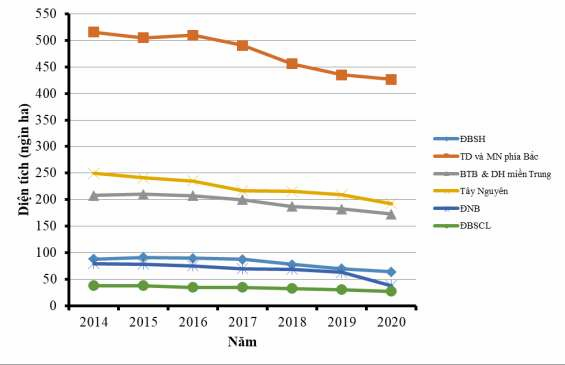
Figure 1.6 Corn area in domestic regions in the period 2014 - 2020
Source: General Statistics Office, 2020 [50],
1.6.2 Facility for converting corn production on rice land in the Mekong Delta
1.6.2.1 Water shortage in dry season due to climate change
According to the report of the Ministry of Natural Resources and Environment (2016) [5], the average temperature will increase by 1.7 - 1.9°C in the South according to the RCP4.5 scenario (representative greenhouse gas concentration - "Representative Concentration Pathways - RCP) and 3.0 - 3.5°C according to the RCP8.5 scenario; annual rainfall will increase by 5 - 15% according to the RCP4.5 scenario; the number of hot days (≥ 35°C) tends to increase; droughts may become more severe in some areas due to rising temperatures and the possibility of reduced rainfall in the dry season. Le Anh Tuan (2014) [18] reported that in the next 3 decades, the climate in the Mekong Delta will change in the direction of increasing temperature, increasing number of hot days (> 35°C), decreasing early season rainfall, increasing late season rainfall, increasing unusual heavy rains, increasing floods and high tides, these factors have a great impact on agricultural cultivation. and other industries. When the air temperature increases by 1°C, rice productivity will decrease by about 10%. Thus, the Mekong Delta region can lose from 2 - 4 million tons of rice each year (SRD, 2013) [48].
In fact, the 2016 drought and salinity seriously affected agricultural production in the Mekong Delta, especially rice production due to lack of water for production. Up to now, the record drought and salinity in 2020 has shown that climate change has clearly affected the Mekong Delta and is no longer a prediction. Therefore, converting crops to save irrigation water is considered the optimal solution to ensure productivity and economic efficiency (Trinh Quang Khuong and Pham Ngoc Hai, 2015).
[190] because rice plants need a lot of water during their life cycle. For rice fields in the South, the total amount of irrigation water needed for rice plants ranges from 4,500 -
8,000 m 3 /ha depending on the season (average 5,900 m 3 /ha) (TCVN 8641: 2011) [1]. Research
Mekonnen's (2010) [115] study shows that rice plants need 1,673 liters of water to produce 1 kg of rice. The research results of the Mekong Delta Rice Institute show that in the Spring-Summer crop, if the rice field is continuously flooded, each crop will consume 4,038 m 3 /ha / crop, if the irrigation is alternately dry and flooded, it will consume 2,571 m 3 /ha / crop; thus, each cubic meter (m 3 ) of water can only produce 0.94 - 1.45 kg of rice, (Trinh Quang Khuong and Pham Ngoc Hai,
2015) [190]. With the impact of climate change and the continuous increase in the area of Spring-Summer rice, there will be unfavorable conditions for crop cultivation.
Meanwhile, corn needs little water during the growth cycle, it is a plant that photosynthesizes according to the C4 pathway, so water use efficiency is high. The amount of water needed for corn in a crop is from 2,000 - 2,500 m 3 /ha (TCVN 8641: 2011) [1]. Mekonnen's report (2010) [115] shows that corn needs 1,222 liters of water/kg of corn kernels. Research results from the Mekong Delta Rice Institute show that growing hybrid corn in the Spring-Summer crop only costs
1,058 m3 of water/ha/crop. In the Spring-Summer crop, the average rice yield is 4.12 - 4.28
tons/ha, hybrid corn yield reaches from 6.24 - 6.91 tons/ha, on average each m3 of water produces 3.25 - 4.19 kg of corn kernels (Trinh Quang Khuong and Pham Ngoc Hai, 2015) [190]. Thus, with the measure of rotating hybrid corn on rice, the need for water will be reduced (1,513 - 2,980 m3 / ha/crop), much lower than rice cultivation.
In summary, under the current direct impact of climate change in the Mekong Delta, hybrid maize is suitable for the conversion structure to upland crops on inefficient rice-growing lands, at risk of water shortage in the dry season under the current climate change in the Mekong Delta.
1.6.2.2 Domestic demand for corn grain is increasing rapidly
By 2020, the amount of corn consumed in Vietnam will reach 16.66 million tons (domestic corn output will reach 4.59 million tons, imported 12.07 million tons) (General Statistics Office, 2020 [50], General Department of Customs, 2021 [49]). According to forecasts, the amount of corn consumed and the demand for corn for livestock will continue to increase, by 2028 the amount of imported corn will be 14.31 million tons to meet domestic corn demand (OECD, 2019) [188]. Therefore, the development of domestic corn is inevitable to reduce dependence on imported corn, proactively providing raw materials for commercial corn to serve domestic needs.
1.6.2.3 Trade conflict between the US and China
Currently, the trade conflict between the US (a corn exporting powerhouse) and China has affected the global import-export market in general and Vietnam's corn imports in particular. Thus, self-sufficiency in corn raw material areas
is urgent, in which selecting and creating domestic hybrid corn varieties is the fastest solution in the current period to proactively source commercial corn materials, ensuring to serve the increasing domestic demand for corn.
Comment: The conversion of the farming system to corn is currently facing many difficulties due to the following issues:
- Small, fragmented, unconcentrated production area;
- There are very few domestically bred corn varieties suitable for cultivation on rice fields in the Mekong Delta;
- High production costs (fertilizers, seeds, pesticides, harvesting);
- Lack of machinery and equipment for mechanization of corn;
- The corn cultivation process is still general, there is no technical process for corn cultivation on rice land for different soil groups;
- Unstable prices, low profits.
Therefore, in order for farmers not to turn their backs on corn, which has great potential for development in the Mekong Delta, it is urgent to quickly select suitable hybrid corn varieties for this region. At the same time, research and develop appropriate cultivation processes for each ecological sub-region, applying mechanization to important stages in corn cultivation to reduce labor. Thereby reducing corn production costs, increasing the competitiveness of domestically produced corn compared to imported corn, gradually reducing the proportion of imported seeds and commercial corn, ensuring domestic raw corn sources.
1.6.3 Some obstacles to corn cultivation on rice land in the Mekong Delta
According to Prasanna et al. (2018) [130], more than 80% of maize growing area is susceptible to extreme climate in South and Southeast Asia. Accordingly, abiotic stresses, especially drought, high temperature, waterlogging, acid soils, and unfavorable combinations of drought and temperature, have a great impact on rainfed maize production in Asia. In addition, pathogens and insect pests are likely to react
different responses to global warming, changes in their relative impacts both geographically and among different crops. According to Deutsch et al. (2018) [82], global yield losses of the three most important cereals (rice, maize, and wheat) are predicted to increase by 10 to 25% as global average temperatures increase. In this context, the development and deployment of improved maize varieties with tolerance to abiotic stresses (drought, high temperature, waterlogging, salinity, and combined drought and temperature stresses), nitrogen use efficiency, pest resistance, and improved nutritional quality are important factors for building the resilience and adaptability of farming communities in the tropics to a changing climate (Prasanna et al., 2018) [130].
Vietnam is among the countries strongly affected by climate change, especially in the Mekong Delta. Current challenges in corn cultivation in this region include the following issues:
1.6.3.1 Breeding work
According to the Department of Crop Production, currently 100% of the cultivated area uses hybrid corn varieties, with about 50 hybrid corn varieties being used in production supplied by domestic and foreign companies (Ministry of Agriculture and Rural Development, 2017) [183]. The current structure of corn varieties grown in the Mekong Delta is mainly from foreign companies, domestic corn varieties occupy very little area and the actual participation in production of these varieties is very modest in the seed market in the South. The market share of hybrid corn varieties selected and supplied by domestic agencies is shrinking at an even faster rate (Tran Kim Dinh et al., 2015) [52].
Survey data from the Department of Crop Production and Plant Protection of Dong Thap province (2017) shows that the structure of corn varieties that farmers are producing includes fresh corn and corn for animal feed (non-glutinous corn). In the Summer-Autumn crop of 2017, the main varieties are imported varieties such as NK6326, DK9901, DK9955, DK6919, DK6818, CP333. In the Autumn-Winter crop of 2017, farmers mainly grow varieties DK9901, NK6919.
Genetically modified corn was introduced to Vietnam in 2015 and the area planted with genetically modified corn in Vietnam is constantly increasing. In the Mekong Delta, genetically modified corn is
Farmers have tested and initially accepted the crop thanks to its ability to resist glyphosate-based herbicides and stem borers, saving costs and increasing income.
Imported corn varieties have uniformity, good resistance to pests and diseases, can be planted at high density, and have high and stable yields. However, imported corn varieties are not really suitable for each ecological region and crop rotation structure such as inappropriate growth period, ability to adapt to soil conditions, high seed prices, and producers have to depend entirely on foreign companies (Le Quy Kha et al., 2015) [23].
Transgenic corn varieties are resistant to glyphosate-based herbicides, resistant to stem borers, saving costs and increasing income. However, transgenic corn also has limitations such as very high seed prices, not really suitable for each ecological region and crop rotation structure on rice land. When there are new types of pests, transgenic corn cannot really solve the problem, depending on foreign seed sources, only really effective in certain areas (Le Quy Kha et al., 2015) [23].
Although domestically produced hybrid corn varieties have high productivity, they are not stable (poor adaptability), and the corn has poor condition (large cob, small kernels, not really beautiful color, hump shape, rat tail, etc.) so they are not as popular as imported varieties, leading to people having to use imported hybrid corn varieties with high cost and not being able to proactively source seeds.
In addition, a suitable hybrid maize variety for converted rice land needs to have:
(i) Short growing period (90 days in Summer-Autumn crop, 95 days in Winter-Spring crop) to ensure crop rotation and flood avoidance; (ii) High and stable yield, high adaptability, no lodging (corn is mainly grown in Spring-Summer and Summer-Autumn crops, resistant to waterlogging, resistant to acid sulfate, resistant to pests (stem borer and sheath blight), good corn condition and leaf durability; and (iii) Easy to grow, competitive seed price (Le Quy Kha et al., 2015) [23].
1.6.3.2 Fertilizer use efficiency
The efficiency of fertilizer use is currently low. People tend to use more fertilizer than recommended, leading to nutritional imbalance in the soil, environmental pollution, waste and ultimately increased production costs.
Therefore, it is necessary to have a suitable fertilization process for each ecological zone and each different type of soil. In addition, there should be more research to recommend the use of biological products and high-tech fertilizer products that provide nutrients according to the needs of crops. This helps to improve the efficiency of fertilizer use, reduce labor, be safe for humans and the environment, and reduce production costs.
1.6.3.3 Technical measures
There is no suitable maize cultivation technique for all maize growing areas. In the Mekong Delta with many different ecological sub-regions and different soil conditions, different technical solutions are needed. The research results of Duong Van Chin (2010) [11] and the maize cultivation process issued by the Department of Crop Production in 2016 are not really suitable for the Mekong Delta because they are still general among ecological regions. Moreover, varieties have different growth characteristics, so it is necessary to understand the characteristics of each variety to have appropriate recommendations. In addition, maize cultivation techniques on rice land are not the same as on upland land, with many unfavorable biological and abiotic factors such as waterlogging and pests. Therefore, it is necessary to develop a technical process for maize cultivation on rice land to improve maize production efficiency.
1.6.3.4 Disease control
The Mekong Delta has a hot and humid climate with a lot of rain, so there are many risks of pests developing and causing damage to maize plants. The report of Gerpacio and Pingali (2007) [90] shows that the groups of pests and diseases on maize plants in tropical climate conditions in the Mekong Delta include stem borer ( Chilo partellus ) and small leaf spot ( Helminthosporium maydis ) which are common in hotter and more humid conditions and large leaf spot ( Exerohilum turcicum) which is common in cooler conditions. The survey shows that the important groups of pests and diseases at the pilot sites are
The damage caused by pests and diseases can be up to 30% of corn yield.
Therefore, in addition to selecting corn varieties that are resistant to pests and diseases, good control of pests and diseases from an early stage helps limit their impact on growth and final yield, limit the use of pesticides, ensure health, the environment and increase economic efficiency. Survey results by Ho Cao Viet (2015) [17] show that the cost of pesticides accounts for 4.9 - 12.2% of the total cost of corn production in the Mekong Delta.
1.6.3.5 Mechanization in production
Mechanization in production is the weakest link in corn cultivation on rice fields in the Mekong Delta, the reason is that hybrid corn cultivation is still small and fragmented, so there are not many individuals or organizations investing in machinery and equipment for the corn growing industry. Therefore, currently, the stages from land preparation to harvesting depend heavily on manual labor, the shortage of labor or the high cost of hiring labor leads to high production costs and low production efficiency. Therefore, it is difficult to convince farmers to bring hybrid corn into cultivation on converted rice fields.
The survey results of Ho Cao Viet (2015) [17] show that mechanization accounts for 5.0
- 8.7% of corn production costs. From this mechanization situation, it requires a policy to organize mechanization services to meet the needs of producers who do not have the conditions to invest in expensive machinery and equipment.
1.6.3.6 Domestic corn consumption market
Output for corn production is currently facing many obstacles due to high corn production costs and competitive prices from corn exporting countries. According to data published by FAO, the corn production cost of Thailand is 225 USD/ton, the Philippines is 275 USD/ton, Indonesia is 282 USD/ton, the US is 142 USD/ton. Brazil is the country with the lowest corn production cost, 138 USD/ton while in Vietnam the production cost is twice as high (329 USD/ton) (Le Quy Kha and Doan Vinh Phuc, 2018) [108]. The survey results of Ho Cao Viet (2015) [17] on 360 farming households converting from rice fields to hybrid corn in the three provinces of Long An, Dong Thap and Hau Giang showed that the production efficiency