
Chapter 5: Suggested solutions and conclusions
Draw implications from the research results and suggest policy and recommendations.
Maybe you are interested!
-

 Concept of Hotel Room Service Quality
 -
 Discussion on Causes, Limitations and Existing Problems of Short-Term Loan Service Quality Khdn
 -
 Current situation and solutions to improve the quality of room service at Habana Hotel - 2
 -
 The impact of online banking service quality of Vietnam Development Investment Bank on customer satisfaction in Ho Chi Minh City market - 14
 -
 Review of service quality of Vung Tau - Con Dao tour at ATZ Travel Company - 2
Chapter 2: THEORETICAL OVERVIEW AND RESEARCH MODEL
2.1- Concept of service and service quality 2.1.1- Definition of service
Service is a popular concept so there are many ways to define service. According to Zeithaml and Britner (2000), service is the behavior, process, and method of performing a certain job to create value for customers to satisfy their needs and expectations.
According to Kotler and Armstrong (2004), services are activities or benefits that businesses can contribute to customers to establish, strengthen and expand long-term relationships and cooperation with customers.
2.1.2- Service characteristics
Services are unique products with many characteristics that are different from other goods such as intangibility, heterogeneity, inseparability and perishability. These characteristics make services difficult to quantify and cannot be identified by the naked eye.
Intangibility
Unlike physical products, services cannot be seen, tasted, heard, or smelled before they are purchased. To reduce uncertainty, buyers look for signs or evidence of service quality. They make inferences about service quality from the place, people, equipment, materials, information, symbols, and price they see. Because of their intangibility, it is difficult for companies to perceive how services are perceived and to evaluate service quality.
Heterogeneity:
This characteristic is also called service differentiation. Accordingly, service performance often varies depending on the service method, service provider, service provider, time of performance, service area, service target and service location.
This characteristic is most evident in labor-intensive services. It is difficult to ensure consistent quality from the staff. The reason is that what the company intends to serve may be completely different from what the consumer receives.
Inseparability:
The inseparability of services is reflected in the difficulty in dividing services into two distinct stages: the production stage and the use stage. Services are often created and used at the same time. This is not true for physical goods that are produced, stored, distributed through many intermediary stages of purchase and sale, and then consumed. For goods, customers only use the product at the final stage, but for services, customers accompany the entire or part of the service creation process.
For labor-intensive services, such as those in which quality occurs during the service delivery process, service quality is reflected in the interaction between the customer and the service provider's employees. For services that require consumer input, such as hairdressing or medical care, service providers rarely exercise quality control or management because consumers influence the process. In such cases, customer input, such as describing the hairstyle they want or patients describing symptoms to doctors, becomes important to the quality of the service.
Non-retention:
Services cannot be stored, warehoused, and sold like other goods. The fragility of services is not a problem when demand is stable. When demand fluctuates, service companies face difficulties. For example, public transport companies must have many times more vehicles than are needed for normal demand throughout the day to ensure service during peak hours.
peak. Therefore, services are products that are used when they are created and finished immediately afterwards.
2.1.3- Service quality
Service quality is a concept that has attracted much attention and controversy in the research literature because researchers have had difficulty defining and measuring service quality without any consensus (Wisniewski, 2001).
Service quality is defined in many different ways depending on the research object and research environment. Service quality is the extent to which a service meets the needs and expectations of customers (Lewis & Mitchell, 1990; Asubonteng, Karl & John, 1996; Wisniewski & Donnelly, 1996). Edvardsson, Thomsson and Ovretveit (1994) believe that service quality is a service that meets customers' expectations and satisfies their needs. According to Parauraman et al (1985, 1988), service quality is the gap between customers' expectations and their perceptions after using the service.
Unlike the quality of goods, which is tangible and can be measured by objective criteria such as features, characteristics, and durability. However, service quality is intangible. Therefore, the literature defines service quality based on: subjectivity, attitude, and perception. Zeithaml (1988) explains: “Service quality is the customer’s assessment of the overall superiority and excellence of an entity. It is a form of attitude and the consequences of a comparison between what is expected and the perception of what is received”. Creating a quality service means meeting customer expectations consistently. This statement clearly shows that service quality is related to customer expectations and their perceptions of the service. From there, the researcher asserts: measuring service quality is measuring customer satisfaction with service quality.
2.1.4- Measuring service quality
For a long time, many researchers have tried to define and measure service quality. For example, Lehtinen and Lehtinen (1982) suggested that service quality should be assessed on two aspects, (1) the service delivery process and (2) the outcome of the service. Gronroos (1984) also proposed two areas of service quality, which are (1) technical quality and (2) functional quality. Parasuraman et al. (1985) proposed a model of five gaps and five components of service quality, abbreviated as SERVQUAL.
2.1.4.1- SERVQUAL model - five service quality gap model:
Parasuraman et al. (1985, 1988) proposed a model of five gaps in service quality. (Figure 2.1)
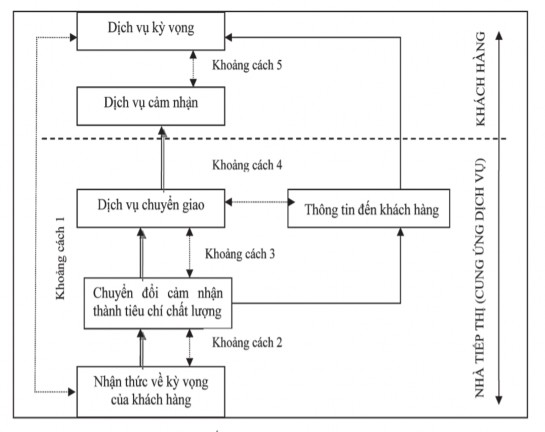
Figure 2.1: Service quality model
(Source: Parasuraman and Ctg (1985: 44)).
The first gap occurs when there is a difference between what customers expect from a service and what service managers perceive to be the customer’s expectations. The basic reason for this gap is that the service firm does not fully understand what constitutes quality in its service and how to deliver it to customers to satisfy their needs.
The second gap occurs when the service firm has difficulty translating its perception of customer expectations into service quality characteristics. In many cases, the firm may perceive customer expectations, but it cannot always translate these expectations into specific quality criteria and deliver them in accordance with customer expectations and service quality characteristics. The main causes of this problem are the technical capabilities of the service staff as well as the large fluctuations in service demand. There are times when the service demand is so high that the firm cannot meet it.
The third gap appears when service employees do not deliver services to customers according to the established criteria. In service, employees have direct contact with customers, play an important role in the process of creating quality. However, employees cannot always complete the tasks according to the established criteria.
Advertising and communication media also influence customer expectations of service quality. Promises made in promotional advertising programs may raise customer expectations but will also lower customer perceptions of quality when they are not delivered as promised. This is the fourth gap.
The fifth gap appears when there is a difference between the quality and expectation by customers and the quality they perceive. Service quality depends on this fifth gap. Once customers perceive no difference between the quality they expect and the quality they perceive when consuming a service, the service quality is considered excellent.
Parasuraman et al. (1985) stated that service quality is a function of the fifth gap. This fifth gap depends on the previous gaps. That is, gaps 1, 2, 3, 4. Therefore, to shorten the fifth gap and increase service quality, service managers must make efforts to shorten these gaps.
The service quality model according to these researchers can be represented as follows:
CLDV = F((KC_5 = f (KC_1, KC_2, KC_3, KC_4))
In which, CLDV is service quality and KC_1, KC_2, KC_3, KC_4 are quality gaps 1, 2, 3, 4, 5.
Service quality components:
Parasuraman et al. (1985) service quality model gives us an overall picture of service quality. Parasuraman et al. (1985) believes that any service
So, service quality perceived by customers can be modeled into 10 components, which are:
1. Reliability refers to the ability to perform the service correctly and on time the first time.
2. Responsiveness refers to the desire and readiness of employees.service providing services to customers.
3. Service capacity (competence) refers to the level of expertise to performservice. Service ability is demonstrated when employees come into contact with customers, employeesstaff directly performing the service, research ability to grasp relevant informationnecessary for customer service.
4. Access involves making things easy for customers.customers in accessing services such as shortening customer waiting time,Service locations and opening hours convenient for customers.
5. Courtesy refers to the attitude of serving warmly, respectfully and friendly.with customers.
6. Information (communication) related to communication and communication with customerscustomers in a language they (customers) can easily understand and listen to what they have to say.issues related to them such as explaining services, costs, resolving complaints and questions.
7. Credibility refers to the ability to create trust with customers, makingcustomers trust the company. This ability is demonstrated through the name and reputation of thecompany, personality of service staff directly communicating with customers.
8. Security refers to the ability to ensure the safety of customers.goods, demonstrated through physical and financial safety, as well as information security.
9. Understanding/knowing the customer: demonstrated throughthe ability to understand and grasp customer needs through learning aboutcustomer demands, personal attention and customer identificationfrequent.