
In the VBVB of Quang Nam province, fishermen use two types of trawl nets, which are single trawl nets and three-layer trawl nets. Single trawl nets have been used for a long time and have become a traditional occupation of the locality. Three-layer trawl nets (called three-screen trawl nets by fishermen) were introduced to Quang Nam about 15 years ago (2005). They are effective in catching fish but also have harmful effects on aquatic resources and marine ecosystems.
The structure of the 3-layer trawl net consists of 3 overlapping mesh panels, including 1 panel in the middle (called the inner panel) and 2 panels on both sides (called the outer panels). The inner panel usually has a smaller mesh size than the 2 outer panels. The upper edges of the 3 mesh panels are assembled onto the buoy grid, while the lower edges of the 3 panels are joined together onto the lead grid.
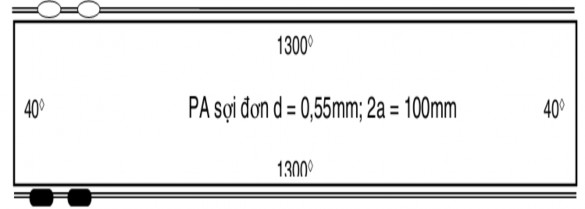
Nets are rectangular nets, depending on the target fished, each type of net uses a different specification and color. The net thread material is PA, d= 0.35mm, white, frog-foot knotted; the mesh size 2a of the 2 outer nets is 50mm.
The rope system includes buoy rope and tape rope. Float rope type PE, Φ = 8mm.
The lead wire helps to shape the net in water and during the working process, the lead wire always tends to stretch the net downwards. The lead wire is made of PA material, model number 210D/24, diameter d = 0.85mm and is threaded into the net cover. Each assembled net cover is about 7 kg of lead.
The 3-layer trawl buoy has dimensions of 130 * 30 * 20 (mm); the distance between two buoys is 16 ÷ 18 meshes; each net has 80 small buoys evenly distributed on the buoy's girder. The basic parameters of the trawl net used for exploitation in VBNC are shown in Figure 3.1 and Table 3.9.
80 PVC (130x30x20)mm 2 x 42.30m PE Φ 8 U1 = 0.75
Figure 3.1: Drawing of the trawl net development
Table 3.9: Basic parameters of trawl net
Required Information
Single trawl | 3 layer trawl net |
Maybe you are interested!
-

 Basic Solutions to Improve Human Resources Treatment at Asia Food and Beverage Company Limited
 -
 Some Basic Theoretical Issues on Tourism and Tourism Resources.
 -
 Improving the efficiency of exploitation and protection of aquatic resources in coastal waters of Quang Nam province - 2
 -
 Studying tourism resources in Cua Van fishing village. Current status and solutions for tourism development - 2
 -
![Basic Summarization-Oriented Single-Text Summarization Model [128]](https://tailieuthamkhao.com/uploads/2022/06/10/nghien-cuu-phat-trien-mot-so-phuong-phap-tom-tat-van-ban-su-dung-ky-13-1-120x90.jpg) Basic Summarization-Oriented Single-Text Summarization Model [128]
Basic Summarization-Oriented Single-Text Summarization Model [128]
Inner plate | Outer plate | ||
Mesh panel material | PA fee | PA fee | PA fee |
Mesh size | 10 15 | 15 ÷ 30 | 20 ÷ 35 |
Horizontal reduction factor U1 | 0.8 | 0.75 | 0.75 |
Horizontal reduction factor U1 | 0.58 | 0.58 | 0.58 |
Shortened length of 1 mesh (m) | 40 | 50 | 50 |
Height of 1 net panel (m) | 10 | 10 | 10 |
Number of nets per ship | 50 | 60 | 60 |
3.1.2.2. Fishing gear
Source: survey data
Hook is also a type of fishing gear with a very simple structure, easy to manufacture, low investment cost, so it appeared very early in the folk. Hook is also a passive fishing gear but has high selectivity, is an environmentally friendly profession, does not damage the living environment of aquatic species. In the VBVB of Quang Nam province, hook is the fishing gear that accounts for the second largest proportion after trawling. Fishing gear usually has 2 types: pole fishing (hand fishing) and longline fishing. Hand fishing has a simple structure while longline fishing has a complex structure. The results of the survey of the current situation and the basic parameters of fishing gear are presented in Table 3.10.
Table 3.10: Basic parameters of longline fishing gear
TT
Name | Material | Quantity | Specifications | |
1 | Main line | PA Mono | 7,500 | Ø1.80mm |
2 | The above sentence tag | PA Mono | 1.500x28 | Ø0.90mm |
3 | Tag below | PA Mono | 1,500x2 | Ø0.90mm |
4 | Lifebuoy | PE | 1.500x11 | Ф5mm |
5 | Artificial bait | PVC | 1500 | L = 140mm |
6 | Beads create a link button | PVC | 1,500x2 | Ф5mm |
7 | Sentence rotation lock | Stainless steel | 1,500x2 | L = 30mm |
8 | Clamp (with swivel lock) | Stainless steel | 1,500 | L = 35mm |
9 | float | PVC | 1,500 | L400, Ф100 |
10 | Lead | Pb | 1,500x7 | 20g |
11 | Flag buoy | PVC | 30 | L400, Ф100 |
12 | Big flag (yellow head) | Bamboo, fabric | 2 | 2.5m |
3.1.2.3. Purse fishing gear
Source: survey data
Purse nets are fishing gear used to catch pelagic fish, an active fishing method with complex structure and high technical requirements. On the other hand, pelagic fish reserves in Quang Nam province are not large, only 16.23% of the total reserves. Therefore, the proportion of purse seine fishing in Quang Nam province is not high, only 3.17% of the total number of vessels. Mainly the
There are vessels over 20CV operating in purse seine fishing here, but there are no vessels under 20CV. The results of the survey of the basic structural parameters of purse seine fishing are presented in Table 3.11.
Table 3.11: Basic parameters of the purse seine
Name
Materials, specifications | 2a (mm) | Quantity | ||
Meat mesh | Close | PA210D/9 | 23 | 25 |
Pine | PA210D/15 | 15 20 mm | 10 | |
Wing | PAP210D/9 | 25 | 50 | |
Net | float | PA210D/21 | 25 | 1 |
Lead | PE700D/18 | 40 | 1 | |
Chao Bien | PE700D/18 | 40 | 2 | |
Rope | Float ring | PPɸ14 car | d =14 | 2 |
Lead | PPɸ10,PPɸ12 | d =10÷12 | 2 | |
withdrawal | PP ɸ36 braided | d =36 | 1 | |
Lifebuoy | Flexible foam | 200x60x40 | 2000 | |
Lead | Lead (Pb) | 60x30 ɸ11 | 1700 | |
Ring | Cu D190xɸ25 | d=25÷35 | 70 | |
Source: survey data
From Table 3.11, it can be seen that the purse seine here has a mesh structure in the upper part that does not satisfy the regulations in Appendix II, Circular 19/2018/TT-BNNPTNT [4]. Thus, it can be said that the purse seine fishing industry is generally environmentally friendly, but with 2a in the middle part, the product is smaller than the regulations, so there is a possibility of catching juvenile fish, young fish, and immature fish.
3.1.2.4. Trawl fishing gear
Trawling is a fishing gear that operates on the principle of filtering water to get fish. Trawling is a type of fishing gear that harms resources and their habitat. Therefore, the State has issued a document banning trawling in the VBVB nationwide since 2006 [2, 7, 11]. Due to many different reasons, fishermen still defy the law and bring trawling boats here to operate. In the VBVB of Quang Nam province, there are two types of trawling nets operating illegally day and night: pair trawling nets and single trawling nets. The results of the actual investigation of the basic parameters of single trawling nets and pair trawling nets operating in the VBVB of Quang Nam province are presented in Table 3.12 and Table 3.13.
Table 3.12: Basic parameters of single trawl fishing gear
TT
Name | Materials, structures | Specifications | Quantity | |
1 | Mesh Wing | PE700D/21 | 2a= 60÷80 (mm) | 2 |
2 | Mesh body | PE700D/15 | 2a=25÷40 (mm) | 6 |
Name | Materials, structures | Specifications | Quantity | |
3 | missed | PE700D/25 | 2a=15÷20 (mm) | 1 |
4 | Lead | PP | 20÷30 (mm) | 1 |
5 | Float ring | PP | 15÷30 (mm) | 1 |
6 | Cable pull | Fe | 18÷22 (mm) | 2 |
7 | Lifebuoy | PVC | 200÷250 (mm) | 20 |
8 | Lead | Pb, chain | 10÷12 (mm) | 1 wire |
9 | Mesh board | Steel covered with wood, | 1.5mx0.5m | 2 |
TT
Source: survey data
Table 3.13: Basic parameters of pair trawl fishing gear
TT
Name | Materials, structures | Specifications | Quantity | |
1 | Mesh Wing | PE700D/21 | 2a = 60÷80 (mm) | 2 |
2 | Mesh body | PE700D/15 | 2a = 25÷40 (mm) | 6 |
3 | missed | PE700D/25 | 2a = 15÷20 (mm) | 1 |
4 | Lead | PP | 25÷40 (mm) | 1 |
5 | Float ring | PP | 20÷40 (mm) | 1 |
6 | Lifebuoy | PVC | 200÷250 (mm) | 20 |
7 | Lead | Pb, chain | 10÷12 (mm) | 1 wire |
8 | Red wire | Jute sheathed cable | 80; 100 m | 2 |
9 | Cable pull | Fe | 20÷25 (mm) | 2 |
Source: survey data
From Table 3.12 and Table 3.13, it can be seen that the trawl here has a mesh size in the fish holding part smaller than the regulation [2, 7]. On the other hand, both types of trawls have a lead structure and especially the single trawl is equipped with a net board which is the part that scrapes the seabed during the working process. This is an important factor that harms the resources and habitat of aquatic species.
3.1.2.5. Fishing gear for cage and trap fishing
Cage traps are one of the traditional occupations of fishermen in Quang Nam province, including crab traps, squid traps, crab traps, etc. Cage traps are considered an environmentally friendly fishing profession because they are fixed fishing gear that people drop to the bottom of the sea, and seafood species crawl into them and are then retained. In recent years, in Quang Nam province, cage trap fishing gear from China (commonly known as wire traps) has been imported. Currently, wire traps, also known as octagonal cages, Chinese stacking traps, are fishing gear prohibited from exploitation according to Circular 19/2018 of the Ministry of Agriculture and Rural Development [4]. The structure of the wire trap fishing gear is as follows:
Figure 3.2: Structure of the fishing gear
- Average length: 10m
- Width: 300 350 mm
- Height: 200 250 mm
- Mesh size 2a in the fish holding part: 10 15 mm
- Mesh size 2a of the net jacket (fish guide): 15 20 mm
- Rectangular cuttings, size: 14 * 80 mm
Each fishing household equips its boat with 100 to 150 fishing lines (if pulling manually); or 300 to 400 fishing lines (if using a fishing machine). The basic parameters of the fishing lines are described in Figure 3.2 and Table 3.14.
Table 3.14: Technical parameters of wire rope
TT
Specifications | Unit | Biggest | Medium | Smallest | |
1 | Length | m | 12 | 10 | 8 |
2 | Height | m | 0.3 | 0.25 | 0.2 |
3 | Width | m | 0.35 | 0.3 | 0.25 |
4 | 2a of the mesh bag | mm | 20 | 15 | 10 |
5 | Length of the cutting | mm | 10 | 9 | 8 |
6 | Width of the trap | mm | 300 | 250 | 200 |
7 | 2a of hom lu | mm | 20 | 15 | 10 |
8 | 2a in the bag | mm | 15 | 10 | 8 |
Source: survey data
3.1.3. Current status of labor on KTTS fishing vessels in VBVB, Quang Nam province
3.1.3.1. Age structure and education level of workers
To clearly see the current situation of labor working on fishing vessels in Quang Nam province, the researcher conducted direct interviews with crew members of 366 vessels. The total number of respondents was 1956, distributed by occupation as shown in Table 3.15. The survey results by education level and age are presented in Table 3.16.
Table 3.15: Distribution of the number of surveyed workers by mining occupation in 2019
TT
Profession | Number of respondents | Rate (%) | |
1 | trawl | 360 | 18.40 |
2 | Sentence | 240 | 12.27 |
3 | Seine | 300 | 15.34 |
4 | Seine net | 360 | 18.40 |
5 | Trap cage | 396 | 20.25 |
6 | Other professions | 300 | 15.34 |
Total | 1,956 | 100 | |
Source: survey data
Table 3.16: Education level and working age of KTTS
TT
Age | Level of education | Total | ||||||
Illiterate | Elementary | Secondary School | High School | (People) | (%) | |||
1 | < 20 | 8 | 130 | 175 | 0 | 313 | 16.00 | |
2 | 20 ÷ 39 | 21 | 485 | 431 | 61 | 998 | 51.02 | |
3 | 40 ÷ 59 | 41 | 238 | 177 | 33 | 489 | 25.00 | |
4 | ≥ 60 | 35 | 74 | 42 | 5 | 156 | 7.98 | |
Total | (People) | 105 | 927 | 825 | 99 | 1,956 | 100 | |
(%) | 5.37 | 47.39 | 42.18 | 5.06 | 100 | |||
Source: survey data
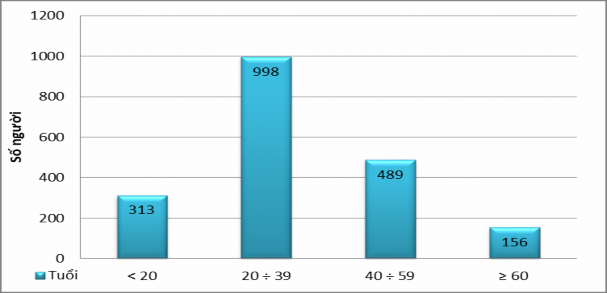
Chart 3.4: Distribution of people by age of workers
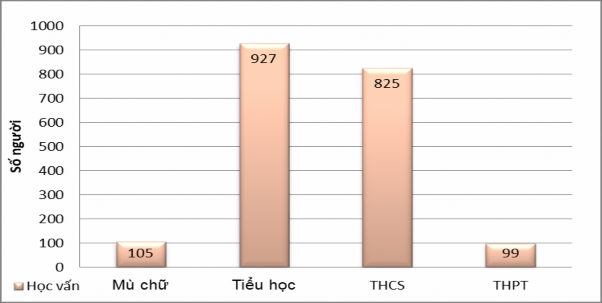
Chart 3.5: Distribution of people by education level
From table 3.16, chart 3.4, it is easy to see that the age group with the best health, suitable for the marine fishing profession, is 20÷39 years old, accounting for 51.02%. Although this age group has good health, they do not have much experience. Next is the age group from 40 to 59, accounting for 25.00% of the total number of people surveyed. At this age group, the advantage is that workers have a lot of experience but their health begins to decline. At the remaining age group, under 20 years old, they have good health but lack experience at sea (accounting for 16.00%), on the contrary, those aged 60 and over have a lot of experience but poor health, accounting for only 7.98%.
From table 3.15, chart 3.5 shows that the majority of crew members on fishing vessels operating in VBVB, Quang Nam province have low education, primary school level accounts for 47.39%, even 5.37% of the total number of respondents are illiterate. The number of crew members with secondary school education accounts for a relatively high proportion (42.18%), after the primary school group. The remaining number with high school education accounts for only 5.06% of the total number of crew members surveyed. This situation is quite high compared to the education level of crew members operating in VBVB fishing vessels nationwide [10, 42]. However, compared to the requirements for applying science, technology and State laws to fisheries, there are still many difficulties and shortcomings.
3.1.3.2. Professional qualifications and experience of workers
Partly due to low education level, on the other hand, fishermen have long abandoned books, so their main occupation is to study while doing, learning practically according to family tradition, passed down from father to son by hand-holding. The level of skills and expertise mainly depends on experience at sea through the number of years working on ships. The more you work
The longer a person has been at sea, the more experience he has and the higher his skill level. The certificates that the captain, chief engineer, mate, crew member, and mechanic have are to assess the level of law enforcement of the ship owner. The results of the survey on the professional qualifications and experience of workers are shown in Table 3.17.
Table 3.17: Age and experience of crew members
TT
Age in career (years) | Number (people) | Rate (%) | Rating level | |
1 | < 5 | 246 | 12.60 | New to the profession, no experience |
2 | 5 ÷ 10 | 641 | 32.80 | Moderate experience |
3 | 10 ÷ 20 | 716 | 36.60 | Highly experienced |
4 | ≥ 20 | 353 | 18.00 | Very experienced |
Total | 1956 | 100 | ||
From table 3.17 shows:
Source: survey data
- The survey was conducted on a total of 1,956 crew members, according to the following groups: under 5 years, 5 ÷ 10 years, 10 ÷ 20 years, ≥ 20 years. The group of crew members with 10 ÷ 20 years of experience accounted for the highest proportion (36.6%) compared to the remaining groups. The group of crew members with 5 ÷ 10 years of experience ranked second with 32.80%. The remaining group with low experience (under 5 years) accounted for only 12.6% and the group of experienced crew members accounted for 18% of the total number of respondents.
Table 3.18: Professional qualifications of crew members
Ship length
Type of training | Captain's Certificate | Chief Engineer Certificate | Sailor's Certificate | Mechanic Certificate | |
<6m | Number of respondents | 271 | 271 | 271 | 271 |
Number of people with certificates | 170 | 117 | 0 | 0 | |
6÷<12m | Number of respondents | 95 | 95 | 95 | 95 |
Number of people with certificates | 95 | 95 | 65 | 0 |
Source: survey data
According to Circular No. 22/2018/TT-BNN [5], ships under 6m in length are not required to have a captain, chief engineer, sailor, or mechanic certificate; for ships from 6÷12m in length, only the captain and 1 sailor are required to have a certificate. The results of the investigation of 366 fishing vessels operating in the VBVB of Quang Nam province, of which 271 vessels were under 6m in length, 95 vessels were from 6÷12m in length, the specific results are presented in Table 3.18. From Table 3.18, it can be seen that: