
Survey results in communities in the North of Quang Binh province show that the history of forest management in the past was quite complicated. Most of the previously assigned forest areas were under the management of the People's Committees of communes. When implementing community forests, they were assigned to the communities. However, in some communities such as La Trong 1-2, a part of the forest area was previously assigned to the village or in Thanh Liem 1 and Thanh Liem 2 villages, some of the forest areas were previously assigned to households. When implementing community forests, the people agreed to return the forest to implement community forests because the reason was that the previously assigned forest areas were not actually known to the families about the area and location of the assigned forest. In this area, it was also noted that some communities were assigned forests from areas previously assigned to the Protection Forest Management Board (PFMB) of Tuyen Hoa district such as Cao, Ke and Chuoi villages.
Meanwhile, the research on the history of forest management by communities in the western region of Quang Binh province shows that most of the forest area was previously managed by the People's Committee of the commune. In this area, in the case of Ca Roong 2 village, the forest area was previously managed by the village itself in the form of sacred forest and water mo forest. This area also has many communities with rich and very rich forest areas, the forest area assigned is relatively large and located deep in the core zone of Phong Nha National Park.
- Ke Bang.
Table 3.2.b. Forest resources allocated to communities and history of forest management in the highlands of western Quang Binh province
STT
Village | Year of delivery | Forest type | Main forest status | History of community forest management | |
1 | Carrot 1 | 2014 | RSX | Bamboo forest | Before 2014, managed by the Commune People's Committee |
2 | Carrot 2 | 2013 | RSX | Bamboo forest | Previously managed by the village community |
3 | hug | 2013 | RSX | Poor forest | Before 2013, managed by the Commune People's Committee |
4 | Version 51 | 2014 | RSX | Rich forest | Before 2014, managed by the Commune People's Committee |
5 | You | 2016 | RSX | Medium forest | Before 2016, managed by the Commune People's Committee |
6 | Vibration Slot | 2014 | RSX | Rich forest | Before 2014 by the People's Committee of the commune |
Maybe you are interested!
-
 Research and propose solutions for community forest management in Ngan Son - Bac Kan - 2
 -
 Community forestry in Quang Tri province and main activities in community forest management in Lang Cat village, Dakrong commune, Dakrong district, Quang Tri province - 12
 -
 Identify Rating Levels and Rating Scales
zt2i3t4l5ee
zt2a3gstourism,quan lan,quang ninh,ecology,ecotourism,minh chau,van don,geography,geographical basis,tourism development,science
zt2a3ge
zc2o3n4t5e6n7ts
of the islanders. Therefore, this indicator will be divided into two sub-indicators:
a1. Natural tourism attractiveness a2. Cultural tourism attractiveness
b. Tourist capacity
The two island communes in Quan Lan have different capacities to receive tourists. Minh Chau Commune is home to many standard hotels and resorts, attracting high-income domestic and international tourists. Meanwhile, Quan Lan Commune has many motels mainly built and operated by local people, so the scale and quality are not high, and will be suitable for ordinary tourists such as students.
c. Time of exploitation of Quan Lan Island Commune:
Quan Lan tourism is seasonal due to weather and climate conditions and festivals only take place on certain days of the year, specifically in spring. In Quan Lan commune, the period from April to June and from September to November is considered the best time to visit Quan Lan because the cultural tourism activities are mainly associated with festivals taking place during this time.
Minh Chau island commune:
Tourism exploitation time is all year round, because this is a place with a number of tourist attractions with diverse ecosystems such as Bai Tu Long National Park Research Center, Tram forest, Turtle Laying Beach, so besides coming to the beach for tourism and vacation in the summer, Minh Chau will attract research groups to come for tourism combined with research at other times of the year.
d. Sustainability
The sustainability of ecotourism sites in Quan Lan and Minh Chau communes depends on the sensitivity of the ecosystems to climate changes.
landscape. In general, these tourist destinations have a fairly high level of sustainability, because they are natural ecosystems, planned and protected. However, if a large number of tourists gather at certain times, it can exceed the carrying capacity and affect the sustainability of the environment (polluted beaches, damaged trees, animals moving away from their habitats, etc.), then the sustainability of the above ecosystems (natural ecosystems, human ecosystems) will also be affected and become less sustainable.
e. Location and accessibility
Both island communes have ports to take tourists to visit from Van Don wharf:
- Quan Lan – Van Don traffic route:
Phuc Thinh – Viet Anh high-speed boat and Quang Minh high-speed boat, depart at 8am and 2pm from Van Don to Quan Lan, and at 7am and 1pm from Quan Lan to Van Don. There are also wooden boats departing at 7am and 1pm.
- Van Don - Minh Chau traffic route:
Chung Huong high-speed train, Minh Chau train, morning 7:30 and afternoon 13:30 from Van Don to Minh Chau, morning 6:30 and afternoon 13:00 from Minh Chau to Van Don.
f. Infrastructure
Despite receiving investment attention, the issue of infrastructure and technical facilities for tourism on Quan Lan Island is still an issue that needs to be resolved because it has a direct impact on the implementation of ecotourism activities. The minimum conditions for serving tourists such as accommodation, electricity, water, communication, especially medical services, and security work need to be given top priority. Ecotourism spots in Minh Chau commune are assessed to have better infrastructure and technical facilities for tourism because there are quite complete and synchronous conditions for serving tourists, meeting many needs of domestic and foreign tourists.
3.2.1.4. Determine assessment levels and assessment scales
Corresponding to the levels of each criterion, the index is the score of those levels in the order of 4, 3, 2, 1 decreasing according to the standard of each level: very attractive (4), attractive (3), average (2), less attractive (1).
3.2.1.5. Determining the coefficients of the criteria
For the assessment of DLST in the two communes of Quan Lan and Minh Chau islands, the students added evaluation coefficients to show the importance of the criteria and indicators as follows:
Coefficient 3 with criteria: Attractiveness, Exploitation time. These are the 2 most important criteria for attracting tourists to tourism in general and eco-tourism in particular, so they have the highest coefficient.
Coefficient 2 with criteria: Capacity, Infrastructure, Location and accessibility . Because the assessment area is an island commune of Van Don district, the above criteria are selected by the author with appropriate coefficients at the average level.
Coefficient 1 with criteria: Sustainability. Quan Lan has natural and human-made ecotourism sites, with high biodiversity and little impact from local human factors. Most of the ecotourism sites are still wild, so they are highly sustainable.
3.2.1.6. Results of DLST assessment on Quan Lan island
a. Assessment of the potential for natural tourism development
For Minh Chau commune:
+ Natural tourism attractiveness is determined to be very attractive (4 points) and the most important coefficient (coefficient 3), so the score of the Attractiveness criterion is 4 x 3 = 12.
+ Capacity is determined as average (2 points) and the coefficient is quite important (coefficient 2), then the score of Capacity criterion is 2 x 2 = 4.
+ Exploitation time is long (4 points), the most important coefficient (coefficient 3) so the score of the Exploitation time criterion is 4 x 3 = 12.
+ Sustainability is determined as sustainable (4 points), the important coefficient is the average coefficient (coefficient 1), so the score of the Sustainability criterion is 4 x 1 = 4 points
+ Location and accessibility are determined to be quite favorable (2 points), the coefficient is quite important (coefficient 2), the criterion score is 2 x 2 = 4 points.
+ Infrastructure is assessed as good (3 points), the coefficient is quite important (coefficient 2), then the score of the Infrastructure criterion is 3 x 2 = 6 points.
The total score for evaluating DLST in Minh Chau commune according to 6 evaluation criteria is determined as: 12 + 4 + 12 + 4 + 4 + 6 = 42 points
Similar assessment for Quan Lan commune, we have the following table:
Table 3.3: Assessment of the potential for natural ecotourism development in Quan Lan and Minh Chau communes
Attractiveness of self-tourismof course
Capacity
Mining time
Sustainability
Location and accessibility
Infrastructure
Result
Point
DarkMulti
Point
DarkMulti
Point
DarkMulti
Point
DarkMulti
Point
DarkMulti
Point
DarkMulti
CommuneMinh Chau
12
12
4
8
12
12
4
4
4
8
6
8
42/52
Quan CommuneLan
6
12
6
8
9
12
4
4
4
8
4
8
33/52
b. Assessment of the potential for humanistic tourism development
For Quan Lan commune:
+ The attractiveness of human tourism is determined to be very attractive (4 points) and the most important coefficient (coefficient 3), so the score of the Attractiveness criterion is 4 x 3 = 12.
+ Capacity is determined to be large (3 points) and the coefficient is quite important (coefficient 2), then the score of the Capacity criterion is 3 x 2 = 6.
+ Mining time is average (3 points), the most important coefficient (coefficient 3) so the score of the Mining time criterion is 3 x 3 = 9.
+ Sustainability is determined as sustainable (4 points), the important coefficient is the average coefficient (coefficient 1), so the score of the Sustainability criterion is 4 x 1 = 4 points.
+ Location and accessibility are determined to be quite favorable (2 points), the coefficient is quite important (coefficient 2), the criterion score is 2 x 2 = 4 points.
+ Infrastructure is rated as average (2 points), the coefficient is quite important (coefficient 2), then the score of the Infrastructure criterion is 2 x 2 = 4 points.
The total score for evaluating DLST in Quan Lan commune according to 6 evaluation criteria is determined as: 12 + 6 + 6 + 4 + 4 + 4 = 36 points.
Similar assessment with Minh Chau commune we have the following table:
Table 3.4: Assessment of the potential for developing humanistic eco-tourism in Quan Lan and Minh Chau communes
Attractiveness of human tourismliterature
Capacity
Mining time
Sustainability
Location and accessibility
Infrastructure
Result
Point
DarkMulti
Point
DarkMulti
Point
DarkMulti
Point
DarkMulti
Point
DarkMulti
Point
DarkMulti
Quan CommuneLan
12
12
6
8
9
12
4
4
4
8
4
8
39/52
Minh CommuneChau
6
12
4
8
12
12
4
4
4
8
6
8
36/52
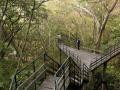
Basically, both Minh Chau and Quan Lan localities have quite favorable conditions for developing ecotourism. However, Quan Lan commune has more advantages to develop ecotourism in a humanistic direction, because this is an area with many famous historical relics such as Quan Lan Communal House, Quan Lan Pagoda, Temple worshiping the hero Tran Khanh Du, ... along with local festivals held annually such as the wind praying ceremony (March 15), Quan Lan festival (June 10-19); due to its location near the port and long exploitation time, the beaches in Quan Lan commune (especially Quan Lan beach) are no longer hygienic and clean to ensure the needs of tourists coming to relax and swim; this is also an area with many beautiful landscapes such as Got Beo wind pass, Ong Phong head, Voi Voi cave, but the ability to access these places is still very limited (dirt hill road, lots of gravel and rocks), especially during rainy and windy times; In addition, other natural resources such as mangrove forests and sea worms have not been really exploited for tourism purposes and ecotourism development. On the contrary, Minh Chau commune has more advantages in developing ecotourism in the direction of natural tourism, this is an area with diverse ecosystems such as at Rua De Beach, Bai Tu Long National Park Conservation Center...; Minh Chau beach is highly appreciated for its natural beauty and cleanliness, ranked in the top ten most beautiful beaches in Vietnam; Minh Chau commune is also home to Tram forest with a large area and a purity of up to 90%, suitable for building bridges through the forest (a very effective type of natural ecotourism currently applied by many countries) for tourists to sightsee, as well as for the purpose of studying and researching.
Figure 3.1: Thenmala Forest Bridge (India) Source: https://www.thenmalaecotourism.com/(August 21, 2019)
3.2.2. Using SWOT matrix to evaluate Quan Lan island tourism
General assessment of current tourism activities of Quan Lan island is shown through the following SWOT matrix:
Table 3.5: SWOT matrix evaluating tourism activities on Quan Lan island
Internal agent
Strengths- There is a lot of potential for tourism development, especially natural ecotourism and humanistic ecotourism.- The unskilled labor force is relatively abundant.- resource environmentunpolluted, still
Weaknesses- Poorly developed infrastructure, especially traffic routes to tourist destinations on the island.- The team of professional staff is still weak.- Tourism products in general
quite wild, originalintact
general and DLST in particularalone is monotonous.
External agents
Opportunity- Tourism is a key industry in the socio-economic development strategy of the province and Van Don economic zone.- Quan Lan was selected as a pilot area for eco-tourism development within the framework of the green growth project between Quang Ninh province and the Japanese organization JICA.- The flow of tourists and especially ecotourism in the world tends toincreasing
Challenge- Weather and climate change abnormally.- Competition in tourism products is increasingly fierce, especially with other localities in the province such as Ha Long, Mong Cai...- Awareness of tourists, especially domestic tourists, about ecotourism and nature conservation is not high.
Through summary analysis using SWOT matrix we see that:
To exploit strengths and take advantage of opportunities, it is necessary to:
- Diversify products and service types (build more tourism routes aimed at specific needs of tourists: experiential tourism immersed in nature, spiritual cultural tourism...)
- Effective exploitation of resources and differentiated products (natural resources and human resources)
div.maincontent .p { color: black; font-family:"Times New Roman", serif; font-style: normal; font-weight: normal; text-decoration: none; font-size: 14pt; margin:0pt; } div.maincontent p { color: black; font-family:"Times New Roman", serif; font-style: normal; font-weight: normal; text-decoration: none; font-size: 14pt; margin:0pt; } div.maincontent .s1 { color: black; font-family:"Times New Roman", serif; font-style: normal; font-weight: normal; text-decoration: none; font-size: 13pt; } div.maincontent .s2 { color: black; font-family:"Times New Roman", serif; font-style: normal; font-weight: normal; text-decoration: none; font-size: 13pt; } div.maincontent .s3 { color: #0D0D0D; font-family:"Times New Roman", serif; font-style: normal; font-weight: bold; text-decoration: none; font-size: 14pt; } div.maincontent .s4 { color: black; font-family:"Times New Roman", serif; font-style: italic; font-weight: normal; text-decoration: none; font-size: 14pt; } div.maincontent .s5 { color: black; font-family:"Times New Roman", serif; font-style: italic; font-weight: bold; text-decoration: none; font-size: 14pt; } div.maincontent .s6 { color: black; font-family:"Times New Roman", serif; font-style: italic; font-weight: normal; text-decoration: none; font-size: 14pt; vertical-align: -3pt; } div.maincontent .s7 { color: black; font-family:"Times New Roman", serif; font-style: italic; font-weight: normal; text-decoration: none; font-size: 14pt; vertical-align: -2pt; } div.maincontent .s8 { color: black; font-family:"Times New Roman", serif; font-style: italic; font-weight: normal; text-decoration: none; font-size: 14pt; vertical-align: -1pt; } div.maincontent .s9 { color: black; font-family:"Times New Roman", serif; font-style: normal; font-weight: normal; text-decoration: none; font-size: 14pt; } div.maincontent .s10 { color: black; font-family:"Times New Roman", serif; font-style: normal; font-weight: bold; text-decoration: none; font-size: 14pt; } div.maincontent .s11 { color: black; font-family:"Times New Roman", serif; font-style: normal; font-weight: normal; text-decoration: none; font-size: 14pt; } div.maincontent .s12 { color: black; font-family:Symbol, serif; font-style: normal; font-weight: normal; text-decoration: none; font-size: 14pt; } div.maincontent .s13 { color: black; font-family:Wingdings; font-style: normal; font-weight: normal; text-decoration: none; font-size: 14pt; } div.maincontent .s14 { color: black; font-family:"Times New Roman", serif; font-style: normal; font-weight: normal; text-decoration: none; font-size: 9pt; vertical-align: 5pt; } div.maincontent .s15 { color: black; font-family:"Times New Roman", serif; font-style: normal; font-weight: normal; text-decoration: none; font-size: 9pt; vertical-align: 5pt; } div.maincontent .s16 { color: black; font-family:Cambria, serif; font-style: italic; font-weight: normal; text-decoration: none; font-size: 14pt; } div.maincontent .s17 { color: #080808; font-family:"Times New Roman", serif; font-style: normal; font-weight: bold; text-decoration: none; font-size: 14pt; } div.maincontent .s18 { color: #080808; font-family:"Times New Roman", serif; font-style: normal; font-weight: normal; text-decoration: none; font-size: 14pt; } div.maincontent .s19 { color: black; font-family:"Times New Roman", serif; font-style: normal; font-weight: normal; text-decoration: none; font-size: 11pt; } div.maincontent .s20 { color: black; font-family:"Times New Roman", serif; font-style: normal; font-weight: normal; text-decoration: none; font-size: 10pt; } div.maincontent .s21 { color: black; font-family:"Times New Roman", serif; font-style: normal; font-weight: bold; text-decoration: none; font-size: 11pt; } div.maincontent .s22 { color: black; font-family:"Times New Roman", serif; font-style: normal; font-weight: normal; text-decoration: none; font-size: 11pt; } div.maincontent .s23 { color: black; font-family:"Times New Roman", serif; font-style: italic; font-weight: normal; text-decoration: none; font-size: 14pt; } div.maincontent .s24 { color: #212121; font-family:"Times New Roman", serif; font-style: normal; font-weight: normal; tex
Identify Rating Levels and Rating Scales
zt2i3t4l5ee
zt2a3gstourism,quan lan,quang ninh,ecology,ecotourism,minh chau,van don,geography,geographical basis,tourism development,science
zt2a3ge
zc2o3n4t5e6n7ts
of the islanders. Therefore, this indicator will be divided into two sub-indicators:
a1. Natural tourism attractiveness a2. Cultural tourism attractiveness
b. Tourist capacity
The two island communes in Quan Lan have different capacities to receive tourists. Minh Chau Commune is home to many standard hotels and resorts, attracting high-income domestic and international tourists. Meanwhile, Quan Lan Commune has many motels mainly built and operated by local people, so the scale and quality are not high, and will be suitable for ordinary tourists such as students.
c. Time of exploitation of Quan Lan Island Commune:
Quan Lan tourism is seasonal due to weather and climate conditions and festivals only take place on certain days of the year, specifically in spring. In Quan Lan commune, the period from April to June and from September to November is considered the best time to visit Quan Lan because the cultural tourism activities are mainly associated with festivals taking place during this time.
Minh Chau island commune:
Tourism exploitation time is all year round, because this is a place with a number of tourist attractions with diverse ecosystems such as Bai Tu Long National Park Research Center, Tram forest, Turtle Laying Beach, so besides coming to the beach for tourism and vacation in the summer, Minh Chau will attract research groups to come for tourism combined with research at other times of the year.
d. Sustainability
The sustainability of ecotourism sites in Quan Lan and Minh Chau communes depends on the sensitivity of the ecosystems to climate changes.
landscape. In general, these tourist destinations have a fairly high level of sustainability, because they are natural ecosystems, planned and protected. However, if a large number of tourists gather at certain times, it can exceed the carrying capacity and affect the sustainability of the environment (polluted beaches, damaged trees, animals moving away from their habitats, etc.), then the sustainability of the above ecosystems (natural ecosystems, human ecosystems) will also be affected and become less sustainable.
e. Location and accessibility
Both island communes have ports to take tourists to visit from Van Don wharf:
- Quan Lan – Van Don traffic route:
Phuc Thinh – Viet Anh high-speed boat and Quang Minh high-speed boat, depart at 8am and 2pm from Van Don to Quan Lan, and at 7am and 1pm from Quan Lan to Van Don. There are also wooden boats departing at 7am and 1pm.
- Van Don - Minh Chau traffic route:
Chung Huong high-speed train, Minh Chau train, morning 7:30 and afternoon 13:30 from Van Don to Minh Chau, morning 6:30 and afternoon 13:00 from Minh Chau to Van Don.
f. Infrastructure
Despite receiving investment attention, the issue of infrastructure and technical facilities for tourism on Quan Lan Island is still an issue that needs to be resolved because it has a direct impact on the implementation of ecotourism activities. The minimum conditions for serving tourists such as accommodation, electricity, water, communication, especially medical services, and security work need to be given top priority. Ecotourism spots in Minh Chau commune are assessed to have better infrastructure and technical facilities for tourism because there are quite complete and synchronous conditions for serving tourists, meeting many needs of domestic and foreign tourists.
3.2.1.4. Determine assessment levels and assessment scales
Corresponding to the levels of each criterion, the index is the score of those levels in the order of 4, 3, 2, 1 decreasing according to the standard of each level: very attractive (4), attractive (3), average (2), less attractive (1).
3.2.1.5. Determining the coefficients of the criteria
For the assessment of DLST in the two communes of Quan Lan and Minh Chau islands, the students added evaluation coefficients to show the importance of the criteria and indicators as follows:
Coefficient 3 with criteria: Attractiveness, Exploitation time. These are the 2 most important criteria for attracting tourists to tourism in general and eco-tourism in particular, so they have the highest coefficient.
Coefficient 2 with criteria: Capacity, Infrastructure, Location and accessibility . Because the assessment area is an island commune of Van Don district, the above criteria are selected by the author with appropriate coefficients at the average level.
Coefficient 1 with criteria: Sustainability. Quan Lan has natural and human-made ecotourism sites, with high biodiversity and little impact from local human factors. Most of the ecotourism sites are still wild, so they are highly sustainable.
3.2.1.6. Results of DLST assessment on Quan Lan island
a. Assessment of the potential for natural tourism development
For Minh Chau commune:
+ Natural tourism attractiveness is determined to be very attractive (4 points) and the most important coefficient (coefficient 3), so the score of the Attractiveness criterion is 4 x 3 = 12.
+ Capacity is determined as average (2 points) and the coefficient is quite important (coefficient 2), then the score of Capacity criterion is 2 x 2 = 4.
+ Exploitation time is long (4 points), the most important coefficient (coefficient 3) so the score of the Exploitation time criterion is 4 x 3 = 12.
+ Sustainability is determined as sustainable (4 points), the important coefficient is the average coefficient (coefficient 1), so the score of the Sustainability criterion is 4 x 1 = 4 points
+ Location and accessibility are determined to be quite favorable (2 points), the coefficient is quite important (coefficient 2), the criterion score is 2 x 2 = 4 points.
+ Infrastructure is assessed as good (3 points), the coefficient is quite important (coefficient 2), then the score of the Infrastructure criterion is 3 x 2 = 6 points.
The total score for evaluating DLST in Minh Chau commune according to 6 evaluation criteria is determined as: 12 + 4 + 12 + 4 + 4 + 6 = 42 points
Similar assessment for Quan Lan commune, we have the following table:
Table 3.3: Assessment of the potential for natural ecotourism development in Quan Lan and Minh Chau communes
Attractiveness of self-tourismof course
Capacity
Mining time
Sustainability
Location and accessibility
Infrastructure
Result
Point
DarkMulti
Point
DarkMulti
Point
DarkMulti
Point
DarkMulti
Point
DarkMulti
Point
DarkMulti
CommuneMinh Chau
12
12
4
8
12
12
4
4
4
8
6
8
42/52
Quan CommuneLan
6
12
6
8
9
12
4
4
4
8
4
8
33/52
b. Assessment of the potential for humanistic tourism development
For Quan Lan commune:
+ The attractiveness of human tourism is determined to be very attractive (4 points) and the most important coefficient (coefficient 3), so the score of the Attractiveness criterion is 4 x 3 = 12.
+ Capacity is determined to be large (3 points) and the coefficient is quite important (coefficient 2), then the score of the Capacity criterion is 3 x 2 = 6.
+ Mining time is average (3 points), the most important coefficient (coefficient 3) so the score of the Mining time criterion is 3 x 3 = 9.
+ Sustainability is determined as sustainable (4 points), the important coefficient is the average coefficient (coefficient 1), so the score of the Sustainability criterion is 4 x 1 = 4 points.
+ Location and accessibility are determined to be quite favorable (2 points), the coefficient is quite important (coefficient 2), the criterion score is 2 x 2 = 4 points.
+ Infrastructure is rated as average (2 points), the coefficient is quite important (coefficient 2), then the score of the Infrastructure criterion is 2 x 2 = 4 points.
The total score for evaluating DLST in Quan Lan commune according to 6 evaluation criteria is determined as: 12 + 6 + 6 + 4 + 4 + 4 = 36 points.
Similar assessment with Minh Chau commune we have the following table:
Table 3.4: Assessment of the potential for developing humanistic eco-tourism in Quan Lan and Minh Chau communes
Attractiveness of human tourismliterature
Capacity
Mining time
Sustainability
Location and accessibility
Infrastructure
Result
Point
DarkMulti
Point
DarkMulti
Point
DarkMulti
Point
DarkMulti
Point
DarkMulti
Point
DarkMulti
Quan CommuneLan
12
12
6
8
9
12
4
4
4
8
4
8
39/52
Minh CommuneChau
6
12
4
8
12
12
4
4
4
8
6
8
36/52
Basically, both Minh Chau and Quan Lan localities have quite favorable conditions for developing ecotourism. However, Quan Lan commune has more advantages to develop ecotourism in a humanistic direction, because this is an area with many famous historical relics such as Quan Lan Communal House, Quan Lan Pagoda, Temple worshiping the hero Tran Khanh Du, ... along with local festivals held annually such as the wind praying ceremony (March 15), Quan Lan festival (June 10-19); due to its location near the port and long exploitation time, the beaches in Quan Lan commune (especially Quan Lan beach) are no longer hygienic and clean to ensure the needs of tourists coming to relax and swim; this is also an area with many beautiful landscapes such as Got Beo wind pass, Ong Phong head, Voi Voi cave, but the ability to access these places is still very limited (dirt hill road, lots of gravel and rocks), especially during rainy and windy times; In addition, other natural resources such as mangrove forests and sea worms have not been really exploited for tourism purposes and ecotourism development. On the contrary, Minh Chau commune has more advantages in developing ecotourism in the direction of natural tourism, this is an area with diverse ecosystems such as at Rua De Beach, Bai Tu Long National Park Conservation Center...; Minh Chau beach is highly appreciated for its natural beauty and cleanliness, ranked in the top ten most beautiful beaches in Vietnam; Minh Chau commune is also home to Tram forest with a large area and a purity of up to 90%, suitable for building bridges through the forest (a very effective type of natural ecotourism currently applied by many countries) for tourists to sightsee, as well as for the purpose of studying and researching.
Figure 3.1: Thenmala Forest Bridge (India) Source: https://www.thenmalaecotourism.com/(August 21, 2019)
3.2.2. Using SWOT matrix to evaluate Quan Lan island tourism
General assessment of current tourism activities of Quan Lan island is shown through the following SWOT matrix:
Table 3.5: SWOT matrix evaluating tourism activities on Quan Lan island
Internal agent
Strengths- There is a lot of potential for tourism development, especially natural ecotourism and humanistic ecotourism.- The unskilled labor force is relatively abundant.- resource environmentunpolluted, still
Weaknesses- Poorly developed infrastructure, especially traffic routes to tourist destinations on the island.- The team of professional staff is still weak.- Tourism products in general
quite wild, originalintact
general and DLST in particularalone is monotonous.
External agents
Opportunity- Tourism is a key industry in the socio-economic development strategy of the province and Van Don economic zone.- Quan Lan was selected as a pilot area for eco-tourism development within the framework of the green growth project between Quang Ninh province and the Japanese organization JICA.- The flow of tourists and especially ecotourism in the world tends toincreasing
Challenge- Weather and climate change abnormally.- Competition in tourism products is increasingly fierce, especially with other localities in the province such as Ha Long, Mong Cai...- Awareness of tourists, especially domestic tourists, about ecotourism and nature conservation is not high.
Through summary analysis using SWOT matrix we see that:
To exploit strengths and take advantage of opportunities, it is necessary to:
- Diversify products and service types (build more tourism routes aimed at specific needs of tourists: experiential tourism immersed in nature, spiritual cultural tourism...)
- Effective exploitation of resources and differentiated products (natural resources and human resources)
div.maincontent .p { color: black; font-family:"Times New Roman", serif; font-style: normal; font-weight: normal; text-decoration: none; font-size: 14pt; margin:0pt; } div.maincontent p { color: black; font-family:"Times New Roman", serif; font-style: normal; font-weight: normal; text-decoration: none; font-size: 14pt; margin:0pt; } div.maincontent .s1 { color: black; font-family:"Times New Roman", serif; font-style: normal; font-weight: normal; text-decoration: none; font-size: 13pt; } div.maincontent .s2 { color: black; font-family:"Times New Roman", serif; font-style: normal; font-weight: normal; text-decoration: none; font-size: 13pt; } div.maincontent .s3 { color: #0D0D0D; font-family:"Times New Roman", serif; font-style: normal; font-weight: bold; text-decoration: none; font-size: 14pt; } div.maincontent .s4 { color: black; font-family:"Times New Roman", serif; font-style: italic; font-weight: normal; text-decoration: none; font-size: 14pt; } div.maincontent .s5 { color: black; font-family:"Times New Roman", serif; font-style: italic; font-weight: bold; text-decoration: none; font-size: 14pt; } div.maincontent .s6 { color: black; font-family:"Times New Roman", serif; font-style: italic; font-weight: normal; text-decoration: none; font-size: 14pt; vertical-align: -3pt; } div.maincontent .s7 { color: black; font-family:"Times New Roman", serif; font-style: italic; font-weight: normal; text-decoration: none; font-size: 14pt; vertical-align: -2pt; } div.maincontent .s8 { color: black; font-family:"Times New Roman", serif; font-style: italic; font-weight: normal; text-decoration: none; font-size: 14pt; vertical-align: -1pt; } div.maincontent .s9 { color: black; font-family:"Times New Roman", serif; font-style: normal; font-weight: normal; text-decoration: none; font-size: 14pt; } div.maincontent .s10 { color: black; font-family:"Times New Roman", serif; font-style: normal; font-weight: bold; text-decoration: none; font-size: 14pt; } div.maincontent .s11 { color: black; font-family:"Times New Roman", serif; font-style: normal; font-weight: normal; text-decoration: none; font-size: 14pt; } div.maincontent .s12 { color: black; font-family:Symbol, serif; font-style: normal; font-weight: normal; text-decoration: none; font-size: 14pt; } div.maincontent .s13 { color: black; font-family:Wingdings; font-style: normal; font-weight: normal; text-decoration: none; font-size: 14pt; } div.maincontent .s14 { color: black; font-family:"Times New Roman", serif; font-style: normal; font-weight: normal; text-decoration: none; font-size: 9pt; vertical-align: 5pt; } div.maincontent .s15 { color: black; font-family:"Times New Roman", serif; font-style: normal; font-weight: normal; text-decoration: none; font-size: 9pt; vertical-align: 5pt; } div.maincontent .s16 { color: black; font-family:Cambria, serif; font-style: italic; font-weight: normal; text-decoration: none; font-size: 14pt; } div.maincontent .s17 { color: #080808; font-family:"Times New Roman", serif; font-style: normal; font-weight: bold; text-decoration: none; font-size: 14pt; } div.maincontent .s18 { color: #080808; font-family:"Times New Roman", serif; font-style: normal; font-weight: normal; text-decoration: none; font-size: 14pt; } div.maincontent .s19 { color: black; font-family:"Times New Roman", serif; font-style: normal; font-weight: normal; text-decoration: none; font-size: 11pt; } div.maincontent .s20 { color: black; font-family:"Times New Roman", serif; font-style: normal; font-weight: normal; text-decoration: none; font-size: 10pt; } div.maincontent .s21 { color: black; font-family:"Times New Roman", serif; font-style: normal; font-weight: bold; text-decoration: none; font-size: 11pt; } div.maincontent .s22 { color: black; font-family:"Times New Roman", serif; font-style: normal; font-weight: normal; text-decoration: none; font-size: 11pt; } div.maincontent .s23 { color: black; font-family:"Times New Roman", serif; font-style: italic; font-weight: normal; text-decoration: none; font-size: 14pt; } div.maincontent .s24 { color: #212121; font-family:"Times New Roman", serif; font-style: normal; font-weight: normal; tex -
 Research on the Current Characteristics of Forest Resources and Factors Affecting Forest Resources Management in the National Park Area
 -
 Current Status of Soc Son Protective Forest Resources for Tourism Purposes
STT
Village | Year of delivery | Forest type | Main forest status | History of community forest management | |
manage | |||||
7 | Cooc | 2016 | RSX | Rich forest | Before 2016, managed by the Commune People's Committee |
8 | Cu Ton | 2016 | RSX | Poor forest | Before 2016, managed by the Commune People's Committee |
9 | Cham Pu | 2014 | RSX | Rich forest | Before 2014, managed by the Commune People's Committee |
10 | Top | 2016 | RSX | Forest restoration | Before 2016, managed by the Commune People's Committee |
11 | Version 61 | 2016 | RSX | Poor forest | Before 2016, managed by the Commune People's Committee |
12 | Red Flag | 2014 | RSX | Rich forest | Before 2014, managed by the Commune People's Committee |
13 | Village 8 | 2016 | RSX | Poor forest | Before 2016, managed by the Commune People's Committee |
14 | Village 9 | 2016 | RSX | Poor forest | Before 2016, managed by the Commune People's Committee |
15 | Village 10 | 2016 | RSX | Poor forest | Before 2016, managed by the Commune People's Committee |
(Source: Survey data, 2017)
Surveying communities in the southern region of Quang Binh province shows that forests were allocated from 2012 to 2016 with forest status mainly poor or poor forests in recovery (accounting for 70% of villages). Surveying the history of forest management in these areas shows that part of the area was previously managed by the Commune People's Committee, part of the forest area previously managed by the Ba Ren Forest Protection Management Board was recovered by the Provincial People's Committee and allocated to the communities for management.
Table 3.2.c. Forest resources allocated to communities and history of forest management in the southern mountainous region of Quang Binh province
STT
Village | Year of delivery | Forest type | Main forest status | History of community forest management | |
1 | Ancient Town | 2012 | RSX | Rich forest | Before 2012, managed by the Commune People's Committee |
2 | Iron | 2013 | RSX | Rich forest | Before 2013, managed by the Commune People's Committee |
3 | Sand Creek | 2014 | RSX | Medium forest | Before 2014, it was managed by the People's Committee of the commune and the Ba Ren Forest Protection Management Board. |
4 | Zhongshan | 2014 | RSX | Medium forest | Before 2014, it was managed by Ba Ren Forest Management Board. |
5 | Long Son | 2014 | RSX | Medium forest | Before 2014, it was managed by Ba Ren Forest Management Board. |
6 | Cloud Slope | 2016 | RSX | Medium forest | Before 2014, it was managed by Ba Ren Forest Management Board. |
7 | Po Loang | 2016 | RSX | Medium forest | Before 2014, it was managed by Ba Ren Forest Management Board. |
8 | Din Din | 2016 | RSX | Medium forest | Before 2014, it was managed by Ba Ren Forest Management Board. |
(Source: Survey data, 2017)
Comments: The study shows that the forests allocated to communities for management are quite diverse in origin. Most of them were previously managed by the Commune People's Committees, a small part was cut from the Forest Enterprises and Forest Protection Management Boards to hand over to the communities according to the Decisions of the Provincial People's Committee; a part was previously allocated land under other programs. Some areas were previously sacred forests and water-retaining forests of the communities, now the State recognizes the land use rights.
The survey results also show that in some places such as Thanh Liem 1, Thanh Liem 2, La Trong 1-2 villages, households that were previously allocated land found that household-based management was not effective, so they voluntarily returned the land to participate in community forest management by village. This shows that people's awareness has changed positively. Partly because the previous land allocation process did not involve participation, people received land and forest in the form of only receiving on paper and forest land.
assigned to households in the form of evenly distributed by furrows and ditches. This result was also given by Dam Trong Tuan (2012) when evaluating the effectiveness of the previous land allocation process, stating that the scale of the area assigned to households was from 0.5-1.5 ha, distributed from the foot of the hill to the top; The boundaries between households were demarcated by small wooden markers and were not clearly marked, so they were not sustainable.
Through a survey of community forest management models in the research area, it was found that the communities participating in forest management are mainly communities residing in remote areas; production is mainly self-sufficient; ethnic minorities account for a high proportion of the population; Some communities still maintain many of their ethnic customs and practices; the lives of community members are close-knit and have not been much affected by the market mechanism. At the same time, the role of village elders and village chiefs also plays an important role in organizing and directing community work.
Overall rating:
The communities managing community forests are mainly ethnic minorities, 36/38 communities are poor villages. There are 14 communities with a poverty rate of 100%, only 1 community has a low poverty rate of 16%. This shows that financial capacity or mobilization for community forest management is very difficult. The average forest area/household of the communities is 3.5 ha/household, the highest is 28.3 ha/household and the lowest is 0.2 ha/household. The forests assigned to the communities are mainly poor forests or poor forests that are recovering.
3.2. CURRENT STATUS OF COMMUNITY FOREST RESOURCES
3.2.1. Area scale and volume of forest allocation lots in villages
In community-based forest management research, we must understand the ecological and human characteristics of the community to determine appropriate solutions for them in the process of community forest management. The thesis has conducted case studies in 3 villages, the research sites include: Co Trang village, Ca Roong 2 village and Phu Minh village as presented in the research site selection method. The following are some social characteristics of the 3 research sites
Co Trang village is one of 21 villages of Truong Son commune, Quang Ninh district, Quang Binh province, a particularly difficult commune. Co Trang village has the advantage of being located at the Rao Trang river junction, located to the northwest of Truong Son commune, 2 km from the commune center, 65 km west of Dong Hoi city. In 1953, due to fierce war, a part of Van Kieu people living in Cam Lo district, Quang Tri province migrated north to live in Lam Thuy commune, Le Thuy district. In 1960, the whole village continued to migrate to Rao Tru, Ngan Thuy commune. In 1967, they migrated to Da Chat area, Truong Son commune. In 1970, they migrated to the Rao Trang river junction and settled down until now, the form
forming Ban Co Trang [26]. Ban Co Trang has 71 households with 310 people, all of whom are Van Kieu ethnic people. The total number of main workers is 141 people, of which 72 are male and 69 are female. The main workers are traditional agricultural production, the main farming method is to grow one crop of rice, corn, beans and raise livestock; farmer labor is still quite common in the village.
Ca Roong 2 village is located in the center of Thuong Trach commune, about 80 km from the center of Bo Trach district. To the north it borders Tan Trach commune, to the south it borders But village, to the east it borders Niu village, to the west it borders Ca Roong 1 village. The history of the formation of Ca Roong 2 village is closely linked to the history of the Ma Coong people in Quang Binh; The Ma Coong people in Quang Binh are a part of the Bru Ma Coong ethnic group that migrated from Laos [26], a local group of the Bru-Van Kieu ethnic group. According to Ma Coong village elders, their ancestors were not in this area before, but a few days' walk away, which could be the area of Highway 9 (Quang Tri) close to the border with Laos or the area across the border in today's Sanavakhet province. During the migration process, the main place of residence was Ca Roong village in Thuong Trach commune, Bo Trach district, Quang Binh province today. The Ma Coong people's living habits are to establish villages and find land for cultivation along streams, on both sides of ravines and low mountain slopes. The whole village has 27 households with 104 people, 54 men accounting for 52%, 50 women accounting for 48%. The total number of workers is 60 people, of which: men: 31 people, women: 29 people. The main labor force is agricultural production, manual farming methods, mainly growing upland rice, corn, cassava, and raising livestock.
Phu Minh village is more than 6 km northwest of the center of Thuong Hoa commune, Minh Hoa district, Quang Binh province, located on both sides of the Ho Chi Minh road, the East branch. Phu Minh village was established in 1985, when there were 7 households of the Sach, Ruc and Arem ethnic groups living there. At that time, the people had not yet received universal primary education, so their educational level was very low. Moreover, their living habits were backward and poor, mainly shifting cultivation and slash-and-burn farming. Their lives mainly depended on the forest. From 2002 to 2008, 4 other households immigrated and the number of households was 11 with 50 people. From 2008 to 2010, due to the natural population increase and the people in the village reaching the age of marriage, they were separated, and at this time the number of households increased to 27 with 122 people. Since the beginning of 2012, due to the immigration of a number of Kinh households living in neighboring villages to the village with support from the state, up to now the whole village has 33 households with 132 people [26].
Researching the records of forest allocation to the community in 3 research villages, the results are presented in the following summary table:
Table 3.3. Area and volume of forest allocated to communities in the study villages
Status
Ancient Version | Phu Minh Village | Ca Roong Village 2 | ||||
Area (ha) | Reserves (m 3 ) | Area (ha) | Reserves (m 3 ) | Area (ha) | Reserves (m 3 ) | |
Total | 207,152 | 32,602 | 803,868 | 101,872 | 174,715 | 9,742 |
I. Forested land | 175.93 | 704,453 | 119.49 | |||
1. Natural forest | 175.93 | 704,453 | 101,872 | 119.49 | ||
- Rich forest | 90,974 | 22,932 | 29,256 | 7,384 | 32,815 | 8,550 |
- Medium forest | 38,152 | 6,477 | 420,216 | 72,644 | 2,631 | 486 |
- Poor forest | 46,804 | 3,193 | 254,981 | 21,844 | 11,523 | 706 |
- CCTL Forest | 17,679 | |||||
- Bamboo Forest | 54,842 | |||||
2. Planted forests | ||||||
II. Land without forest | 31,222 | 99,415 | 55,225 | |||
1. Bare land, grass | 24,137 | |||||
2. Bare land and bushes | 0.608 | 1,656 | 26,194 | |||
3. Vacant land with scattered trees | 30,614 | 97,759 | 4,894 | |||
(Source: Forest allocation records of villages, 2017)
Through the data in Table 3.3., it can be seen that in Co Trang village, the forested land area is 175.93 ha, accounting for 84.9% of the assigned land area, the non-forested land area is 31,222 ha, accounting for 15.1% of the assigned land area. Similarly, in Phu Minh, the forested land area accounts for 87.6% of the assigned land area, the remaining 12.4% of the land is non-forested. In Ca Roong 2 village, the forested land area is 119.49 ha, accounting for 68.4% and 31.6% of the non-forested land area. Thus, it can be seen that in the villages assigned to forests, the forested land area accounts for a relatively large proportion. In addition, the natural forest area with reserves in the villages assigned to forests also accounts for a large proportion. In which, Phu Minh village has the largest allocated forest reserve with 101,872 m 3 , this is also the village with the largest forest area. The village has
The largest area of rich forest is Co Trang village with 90,974 ha of rich forest, accounting for 43.9% of the village's assigned forest area, with a reserve of 22,932 m 3, accounting for 70.3% of the total assigned forest reserve (32,602 m 3 ). Ca Roong 2 village has an assigned forest area of 174,715 ha with a forest reserve of 9,742 m 3 , the lowest of the 3 villages. However, this is also an area with a relatively large area of bamboo and reed forests (54,842 ha), which is one of the characteristics of forest resources in this area.
Table 3.4. Community forest resource reserves classified by status and quality level
Unit: m3
TT
Status | Reserves index | Total reserves | Classified by quality | |||
A | B | C | ||||
Ancient Town | Total | 32,602 | 15,980 | 11,388 | 5.234 | |
Rich | Total | 22,932 | 11,580 | 7,793 | 3,559 | |
BQ/ha | 252 | 127 | 86 | 39 | ||
Medium | Total | 6,477 | 3,602 | 2,195 | 680 | |
BQ/ha | 170 | 94 | 58 | 18 | ||
Poor | Total | 3,193 | 798 | 1,400 | 995 | |
BQ/ha | 68 | 17 | 30 | 21 | ||
Phu Minh | Total | 101,872 | 50,573 | 33,478 | 17,821 | |
Rich | Total | 7,384 | 4,061 | 2,585 | 738 | |
BQ/ha | 252 | 139 | 88 | 25 | ||
Medium | Total | 72,644 | 37,776 | 23,246 | 11,622 | |
BQ/ha | 173 | 90 | 55 | 28 | ||
Poor | Total | 21,844 | 8,736 | 7,647 | 5,461 | |
BQ/ha | 86 | 34 | 30 | 22 | ||
Carrot 2 | Total | 9,742 | 4,176 | 4,980 | 586 | |
Rich | Total | 8,550 | 3,978 | 4.101 | 471 | |
BQ/ha | 261 | 121 | 125 | 14 | ||
Medium | Total | 486 | 198 | 209 | 78 | |
BQ/ha | 185 | 75 | 80 | 30 | ||
Poor | Total | 706 | - | 670 | 37 | |
BQ/ha | 61 | - | 58 | 3 | ||
(Source: Forest allocation records of villages, 2017)
The results of Table 3.4. show that the total forest reserve assigned to Co Trang village is 32,602 m 3 , of which: Average reserve by forest status: Rich forest: 252 m 3 /ha, Average forest: 170 m 3 /ha and Poor forest: 68 m 3 /ha. Forest reserve by quality: Quality A: 15,980 m 3 , accounting for 49.0%, Quality B: 11,388 m 3 , accounting for 34.9%, Quality C: 5,234 m 3 , accounting for 16.1% of total forest reserve.
Research results in Phu Minh village show that the total reserve is 101,872 m 3 , of which: Rich forest: 252 m 3 /ha, average forest: 173 m 3 /ha, poor forest: 86 m 3 /ha. Reserves
Forest classified by quality: Quality A: 50,573 m3 , accounting for 49.6%, quality B: 33,477 m3 , accounting for 32.9% and quality C: 17,822 m3 , accounting for 17.5% of total forest reserves.
The results at Ca Roong 2 village show that the total forest reserve is 9,741.6 m 3 . Average reserve by forest status: Rich forest: 260.5 m 3 / ha, average forest: 184.6 m 3 / ha and poor forest: 61.3 m 3 / ha. Forest reserve by quality: Quality A: 4176.2 m 3 , accounting for 42.9%, quality B: 4979.7 m 3 , accounting for 51.1% and quality C: 586 m 3 , accounting for 6.0% of total forest reserve.
Through the above data, it can be seen that the average reserve according to the quality of the rich forest and average forest in the villages tends to decrease from good quality level (level A) to bad quality level (level C), which is consistent with the natural law for the rich forest state with little or low impact, so the forest quality is still guaranteed. For the poor forest state, the distribution of reserves according to quality is not clear and does not follow the law, which reflects that the forest has been strongly impacted and the level of competition and quality elimination between quality levels is still taking place.
3.2.2. Silvicultural characteristics of community forest status
3.2.2.1. Characteristics of community forest status in Co Trang village
a) Natural timber forests
+ Rich forest: Rich forest 90,974 ha accounts for 51.71% of natural forest area. Including lots: a2 plot 2; lots a1, c1, d2, g1, h1, i2 plot 3, sub-area 348; lots b1, b4 plot 1 sub-area 349. The number of sample plots for measuring the rich state is 29 plots equivalent to 1.44% of the area. Rich forest is mainly distributed at the top of the storm, there is no traffic, the terrain is complex so the forest is less affected. Forest vegetation is quite rich, the main species composition includes: Leo heo, Tau mat, Chua, Nang, Truong, Goi,...; Some typical indicators of rich forest: Density of the timber layer: 477 trees/ha. Average height: 15.2 m. Average diameter: 25.7 cm. Average reserve: 254 m 3 /ha . Canopy cover: 0.6 - 0.7. Total cross-sectional area/ha ( G/ha): 27.9 m 2 .
The community forest area has 9 plots of rich forest status, the fluctuation in reserves of this status is relatively large. The plot with the highest average reserve: 351 m 3 /ha; the plot with the lowest average reserve: 223.74 m 3 /ha.
+ Medium forest: Medium forest is 38,152 ha, accounting for 21.69% of the natural forest area. The number of sample plots for measurement of the average state is 11 plots equivalent to 1.59% of the area. This is a lightly impacted forest or a forest after exhaustion with a relatively long recovery time. Distributed mainly on the slopes and peaks of the storm. Main dominant tree species composition: Tau, Vang, Tram, Ngát, Nang, Bồ lời, Gáo, Dẻ, Trường, Lèo heo, Chân chim, Trâm, etc. Some typical indicators of the medium forest: Density of the timber layer: 417 trees/ha. Average height: 11.8 m. Average diameter: 23.3 cm. Reserve