
- The community is the forest owner, the forest user with full or incomplete legal status depending on the conditions of each community and the forest assigned or contracted.
- Communities are allocated land, forests, and receive long-term forest contracts when they meet the provisions of current laws and policies such as: The forest is currently being effectively managed and used by the community; the forest retains water resources to serve the common interests of the community; the forest bordering villages, communes, and districts cannot be allocated to organizations, households, or individuals but must be allocated to the village community to serve the interests of the community.
- The community enjoys the rights when participating in forest management according to the provisions of law: Being recognized for the right to use the forest stably and long-term in accordance with the forest allocation term; Being able to exploit and use forest products and other benefits of the forest for community purposes and household purposes for community members; Being able to combine agricultural - forestry - fishery production; Being able to enjoy the fruits of labor and investment results on the assigned forest area; Being provided with technical guidance; Being supported with capital according to the State's policy to protect and develop the forest and enjoying the benefits brought about by public works to protect and improve the forest; Being compensated for the fruits of labor and investment results to protect and develop the forest when the State decides to reclaim the forest.
- The community fulfills its obligations when participating in forest management according to the provisions of law such as: Developing conventions on forest protection and development; Organizing forest protection and development; Periodically reporting to competent state agencies on developments in forest resources and activities related to the forest; Fulfilling financial obligations and other obligations according to the provisions of law; Handing over the forest when the state has a decision to reclaim it or when the forest allocation period expires; Not dividing the forest to members of the village community; Not converting, transferring, donating, leasing, mortgaging, guaranteeing, or contributing capital for business with the value of the right to use the assigned forest.
1.2. Current status of research issues
1.2.1. Researched works
Research on community forest management has been conducted by many authors and researchers in many aspects and on different scales. Typical examples are research works such as: "Research on community forest management of ethnic minorities in the Northern mountainous region", "Community forest management in Vietnam: Current situation, problems and solutions" by Dr. Nguyen Ba Ngai; research on "Building benefit sharing regulations in community forest management" by Dr. Bao Huy or research on "Community forest management in Hoa Binh - Solutions" by Tran Duy Ruong - Vietnam Forestry Science Institute and research on "Some experiences in community forest management from the CEFM project" by Nguyen Van Man - Thai Nguyen University of Agriculture and Forestry.
Studies have shown that the area of forest and forest land that communities across the country are managing and using is about 2,792,946.3 hectares, accounting for 17.2% of the land area planned for forestry purposes nationwide, of which: 1,916,169.2 hectares of forest land (accounting for 68.6%) and 876,777.1 hectares of bare hills (accounting for 31.4%) see figure
1.1. There are three forms of community management and use of forestry land:
- Firstly, forests and forest land used for forestry purposes are assigned by competent State agencies to communities for long-term management and use (with decisions or certificates of land and forest use rights) with 58.8% of the forest land area managed and used by communities, see Figure 1.1. In which, most communities are assigned to manage, protect and nurture forests that have recovered after slash-and-burn cultivation or after exhaustion. Some communities are assigned bare hills to plant forests or to promote regeneration. There are rare cases where communities are assigned rich forest areas for long-term management, protection and stable use.
- Second, forests and forest land have been recognized and managed by communities for a long time but have not been allocated by the State with 8.9% see figure 1.1. These are the types of forests traditionally managed by ethnic minority communities. In the areas
In this forest, in terms of law, the ownership and use rights of the forest have not been established, but in reality it is being regulated informally by traditional customs. In the traditional society of some ethnic groups, the village is the highest independent unit, each village has a certain territorial boundary including land, forest, water resources, streams, etc. Within the scope of the village, the above resources are owned by the community and operated by a self-governing apparatus. Village members have the right to freely choose a piece of forest for slash-and-burn cultivation. When the forest area is narrowed and the population increases, the slash-and-burn area is under the use of the clan. All community resource management activities are carried out through customary laws or village conventions, and the effectiveness of customary laws is realized through the combined efforts of society and spirituality.
- Third, forests and forest land used for forestry purposes by state organizations (Forestry Enterprises, Management Boards of Special-use Forests and Protective Forests, etc.) are contracted by communities to protect, protect and grow according to long-term forest contracts, 50 years with 32.3% see Figure 1.1. In essence, with this type of contract, the community is only an employee of the forest owner. Apart from the work performed according to the agreement between the parties in the contract, the community has no other rights or obligations.
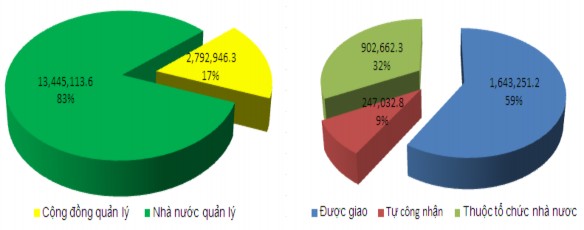
Figure 1.1: Diagram of the proportion of community forest and forest land management
Community forest management in Vietnam is gradually taking shape according to two trends suitable to specific conditions in each region, which are community forest management to meet livelihood needs and community forest management for commodity production.
- Community forest management meets the livelihood needs of remote, isolated and ethnic minority areas in accordance with traditional customs, production conditions and underdeveloped markets. Forest products are mainly used for community consumption. Forests are managed according to community customary law.
- Community forest management for commodity production in production areas and developed markets. Management forms are diverse and rich at a high level and the village community will move towards becoming full owners in forest management and use.
Regarding policies and laws in community forest management, they are summarized into the following stages:
- Before 1954, the existence of community forests was recognized: Colonial and feudal forestry recognized traditional community forests. Community forest management was based on traditional village conventions and customary laws.
- From 1954 to 1975, not paying attention to community forests but respecting the communities that were managing the forests traditionally: In the North, implementing land reform and collectivization policies, focusing on developing state-owned and collective forestry and although not paying attention to household forestry and community forestry, but basically still respecting the highland communities that managed forests according to traditional customs and household forestry was identified as a secondary economy. Meanwhile, in the South, it was similar to the period before 1954.
- From 1976 to 1985, focusing on high-level planning of state-owned and collective forestry, community-managed forests were reduced: community forestry and household forestry were not encouraged to develop. However, some
In the highlands and ethnic minority areas, there still exist forests recognized by the community.
- From 1986 to 1992, for the first time, the village was mentioned as a legal forest owner for the traditional forest of the village: In 1986, the government recognized 5 economic sectors; In 1988 and 1991, the Land Law and the Law on Forest Protection and Development were first issued, allowing land and forest allocation to organizations, individuals and households.
- From 1993 to 2002, the decentralization process in forest management was strengthened, and attention was paid to the socialization of forestry, but policies on community forest management were not clear: In localities, many community forest management models were implemented, but at a spontaneous level or on a pilot basis; The 1993 revised Land Law, Decree 02/CP in 1994 and Decree 163/CP in 1999 on forestry land allocation did not stipulate provisions for community subjects, and the 1995 Civil Code also did not stipulate that the community was an economic entity with legal status. During this period, many localities applied a number of State and industry documents for community forest development such as Decree 01/CP in 1995 on forestry land allocation, Decree 29/CP in 1998 on regulations for implementing democracy in communes, Decision 245/1998/QD-TTg on the implementation of state responsibilities at all levels regarding forests and forestry land, Circular 56/TT in 1999 of the Ministry of Agriculture and Rural Development on guidelines for developing conventions on forest protection and development in the community, Decision 08/2001/QD-TTg on regulations for managing 3 types of forests, Decision 178/2001/QD-TTg on benefits and obligations when participating in forest management.
- From 2003 to present, the basic legal framework for community forest management has been formed: The new Land Law of 2003, village communities are allocated land by the State or recognized the right to use agricultural land as land users; The new Law on Forest Protection and Development of 2004 has a separate section regulating the allocation of forests to village communities, the rights and obligations of village communities.
Village residents are assigned forests; the 2005 Civil Code recognizes the concept of common ownership by the community.
In practice, ethnic minorities have customs of managing land and resources according to the community. These customs are part of the traditional customary law of the ethnic community, helping them manage the community in the process of conservation and development. Customs of land and resource management of some typical ethnic minority communities in our country:
- For the Thai people in the Northwest, forests are classified into areas to serve different needs of human life such as: Protective forests located in the water source area, logging is absolutely prohibited. Forests are exploited to build or repair houses and other community needs, absolutely not cleared for farming. Forests serving spiritual life, logging is prohibited.
- Ta Oi and Van Kieu people in the Central region: Customary law stipulates that they are not allowed to clear fields in upstream forests, sacred forests, and toxic forests.
- Raglai people in the Central Highlands: They believe that the forest belongs to the community (village). Therefore, no one is allowed to violate the regulations set by the community, no one is allowed to take it as private property.
Specifically in the Northern mountainous region in Dien Bien, Hoa Binh and Thanh Hoa, there are 4 popular forms of community-based management. Specifically, as shown in Table 1.1:
Table 1.1: Popular forms of community forest management
TT
Management form | Origin of formation | Current status and scale | Purpose of management and use | |
Huoi Cay Village - Mun Chung - Tuan Giao - Dien Bien (H'Mong community) | ||||
1 | Community managed by traditional | Long-standing self-recognition. | 81ha natural forest. | Water resource protection, Wood for house building, forest products other daily consumption. |
Cai Village - Vu Lam - Lac Son - Hoa Binh (Muong community) | ||||
2 | Household Group | Social contract use. | Natural forest and planted forest, 31ha. | Covering vacant land with green, taking wood and bamboo to sell to the market. |
Phang Village - Phu Thanh - Quan Hoa - Thanh Hoa (Thai community) | ||||
3 | Community manage | Delivery and agreement contract | Natural forest 200ha (delivery) | Protect water resources, get wood house building, other forest products |
Maybe you are interested!
-
 Research and propose solutions to protect the environment in the direction of sustainable tourism development in Binh Thuan province - 19
 -
 Research and propose solutions to protect the environment in the direction of sustainable tourism development in Binh Thuan province - 15
 -
 Research and propose solutions to improve the competitiveness of Maritime Commercial Joint Stock Bank in the retail market - 12
 -
 Research on some solutions to improve the quality of human resources at Khanh An Preschool Education Equipment Production and Trading Company Limited - 1
 -
 Evaluate the performance of some distributed hash table algorithms DHT and propose solutions to improve the performance of the CHORD algorithm - 1
protect with area Pu Hu Conservation. | 102ha, contract 98ha). | daily consumption, income import from security deposit | ||
4 | Self-managed household group | Hand over to households for management and use, households themselves link. | 120 hectares by 10 groups of households management link | Planting production forests to supply bamboo to the market. |
(Source: Agriculture and Rural Development Magazine, May, issue 1, 2006, pages 78-80)
Studies also show that in practice, there are three basic tools applied in community forest management: First, the form of organization and management, operation of the community based on the principle of popular election and trust of the community with the village elders and village chiefs; Second, building community forest management conventions based on village rules (village conventions), current needs and in accordance with legal regulations; Third, building a benefit sharing mechanism based on the general consensus of the community and state regulations, first of all, specifying the benefit sharing mechanism according to Decision 178. The stakeholders in community forest management are identified as including the following parties:
- The village community is the main subject including: village chief, deputy village chief, village elder, households and individuals, forest management and protection teams, mass organizations and unions, household groups or interest groups, and village agricultural extension workers.
- Commune forestry organizations disseminate laws and policies, monitor changes in forest resources, provide guidance on forest protection and fire prevention, advise and support the Commune People's Committee on land and forest allocation, forest management, and prevent and handle violations.
- Provincial, district and communal authorities implement 8 contents of State management on Forestry according to Decision 245/1998/QD-TTg dated December 21, 1998 of the Prime Minister.
- Provincial and district forestry agencies have a role in supporting, guiding and promoting community forest management.
- State Forestry organizations transfer technology, provide technical advice and support, and invest capital in forest construction and development.
- Non-state forestry organizations provide support services.
Currently, there are still many problems in the work of community management, especially those related to policies and laws. In addition, technical issues in community management are only piloted. Including the following issues:
- The legal status of the village community is not really clear: Although the 2003 Land Law, the 2004 Law on Forest Protection and Development and a number of other State documents stipulate that the village community is subject to land and forest allocation, and has the right to manage and use forests, the legal status of the community is still not complete and clear. The 2005 Civil Code stipulates that an organization is recognized as a legal entity when it meets the following conditions: It is established or recognized by a competent authority, has a tight organizational structure, has assets, and participates in legal relations independently. The village community does not meet all of the above conditions, so it is not a legal entity. If the forest is allocated to the village community, when a civil dispute occurs with another entity or there is an illegal act, the legal agency cannot resolve it.
- The shortcomings in the policy mechanism are specifically shown in the following points: Decision 178 and Circular 80 do not mention the benefits of the community and their obligations when participating in forest management. Technical requirements such as determining the standards of exploited forests and the benefit rate are very complicated and the community is not able to determine. Administrative procedures for commercial logging of natural forests managed by the community have not been regulated; Decision 40/2005/QD-BNN dated November 27, 2006 of the Ministry of Agriculture and Rural Development on promulgating guidelines for the management of village community forests is limited to the Community Forestry Pilot Program in 40 communes of 10 provinces. This decision allows the community to exploit timber for household use and commercial exploitation according to 2 methods of reserve or trees according to diameter class, Decision 2324/QD-BNN-LN dated August 21, 2007 on guiding the exploitation criteria and procedures for exploiting community forests limits the community to exploit timber for household use according to volume. Showing that the current policy has not