
Bruner also pointed out that representations can be divided into three categories from low to high as follows [48]: + Reality: includes practical representations and operable representations.
+ Symbols: BDTQs use images, graphs, diagrams, tables...
+ Symbols: include language representation and symbolic representation.
In the three representational categories above, BDTQ plays an intermediary role connecting real representation with symbolic representation.
Table 1.1. An illustration of mathematical representation
Type of expression
act
Examples in the topic of morality Jaw | Feature | |
Symbol representation | f (x) x 2 f '(2) 4 | Very precise, concise and clear. |
Perform | Derivative of the function x 2 | Governed by the conventions of language language, lacking in conciseness and brevity |
language | at point x equals 2 is 4. | but descriptive and familiar |
familiar, easy to remember | ||
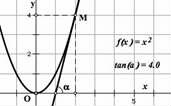
Illustrative, visual representation |
| Because it resembles the object being represented, this type of representation is both visual and intuitive. If designed on a computer, it will show the intermediate process. |
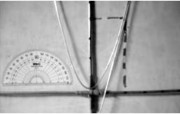
Realistic representation of the operation |
| Model made from bendable materials. Quite specific, can perform operations on the object, acceptable accuracy. |
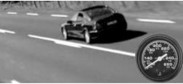
Realistic performance |
| The model depicts the car in motion. Vivid, very specific and natural. |
Maybe you are interested!
-
 Analysis of financial capacity and some solutions to improve financial capacity at Vietnam Telecommunications Technology Investment and Development Joint Stock Company - 5
 -
 Reliability of Managers' and English Teachers' Ratings of the Benefits of Capacity Building and Development Activities
 -
 Current Status of Directing the Implementation of School Psychological Counseling Capacity Development Activities for Teachers in Secondary Schools in Mong Cai City, Province
 -
 Criteria and Scale for Assessing Student Capacity Development
 -
 Assessing the capacity of civil servants at Quang Binh Development Bank Branch - 17
In order for students to be able to perceive a concept, it is necessary to combine different representations to show the aspects of that concept. In this thesis, we focus on BDTQ, especially BDTQ with the support of dynamic geometry software on computers to help students develop reasoning ability.
1.1.2 Visual representation
There are many different views on visualization. For the content of this thesis, the author uses the definition summarized by Arcavi (2003, [31], p. 217) as follows:
Visualization is the process and product of creating, interpreting, using and reflecting on drawings (or images, diagrams...) in our minds, on paper or on scientific and technological tools. Visualization aims to describe and communicate information, thinking and developing previously unknown ideas to reach understanding.
Example 1.1: Find the infinite sum of a geometric sequence
1 1 1 ...
4 4 2 4 3
Students can use algebraic representation to calculate.
S 1 1
1 ... 1 ,
then calculate the limit:
n
1 1
4 4 2 4 3 4 n
n
lim S n lim
( )
1
4 1
n
n 4
1 1 3
4
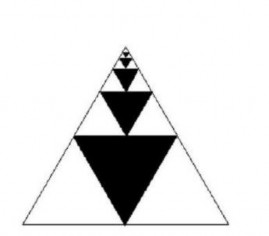
Another proof (figure 1.2) of the above problem is quoted from the article entitled “wordless proof” by Mabry (see Tran Vui, 2009, [29]) using BDTQ as follows:
Suppose the area of a large equilateral triangle is 1. From the large equilateral triangle, we carve out an equilateral triangle in the middle,
Continue to chisel the equilateral triangle above... The total area of the chiseled equilateral triangle series is:
1 1 1 ...
Figure 1.2 Infinite sum BDTQ
4 4 2 4 3
We see that there are three identical infinite sequences of equilateral triangles and these three sequences fill the triangle.
are all big so:
1 1 1 ... 1
4 4 2 4 3 3
learn.
BDTQ is an effective tool for learning math because:
+ BDTQ gives meaning to mathematical concepts and mathematical relationships
+ BDTQ provides simple, concise and powerful approaches to results
mathematics, contributing to the connection between different areas of mathematics such as numbers
math, algebra and geometry.
+ BDTQ helps suggest solutions to problems.
+ BDTQ provides students with additional tools, means, and techniques when looking at a mathematical situation.
1.1.3 Dynamic visual representation
The concept of dynamic geometry can be understood as geometry that allows the use of operations on objects in the representation. Dynamic geometry is often built through dynamic geometry software on computers. [24]
Dynamic geometry software is a computer software program created to construct geometric shapes. The Geometer Sketchpad (GSP), Cabri, Geogebra are three of the dynamic geometry software that are quite commonly used in mathematics education in general schools today. The breakthrough aspect of these software compared to the traditional pen and paper environment is the "dynamic" feature, meaning that the objects on the dynamic BDTQ can move but still ensure to maintain the properties and geometric relationships established initially.
Operations on dynamic geometry on a computer will also be different from operations on dynamic geometry in a paper-and-pencil environment because they have additional support from dynamic geometry software.
Some researchers believe that dynamic geometry software has changed the way of thinking about traditional geometric objects because while moving or dragging geometric objects, measuring and checking properties, learners can recognize geometric invariant properties [25]. From there, the initial hypothesis about geometric objects and
The relationship between them is formed, then the dynamic geometry software also supports
aid in testing the validity of those hypotheses [11].
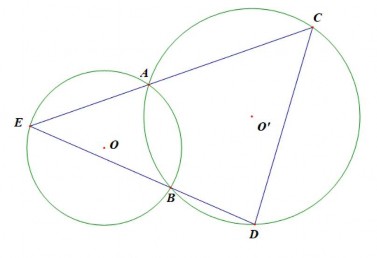
Example 1.2 . Given two circles ( O ) and ( O ') intersecting at A and B. Take point E on ( O ) different from A and B. Lines EA and EB intersect ( O ') at C and D respectively . Measure the lengths of line segments EC , ED and CD .
Figure 1.3 Dynamic operations for points on a circle
As you drag point E around the circle ( O ), the lengths EC and ED change, but the length CD remains constant. In this model, you can see the circle changing its position, changing the size of the circle, adding other objects, etc. Obviously, actively discovering that the length CD is constant is more meaningful than being asked to prove it. The fact that CD remains constant surprises you, excites you, and motivates you to prove this discovery.
The experiences of the dynamic manipulations in this example are completely different from the experiences of doing it with only pen and paper. You will not see the movements and transformations of the objects visually. We can only predict and then work with symbolic representations to confirm them. We can also predict the above behaviors of the model, but that is still only at the level of prediction. The number of images obtained by your eyes is only one, while when you manipulate the model, you will obtain countless variations of that image.
Dynamic geometry software can effectively support learning mathematics through dynamic manipulation, in which learners explore, experiment, and construct mathematical knowledge through interactions. According to Finzer and Jackiw (1998, [49]), dynamic manipulation environments are characterized by three properties:
- Direct operation . Draw the graph of the function f ( x ) and then construct a secant line passing through two points E 0 and E on the graph. You grab point E and drag it to point E 0 . You would say “I drag point E ” instead of “I drag this little dot and it will change the position of point E ”.
- Continuously updated motion . Changes are updated continuously during the drag. Mathematical objects on the screen remain linked.
in a whole at all times. For example, if the distance value from E to E 0 is calculated , the value displayed on this screen will change accordingly to the position of point E when dragged.
- The environment is conducive to manipulation . Your experiments are only concerned with the objects you manipulate. You discover as you work with them. The program interface is virtually inert and you can concentrate on how to achieve mathematical goals, not how to control the technology.
For mathematics learning, dynamic operations can solve problems such as the explanation of continuity. Throughout the curriculum, students learn mathematics and are confronted with two phenomena: continuity and discretization. However, the tools that teachers provide to explain these phenomena do not create a bridge between them. Teachers often describe them on the board, but this only gives a special case in which students find that some conditions hold, and of course it does not fully represent the general case. Teachers then often provide a representation of the relationship between mathematical symbols to generalize all relevant examples. But where can we find the full cases in the representation that it contains?
Software that allows dynamic manipulation helps us overcome this shortcoming. When students directly change a parameter, they understand the creation of a
number of examples related to continuity. The image is no longer just an illustration, but through dynamic operations, it helps students approach the general case. Dynamic operations will help learners know the behavior of mathematical objects. For example, consider the following two descriptions of an isosceles triangle:
- The two sides of an isosceles triangle are equal, the two opposite angles corresponding to those two sides are equal.
- No matter how you change the shape of a triangle, the two sides are still equal and the two corresponding angles are still equal.
The former lists two properties of an isosceles triangle, while the latter describes its behavior. The former is narrative and static, the latter is imperative and mechanical. The difference is further emphasized by the fact that a given isosceles triangle represents all isosceles triangles in the former, while a triangle can become isosceles if it satisfies the latter. In learning and problem-solving situations, where a static list of properties is only appropriate for summarization, the dynamic operational model leads to confirmation and inference.
Dynamic visual representations fall into the category of symbolic representations according to Bruner's arrangement (in Tadao, 2007, [48]). However, these representations, in addition to being visually illustrative, also allow the investigator to perform operations on the objects in the representation. These objects are closely linked together in a predetermined mathematical relationship. When manipulating an object in the representation, sometimes not only is it affected but other related objects are also affected. For example, when you change the expression of a function in a dynamic visual representation, its graph also changes even though you do not affect the graph.
Through the research results, the two authors Finzer and Jackiw (1998, [49]) proposed the following issues that teachers need to facilitate and support students in learning mathematics:
- Students should be exposed to problems or situations in the
There are transitions from one state to another to explain intermediate states. Dynamic manipulation software will support students to experiment and explore these issues.
- With a given dynamic model, teachers need to create conditions for students to be able to discover and express in mathematical language the relationships that exist between objects on the model.
- Teachers need to create conditions for students to experiment, in which they use mathematical tools to build models that can be manipulated with both physical tools or computer tools.
- In addition to listing the properties of mathematical objects, students need to be encouraged by teachers to think about and describe the behaviors of those objects.
- Teachers need to create many opportunities for students to explore mathematics, generalize problems, and engage in open-ended investigations because dynamic software provides an environment that contains many changes, creating surprises and surprises.
Mathematical representations on computers can create different variations of it thanks to the user's manipulations on the objects in the representation. From the original idea of "dynamic geometry", dynamic geometry software has made great strides in supporting users to build algebraic and analytical objects. The forms of representation are therefore also richer and more diverse, a knowledge can be expressed in many different forms of representation on the same page, with close mathematical relationships with each other.
1.1.4 The role of visual representation
Representations provide students with effective thinking tools . Using visual representations as a tool, students can access concepts as well as their applications. Symbolic representations help to confirm conclusions reached accurately, and linguistic representations help to transfer and receive information.
Dynamic visualizations provide students with an effective mathematics learning environment . Dynamic visualizations depict intermediate stages, helping learners
Learn to perform operations on mathematical objects, preserve invariants of geometric objects, perform calculations accurately and corresponding to different positions of the object.
The harmonious combination of representations helps teachers to support students in creating new knowledge . Most of the concepts and methods taught in the program come from solving real-life situations. Therefore, teachers initially use practical representations, then operational representations, and visual representations. Linguistic representations are used mostly in the process of communication between teachers and students and students and students. The lesson ends with the application of theory and understanding of symbolic representations.
Using dynamic representations helps students to approach the nature of a geometry problem and then come up with a solution to the problem . If teachers provide a learning environment with dynamic visual representations, students can experiment with different representations and choose the most meaningful representations. The information stored in the mind about these meaningful representations will be important components in supporting students in solving problems.
Information technology supports the design of dynamic visual representations well . Technology makes drawing easier, and can create three to four types of representations on the screen at the same time. Dynamic visual representations with simultaneous representation of dynamic geometry, dynamic symbols and dynamic numerical representations are a clear strength of applying information technology to mathematics teaching.
1.2. Mathematical ability and competence
1.2.1. Capacity
The concept of competence is a concept belonging to the field of psychology. Nowadays, the concept of competence is understood in many different ways. However, some common concepts of competence can be mentioned as follows:
According to Psychology, capacity is a combination of unique attributes of an individual, suitable for the requirements of a certain activity, ensuring that the activity has results [18].