But in our country, garbage collection (a form of garbage classification) is not only carried out at urban landfills but also at small garbage dumps in cities and towns.
Every day, waste pickers dig through garbage piles to collect waste that can be used for various purposes. This work is done mainly by hand and is not hygienic.
Methods and equipment for waste classification
Manual method
In this method, the classifier uses his hands to pick up each type of waste according to its category.
purpose. The primitive tools used include tongs, shovels, trash scoops...
Airflow Classification
This method is used in industrial production to separate materials and dry mixed products. In the classification of light weight waste (organic) and heavier weight solid waste (inorganic), people use the blowing air method very effectively.
Air blower figure 12.l: Conventional trough type, Zigzag pipe type, type
open vibrating pipe
Magnetic sorting
This method relies on the metal (iron) attraction properties of magnets to separate waste metals from other non-metallic components in the waste pile. This classification method is used for solid waste after crushing and before entering the air-blowing classification system or both after crushing and air-blowing.
If the device has a large magnet head, it can also be used for solid waste before crushing or grinding.
Magnetic methods are also used to extract metals from the ashes after incineration.
incineration of solid waste and also in landfills.
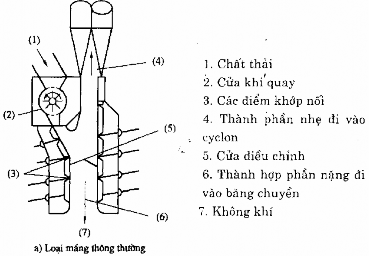
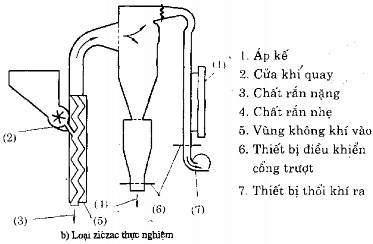
Figure 12. 1. Typical air-blowing classifiers
Magnetic devices (Figure 12.2) for solid waste classification include: suspended magnetic drum, belt type magnetic separator or classification with 2 magnetic drums.
Solid waste classification
For the classification of mixed solid waste with different sizes, people use a multi-layer dynamic or static screening system. Screening is used for both dry and wet, heavy and light solid waste . Normally, this method is applied to solid waste before and after crushing, grinding and after classification by air blowing.
Screening equipment includes the following types: vibrating screen, rotary drum screen.
In addition to the above solid waste classification methods, people also apply other methods such as "floating waste in water (flotation process), "inertial", "optical sorting" or electrostatic, etc.
12.2. REDUCTION OF SOLID WASTE SIZE
Reducing the size of solid waste is reducing the volume, with (size) weight from large to small. Reducing the volume, size may not change the weight of solid waste (if it is dry solid waste), but when reducing the weight, the volume will be significantly reduced.
Reducing the size of solid waste to improve the efficiency of solid waste collection and transportation: collect and transport more solid waste, use fewer vehicles, reduce travel time and costs. At the landfill, reduce the volume of solid waste to increase operating time and reduce the land area of the landfill.
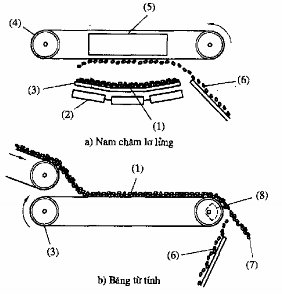
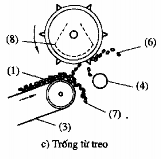
1 Solid waste from shredding equipment 5 Fixed hanging magnet
2. Roller 6. Iron material
3. Conveyor belt 7. Non-ferrous materials
4. Continuous ribbon 8. Electromagnet
Figure 12.2. Typical magnetic separator
a. Compression and pressing technology
Compression to reduce the initial volume of solid waste.
The following factors should be considered when selecting compression equipment:
Characteristics of the waste to be compressed (including size, composition, moisture, density)
garbage level).
Method of transferring waste and loading waste into the compactor.
Method of collecting and using compressed waste.
Design characteristics of pressing and compression equipment.
Operating characteristics include energy requirements, maintenance requirements, noise levels, air and water pollution control requirements.
Compression and pressing technology is used in the transfer and dumping stages at the landfill.
Compression equipment: choose appropriate compression equipment for each of the following types of solid waste:
+ Light dust (for residential areas).
+ Light industrial and commercial waste.
+ Heavy industrial waste.
+ In the transfer station.
Presses used in transfer stations can be divided into many types depending on the pressure compression:
+ Pressure less than 100 lb/in 2 = 0.45 kg, (in = 2.54cm)
+ Pressure higher than 100 lb/in 2
For large compactors, the waste can be compacted: (1) directly into the transport vehicle;
(2) into steel tanks; (3) into a specially designed steel chamber.
b. Incineration technology
Incineration is also used to reduce the initial volume of combustible solid waste. Using this technology, the volume can be reduced by 80 to 90%. During the incineration process, the problem of air pollution needs to be given due attention. The product of solid waste incineration is ash. If the solid waste classification is done well and the type of solid waste fed into the incinerator is organic, the ash should be used as fertilizer. Such a solid waste incinerator is shown in Figure 12.3.
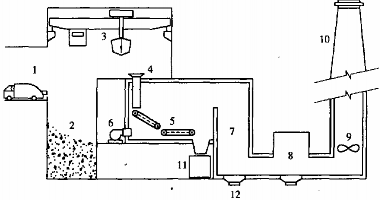
Figure 12.3. Municipal waste incinerator with continuous loading method
1 Garbage truck 7. Combustion chamber
2. Container 8. Pile equipment
3. Lifting arm 9. Fan
4. Receiving funnel 10. Chimney
5. Moving screen 11 Hopper to collect excess material
6. Fan 12. Ash discharge channel
c. Grinding, cutting, and chopping technology
Using this technology to turn large solid waste into small pieces and broken pieces, to improve collection and transportation efficiency. For example: large cardboard boxes, concrete slabs, rocks, tables, chairs... need to be cut, chopped, and crushed.
Crushing and grinding technology has been applied to a number of industries such as cement production, paper production, etc.
Crushing and chopping equipment
To increase the efficiency of crushing operation, the following factors must be considered:
This:
+ Characteristics of chopped waste and characteristics of waste after chopping.
+ Small chopping size required.
+ Method of loading garbage into the shredder.
+ Activity type.
+ Operating characteristics include energy requirements, working mechanism, maintenance
nutrition, noise, air and water pollution.
+ Location includes: Space, height, environmental limitations.
+ Store solid waste after reducing its size...
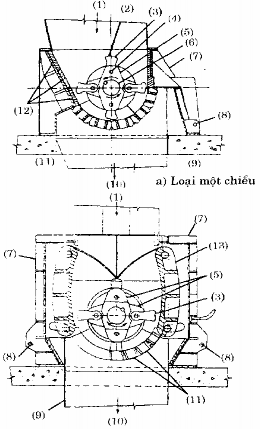
Some typical crushing and chopping equipment
is shown in Figure 12.4.
b. Reversible small beater
Figure 12.4. Crushing device to reduce the size of solid waste
1. Solid waste
2. Hopper
3. Hammer out.
4. Hammer screw
5. Disk
6. Axis
8. Lid hinge
9. Crushed trash hopper
10. Crushed garbage
11. Sieve
12. Movable shield
13. Reversible small stamping
Chapter 13
SOLID WASTE PROCESSING AND DISPOSAL
13.1. PURPOSES OF SOLID WASTE USE
Reusing, making raw materials for some industries, handicrafts, fuel, building materials, fertilizer, animal feed... are activities to utilize and minimize the amount of solid waste.
a. Reuse : Many types of solid waste are reused without additional upgrading or recycling techniques.
This type of solid waste, after use, is still intact and of good quality, including: glass bottles, bottles, boxes, plastic bags, inappropriate and old items from one owner transferred to another owner, etc.
b. Recycling . Some types of solid waste are used as raw materials and additives for many industrial and handicraft production sectors such as: broken glass, broken tires, broken plastic, iron, coal slag (as additives for cement production), etc.
c. Fuel : Straw, leaves, branches, bamboo sticks, wood, sawdust, shavings... are very good sources of fuel. Up to now, in rural areas of our country, especially in the Red River Delta provinces, the above-mentioned wastes have played a very important role in the balance of fuel use.
d. Construction materials. Bricks, broken tiles, coal slag,... are used to pave rural roads and narrow alleys. Three-hole bricks are made from coal slag mixed with cement and lime.
f. Animal feed : Straw, rice husks, sweet potato vines, peanuts, food waste such as rice, leftover vegetables, bagasse, wine lees, animal manure ... are all used by rural families as animal feed and fish feed.
13.2. PROCESSING OF MICROBIOLOGICAL FERTILIZER (COMPOST)
a. Solid waste biodegradation process
The biological decomposition of solid waste produces new products including compost, methane, proteins, alcohols and other organic intermediates. A summary of the above processes is presented in Table 13.1.
b. Microorganisms involved in the biodegradation of solid waste
Microorganisms involved in the process of decomposing solid waste to create new products or semi-finished products are PKOTIST (protozoans). Microorganisms in this group can be unicellular or multicellular but there is no difference in cell structure. Representatives of the PROTIST group are bacteria, fungi, yeast, actinomycites, protozoa and algae...
Table 13. 1. Solid waste biodegradation process
Progress
Decomposition products | Processing requirements | Note | |
Compost | Humus | Crush, chop, classify solid waste by air blowing. | Making organic fertilizer requires a consumer market and synchronous application of advanced technology. |
Anaerobic digestion (Septic tank) | Methane | Crush, chop, classify solid waste by air blowing. | Laboratory implementation, biogas use case. |
Biological process that creates proteins. | Protein, alcohol | Crush, chop, classify solid waste by air blowing. | Made in a laboratory. |
Fermentation process | Glucose | Crushing, chopping, classifying solid waste by air blowing | Combined with hydrolysis method. |
Maybe you are interested!
-
 Situation of Information Technology Application in Enterprises
 -
 Gender issues and feminist resonances in contemporary Vietnamese prose through the works of some typical female writers - 21
 -
 Competing Competitive Advantages of Convenient Air and Sea Access
 -
 Law on establishment and management of science and technology enterprises under public higher education institutions in Vietnam - 11
 -
 Analysis of Capital Structure and Cost of Capital at Some Typical Enterprises
Single-celled bacteria are cocci, rods or spirals. Cocci are about 0.5 - 4 µm in diameter, rods are 0.5 - 20 µm long and 0.5 - 4 µm wide, and spirals are over 10 µm long and about 0.5 µm wide.
Fungi are considered multicellular, non-photosynthetic, heterotrophic PROTISTS. Most fungi are able to grow in low humidity conditions that are unsuitable for bacterial activity. In addition, fungi can tolerate low pH and a wide range from 2 – 9 with the ideal pH for fungi being 5 – 6.
- Yeast is a single-celled microorganism, spherical in shape with a diameter of 8-12µm or elliptical in shape (length not exceeding 15µm). The most active activity of this type of fungus is fermenting sugar into alcohol and CO2 .
- Actinomycetes are a group with characteristics intermediate between bacteria and fungi. Actinomycetes have cells with sizes ranging from 0.5 - 1.4µm.
c. Compost
Organic solid waste can be classified as follows: Water-soluble components such as sugars, starches, amino acids and other organic acids.
Hemice11ulose products have 5 to 6 carbon sugars
Ce11ulose - product of 6 carbon sugars, glucose.
Oils and fats are esters of alcohol and higher fatty acids.
Lignin
Lignins - ce11ulose
Proteins are combinations of amino acid chains.
If the above organic components are sorted from municipal solid waste and to
for bacteria to decompose, the remaining products after the assimilation and catabolism of bacteria
The bacteria are humus. This process is also known as composting. The decomposition of organic matter can be carried out by anaerobic or aerobic organisms depending on the oxygen conditions. Anaerobic decomposition is usually quite slow and causes odors, so most composting processes are aerobic.
The physical and chemical properties of humus vary according to the type of solid waste and the conditions under which the composting process is carried out. The following main characteristics distinguish humus from other natural materials:
Dark brown to black in color
Low nitrogen-carbon ratio
There is continued change due to microbial activity.
Capable of base exchange
d. Composting process
Making bio-fertilizer in three steps: Preparing waste for composting; Decomposing (composting) waste; Finished product, consumption.
- In the stage of preparing waste for composting, including: sorting, reducing waste size,
Adjust the moisture content of the waste and the nutrients in the waste.
- Aerobic waste decomposition: Waste is spread out and turned 1-2 times/week and continuously for 5 weeks. To carry out the waste decomposition process, people apply a number of mechanical equipment systems. If the operation of the mechanical system is well controlled, humus can be formed within 5-7 days.
Crush the compost, add some additives, package and put into storage.
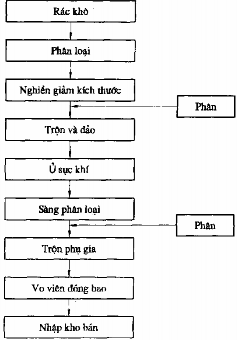
The compost processing process at a waste processing factory in Hanoi is shown below: