
tourism activities of the North Central region to be more suitable and similar.
Third, many practical documents and the situation of tourism development linkage activities in a number of countries and localities in the country are inherited and restructured by the thesis author according to criteria suitable for the topic.
Fourthly, almost all research works mention the viewpoints, directions and systems of solutions to promote tourism development. Here, the thesis only inherits the solutions of tourism linkage or tourism linkage to develop and improve.
Up to now, the author of the thesis has not found any thesis written about the linkage of tourism development in the North Central region. Therefore, the core content in the approved outline of the thesis was researched and developed by the author himself. These are the following basic contents:
Firstly, proving the objectivity of tourism development linkage due to the internal development requirements of localities, in which tourism products as products are born on the basis of local resources and linked with other localities in the region to increase the added value of the tourism service industry.
Second, analyze the current status of tourism development linkage in the North Central provinces with the following core contents: (1) Linking tourism promotion and communication; (2) Linking tourism product development; (3) Linking training and human resource development; (4) Linking synchronous construction of tourism infrastructure, especially transport infrastructure; (5) Linking investment capital mobilization and building a common investment policy mechanism for tourism development in the region, reviewing tourism development planning in accordance with the strengths of each locality; (6) Linking cooperation to improve tourism competitiveness.
Thirdly, it provides basic viewpoints and a system of feasible solutions to strengthen the linkage of tourism development in the North Central region and ensure its stable and sustainable development in the socialist-oriented market economy in Vietnam.
Chapter 2
THEORETICAL AND PRACTICAL BASIS OF TOURISM DEVELOPMENT LINKAGE
near
2.1 Tourism, linkage, linkage tourism development – Some concepts and approaches
2.1.1. Tourism, tourism development, sustainable tourism development
Nowadays, tourism has become a popular socio-economic phenomenon not only
in developed countries but also in developing countries, including Vietnam. However, up to now, the perception of tourism content is still not unified. Due to different circumstances, from different research perspectives, each organization and each individual has a different understanding of tourism.
According to the International Union of Tourism Organizations (IUOTO), tourism is understood as the travel of individuals or groups of people leaving their place of residence for a short period of time to surrounding areas for rest, entertainment and medical treatment.
In 1963, the United Nations Conference on Tourism (held in Rome) stated: “Tourism and the sum of the relationships, phenomena and economic activities arising from the travel and stay of individuals or groups to and from places outside their usual environment for non-business purposes, other than those in which they work” [64].
In 1980, the World Tourism Organization (at the Manila Conference) defined tourism as follows: “Tourism is the movement of people for purposes other than migration and for purposes other than economic, social, cultural or spiritual development of the person and for the promotion of understanding and cooperation among people” [141].
In 1991, the International Conference on Tourism Statistics defined: " Tourism is the activity of a person traveling to a place outside his/her usual environment, for a period of time less than that prescribed by a tourism organization, the purpose of the trip is not to conduct activities earning money within the area visited " [19].
In Vietnam, according to Clause 1, Article 3 of the 2017 Law on Tourism, tourism is activities related to human trips outside of their usual place of residence for no more than 01 consecutive year to meet the needs of sightseeing, relaxation, entertainment, learning, exploring tourism resources or in combination with other legitimate purposes [55]
From the above definitions, according to the author, tourism is an activity related to human travel outside of their regular place of residence to meet the needs of discovery, learning, experience and entertainment within a certain period of time; it is a form of active rest in a living environment completely different from the place of residence.
Tourism is a dynamic and competitive industry that requires adaptability to customer needs and desires as customer satisfaction, safety and enjoyment are the main focus of the tourism business. The development objective of the tourism industry is to contribute to improving the quality and diversity of tourism products and services at target destinations in order to increase the number of tourists, foreign exchange earnings and employment.
Tourism development mainly refers to the situation of quality growth in the tourism industry in terms of development, strong planning and policies and marketing worldwide. Moreover, tourism development includes the approach to the destination, appropriate facilities such as hotels, transportation, amenities, so that tourists have complete satisfaction in the particular destination. Quality is the most important competitive advantage of the tourism company or the key to competition [162].
From there, we can understand that tourism development is a concept that refers to the process of moving forward from low to high, from simple to complex, from less perfect to more perfect activities related to human trips outside the place of residence to meet the needs of sightseeing, relaxation, entertainment, learning, exploring tourism resources or combining with other legitimate purposes.
The criteria for tourism development are also included in the criteria for socio-economic development in general. Accordingly, tourism development is the process in which state agencies, business units, and organizations work together to promote tourism development, create jobs, and improve the living standards of local people in tourist areas. Tourism development also needs to ensure factors for development, including: (i) rationally exploiting tourism resources based on research, selecting attractive tourism resources, building them into specific tourism products, main tourism products, and supplementary tourism products; exploiting tourism resources suitable to the characteristics of the locality and the region; exploiting tourism resources in parallel with the restoration, embellishment, protection of resources, preservation and promotion of traditional cultural values; (ii) ensuring economic benefits for stakeholders including the community, investors, and businesses. At the same time, ensure close and equal linkages between localities participating in the supply chain of tourism products; (iii) protect the natural environment and social environment in tourist areas/spots/routes; exploit tourism resources along with investing in activities to protect the natural environment and social environment in tourist areas/spots/routes.
Thus, according to the author, tourism development is a form of economic development as an industry. Indicators showing the results of the tourism development process include: the number of tourists and tourism income; the number of workers/jobs created by the tourism industry; the number of tourism businesses established; the number of tourist areas/sites, and tourism technical facilities built to meet the needs of tourists in a certain period of time at a specific destination. That destination can be a region, country, area, locality, or locality (province/city).
According to UNEP and UNWTO, sustainable tourism is tourism that minimizes the costs and maximizes the benefits of tourism for natural environments and local communities, and can be carried out sustainably without adversely affecting the ecological resources on which tourism depends. Sustainable tourism is environmentally responsible travel and visitation to natural areas, in order to enjoy and appreciate nature (and any accompanying cultural features, both past and present) in a way that promotes conservation, has a low visitor impact and provides for beneficially active socio-economic involvement of local people [202]. It takes full account of current and future economic, social and environmental impacts to address the needs of tourists, industry, the environment and host communities.
According to UNWTO “sustainable tourism development meets the needs of present tourists and host communities while preserving and enhancing resources for future tourism development” [193]. Sustainable tourism development should be accepted as all types of tourism development that make a significant contribution or, at least, do not conflict with the maintenance of the principles of development over an indefinite period without compromising the ability of future generations to meet their needs and desires. The concept of sustainable tourism development focuses not only on environmental protection but also on maintaining local cultures and ensuring economic development, bringing equitable benefits to the target groups.
According to Clause 14, Article 3 of the 2017 Law on Tourism of Vietnam, sustainable tourism development is tourism development that simultaneously meets socio-economic and environmental requirements, ensuring harmony of interests of subjects participating in tourism activities, and does not harm the ability to meet future tourism needs [55].
From the above analysis, according to the author, tourism is considered sustainable development when that tourism is good for the country at the present time and is sustainable in the long term in the future.
2.1.2. Region, link, link tourism development
2.1.2.1. The concept of region in tourism development
A tourist area is a territorial community of specialized enterprises serving tourists, having close economic relations to best satisfy the needs of tourists on the basis of using the existing natural, historical and cultural complex and the socio-economic conditions of the territory [75]. Some studies show that a tourist area is a tourist space consisting of many different localities, a unified whole of natural, economic, cultural and social objects. There are tourism factors such as tourism resources, tourism infrastructure, tourism labor resources, demand and number of tourists and other socio-economic factors. The characteristics of each region are expressed in the differences in tourism resources and technical facilities serving tourism.
To develop tourism, the organization of tourism territory is the top concern, the reason is that it is impossible to organize and effectively manage the association activities without considering its spatial (territorial) aspect. Territorial organization of tourism is to divide the national territory into tourism economic zones, in order to promote advantages, organize and do tourism business to achieve the highest economic, social and environmental efficiency. Territorial organization of tourism is understood as: (1) A spatial connection system of tourism objects and service facilities; (2) To make optimal use of resources, infrastructure and other factors; (3) Historical organization of tourism territory.
There are two common forms of tourism territorial organization including:
One is the tourism territorial system. It is a complete formation of activities and territories, with a selection of certain social functions. One of the selected functions is the recovery and regeneration of health, working capacity, physical and mental strength. The tourism territorial system is only a place where tourism resources and technical works are concentrated, so the tourism territorial systems may not be closed to the entire natural territory. The tourism territorial system is the nucleus that creates the tourism area.
The system is made up of subsystems that are closely related to each other, including: (i) Client subsystem: Is the central subsystem, controlling other components of the system. Number
The quantity and social, demographic, ethnic characteristics of tourists determine the other components of the system. (ii) Resource subsystem: Is the condition to satisfy the needs of tourism and is the territorial basis for the formation of the system. (iii) Technical works subsystem: Ensures the normal life of guests and service staff in terms of accommodation, travel and entertainment, sightseeing needs, especially medical treatment... (iv) Service staff subsystem: Responds to customer services and ensures normal operation of enterprises. (v) Control department: Has the task of keeping the whole system in general and each part of the system in particular operating optimally.
Second, the tourism region. The tourism region is a socio-economic territorial system, a collection of tourism territorial systems at all levels that are interconnected and infrastructure enterprises to ensure the operation of tourism territorial systems that share the same specialization and socio-economic conditions for tourism development. Thus, the tourism region consists of two closely related elements: the tourism territorial system; and the surrounding socio-economic space.
The tourist area has a larger space, including areas for production of goods, materials, energy, warehouses, public works... The tourist area is a socio-economic space so it has a historical nature, meaning it can change over time [214].
Sub-regional tourism is understood as the second level of classification after the tourist region, which is the place where tourist spots, tourist centers (if any) and tourist sub-regions are gathered, forming a larger tourism territorial space than the tourist sub-region; Sub-regional tourism includes localities without tourist spots. In the sub-regional tourism, specialization begins to form, although not yet clearly. The formation of Sub-regional tourism depends on many factors. In some tourist regions, Sub-regional tourism may not be clearly defined and in many cases, the classification system only really has 4 levels: Tourist spot - Tourist center - Sub-regional tourism - Tourist region.
A tourist center is a territorial combination of tourist attractions with high density, including functional tourist attractions characterized by economic territorial cohesion.
- technical and organizational, where the infrastructure and technical facilities of tourism are quite synchronous to meet the diverse needs of tourists during long stays. The tourist center has a certain scale in terms of area, usually corresponding to a province, is a place with the ability to create highlands and very high regional connectivity, so it is often considered the nucleus of the region or the growth pole of the tourist region.
Tourist attractions are the lowest level in the hierarchy. In terms of territory, a tourist attraction is small in scale, a place where a certain type of resource (natural, cultural-historical or socio-economic) or a separate construction serving tourism or a combination of both on a small scale is concentrated. Tourist attractions can be divided into two types: resource points and functional points. The connection of tourist attractions with transportation systems (road, rail, waterway, air) and services will form a tourist route; the length of stay of tourists at a tourist destination is usually relatively short.
2.1.2.2. Regional tourism linkage
Tourism is a comprehensive economic sector, involving many industries and many parties. Tourism activities and tourism business also take place on a wide scale, requiring cooperation from parties in the process of organizing tourism activities, business and tourism management.
First of all, from the perspective of tourists' trips, understood as the process of leaving their regular residence, traveling to and staying at a new place to visit, learn, explore, rest..., tourism activities cover a wide area, with a long time (at least one day, according to the definition of tourism of the World Tourism Organization - UNWTO). The process of tourists' travel goes through many different localities, at least on the way from the place of residence of the tourists to the place of travel. Tourist activities are also not limited to one location, one tourist destination but often tend to go to many different tourist destinations that can be in many different localities.
Regional tourism connectivity includes intra-regional connectivity and inter-regional connectivity.
Intra-regional linkage is the cooperation, support and division of labor between sub-regions (if any), sub-regions and localities in the region based on the comparative advantages of each sub-region (if any), sub-region and locality to successfully implement the strategic orientations for tourism development of the sub-regions, sub-regions and localities in the region.
Inter-regional linkage is the cooperation and division of labor between tourism regions based on the comparative advantages of each region to successfully implement strategic tourism development orientations, actively contributing to promoting tourism development of those tourism regions. Normally, inter-regional linkage is carried out between two regions with adjacent boundaries.
According to the author, regional tourism linkage is cooperation and division of labor between participating parties in a number of key tourism development areas, including: cooperation in reallocating resources, adjusting development planning in accordance with the strengths of each locality in the region, in each development stage; linkage in developing tourism products, especially typical products of groups of localities, of sub-regions in the region or between two adjacent tourism regions; linkage in promoting and developing destination brands and tourism products; linkage in establishing unity in regional tourism space (system of tourist points and routes) through developing infrastructure connecting the territory; linkage in training and developing human resources; cooperation in mobilizing investment capital and building policy mechanisms for investment in developing common tourism in the region; cooperation in improving the business and investment environment, enhancing the competitiveness of tourism regions; Cooperate in building information systems and exchanging tourism information to serve the goals of regional tourism development; cooperate in environmental protection for regional environmental issues, respond to natural disasters and climate change in the tourism sector.
Sub-regional linkage is the linkage of territorial subdivisions in a tourism region. However, for sub-regional linkage, some specific linkage contents are not set out. However, regional linkage and sub-regional linkage of tourism will be very difficult to implement without a specialized organization to manage tourism activities of the region and each sub-region. This also means that there will be no specific entity representing the region and sub-regions participating in the linkage implementation. Therefore, at times, regional linkage and sub-regional linkage only have "symbolic" and "ideal" meaning in the tourism development planning of the tourism region, especially traffic connection.
From the perspective of tourism product and service consumption, tourists often consume many different types of products and services, from typical tourism products such as hotels, restaurants, tours, to complementary products, which can be common local goods.
Tourism activities
calendar
Stakeholders in the tourism industry | |||
Traveling | Travel business | Tourism Management | Tourist |
People in tourism business | |||
Travel business | |||
Accommodation business | |||
Types of businesses providing tourism services other | |||
Businesses providing tourism services | |||
Tourist attraction manager | |||
Authorities at tourist sites | |||
Local government (commune, district, province, central) | |||
Other participating agencies (industries) | |||
Relevant social organizations | |||
Other participants |
Maybe you are interested!
-
 Promotion, Advancement, Linkage, Cooperation in Tourism Development
 -
 Identify Rating Levels and Rating Scales
zt2i3t4l5ee
zt2a3gstourism,quan lan,quang ninh,ecology,ecotourism,minh chau,van don,geography,geographical basis,tourism development,science
zt2a3ge
zc2o3n4t5e6n7ts
of the islanders. Therefore, this indicator will be divided into two sub-indicators:
a1. Natural tourism attractiveness a2. Cultural tourism attractiveness
b. Tourist capacity
The two island communes in Quan Lan have different capacities to receive tourists. Minh Chau Commune is home to many standard hotels and resorts, attracting high-income domestic and international tourists. Meanwhile, Quan Lan Commune has many motels mainly built and operated by local people, so the scale and quality are not high, and will be suitable for ordinary tourists such as students.
c. Time of exploitation of Quan Lan Island Commune:
Quan Lan tourism is seasonal due to weather and climate conditions and festivals only take place on certain days of the year, specifically in spring. In Quan Lan commune, the period from April to June and from September to November is considered the best time to visit Quan Lan because the cultural tourism activities are mainly associated with festivals taking place during this time.
Minh Chau island commune:
Tourism exploitation time is all year round, because this is a place with a number of tourist attractions with diverse ecosystems such as Bai Tu Long National Park Research Center, Tram forest, Turtle Laying Beach, so besides coming to the beach for tourism and vacation in the summer, Minh Chau will attract research groups to come for tourism combined with research at other times of the year.
d. Sustainability
The sustainability of ecotourism sites in Quan Lan and Minh Chau communes depends on the sensitivity of the ecosystems to climate changes.
landscape. In general, these tourist destinations have a fairly high level of sustainability, because they are natural ecosystems, planned and protected. However, if a large number of tourists gather at certain times, it can exceed the carrying capacity and affect the sustainability of the environment (polluted beaches, damaged trees, animals moving away from their habitats, etc.), then the sustainability of the above ecosystems (natural ecosystems, human ecosystems) will also be affected and become less sustainable.
e. Location and accessibility
Both island communes have ports to take tourists to visit from Van Don wharf:
- Quan Lan – Van Don traffic route:
Phuc Thinh – Viet Anh high-speed boat and Quang Minh high-speed boat, depart at 8am and 2pm from Van Don to Quan Lan, and at 7am and 1pm from Quan Lan to Van Don. There are also wooden boats departing at 7am and 1pm.
- Van Don - Minh Chau traffic route:
Chung Huong high-speed train, Minh Chau train, morning 7:30 and afternoon 13:30 from Van Don to Minh Chau, morning 6:30 and afternoon 13:00 from Minh Chau to Van Don.
f. Infrastructure
Despite receiving investment attention, the issue of infrastructure and technical facilities for tourism on Quan Lan Island is still an issue that needs to be resolved because it has a direct impact on the implementation of ecotourism activities. The minimum conditions for serving tourists such as accommodation, electricity, water, communication, especially medical services, and security work need to be given top priority. Ecotourism spots in Minh Chau commune are assessed to have better infrastructure and technical facilities for tourism because there are quite complete and synchronous conditions for serving tourists, meeting many needs of domestic and foreign tourists.
3.2.1.4. Determine assessment levels and assessment scales
Corresponding to the levels of each criterion, the index is the score of those levels in the order of 4, 3, 2, 1 decreasing according to the standard of each level: very attractive (4), attractive (3), average (2), less attractive (1).
3.2.1.5. Determining the coefficients of the criteria
For the assessment of DLST in the two communes of Quan Lan and Minh Chau islands, the students added evaluation coefficients to show the importance of the criteria and indicators as follows:
Coefficient 3 with criteria: Attractiveness, Exploitation time. These are the 2 most important criteria for attracting tourists to tourism in general and eco-tourism in particular, so they have the highest coefficient.
Coefficient 2 with criteria: Capacity, Infrastructure, Location and accessibility . Because the assessment area is an island commune of Van Don district, the above criteria are selected by the author with appropriate coefficients at the average level.
Coefficient 1 with criteria: Sustainability. Quan Lan has natural and human-made ecotourism sites, with high biodiversity and little impact from local human factors. Most of the ecotourism sites are still wild, so they are highly sustainable.
3.2.1.6. Results of DLST assessment on Quan Lan island
a. Assessment of the potential for natural tourism development
For Minh Chau commune:
+ Natural tourism attractiveness is determined to be very attractive (4 points) and the most important coefficient (coefficient 3), so the score of the Attractiveness criterion is 4 x 3 = 12.
+ Capacity is determined as average (2 points) and the coefficient is quite important (coefficient 2), then the score of Capacity criterion is 2 x 2 = 4.
+ Exploitation time is long (4 points), the most important coefficient (coefficient 3) so the score of the Exploitation time criterion is 4 x 3 = 12.
+ Sustainability is determined as sustainable (4 points), the important coefficient is the average coefficient (coefficient 1), so the score of the Sustainability criterion is 4 x 1 = 4 points
+ Location and accessibility are determined to be quite favorable (2 points), the coefficient is quite important (coefficient 2), the criterion score is 2 x 2 = 4 points.
+ Infrastructure is assessed as good (3 points), the coefficient is quite important (coefficient 2), then the score of the Infrastructure criterion is 3 x 2 = 6 points.
The total score for evaluating DLST in Minh Chau commune according to 6 evaluation criteria is determined as: 12 + 4 + 12 + 4 + 4 + 6 = 42 points
Similar assessment for Quan Lan commune, we have the following table:
Table 3.3: Assessment of the potential for natural ecotourism development in Quan Lan and Minh Chau communes
Attractiveness of self-tourismof course
Capacity
Mining time
Sustainability
Location and accessibility
Infrastructure
Result
Point
DarkMulti
Point
DarkMulti
Point
DarkMulti
Point
DarkMulti
Point
DarkMulti
Point
DarkMulti
CommuneMinh Chau
12
12
4
8
12
12
4
4
4
8
6
8
42/52
Quan CommuneLan
6
12
6
8
9
12
4
4
4
8
4
8
33/52
b. Assessment of the potential for humanistic tourism development
For Quan Lan commune:
+ The attractiveness of human tourism is determined to be very attractive (4 points) and the most important coefficient (coefficient 3), so the score of the Attractiveness criterion is 4 x 3 = 12.
+ Capacity is determined to be large (3 points) and the coefficient is quite important (coefficient 2), then the score of the Capacity criterion is 3 x 2 = 6.
+ Mining time is average (3 points), the most important coefficient (coefficient 3) so the score of the Mining time criterion is 3 x 3 = 9.
+ Sustainability is determined as sustainable (4 points), the important coefficient is the average coefficient (coefficient 1), so the score of the Sustainability criterion is 4 x 1 = 4 points.
+ Location and accessibility are determined to be quite favorable (2 points), the coefficient is quite important (coefficient 2), the criterion score is 2 x 2 = 4 points.
+ Infrastructure is rated as average (2 points), the coefficient is quite important (coefficient 2), then the score of the Infrastructure criterion is 2 x 2 = 4 points.
The total score for evaluating DLST in Quan Lan commune according to 6 evaluation criteria is determined as: 12 + 6 + 6 + 4 + 4 + 4 = 36 points.
Similar assessment with Minh Chau commune we have the following table:
Table 3.4: Assessment of the potential for developing humanistic eco-tourism in Quan Lan and Minh Chau communes
Attractiveness of human tourismliterature
Capacity
Mining time
Sustainability
Location and accessibility
Infrastructure
Result
Point
DarkMulti
Point
DarkMulti
Point
DarkMulti
Point
DarkMulti
Point
DarkMulti
Point
DarkMulti
Quan CommuneLan
12
12
6
8
9
12
4
4
4
8
4
8
39/52
Minh CommuneChau
6
12
4
8
12
12
4
4
4
8
6
8
36/52
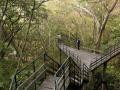
Basically, both Minh Chau and Quan Lan localities have quite favorable conditions for developing ecotourism. However, Quan Lan commune has more advantages to develop ecotourism in a humanistic direction, because this is an area with many famous historical relics such as Quan Lan Communal House, Quan Lan Pagoda, Temple worshiping the hero Tran Khanh Du, ... along with local festivals held annually such as the wind praying ceremony (March 15), Quan Lan festival (June 10-19); due to its location near the port and long exploitation time, the beaches in Quan Lan commune (especially Quan Lan beach) are no longer hygienic and clean to ensure the needs of tourists coming to relax and swim; this is also an area with many beautiful landscapes such as Got Beo wind pass, Ong Phong head, Voi Voi cave, but the ability to access these places is still very limited (dirt hill road, lots of gravel and rocks), especially during rainy and windy times; In addition, other natural resources such as mangrove forests and sea worms have not been really exploited for tourism purposes and ecotourism development. On the contrary, Minh Chau commune has more advantages in developing ecotourism in the direction of natural tourism, this is an area with diverse ecosystems such as at Rua De Beach, Bai Tu Long National Park Conservation Center...; Minh Chau beach is highly appreciated for its natural beauty and cleanliness, ranked in the top ten most beautiful beaches in Vietnam; Minh Chau commune is also home to Tram forest with a large area and a purity of up to 90%, suitable for building bridges through the forest (a very effective type of natural ecotourism currently applied by many countries) for tourists to sightsee, as well as for the purpose of studying and researching.
Figure 3.1: Thenmala Forest Bridge (India) Source: https://www.thenmalaecotourism.com/(August 21, 2019)
3.2.2. Using SWOT matrix to evaluate Quan Lan island tourism
General assessment of current tourism activities of Quan Lan island is shown through the following SWOT matrix:
Table 3.5: SWOT matrix evaluating tourism activities on Quan Lan island
Internal agent
Strengths- There is a lot of potential for tourism development, especially natural ecotourism and humanistic ecotourism.- The unskilled labor force is relatively abundant.- resource environmentunpolluted, still
Weaknesses- Poorly developed infrastructure, especially traffic routes to tourist destinations on the island.- The team of professional staff is still weak.- Tourism products in general
quite wild, originalintact
general and DLST in particularalone is monotonous.
External agents
Opportunity- Tourism is a key industry in the socio-economic development strategy of the province and Van Don economic zone.- Quan Lan was selected as a pilot area for eco-tourism development within the framework of the green growth project between Quang Ninh province and the Japanese organization JICA.- The flow of tourists and especially ecotourism in the world tends toincreasing
Challenge- Weather and climate change abnormally.- Competition in tourism products is increasingly fierce, especially with other localities in the province such as Ha Long, Mong Cai...- Awareness of tourists, especially domestic tourists, about ecotourism and nature conservation is not high.
Through summary analysis using SWOT matrix we see that:
To exploit strengths and take advantage of opportunities, it is necessary to:
- Diversify products and service types (build more tourism routes aimed at specific needs of tourists: experiential tourism immersed in nature, spiritual cultural tourism...)
- Effective exploitation of resources and differentiated products (natural resources and human resources)
div.maincontent .p { color: black; font-family:"Times New Roman", serif; font-style: normal; font-weight: normal; text-decoration: none; font-size: 14pt; margin:0pt; } div.maincontent p { color: black; font-family:"Times New Roman", serif; font-style: normal; font-weight: normal; text-decoration: none; font-size: 14pt; margin:0pt; } div.maincontent .s1 { color: black; font-family:"Times New Roman", serif; font-style: normal; font-weight: normal; text-decoration: none; font-size: 13pt; } div.maincontent .s2 { color: black; font-family:"Times New Roman", serif; font-style: normal; font-weight: normal; text-decoration: none; font-size: 13pt; } div.maincontent .s3 { color: #0D0D0D; font-family:"Times New Roman", serif; font-style: normal; font-weight: bold; text-decoration: none; font-size: 14pt; } div.maincontent .s4 { color: black; font-family:"Times New Roman", serif; font-style: italic; font-weight: normal; text-decoration: none; font-size: 14pt; } div.maincontent .s5 { color: black; font-family:"Times New Roman", serif; font-style: italic; font-weight: bold; text-decoration: none; font-size: 14pt; } div.maincontent .s6 { color: black; font-family:"Times New Roman", serif; font-style: italic; font-weight: normal; text-decoration: none; font-size: 14pt; vertical-align: -3pt; } div.maincontent .s7 { color: black; font-family:"Times New Roman", serif; font-style: italic; font-weight: normal; text-decoration: none; font-size: 14pt; vertical-align: -2pt; } div.maincontent .s8 { color: black; font-family:"Times New Roman", serif; font-style: italic; font-weight: normal; text-decoration: none; font-size: 14pt; vertical-align: -1pt; } div.maincontent .s9 { color: black; font-family:"Times New Roman", serif; font-style: normal; font-weight: normal; text-decoration: none; font-size: 14pt; } div.maincontent .s10 { color: black; font-family:"Times New Roman", serif; font-style: normal; font-weight: bold; text-decoration: none; font-size: 14pt; } div.maincontent .s11 { color: black; font-family:"Times New Roman", serif; font-style: normal; font-weight: normal; text-decoration: none; font-size: 14pt; } div.maincontent .s12 { color: black; font-family:Symbol, serif; font-style: normal; font-weight: normal; text-decoration: none; font-size: 14pt; } div.maincontent .s13 { color: black; font-family:Wingdings; font-style: normal; font-weight: normal; text-decoration: none; font-size: 14pt; } div.maincontent .s14 { color: black; font-family:"Times New Roman", serif; font-style: normal; font-weight: normal; text-decoration: none; font-size: 9pt; vertical-align: 5pt; } div.maincontent .s15 { color: black; font-family:"Times New Roman", serif; font-style: normal; font-weight: normal; text-decoration: none; font-size: 9pt; vertical-align: 5pt; } div.maincontent .s16 { color: black; font-family:Cambria, serif; font-style: italic; font-weight: normal; text-decoration: none; font-size: 14pt; } div.maincontent .s17 { color: #080808; font-family:"Times New Roman", serif; font-style: normal; font-weight: bold; text-decoration: none; font-size: 14pt; } div.maincontent .s18 { color: #080808; font-family:"Times New Roman", serif; font-style: normal; font-weight: normal; text-decoration: none; font-size: 14pt; } div.maincontent .s19 { color: black; font-family:"Times New Roman", serif; font-style: normal; font-weight: normal; text-decoration: none; font-size: 11pt; } div.maincontent .s20 { color: black; font-family:"Times New Roman", serif; font-style: normal; font-weight: normal; text-decoration: none; font-size: 10pt; } div.maincontent .s21 { color: black; font-family:"Times New Roman", serif; font-style: normal; font-weight: bold; text-decoration: none; font-size: 11pt; } div.maincontent .s22 { color: black; font-family:"Times New Roman", serif; font-style: normal; font-weight: normal; text-decoration: none; font-size: 11pt; } div.maincontent .s23 { color: black; font-family:"Times New Roman", serif; font-style: italic; font-weight: normal; text-decoration: none; font-size: 14pt; } div.maincontent .s24 { color: #212121; font-family:"Times New Roman", serif; font-style: normal; font-weight: normal; tex
Identify Rating Levels and Rating Scales
zt2i3t4l5ee
zt2a3gstourism,quan lan,quang ninh,ecology,ecotourism,minh chau,van don,geography,geographical basis,tourism development,science
zt2a3ge
zc2o3n4t5e6n7ts
of the islanders. Therefore, this indicator will be divided into two sub-indicators:
a1. Natural tourism attractiveness a2. Cultural tourism attractiveness
b. Tourist capacity
The two island communes in Quan Lan have different capacities to receive tourists. Minh Chau Commune is home to many standard hotels and resorts, attracting high-income domestic and international tourists. Meanwhile, Quan Lan Commune has many motels mainly built and operated by local people, so the scale and quality are not high, and will be suitable for ordinary tourists such as students.
c. Time of exploitation of Quan Lan Island Commune:
Quan Lan tourism is seasonal due to weather and climate conditions and festivals only take place on certain days of the year, specifically in spring. In Quan Lan commune, the period from April to June and from September to November is considered the best time to visit Quan Lan because the cultural tourism activities are mainly associated with festivals taking place during this time.
Minh Chau island commune:
Tourism exploitation time is all year round, because this is a place with a number of tourist attractions with diverse ecosystems such as Bai Tu Long National Park Research Center, Tram forest, Turtle Laying Beach, so besides coming to the beach for tourism and vacation in the summer, Minh Chau will attract research groups to come for tourism combined with research at other times of the year.
d. Sustainability
The sustainability of ecotourism sites in Quan Lan and Minh Chau communes depends on the sensitivity of the ecosystems to climate changes.
landscape. In general, these tourist destinations have a fairly high level of sustainability, because they are natural ecosystems, planned and protected. However, if a large number of tourists gather at certain times, it can exceed the carrying capacity and affect the sustainability of the environment (polluted beaches, damaged trees, animals moving away from their habitats, etc.), then the sustainability of the above ecosystems (natural ecosystems, human ecosystems) will also be affected and become less sustainable.
e. Location and accessibility
Both island communes have ports to take tourists to visit from Van Don wharf:
- Quan Lan – Van Don traffic route:
Phuc Thinh – Viet Anh high-speed boat and Quang Minh high-speed boat, depart at 8am and 2pm from Van Don to Quan Lan, and at 7am and 1pm from Quan Lan to Van Don. There are also wooden boats departing at 7am and 1pm.
- Van Don - Minh Chau traffic route:
Chung Huong high-speed train, Minh Chau train, morning 7:30 and afternoon 13:30 from Van Don to Minh Chau, morning 6:30 and afternoon 13:00 from Minh Chau to Van Don.
f. Infrastructure
Despite receiving investment attention, the issue of infrastructure and technical facilities for tourism on Quan Lan Island is still an issue that needs to be resolved because it has a direct impact on the implementation of ecotourism activities. The minimum conditions for serving tourists such as accommodation, electricity, water, communication, especially medical services, and security work need to be given top priority. Ecotourism spots in Minh Chau commune are assessed to have better infrastructure and technical facilities for tourism because there are quite complete and synchronous conditions for serving tourists, meeting many needs of domestic and foreign tourists.
3.2.1.4. Determine assessment levels and assessment scales
Corresponding to the levels of each criterion, the index is the score of those levels in the order of 4, 3, 2, 1 decreasing according to the standard of each level: very attractive (4), attractive (3), average (2), less attractive (1).
3.2.1.5. Determining the coefficients of the criteria
For the assessment of DLST in the two communes of Quan Lan and Minh Chau islands, the students added evaluation coefficients to show the importance of the criteria and indicators as follows:
Coefficient 3 with criteria: Attractiveness, Exploitation time. These are the 2 most important criteria for attracting tourists to tourism in general and eco-tourism in particular, so they have the highest coefficient.
Coefficient 2 with criteria: Capacity, Infrastructure, Location and accessibility . Because the assessment area is an island commune of Van Don district, the above criteria are selected by the author with appropriate coefficients at the average level.
Coefficient 1 with criteria: Sustainability. Quan Lan has natural and human-made ecotourism sites, with high biodiversity and little impact from local human factors. Most of the ecotourism sites are still wild, so they are highly sustainable.
3.2.1.6. Results of DLST assessment on Quan Lan island
a. Assessment of the potential for natural tourism development
For Minh Chau commune:
+ Natural tourism attractiveness is determined to be very attractive (4 points) and the most important coefficient (coefficient 3), so the score of the Attractiveness criterion is 4 x 3 = 12.
+ Capacity is determined as average (2 points) and the coefficient is quite important (coefficient 2), then the score of Capacity criterion is 2 x 2 = 4.
+ Exploitation time is long (4 points), the most important coefficient (coefficient 3) so the score of the Exploitation time criterion is 4 x 3 = 12.
+ Sustainability is determined as sustainable (4 points), the important coefficient is the average coefficient (coefficient 1), so the score of the Sustainability criterion is 4 x 1 = 4 points
+ Location and accessibility are determined to be quite favorable (2 points), the coefficient is quite important (coefficient 2), the criterion score is 2 x 2 = 4 points.
+ Infrastructure is assessed as good (3 points), the coefficient is quite important (coefficient 2), then the score of the Infrastructure criterion is 3 x 2 = 6 points.
The total score for evaluating DLST in Minh Chau commune according to 6 evaluation criteria is determined as: 12 + 4 + 12 + 4 + 4 + 6 = 42 points
Similar assessment for Quan Lan commune, we have the following table:
Table 3.3: Assessment of the potential for natural ecotourism development in Quan Lan and Minh Chau communes
Attractiveness of self-tourismof course
Capacity
Mining time
Sustainability
Location and accessibility
Infrastructure
Result
Point
DarkMulti
Point
DarkMulti
Point
DarkMulti
Point
DarkMulti
Point
DarkMulti
Point
DarkMulti
CommuneMinh Chau
12
12
4
8
12
12
4
4
4
8
6
8
42/52
Quan CommuneLan
6
12
6
8
9
12
4
4
4
8
4
8
33/52
b. Assessment of the potential for humanistic tourism development
For Quan Lan commune:
+ The attractiveness of human tourism is determined to be very attractive (4 points) and the most important coefficient (coefficient 3), so the score of the Attractiveness criterion is 4 x 3 = 12.
+ Capacity is determined to be large (3 points) and the coefficient is quite important (coefficient 2), then the score of the Capacity criterion is 3 x 2 = 6.
+ Mining time is average (3 points), the most important coefficient (coefficient 3) so the score of the Mining time criterion is 3 x 3 = 9.
+ Sustainability is determined as sustainable (4 points), the important coefficient is the average coefficient (coefficient 1), so the score of the Sustainability criterion is 4 x 1 = 4 points.
+ Location and accessibility are determined to be quite favorable (2 points), the coefficient is quite important (coefficient 2), the criterion score is 2 x 2 = 4 points.
+ Infrastructure is rated as average (2 points), the coefficient is quite important (coefficient 2), then the score of the Infrastructure criterion is 2 x 2 = 4 points.
The total score for evaluating DLST in Quan Lan commune according to 6 evaluation criteria is determined as: 12 + 6 + 6 + 4 + 4 + 4 = 36 points.
Similar assessment with Minh Chau commune we have the following table:
Table 3.4: Assessment of the potential for developing humanistic eco-tourism in Quan Lan and Minh Chau communes
Attractiveness of human tourismliterature
Capacity
Mining time
Sustainability
Location and accessibility
Infrastructure
Result
Point
DarkMulti
Point
DarkMulti
Point
DarkMulti
Point
DarkMulti
Point
DarkMulti
Point
DarkMulti
Quan CommuneLan
12
12
6
8
9
12
4
4
4
8
4
8
39/52
Minh CommuneChau
6
12
4
8
12
12
4
4
4
8
6
8
36/52
Basically, both Minh Chau and Quan Lan localities have quite favorable conditions for developing ecotourism. However, Quan Lan commune has more advantages to develop ecotourism in a humanistic direction, because this is an area with many famous historical relics such as Quan Lan Communal House, Quan Lan Pagoda, Temple worshiping the hero Tran Khanh Du, ... along with local festivals held annually such as the wind praying ceremony (March 15), Quan Lan festival (June 10-19); due to its location near the port and long exploitation time, the beaches in Quan Lan commune (especially Quan Lan beach) are no longer hygienic and clean to ensure the needs of tourists coming to relax and swim; this is also an area with many beautiful landscapes such as Got Beo wind pass, Ong Phong head, Voi Voi cave, but the ability to access these places is still very limited (dirt hill road, lots of gravel and rocks), especially during rainy and windy times; In addition, other natural resources such as mangrove forests and sea worms have not been really exploited for tourism purposes and ecotourism development. On the contrary, Minh Chau commune has more advantages in developing ecotourism in the direction of natural tourism, this is an area with diverse ecosystems such as at Rua De Beach, Bai Tu Long National Park Conservation Center...; Minh Chau beach is highly appreciated for its natural beauty and cleanliness, ranked in the top ten most beautiful beaches in Vietnam; Minh Chau commune is also home to Tram forest with a large area and a purity of up to 90%, suitable for building bridges through the forest (a very effective type of natural ecotourism currently applied by many countries) for tourists to sightsee, as well as for the purpose of studying and researching.
Figure 3.1: Thenmala Forest Bridge (India) Source: https://www.thenmalaecotourism.com/(August 21, 2019)
3.2.2. Using SWOT matrix to evaluate Quan Lan island tourism
General assessment of current tourism activities of Quan Lan island is shown through the following SWOT matrix:
Table 3.5: SWOT matrix evaluating tourism activities on Quan Lan island
Internal agent
Strengths- There is a lot of potential for tourism development, especially natural ecotourism and humanistic ecotourism.- The unskilled labor force is relatively abundant.- resource environmentunpolluted, still
Weaknesses- Poorly developed infrastructure, especially traffic routes to tourist destinations on the island.- The team of professional staff is still weak.- Tourism products in general
quite wild, originalintact
general and DLST in particularalone is monotonous.
External agents
Opportunity- Tourism is a key industry in the socio-economic development strategy of the province and Van Don economic zone.- Quan Lan was selected as a pilot area for eco-tourism development within the framework of the green growth project between Quang Ninh province and the Japanese organization JICA.- The flow of tourists and especially ecotourism in the world tends toincreasing
Challenge- Weather and climate change abnormally.- Competition in tourism products is increasingly fierce, especially with other localities in the province such as Ha Long, Mong Cai...- Awareness of tourists, especially domestic tourists, about ecotourism and nature conservation is not high.
Through summary analysis using SWOT matrix we see that:
To exploit strengths and take advantage of opportunities, it is necessary to:
- Diversify products and service types (build more tourism routes aimed at specific needs of tourists: experiential tourism immersed in nature, spiritual cultural tourism...)
- Effective exploitation of resources and differentiated products (natural resources and human resources)
div.maincontent .p { color: black; font-family:"Times New Roman", serif; font-style: normal; font-weight: normal; text-decoration: none; font-size: 14pt; margin:0pt; } div.maincontent p { color: black; font-family:"Times New Roman", serif; font-style: normal; font-weight: normal; text-decoration: none; font-size: 14pt; margin:0pt; } div.maincontent .s1 { color: black; font-family:"Times New Roman", serif; font-style: normal; font-weight: normal; text-decoration: none; font-size: 13pt; } div.maincontent .s2 { color: black; font-family:"Times New Roman", serif; font-style: normal; font-weight: normal; text-decoration: none; font-size: 13pt; } div.maincontent .s3 { color: #0D0D0D; font-family:"Times New Roman", serif; font-style: normal; font-weight: bold; text-decoration: none; font-size: 14pt; } div.maincontent .s4 { color: black; font-family:"Times New Roman", serif; font-style: italic; font-weight: normal; text-decoration: none; font-size: 14pt; } div.maincontent .s5 { color: black; font-family:"Times New Roman", serif; font-style: italic; font-weight: bold; text-decoration: none; font-size: 14pt; } div.maincontent .s6 { color: black; font-family:"Times New Roman", serif; font-style: italic; font-weight: normal; text-decoration: none; font-size: 14pt; vertical-align: -3pt; } div.maincontent .s7 { color: black; font-family:"Times New Roman", serif; font-style: italic; font-weight: normal; text-decoration: none; font-size: 14pt; vertical-align: -2pt; } div.maincontent .s8 { color: black; font-family:"Times New Roman", serif; font-style: italic; font-weight: normal; text-decoration: none; font-size: 14pt; vertical-align: -1pt; } div.maincontent .s9 { color: black; font-family:"Times New Roman", serif; font-style: normal; font-weight: normal; text-decoration: none; font-size: 14pt; } div.maincontent .s10 { color: black; font-family:"Times New Roman", serif; font-style: normal; font-weight: bold; text-decoration: none; font-size: 14pt; } div.maincontent .s11 { color: black; font-family:"Times New Roman", serif; font-style: normal; font-weight: normal; text-decoration: none; font-size: 14pt; } div.maincontent .s12 { color: black; font-family:Symbol, serif; font-style: normal; font-weight: normal; text-decoration: none; font-size: 14pt; } div.maincontent .s13 { color: black; font-family:Wingdings; font-style: normal; font-weight: normal; text-decoration: none; font-size: 14pt; } div.maincontent .s14 { color: black; font-family:"Times New Roman", serif; font-style: normal; font-weight: normal; text-decoration: none; font-size: 9pt; vertical-align: 5pt; } div.maincontent .s15 { color: black; font-family:"Times New Roman", serif; font-style: normal; font-weight: normal; text-decoration: none; font-size: 9pt; vertical-align: 5pt; } div.maincontent .s16 { color: black; font-family:Cambria, serif; font-style: italic; font-weight: normal; text-decoration: none; font-size: 14pt; } div.maincontent .s17 { color: #080808; font-family:"Times New Roman", serif; font-style: normal; font-weight: bold; text-decoration: none; font-size: 14pt; } div.maincontent .s18 { color: #080808; font-family:"Times New Roman", serif; font-style: normal; font-weight: normal; text-decoration: none; font-size: 14pt; } div.maincontent .s19 { color: black; font-family:"Times New Roman", serif; font-style: normal; font-weight: normal; text-decoration: none; font-size: 11pt; } div.maincontent .s20 { color: black; font-family:"Times New Roman", serif; font-style: normal; font-weight: normal; text-decoration: none; font-size: 10pt; } div.maincontent .s21 { color: black; font-family:"Times New Roman", serif; font-style: normal; font-weight: bold; text-decoration: none; font-size: 11pt; } div.maincontent .s22 { color: black; font-family:"Times New Roman", serif; font-style: normal; font-weight: normal; text-decoration: none; font-size: 11pt; } div.maincontent .s23 { color: black; font-family:"Times New Roman", serif; font-style: italic; font-weight: normal; text-decoration: none; font-size: 14pt; } div.maincontent .s24 { color: #212121; font-family:"Times New Roman", serif; font-style: normal; font-weight: normal; tex -
 Exploiting the cultural value of Hang Kenh communal house - Hai Phong to serve tourism development - 1
 -
 Restoration and Restoration of Monuments Associated with the Construction and Development of Zen Tourism
 -
 Foreign Studies on Improving Competitiveness for Tourism Development
Figure 2.1: Parties involved in tourism activities
Source: Author's construction. From the perspective of tourism business, tourism activities are associated with a long value chain (UNWTO 2013) [193]. A tour involves many services such as accommodation, food, shopping, etc. These services, such as food and beverage business, require the purchase of many different raw materials and goods from the locality as well as other places. Therefore, tourism is considered a "composite economic sector" with the participation of many different economic sectors. The relationship and cooperation between sectors and businesses
Industry is an indispensable condition.
Tourism development is an important goal in regional economic development and can also be considered a factor/condition to promote the implementation of regional development policies, regional and sub-regional linkages in geographical areas with common natural and human characteristics, which can be connected to create potential for tourism development cooperation to bring economic value and contribute to regional growth. Therefore, the promulgation of tourism development policies based on regional and sub-regional linkages needs to be based on a two-way approach to the role of the Government in determining regional development strategies and regional linkages; prioritizing investment to ensure conditions for sub-regional development and the proactive role of local authorities in determining tourism development goals in the direction of regional and sub-regional linkages.
2.1.3. Objectives, principles and scope of regional linkage in tourism development
2.1.3.1. Objective
Linking tourism development to exploit and effectively promote the potentials and strengths of each locality, each sub-region and the whole region, contributing to promoting rapid and sustainable tourism growth. Strongly developing specific tourism products of each locality and region with high added value, competitive at the national, regional and international levels; contributing to job creation, poverty reduction, improving living standards and intellectual level of local communities.
Firstly, creating competitive advantages in regional tourism in the market economy and international integration such as reducing tourism costs, sustainable resource management, increasing investment efficiency.
private and social investment, increasing the scale of tourism. When provinces in the region participate in tourism linkage activities, there will be many multilateral and bilateral cooperation agreements established to form a tourism network, reducing costs and barriers. Tourism linkage also forms common values that each subject must respect. On the other hand, interaction in tourism linkage will create a flow of information and knowledge spreading in the network, the thicker the network, the higher the spreading power, which does not happen if linkage is not implemented.
Second, maximize and rationally utilize the advantages of a region in terms of natural conditions and socio-economic conditions into comprehensive competitive advantages, promote production specialization, thereby promoting the potential and advantages of each locality and enhancing competitiveness. In the context of similarities in natural tourism resources and cultural tourism resources among provinces in the region, linking sub-regions and sub-regions connects these absolute advantages into a whole of division of labor and production specialization. Each locality will focus on its outstanding and specific strengths and exchange with other localities to form a chain of integrated tourism products and all provinces benefit from this relationship.
Third, find breakthroughs in the development of tourism growth centers and poles, creating spillover effects for other localities; promote institutional reform, attract investment, and international integration; improve the efficiency of tourism activities, the outstanding role in investment efficiency and spillover, and the international gateway capacity of growth centers through accurate zoning, building truly superior tourism policy mechanisms, and enhancing economic concentration.
Fourth, promote international linkages, build the image of a highly unique tourist region with international competitiveness; reduce costs and overlaps in investment, limit conflicts in planning and investment, and attract investment between localities.
Fifth, gradually reduce the development gap between localities, by forming specific, appropriate, preferential mechanisms and policies on tourism for disadvantaged areas, especially in terms of public investment and basic public services; specific policies for each disadvantaged area, connecting with key economic regions to create connections and participation of these regions in the development process.
Sixth, promote regional socio-economic development, create jobs, and reduce poverty for local communities. Tourism activities will significantly contribute to increasing revenue, promoting economic growth, and creating a spillover effect on developing other industries in the area. Tourism activities, especially community tourism, significantly contribute to creating more jobs, contributing to reducing poverty and ensuring sustainable livelihoods for local communities.
Seventh, protect the tourism environment and resources through commitments on service quality and facilities for travel businesses; coordinate propaganda to raise awareness of environmental protection for tourists and communities; organize training courses on environmental protection for local people.
2.1.3.2. Principle
There are many different principles in regional and sub-regional linkage according to different approaches. According to author Nguyen Van Huan (2012), regional linkage needs to be implemented based on the following basic principles: (1) Distribution of industries and regions must be based on comparative advantages that can make the total cost of production and distribution of products more reasonable.