
OECD also increased significantly. This figure reached nearly 48 million barrels/day in 2002, and reached 49.1 million barrels in 2007, always accounting for more than half of the total oil consumption worldwide. Also according to data from EIA in the period 2002-2007, the US has always been the country that consumes the most gasoline in the world: 19.8 million barrels per day in 2002, continuously increasing in the following years and reaching nearly 20.8 million barrels in 2007. On average, the US consumed nearly 21 million barrels per year during this period. During the period 2002-2007, the region that consumed the most oil was North America, consuming an average of 24-25 million barrels per day. Next is the Asia and Oceania region, since 2002 until now, the amount of oil consumed in this region has continuously increased, especially China and India, which are the largest oil consumers in the world.
2.2. The role of petroleum for developing countries
Developing countries, including Vietnam, account for more than 80% of the world's population. With basic characteristics such as low starting point economies, mainly based on agricultural production and low level of science and technology. This situation requires these countries to make great efforts in the process of integrating into the world economy along with the process of industrialization and modernization of the economy. Many developing economies are countries rich in natural resources, including oil, but are importers of petroleum products. Following the general development trend of the world, the demand for petroleum in developing countries is also constantly increasing. Although the consumption of petroleum in general and petroleum in particular in developing and underdeveloped countries is lower than that of developed countries, petroleum also plays an important role in the economic development of these countries when currently there is no industry that does not need the contribution of petroleum. The role of petroleum is even more important when developing countries are undergoing the process of industrialization and modernization.
Therefore, the demand for oil is increasing. According to EIA's statistics, the oil consumption of each region in the world in the period 2002-2007 is shown in the following table (unit: thousand barrels/day).
Table 1.2: Oil consumption output of each region in the world
Year
Area
2002 | 2003 | 2004 | 2005 | 2006 | 2007 | |
North America | 23,806.76 | 24,207.13 | 25,045.96 | 25,220.97 | 25,070.75 | 25,174.10 |
Central and South America | 5,237.88 | 5,195.68 | 5,347.07 | 5,481.75 | 5,691.71 | 5,979.86 |
Europe | 16,056.03 | 16,187.11 | 16,259.80 | 16,422.86 | 16,443.08 | 16,076.87 |
Eurasia | 3,828.45 | 3,910.22 | 4,040.80 | 4,158.81 | 4,197.50 | 4,200.20 |
Middle East | 5,107.25 | 5,286.23 | 5,539.41 | 5,808.18 | 6,065.30 | 6,352.00 |
Africa | 2,667.73 | 2,715.09 | 2,819.46 | 2,972.25 | 2,984.93 | 3,078.89 |
Asia and Africa Ocean | 21,385.30 | 22,158.91 | 23,353.17 | 23,940.05 | 24,526.12 | 25,035.59 |
Maybe you are interested!
-

 Assessment of the World Trade Organization's Dispute Settlement Mechanism for Developing Countries
 -
 The Impact of Financial Integration on Poverty in Developing Countries in Asia.
 -
 Developing the market for essential food products of Tan Duc Trading Limited Company - 6
 -
 The Role of Valuation in a Market Economy
 -
 Strategy for exploiting and developing the MICE tourist market at the International High-Quality Conference and Tourism Center - 16
Source: Table constructed by the author based on data from EIA Energy Information Page 7
From the data in the table above, we can see that oil consumption in developing countries increased significantly during the period 2002-2007. The Central and South American region had an average increase of 2.69%/year in oil consumption during this period, the Middle East increased by 3.51%/year, Africa increased by 2.91%, Asia and Oceania increased by 3.194%. The reason why oil consumption in developing countries increased significantly during this period is because these countries are in the process of industrialization and modernization. During this period, these countries have to invest in developing many new industries such as automobile industry, mining... These new industries require the use of a large amount of oil during the operation and development process. Moreover, because the living standards of people in these countries are improving a lot, the demand for travel, services, and entertainment is also increasing.
7 http://www.eia.doe.gov/emeu/international/oilconsumption.htm, accessed on February 3, 2009
High oil prices also require a large amount of oil for circulation and other services in life.
In line with the regional and global trends, the consumption of oil in particular and gasoline in general is also continuously increasing. Vietnam is a developing country and has just joined the WTO, so the demand for energy, especially gasoline, to serve the construction and development of the country and the integration into the world economy is increasing. In 2002, the average oil consumption in Vietnam was nearly 193 thousand barrels/day, in 2007 it was 270 thousand barrels/day. On average, during this period, oil consumption in our country increased by nearly 7.1%/year 8 . With the current development momentum, as well as forecasts in the following years, the Asian region, especially Southeast Asia, including Vietnam, has a relatively high economic growth rate in the world. Economic growth requires more and more fuel to serve production and business. This also requires strong growth in demand for leading energy products such as gasoline.
Thus, it is undeniable that there is a correlation between the level of economic development and social consumption needs, especially the demand for energy. In general, countries with large petroleum consumption in the world are all developed economies. The reason is that the more developed the economy is, the more energy is consumed in the fields of production, transportation, industry, etc., in order to create more material wealth for society. Moreover, the improvement of people's living standards increases the demand for modern energy-consuming equipment, or means of transport to serve travel and tourism activities, etc. On the contrary, for developing and underdeveloped countries, the demand for energy is lower, but these countries should accelerate.
8 Data compiled from EIA Energy Information Administration http://www.eia.doe.gov/emeu/international/oilconsumption.htmSearched on 02/03/2009
The need to use energy to support the development of industry, transportation, trade, etc. Up to now, petroleum is still the main energy source necessary for the industrialization and modernization of the economy and society of countries around the world.
II. GENERAL OVERVIEW OF THE WORLD OIL MARKET
1. Needs
Since the discovery of oil and the recognition of its role in human life and economic development, the demand for oil has been continuously increasing in all countries around the world. According to the EIA, the increase in the world's demand for oil is shown in the following chart: (unit: thousand barrels/day).
Chart 1.1: Oil consumption from 1997-2007
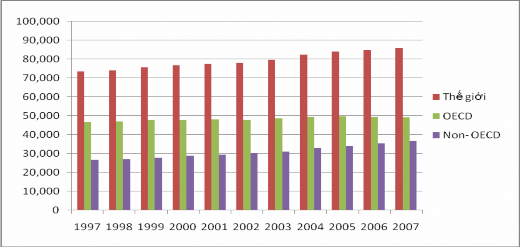
Source: The chart was built by the author based on data compiled from the EIA Energy Information page 9
In the 10 years from 1997-2007, world oil consumption increased by 17% from 73.4 million barrels/day in 1997 to 85.9 million barrels/day in 2007. In particular, oil demand increased sharply in the period 2003-2007, in 2003 the consumption was at nearly 78.1 million barrels/day and in 2007 the consumption was at 85.9 million barrels/day.
9 Website Energy Information Page: http://www.eia.doe.gov/emeu/international/oilconsumption.htm
In 2007, this figure reached 85.6 million barrels/day, an increase of nearly 8% in 4 years. The reason why the demand for oil increased rapidly is because in the process of development in countries, a large amount of oil is required for production and development of industries. Moreover, as life develops, the needs of life are increasingly improved, especially the need for travel and the need for trade between countries, requiring a large amount of oil to develop transportation services. Especially in the US, where the number of people traveling by car is the highest in the world, for every 1 person going to work by bicycle,
5 people walk, 9 people take public transportation, and 154 people go to work by car, which requires a large amount of oil to meet the travel needs of 10. Currently, the United States uses ¼ of the world's oil production, half of which is for travel needs, making the United States increasingly dependent on foreign oil supplies. In the world's oil consumption, the demand for oil in the
Developed countries in the OECD account for a large proportion, on average accounting for more than 61% of the world's oil consumption. In the 10 years from 1997 to 2007, oil consumption in developed countries in the OECD increased by more than 5%, with a consumption of more than 46 million barrels/day in 1997 and by 2007 these countries consumed more than 49 million barrels/day, accounting for more than 57% of the world's consumption. These are developed industrial countries with high incomes and living standards, so the demand for energy, especially oil used in daily life as well as in industry, always accounts for a large proportion of the world. Although accounting for less than 20% of the world's population, industrial countries account for more than 80% of the world's automobiles. With such a large number of automobiles in use, large oil consumption is inevitable. Among them, the United States is the world's leading oil consumer. In 2007, the country consumed 20.7 million barrels of oil per day, accounting for more than 50% of the total consumption of developed countries in the OECD and
10 Website: http://www.dautudung.com/content/view/4018/55/
accounting for more than ¼ of the world's total oil consumption. According to the statistics compiled by the World Energy Information Agency (EIA), the countries that consumed the most oil in 2007 were: the US 20.68 million barrels/day, nearly 3 times higher than the second country, China 7.6 million; followed by Japan 5 million; Russia 2.82 million; India 2.8 million; Germany 2.45 million; Canada 2.36 million barrels/day. 11
Due to industrial development and high living standards, the amount of oil consumed in developed industrial countries is much larger than that in developing and underdeveloped countries. However, the proportion of oil consumption in non-OECD countries has been increasing continuously during the period 1997-2007, in 1997 the amount of oil consumed in these countries accounted for only 36% of the total oil consumption in the world and in 2007 the proportion of oil consumption in these countries reached nearly 43%. Developing Asia has a large demand for oil, producing about 11% of the world's crude oil, but consuming more than 20%. This shortage is getting bigger as the two major economies of the region, India and China, continue to increase their demand for oil. In 2003, 44.7% of the oil consumed in the region had to be imported compared to about 10% in the mid-1980s of the last century. Along with the rapid industrialization and modernization process in our country and the GDP always at a high level, reaching an average growth rate of 7.46% in the period 2001-2008, the demand for oil is also constantly increasing. In the period 2001-2007, Vietnam's oil consumption increased by more than 50%, reaching 178.5 thousand barrels/day in 2001 and 270 thousand barrels/year in 2007. Our country is a crude oil exporter but imports almost 100% of gasoline, so with the increase in demand for oil and the current fluctuating oil prices, it will greatly affect the domestic economy and the national budget. Therefore, it is necessary to have measures to reduce the impact of world oil prices on Vietnam's economy in the coming period.
11 Energy Information Administration EIA http://tonto.eia.doe.gov/country/index.cfm
2. Supply
2.1. Organization of the Petroleum Exporting Countries (OPEC)
2.1.1. Origin of OPEC
In the late 1950s, oil exploitation in the world was undertaken by large companies, oil prices and production output controlled by each company led to a situation where oil prices continuously fell due to companies competing to sell at dumping prices. Faced with this situation, oil exporting countries in the world realized the need for a common organization to manage and unify oil prices and production output in the world, protecting the interests of each country. They sat down at the same table and on September 14, 1960, OPEC was born. The Organization of the Petroleum Exporting Countries in English is abbreviated as OPEC - Organization of the Petroleum Exporting Countries . OPEC is a multi-governmental organization established by Iran, Iraq, Kuwait, Saudi Arabia and Venezuela at a conference in Bagdad (from September 10 to September 14, 1960). Qatar (1961), Indonesia (1962), Libya (1962), the United Arab Emirates (1967), Algeria (1969), and Nigeria (1971) joined the organization later. Among the member countries, two countries joined later, but later withdrew from OPEC: Ecuador (joined in 1973, withdrew in 1992), Gabon (joined in 1975, withdrew in 1995). During the first five years, OPEC's headquarters were in Geneva, Switzerland, then moved to Vienna, Austria from September 1995.
1965. 12
OPEC member countries exploit about 40% of the world's total oil production and hold about 3/4 of the world's oil reserves. 13 The development of each OPEC member is also uneven, the Gulf countries such as Kuwait, Qatar, Saudi Arabia, and the United Arab Emirates have higher reserves and production, creating prosperity for the country.
12 Website: http://nguoivienxu.vietnamnet.vn/vandecuachungta/2005/09/489309/, searched on February 4, 2009
13 Website: http://vietbao.vn/The-gioi/OPEC-trum-dau-mo-the-gioi/45152052/162
and always knows how to use oil prices as an important political tool to control the world, especially Western countries. Every move of OPEC can have a great influence on world oil prices over the years, especially in the fluctuations of oil prices in recent years.
OPEC has the ability to adjust the oil production quotas of its member countries and thereby control oil prices . 14. The OPEC Energy and Petroleum Ministers' Conference is held twice a year to assess the oil market and propose appropriate measures to ensure oil supply. Ministers of member countries take turns as the organization's president on a rotational basis for a term of two years.
2.1.2. OPEC's role in the world oil market
Given the importance of oil, one of the biggest concerns for oil-consuming countries is the security of oil supplies from the major oil-producing countries (OPEC). Under the right conditions, these countries can meet the growing demand for oil in the world. Currently, OPEC countries can meet 40% of the world's demand and can also expand production to meet future demand growth. Although oil wells can be found in many parts of the world, a large portion is concentrated in the Middle East. According to BP, in 2005, world oil reserves were approximately 1,200 billion barrels. In the same year, OPEC oil reserves were estimated at 743 billion barrels.
or 62% of the world's total reserves. This region also enjoys the lowest production costs in the world, in Iraq only about 1-2 dollars/barrel. 15 Since its inception, OPEC has always played a huge role in providing a large amount of oil to the world and therefore this organization has a significant influence on price fluctuations in the world oil market.
14 Compiled from websites www.vietnamnet.vn and www.vi.wikipediaa.org , searched on February 4, 2009
15 Website: http://www.saga.vn/Publics/PrintView.aspx?id=11906, searched on February 4, 2009