
Tourists, (2) Service quality, (3) Investment, (4) Human resources and (5) Potential. The three dimensions considered are: (1) the current status of the factor groups, (2) changes in the factor groups and (3) the future of the factor groups in harmony with the goals. The subjects using tourism services are tourists (domestic and foreign) as well as the businessmen (enterprises) themselves.
The tourism pillar contributes greatly to THDP in terms of providing practical experiences and knowledge, which, if positive, will lead to actions such as returning tourists, settling down, shopping, trading, doing business, organizing local events, etc.
d. People
Any locality is owned by local people and developed by/for local people. The pursuit of local people's happiness is indirectly realized through the representative of the local government, aiming to continuously improve the quality of life and living in the locality while helping to grow the economy, create income and jobs for local workers.
The human factor in local branding is considered based on the assessment of 3 groups of factors: life, human resources and employment. The Life index considers criteria on income equality, quality of life, education and training, health care and entertainment services. The human resources index includes criteria on quantity, quality and suitability of human resources to market requirements. The employment index considers criteria on the effectiveness of human resources policies in attracting people to work for local authorities or businesses.
Maybe you are interested!
-

 Building a Research Model of Factors Affecting Agribank's Brand Value
 -
 VNPT brand building strategy in the process of international economic integration - 10
 -
 Brand Building & Development Capability
 -
 Factors affecting the building of Vinh Long Tourism brand - 13
 -
 Building Brand Identity System and Other Activities
e. Infrastructure
The infrastructure factor affecting the local brand is based on the consideration of four groups of factors on infrastructure services, electricity and water, IT and transportation. These groups of factors serve the local economic development and are consistent with the THDP identities prescribed in connection with the implementation of plans in many fields.
Infrastructure is to serve people in production and life, therefore, assessing the suitability of infrastructure to the current and future needs of the locality is the basic criterion in considering the capacity of infrastructure to serve the development and construction of the THDP. The group of infrastructure factors is considered in 3 aspects: first is the current status of meeting the needs of businesses and people, second is the development process of investment to meet this need and finally the conditions for infrastructure to better meet future needs.
f. Culture
Cultural factors affecting local brands are studied on five groups of factors and three aspects. Five groups of factors: first is symbol
local in the perception of the target audience, second is the local heritage
The three aspects considered are (1) the current status of the factor groups, (2) the expectations of the factors, and (3) the suitability between the factor groups and within each factor group with the needs of THDP development.
g. Local characteristics
Each locality itself on the global map has a specific geographical location with certain latitude and longitude coordinates with each of its climatic sub-regions, and at the same time it can be similar or different from the characteristics of other localities at other coordinates on the global map. Almost no locality is exactly the same as another locality in terms of local characteristics.
Consider how local factors interact with THDP through moving factors such as people, tourists,
capital, goods, thesis considers 5 groups of problems
about: position
strategic geography, finance
natural resources, weather, specialty products and local destinations.
h. Institutions
Institution is a broad and multi-faceted concept. This thesis examines institutional factors affecting local brands in specific content aspects:
(1) local government, local businesses and local people
(2) how the local community accepts the way and values of communication and work, (3) the implementation of administrative reform at the local level, and (4) the attitude of local civil servants. There are issues that the locality itself wants to reform, such as salaries to improve the attitude of civil servants, but these are issues of central regulation and the locality cannot intervene.
Most institutional issues lie in central regulations, which can only be applied by localities. Policies are based on laws established by the central government, but when put into practice, there are many inappropriate factors, which largely hinders local development. The creation of local institutions with a business production environment depends more on the head of that locality.
1.2. Building local brands
Organizing a local branding program requires
understand the market
target school to pay
Answers to 3 questions: (1) Where is the market?
What are the main target markets for communicating and promoting the attractiveness of local brands?, (2) How to market local brands to communities and regions? and (3) Who is the unit promoting and communicating local brands? Answer these questions to create models and methods for implementing local branding.
The four main target groups for local branding strategies include: (1) building THDPs for enterprises developing production, business and trade to create high productivity at low cost, (2) building THDPs associated with
with outstanding and distinctive products to promote the locality through products
products that can be traded to other localities or exported to the world, (3) building a THDP to attract tourists to travel, to work, to organize seminars and surveys, and (4) building a THDP to attract residents to settle down and workers to work.
1.2.1. Local brand development models
Vuignier (2016) has summarized the contents related to local branding to see the diversity of strategies and plans that localities implement, from the definition of local branding in a narrow to a broad sense and from specific activities to strategic factors.
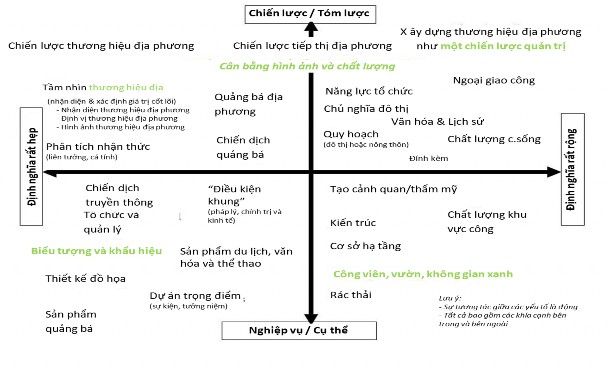
Figure 1.2: Diversity of local branding
(Source: Vuignier, 2016)
The first model in the broadest sense is to promote a common local image associated with a group of attractive and appealing values. Localities will choose a common logo (Symbol), design a unified image identification system in terms of image size and standards for using the symbol, and plan to synchronously deploy the image on local fronts. This image identification system is like a coat to reflect the values that the locality wants to introduce synchronously and consistently. On the other hand, some localities choose a key economic sector with outstanding strengths and characteristics to promote trade and investment in this sector nationwide and internationally. Consuming local products is a way to experience and feel about the locality, thereby encouraging tourism and investment in the locality.
In this thesis, using Philip Kotler's approach, it is argued that the content of a local brand strategy must include: Content 1: Developing public services to serve society and the community; Content 2: Planning and implementing urban planning; Content 3: Economic development and growth; Content 4: Strategic market planning including building local brands for products (goods and services) in target markets. To implement the local brand development model, Philip Kotler argues that it is necessary to ensure general principles, of which 4 principles are described as: Principle 1: Building a strong and attractive local image and position; Principle 2: Implementing promotional programs to potential or target customers for products of local origin (made in ...); Principle 3: Distribute local products and services in an accessible manner to users and Principle 4: Ensure that relevant subjects are fully aware of the advantages and strengths of the locality. At the same time, to implement this, it is necessary to ensure 4 conditions for local branding: (1) Provide public services with the best infrastructure for residents, tourists and businesses; (2) Build a THDP to attract investment and immigration; (3) Have a vivid image and good communication strategy; and (4) Gain support from all subjects and components in society for the common goal with the motto that each citizen is a local brand ambassador.
Philip Kotler also believes that there are 4 local brand marketing strategies:
(1) Local image marketing:
- Local images are so attractive and appealing
- Positive local image
- Blurry local image
- Images that contrast with local characteristics
- Negative image associated with the locality
(2) Strategic geographic location marketing:
Implement marketing activities associated with destinations: Shopping places; beautiful and attractive natural landscapes; entertainment venues; events and festivals, historical/famous figures; cultural destinations; sports activities; architectural works, memorials and sculptures; museums,...
(3) Marketing local infrastructure
- Assessing basic construction investment needs
- Efficient infrastructure management
- Intergovernmental planning
- Focus on environmental requirements
- Synchronize regional development needs with infrastructure development
- Education reform programs
- Social security improvement programs
- Planning of houses, streets and traffic, electricity and water supply, hotels, restaurants and social conventions, services for tourists
(4) Marketing local human resources
- Dedicated local leaders
- Local celebrities
- Local talents
- Typical entrepreneurial spirit
- Attract people to live and work locally
1.2.2. Stages of local branding
Philip Kotler believes that there are 5 stages in building a local brand. Stage 1 is to re-evaluate the representative image of the local production and business: attractive factors, identifying competitors, trends and development directions, strengths and weaknesses, opportunities and threats, key issues to be solved.
decision. Phase 2 is to survey the business community and residents about what the image of production and business will be in the future, and what the vision and goals of the locality will be in 102050 years. Phase 3 is what strategies the government and people need to plan and implement to achieve the set goals. Phase 4, what specific actions the government needs to take to implement the above strategies: who is responsible, how to implement, how much budget and time will be spent
expected completion date? And finally, Phase 5 is community control.
government to ensure successful implementation.
In the process of building a THDP, attention must be paid to 5 management aspects:
First, the factors that determine local brand image:
- Image
THDP image is a synthesis of beliefs, ideas and
impressive
people have been in a place for a long time
- Different people can have quite different brand images of the same THDP.
- Strategic brand image management is a continuous process of researching the perceptions of different audience groups about the THDP, segmenting and targeting specific audiences, positioning local attractions to communicate these attractions to the target group thereby enhancing the perception of the local image.
- Because the THDP image is recognizable and changes over time, it can have different impacts on different target groups.
Second, how to measure the strength of local brand image:
- Select audience: residents, tourists, administrators, investors,
Entrepreneurial innovators, investors, local research experts
foreign, the
- Highlight the differences between segments with different images based on: demographics, needs, benefits sought, geography, social class, family life cycle, lifestyle, time of purchase, usage speed, personality, etc.
- Measuring audience awareness: Measuring familiarity, measuring semantics, mapping geographic evaluation
favorite, measure
- 6 characteristics of useful image segments: mutually exclusive, comprehensive, measurable, accessible, large enough to be worth pursuing, respond differently to the same branding strategy.
- Semantic discrimination to measure brand image: build a suitable evaluation system, shorten the appropriate evaluation criteria system, deploy research investigation for the surveyed people, synthesize and use statistics to evaluate perception to compare actual perception with desired image.
Third, local brand image design method:
For a place brand image to be effective it must meet the following five criteria: (1) The brand image must be valuable and realistic, (2) The brand image must be trustworthy, (3) The brand image must be simple, (4) The brand image must be appealing (clearly stating why it is appealing), and (5) The brand image must be distinctive.
Fourth, how to coordinate and use tools and means to convey local brand images:
Local Symbols: (1) Diverse visual strategies, (2) Consistent visual strategies, (3) Humorous images, (4) Images that negate negative aspects
- Slogan, theme and local brand image positioning
- Important major events
- Brand touchpoints and brand identity
brand identities
Fifth, risk management system for negative associations with local brand image:
There are many risk management and risk handling methods for place branding in limiting, eliminating negative associations by destroying an image, creating a positive image from a negative image, marketing symbols and eliminating negative images.
1.2.3. Local branding capacity
Competence does not come naturally, it depends on the resources it is formed from. In terms of the origin of competitive advantage, there are 3 basic theoretical lines.