
Figure 2.5. Students participate in learning about the dragon bed at Nghi Mon Ngoai - National treasure at the Temple of King Dinh Tien Hoang
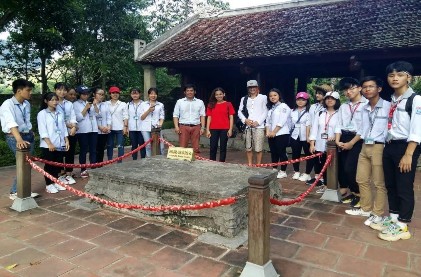
- With the control lesson, students are very shy, do not dare or are afraid to express their own opinions because the lesson takes place normally in the classroom with the main teaching method being the teacher asking questions - students answering. makes students not show enthusiasm for the lesson content.
In the experimental lesson, project teaching is used to organize a study tour to the Hoa Lu ancient capital cultural heritage, with the main content being groups of students performing learning tasks and reporting on the above learning products. class. In particular, the group's tasks always have specific tasks assigned to each member in the spirit that the group's learning outcome is the effort to complete and promote the strengths of each group member. Under the organization and encouragement of teachers, students actively discuss and exchange with other group members in a spirit of cooperation and respect for their personal opinions. At the same time, students also boldly comment and evaluate friends from other groups in the class. Thereby, students in the experimental class clearly demonstrated their self-discipline, communication and cooperation abilities, and problem-solving abilities when performing their learning tasks.
Figure 2.6. Students actively participate in group activities in the practice session "Plating heritage paintings in groups"
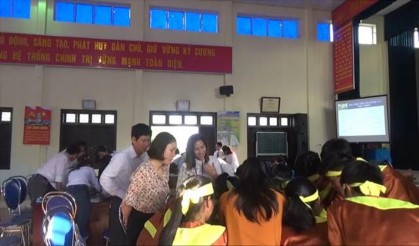
- On the part of the teacher directly teaching the feeling: With the way of organizing the lesson like in the experimental class during the teaching process combined with observing the teacher realizing that students are interested, the teacher has stimulated the cognitive and thinking abilities of the students. children. Students enthusiastically participated in activities organized by teachers and performed very well. This is different from the control class, where the students are still very passive. In addition, in the experimental lesson, with increased testing and assessment through many active methods such as observation, organizing for students to self-evaluate and evaluate each other, it contributes to promoting students' learning activities. more prominent and effective, contributing to a more comprehensive assessment of students' learning efforts.
For students, we have a few questions to probe students' attitudes and interests with questions such as : How do you feel after studying the above lesson? What do you think about this lesson?
Through summarizing the results, the majority of students in the experimental class said that they really liked the lesson that the teachers organized in the direction of using cultural heritage, the reason they gave was the form and method. This teaching makes the classroom atmosphere very exciting, students can express their talents and creativity, they feel they understand the lesson, absorb knowledge quickly and remember it longer.
2.4.4.2. Quantitatively
After grading the test according to the prescribed scale, classifying students through levels (Excellent, Good, Average, Weak), we analyzed and saw the difference in results between the experimental and control classes. Specifically as follows:
Table 2.9. Statistics of test scores for the experimental class and the control class
Group
Class | Number of students | Result | ||||||||
Good (9 – 10 point) | Rather (7 – 8 points) | Average (5 – 6 points) | Weak (< 5 points) | |||||||
Number HS | % | Number HS | % | Number HS | % | Number HS | % | |||
Experiment | 10A8 | 40 | 12 | 30 | 15 | 37.5 | 13 | 32.5 | 0 | 0 |
Control | 10A7 | 38 | 5 | 13.2 | 6 | 15.8 | 24 | 63.1 | 3 | 7.9 |
Maybe you are interested!
-

 Applying Project-Based Learning to Organize Study Tours to the Hoa Lu Ancient Capital Cultural Heritage
 -
 Using the cultural heritage of Hoa Lu Ancient Capital in teaching local history in grade 10 high school in Ninh Binh province - 2
 -
 Sports Practice Motivation of Students at Thanh Hoa University of Culture, Sports and Tourism (N = 485)
 -
 Deviant Behavior of PCT Group in High School Students (%, N=448)
 -
 Exploring Factors Affecting SMEs' Access to Credit Capital
Chart 2.1. Compare experimental results
Statistics of test scores for experimental and control classes
25
20
15
10
5
0
Good
Weak
Quite Central
jar
10A8 - TN 10A7 - DC
Weak Average Fairly Good
The data table above shows:
- In experimental class (10A8): results are higher than control class; The rate of students achieving excellent and quite high scores - 12 students, equivalent to 30%; Students achieved good scores: 15 students, equivalent to 37.5%; Students achieving an average of 13 students, equivalent to 32.5%.
- In the control class (10A7): 5 students scored excellent, equivalent to 13.2%; Good score is 6 students, equivalent to 15.8%; The average score is 24 students, equivalent to 63.1%; The weak point is 3 students, equivalent to 7.9%.
From the above results, it shows that the quality of learning in the experimental class is higher than the control class (the ratio of good and good students is higher than the control class, there are no weak students).
To ensure reliability, we used a mathematical formula to calculate the average score, variance, and standard deviation of the experimental class and the control class. The results were as follows:
* Experimental class 10A8: number 40
Test score: includes 3 points out of 10; 9 points 9. Total 12 students with good scores. 28 studies
Students with good and average scores include: 7 points 8; 8 point 7; 6 point 6; 7 point 5.
- Average Score: == 7.35
- Phuong Sai:
∫=
2,4775
- Standard deviation:= √ ≈ 1.5740
* Control class 10A7: number 38
Test score: includes 1 point out of 10; 4 points out of 9. There are a total of 5 students with good scores. There are 30
Students with good and average scores include: ; 2 points 8; 4 point 7; 9 point 6; 15 points 5.
There were 3 students with weak scores including: 2 scores of 3; 1 point 4.
- Average Score: == 6.03
- Phuong Sai:
∫
= 2.6572
- Standard deviation:= √ ≈ 1,630
Standard deviation is the difference of the score from the average score of the entire test. The above results show that the smaller the standard deviation, the less scattered the scores and the more reliable the results.
* General comments:
Through experimental results, we found that the learning outcomes in the experimental class were higher than the control class when implementing some of the proposed pedagogical measures.
+ In the control class, students are organized to study and research in the traditional way, mainly using the method of questioning the teacher and asking students to answer. We found the class atmosphere boring, most students only attentively took notes following the teacher, only a few students enthusiastically expressed their opinions.
+ In the experimental class, students are organized to study and research lessons in a number of ways
Method: Exchange, discuss, cooperate and work in groups, etc. after taking a study tour at the heritage site. We find that students promote positivity, initiative, and enthusiasm in learning. Students interact smoothly with teachers and boldly debate and express opinions to build lessons. Regarding the initial cognitive results, through the test scores of the two classes, we found that the test results of the experimental class were much higher than the control class (the average score was 7.35, higher than the control class's score of 6. 03).
Through experimental results, we can initially confirm the feasibility of the forms and measures proposed by the project. If applied, it will not only foster knowledge, promote positivity and initiative in learning, but also orient students' learning attitudes. Thereby contributing to the development of general abilities: self-study, problem solving, communication, cooperation; Subject capacity: learning history, historical awareness, applying knowledge and educating moral qualities of pride, love of homeland and country for students.
Conclusion of chapter 2
In summary, based on the position, objectives, and basic content of local LS in the 10th grade high school program, based on the practice of teaching local LS in Ninh Binh province, we realize that in order to promote the effectiveness of using Using cultural heritage of the ancient capital of Hoa Lu in teaching local history, teachers need to apply the forms and measures of using cultural heritage given in teaching in the most effective way. These are forms of intracurricular activities such as: history lessons in class, lessons at heritage sites, project teaching and study tours at heritage sites. In addition, depending on the conditions of the school and locality, teachers can flexibly choose extracurricular forms such as: visiting heritage experiences, historical evenings, organizing the collection of documents on cultural heritage and cultural heritage. organize participation in festivals... In order for teaching activities to be effective, teachers also need to focus on testing and evaluating students' local historical learning results through Hoa Lu Cultural Heritage. That is diversifying and innovating inspection and assessment in the direction of promoting regular and periodic forms of assessment, assessment through predetermined scales and strengthening self-assessment and mutual assessment activities. in HS. The proposed measures and the results of the pedagogical experiment have initially demonstrated the feasibility of the project.
Thus, using cultural heritage in teaching local history in particular and national history in general is a long and complex process, including many different factors. Each element has a different important role and position in achieving the common goal of education. In particular, innovating teaching forms and methods in using cultural heritage is considered a key step in teaching local heritage. Using Hoa Lu Cultural Heritage in particular and other cultural heritage in general in teaching local heritage is one of the ways that need to be organized to teach students, especially high school students in Ninh Binh province.
CONCLUSION AND RECOMMENDATIONS
1. Conclusion
Today, the process of globalization and international integration is placing new requirements on education. That is to innovate education in the direction of comprehensively developing students' awareness, skills, and attitudes to contribute to developing students' abilities and fostering qualities to train human resources for the future. of the country. This goal poses a new challenge for the education sector in general, and for the history subject in particular, including local history.
Local historical knowledge has its own characteristics, so when organizing learning activities for students, teachers are required to skillfully coordinate teaching forms and measures, on that basis to form, Expand knowledge of local history and national history, foster love and pride in your locality, and appreciate the good traditional values of your homeland. The use of cultural heritage in teaching local history contributes to raising children's awareness and responsibility in promoting the good traditions of their homeland, inheriting the career of their ancestors in the cause of construction. and protect the country.
In fact, the work of teaching local history in high schools in Ninh Binh province still faces many difficulties due to objective and subjective reasons, but the most important is limited awareness and lack of importance. Local educational content in teaching history. Therefore, students' awareness of local history as well as homeland historical and cultural traditions is still limited. Based on the theoretical basis of using cultural heritage in teaching local history, in the spirit of innovation in the general education program along with innovation in teaching and assessment methods, we have Propose pedagogical forms and measures to initially solve the difficulties posed by the practical basis in high schools in Ninh Binh province. These measures have initially been tested and have proven their feasibility and effectiveness during the implementation process. That is shown in students participating enthusiastically, showing their interest through exploiting and using resources.
data on local cultural heritage; The children's cognitive results have also been proven through the pedagogical experiment process.
The content that the thesis mentions is not only effective for teaching local history in particular, and history in general in the current general education curriculum, but can also be applied in accordance with the curriculum. general education in 2018 at high schools in Ninh Binh province.
With the enthusiasm and passion for the profession of history teachers and the spirit of inquisitiveness, creativity, and interest in learning cultural heritage of students, we believe that the use of cultural heritage Culturalizing the ancient capital of Hoa Lu in teaching will contribute to improving the quality of teaching and learning of local history subjects in particular, and History subjects of high schools in Ninh Binh province in general.
2. Recommendations
From the above conclusions, to contribute to the effective use of cultural heritage in general and the cultural heritage of Hoa Lu ancient capital in teaching local history as well as improving the effectiveness of history teaching, we propose Some recommendations are as follows:
2.1. For management level
Educational management levels and school boards of high schools need to create conditions for facilities, motivate and encourage, as well as have plans to train professional teachers in innovating forms and methods. teaching and assessment. In addition, it is necessary to be responsible in building and changing the content of teaching local history accordingly, and guiding the flexible use of local cultural heritage in teaching history to contribute to meeting the needs of local people. spirit of reforming general education programs in the near future. On the other hand, school administrators need to coordinate closely with families and society to create opportunities for diverse forms of historical learning in the use of local and ethnic cultural heritage.
2.2. For teachers
To well perform the task of educating students on local historical and cultural traditions, teachers need to regularly innovate teaching methods towards