
Bac Giang focuses on mobilizing resources from the central budget, enterprises, communities, the participation of the whole political system, especially the role of mass organizations and the people actively participating in contributing to the construction of the new rural area. Thanks to that, resource mobilization has achieved high results; the system of policies and mechanisms has been issued synchronously, creating favorable conditions for local implementation, especially the province's cement support mechanism is suitable to the aspirations of the people, so it has mobilized great internal strength among the people.
To mobilize and use resources in building new rural areas, the experience of the Bac Giang Provincial Party Committee is:
First, correctly assess the role of each resource to mobilize and use it effectively.
This is both a science and an art of Party committees, Party organizations and cadres and Party members. According to the Project on New Rural Construction for the period 2010 - 2020 of the People's Committee of Bac Giang province, the state budget capital is 10,400 billion VND (accounting for 40%) of the total capital for implementing the National Target Program on New Rural Construction, credit capital is 7,800 billion VND (accounting for 30%), capital from enterprises, cooperatives, other economic types is 5,200 billion VND (accounting for 20%) and mobilized people's contributions is 2,600 billion VND (accounting for 10%) [106, p. 15]. Determining the proportion of capital sources as above shows that the role of state budget capital in building new rural areas is very important, demonstrating the attention of the Party and State in rural development. The role of credit capital in investing in the construction of rural socio-economic infrastructure works and local production development projects is also focused on with the investment capital ratio determined at 30%. Regarding resource mobilization from enterprises, cooperatives, and other economic forms to encourage enterprises to invest in the agricultural and rural sectors, it is 20%. The regulation on the mobilization rate of contributions from the community is low because people in rural areas
Maybe you are interested!
-

 Strengthening Internal Control and Inspection Activities of NHTM
 -
 Strengthening Inspection and Control of District's State Budget Management
 -
 Car body electrical practice - 8
zt2i3t4l5ee
zt2a3gs
zt2a3ge
zc2o3n4t5e6n7ts
If the voltage is out of specification, replace the wire or connector.
If the voltage is within specification, install the front fog light relay and follow step 5.
Step 5 Check the front fog light switch
- Remove the D4 connector of the fog light switch
- Use a multimeter to measure the resistance of the front fog light switch.
Measurement location
Condition
Standard
D4-3 (BFG) -D4-4 (LFG)
Light switchFront Fog OFF
>10kΩ
D4-3 (BFG) -D4-4 (LFG)
Front fog light switchON
<1 Ω
- Standard resistor
D4 connector is located on the combination switch assembly.
If the resistance is out of specification, replace the combination switch (the fog light switch is located in the combination switch).
If the resistance is within specification, follow step 6.
Step 6 Check wiring and connectors (front fog light relay-light selector switch)
- Disconnect connector D4 of the combination switch assembly
- Use a voltmeter to measure the voltage value of jack D4 on the wire side.
Measurement location
Control modecontrol
Standard
D4-3 (BFG) - (-) AQ
TAIL
11 to 14 V
D4 connector for the wiring of the combination switch assembly
If the voltage does not meet the standard, replace the wire or connector.
If the voltage is within standard, there may have been an error in the previous measurements.
Step 7 Check the front fog lights
- Remove the front fog light electrical connector.
- Supply battery voltage to the fog lamp terminals
Jack 8, B9 of front fog lamp on the electrical side
blind first.
Power supply location
Terms and Conditions
Battery positive terminal - Terminal 2Battery negative terminal - Terminal 1
Fog lightsbefore morning
- If the light does not come on, replace the bulb.
If the light is on, re-plug the jack and continue to step 8.
Step 8 Check wiring and connectors (relay and front fog lights)
- Disconnect the B8 and B9 connectors of the front fog lights.
- Use a voltmeter to measure voltage at the following locations:
Measurement location
Switch location
Terms and Conditions
B8-2 - (-) AQ
Electric lock ON TAIL size switchFog switch ON
11 to 14 V
B9-2 - (-) AQ
Electric lock ONTAIL size switch Fog switch ON
11 to 14 V
B8 and B9 connectors on the front fog lamp wiring side
Voltage is not up to standard, repair or replace the jack. If up to standard, there may have been an error in the measurement process.
2.2.4. Procedure for removing, installing and adjusting fog lights 1. Procedure for removing
- Remove the front inner ear pads
Use a screwdriver to remove the 3 screws and remove the front part of the front inner ear liner
-Remove the fog light assembly
+ Disconnect the connector.
+ Use a screwdriver to remove 3 screws to remove the fog light cover
2. Installation sequence
-Rotate the fog lamp bulb in the direction indicated by the arrow as shown in the figure and remove the fog lamp from the fog lamp assembly.
-Rotate the fog light bulb in the direction indicated by the arrow as shown in the figure and install the light into the fog light assembly.
- Use a screwdriver to install the fog light cover
-Install the electrical connector
Attention: Be careful not to damage the plastic thread on the lamp assembly.
- Install the front inner ear pads
Use a screwdriver to install the front inner bumper with 3 screws.
3. Prepare the vehicle to adjust the fog light convergence. Prepare the vehicle:
- Make sure there is no damage or deformation to the vehicle body around the fog lights.
- Add fuel to the fuel tank
- Add oil to standard level.
- Add engine coolant to standard level.
- Inflate the tire to standard pressure.
- Place spare tire, tools and jack in original design position
- Do not leave any load in the luggage compartment.
- Let a person weighing about 75 kg sit in the driver's seat.
4. Prepare to check the fog light convergence
a/ Prepare the vehicle status as follows:
- Place the car in a dark enough place to see the lines. The lines are the dividing line, below which the light from the fog lights can be seen but above which it cannot.
- Place the car perpendicular to the wall.
- Keep a distance of 7.62 m between the center of the fog lamp and the wall.
- Park the car on level ground.
- Press the car down a few times to stabilize the suspension.
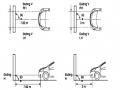
Note: A distance of approximately 7.62 m is required between the vehicle (fog lamp center) and the wall to adjust the convergence correctly. If the distance of 7.62 m cannot be achieved, set the correct distance of 3 m to check and adjust the fog lamp convergence. (Since the target area varies with the distance, please follow the instructions as shown in the figure.)
b/ Prepare a piece of thick white paper about 2 m high and 4 m wide to use as a screen.
c/ Draw a vertical line through the center of the screen (line V).
d/ Set the screen as shown in the picture. Note:
- Keep the screen perpendicular to the ground.
- Align the V line on the screen with the center of the vehicle.
e/Draw the reference lines (H, V LH and V RH lines) on the screen as shown in the figure.HINT:
Mark the center of the fog lamp on the screen. If the center mark cannot be seen on the fog lamp, use the center of the fog lamp or the manufacturer's name mark on the fog lamp as the center mark.
H line (fog light height):
Draw a line across the screen so that it passes through the center mark. Line H should be at the same height as the center mark of the fog light bulb.
Line V LH, V RH (center mark position of left fog lamp LH and right fog lamp RH):
Draw two lines so that they intersect line H at the center marks.
5. Check the fog light convergence
a/ Cover the fog lamp or remove the connector of the other side fog lamp to prevent light from the unchecked fog lamp from affecting the fog lamp convergence test.
b/ Start the engine.
c/ Turn on the fog lights and make sure that the dividing line is outside the standard area as shown in the drawing.
6. Adjust the fog light convergence
Use a screwdriver to adjust the fog light to the standard area by turning the toe adjustment screw.
Note: If the screw is adjusted too far, loosen it and then tighten it again, so that the last rotation of the light adjustment screw is clockwise.
3. Self-study questions
1. Describe the operating principle of the lighting system with automatic headlight function
2. Describe the operating principle of the lighting system with the function of rotating headlights when turning
3. Draw diagram and connect lighting system on Hyundai Porter car
4. Draw diagram and connect lighting system on Honda Accord 1992
5. Draw the lighting circuit on a 1993 Toyota Lexus
LESSON 3 MAINTENANCE AND REPAIR OF SIGNAL SYSTEM
I. IMPLEMENTATION GOAL
After completing this lesson, students will be able to:
- Distinguish between types of signals on cars
- Correctly describe common symptoms and suspected areas causing damage.
- Connecting signal circuits ensures technical requirements
- Disassemble, install, check, maintain and repair the signal system to ensure technical requirements.
- Ensure safety in work and industrial hygiene
II. LESSON CONTENT
1. General description
The signal system equipped on cars aims to create signals to notify other vehicles participating in traffic about the vehicle's operating status such as: stopping, parking, braking, reversing, turning...
Signals are used either by light such as headlamps, brake lights, turn signals….. or by sound such as horns, reverse music….
Just like the lighting system. A signal system circuit usually consists of: battery, fuse, wire, relay, electrical load and control switch. Only some switches of the signal system are on the combination switch. The switches of other signals are usually located in different locations such as in the gearbox or brake pedal……
2. Maintenance and repair
2.1. Turn signals and hazard lights
The installation location of the turn signal is shown in Figure 3.1. The turn signal control switch is located in the combination switch under the steering wheel. Turning this switch to the right or left will make the turn signal turn right or left.
The hazard light switch is used when the vehicle has a problem while participating in traffic. When the hazard light switch is turned on, all the turn signals on the vehicle will light up at a certain frequency. The hazard light switch is usually placed separately from the turn signal switch (some old cars integrate the hazard and turn signal switches on the same combination switch cluster).
Figure 3.1 Turn signal switch Figure 3.2 Hazard switch
The part that generates the flashing frequency for the lights is called a turn signal relay. The turn signal relay usually has 3 terminals: B (positive power supply); E (negative power supply); L (providing the turn signal switch to distribute to the
lamp)
2.1.1. Circuit diagram
To generate the frequency for the turn signal, a turn signal relay is used in the turn signal circuit. The current from the turn signal relay will be sent to the turn signal switch assembly to distribute the current to the turn signal lights for the driver's purpose.
Figure 3.3. Schematic diagram of a turn signal circuit without a hazard switch
1. Battery; 2. Electric lock; 3. Turn signal relay; 4. Turn signal switch; 5. Turn signal lamp; 6. Turn signal lamp; 7. Hazard switch
Figure 3.4 Schematic diagram of turn signal circuit with hazard switch
1. Battery; 2. Combination switch cluster; 3. Turn signal;
4. Turn signal light; 5. Turn signal relay
Today's cars no longer use three-pin turn signal relays (B, L, E) but use eight-pin turn signal relays (figure 3.5) (pin number 8 is used for hazard lights).
For this type, the current supplying the turn signal lights is supplied directly from the turn signal relay to the lights.
div.maincontent .p { color: black; font-family:"Times New Roman", serif; font-style: normal; font-weight: normal; text-decoration: none; font-size: 14pt; margin:0pt; } div.maincontent p { color: black; font-family:"Times New Roman", serif; font-style: normal; font-weight: normal; text-decoration: none; font-size: 14pt; margin:0pt; } div.maincontent .s1 { color: black; font-family:"Times New Roman", serif; font-style: normal; font-weight: normal; text-decoration: none; font-size: 13pt; } div.maincontent .s2 { color: black; font-family:"Times New Roman", serif; font-style: italic; font-weight: normal; text-decoration: none; font-size: 14pt; } div.maincontent .s3 { color: black; font-family:"Times New Roman", serif; font-style: normal; font-weight: normal; text-decoration: none; font-size: 14pt; } div.maincontent .s4 { color: black; font-family:"Times New Roman", serif; font-style: normal; font-weight: normal; text-decoration: none; font-size: 13pt; } div.maincontent .s5 { color: black; font-family:"Times New Roman", serif; font-style: normal; font-weight: normal; text-decoration: none; font-size: 13pt; vertical-align: 1pt; } div.maincontent .s6 { color: black; font-family:"Times New Roman", serif; font-style: normal; font-weight: normal; text-decoration: none; font-size: 11pt; } div.maincontent .s7 { color: black; font-family:"Times New Roman", serif; font-style: normal; font-weight: normal; text-decoration: none; font-size: 14pt; vertical-align: -9pt; } div.maincontent .s8 { color: black; font-family:"Times New Roman", serif; font-style: normal; font-weight: normal; text-decoration: none; font-size: 11pt; } div.maincontent .s9 { color: #008000; font-family:"Times New Roman", serif; font-style: normal; font-weight: normal; text-decoration: none; font-size: 14pt; } div.maincontent .s10 { color: black; font-family:"Times New Roman", serif; font-style: italic; font-weight: normal; te
Car body electrical practice - 8
zt2i3t4l5ee
zt2a3gs
zt2a3ge
zc2o3n4t5e6n7ts
If the voltage is out of specification, replace the wire or connector.
If the voltage is within specification, install the front fog light relay and follow step 5.
Step 5 Check the front fog light switch
- Remove the D4 connector of the fog light switch
- Use a multimeter to measure the resistance of the front fog light switch.
Measurement location
Condition
Standard
D4-3 (BFG) -D4-4 (LFG)
Light switchFront Fog OFF
>10kΩ
D4-3 (BFG) -D4-4 (LFG)
Front fog light switchON
<1 Ω
- Standard resistor
D4 connector is located on the combination switch assembly.
If the resistance is out of specification, replace the combination switch (the fog light switch is located in the combination switch).
If the resistance is within specification, follow step 6.
Step 6 Check wiring and connectors (front fog light relay-light selector switch)
- Disconnect connector D4 of the combination switch assembly
- Use a voltmeter to measure the voltage value of jack D4 on the wire side.
Measurement location
Control modecontrol
Standard
D4-3 (BFG) - (-) AQ
TAIL
11 to 14 V
D4 connector for the wiring of the combination switch assembly
If the voltage does not meet the standard, replace the wire or connector.
If the voltage is within standard, there may have been an error in the previous measurements.
Step 7 Check the front fog lights
- Remove the front fog light electrical connector.
- Supply battery voltage to the fog lamp terminals
Jack 8, B9 of front fog lamp on the electrical side
blind first.
Power supply location
Terms and Conditions
Battery positive terminal - Terminal 2Battery negative terminal - Terminal 1
Fog lightsbefore morning
- If the light does not come on, replace the bulb.
If the light is on, re-plug the jack and continue to step 8.
Step 8 Check wiring and connectors (relay and front fog lights)
- Disconnect the B8 and B9 connectors of the front fog lights.
- Use a voltmeter to measure voltage at the following locations:
Measurement location
Switch location
Terms and Conditions
B8-2 - (-) AQ
Electric lock ON TAIL size switchFog switch ON
11 to 14 V
B9-2 - (-) AQ
Electric lock ONTAIL size switch Fog switch ON
11 to 14 V
B8 and B9 connectors on the front fog lamp wiring side
Voltage is not up to standard, repair or replace the jack. If up to standard, there may have been an error in the measurement process.
2.2.4. Procedure for removing, installing and adjusting fog lights 1. Procedure for removing
- Remove the front inner ear pads
Use a screwdriver to remove the 3 screws and remove the front part of the front inner ear liner
-Remove the fog light assembly
+ Disconnect the connector.
+ Use a screwdriver to remove 3 screws to remove the fog light cover
2. Installation sequence
-Rotate the fog lamp bulb in the direction indicated by the arrow as shown in the figure and remove the fog lamp from the fog lamp assembly.
-Rotate the fog light bulb in the direction indicated by the arrow as shown in the figure and install the light into the fog light assembly.
- Use a screwdriver to install the fog light cover
-Install the electrical connector
Attention: Be careful not to damage the plastic thread on the lamp assembly.
- Install the front inner ear pads
Use a screwdriver to install the front inner bumper with 3 screws.
3. Prepare the vehicle to adjust the fog light convergence. Prepare the vehicle:
- Make sure there is no damage or deformation to the vehicle body around the fog lights.
- Add fuel to the fuel tank
- Add oil to standard level.
- Add engine coolant to standard level.
- Inflate the tire to standard pressure.
- Place spare tire, tools and jack in original design position
- Do not leave any load in the luggage compartment.
- Let a person weighing about 75 kg sit in the driver's seat.
4. Prepare to check the fog light convergence
a/ Prepare the vehicle status as follows:
- Place the car in a dark enough place to see the lines. The lines are the dividing line, below which the light from the fog lights can be seen but above which it cannot.
- Place the car perpendicular to the wall.
- Keep a distance of 7.62 m between the center of the fog lamp and the wall.
- Park the car on level ground.
- Press the car down a few times to stabilize the suspension.
Note: A distance of approximately 7.62 m is required between the vehicle (fog lamp center) and the wall to adjust the convergence correctly. If the distance of 7.62 m cannot be achieved, set the correct distance of 3 m to check and adjust the fog lamp convergence. (Since the target area varies with the distance, please follow the instructions as shown in the figure.)
b/ Prepare a piece of thick white paper about 2 m high and 4 m wide to use as a screen.
c/ Draw a vertical line through the center of the screen (line V).
d/ Set the screen as shown in the picture. Note:
- Keep the screen perpendicular to the ground.
- Align the V line on the screen with the center of the vehicle.
e/Draw the reference lines (H, V LH and V RH lines) on the screen as shown in the figure.HINT:
Mark the center of the fog lamp on the screen. If the center mark cannot be seen on the fog lamp, use the center of the fog lamp or the manufacturer's name mark on the fog lamp as the center mark.
H line (fog light height):
Draw a line across the screen so that it passes through the center mark. Line H should be at the same height as the center mark of the fog light bulb.
Line V LH, V RH (center mark position of left fog lamp LH and right fog lamp RH):
Draw two lines so that they intersect line H at the center marks.
5. Check the fog light convergence
a/ Cover the fog lamp or remove the connector of the other side fog lamp to prevent light from the unchecked fog lamp from affecting the fog lamp convergence test.
b/ Start the engine.
c/ Turn on the fog lights and make sure that the dividing line is outside the standard area as shown in the drawing.
6. Adjust the fog light convergence
Use a screwdriver to adjust the fog light to the standard area by turning the toe adjustment screw.
Note: If the screw is adjusted too far, loosen it and then tighten it again, so that the last rotation of the light adjustment screw is clockwise.
3. Self-study questions
1. Describe the operating principle of the lighting system with automatic headlight function
2. Describe the operating principle of the lighting system with the function of rotating headlights when turning
3. Draw diagram and connect lighting system on Hyundai Porter car
4. Draw diagram and connect lighting system on Honda Accord 1992
5. Draw the lighting circuit on a 1993 Toyota Lexus
LESSON 3 MAINTENANCE AND REPAIR OF SIGNAL SYSTEM
I. IMPLEMENTATION GOAL
After completing this lesson, students will be able to:
- Distinguish between types of signals on cars
- Correctly describe common symptoms and suspected areas causing damage.
- Connecting signal circuits ensures technical requirements
- Disassemble, install, check, maintain and repair the signal system to ensure technical requirements.
- Ensure safety in work and industrial hygiene
II. LESSON CONTENT
1. General description
The signal system equipped on cars aims to create signals to notify other vehicles participating in traffic about the vehicle's operating status such as: stopping, parking, braking, reversing, turning...
Signals are used either by light such as headlamps, brake lights, turn signals….. or by sound such as horns, reverse music….
Just like the lighting system. A signal system circuit usually consists of: battery, fuse, wire, relay, electrical load and control switch. Only some switches of the signal system are on the combination switch. The switches of other signals are usually located in different locations such as in the gearbox or brake pedal……
2. Maintenance and repair
2.1. Turn signals and hazard lights
The installation location of the turn signal is shown in Figure 3.1. The turn signal control switch is located in the combination switch under the steering wheel. Turning this switch to the right or left will make the turn signal turn right or left.
The hazard light switch is used when the vehicle has a problem while participating in traffic. When the hazard light switch is turned on, all the turn signals on the vehicle will light up at a certain frequency. The hazard light switch is usually placed separately from the turn signal switch (some old cars integrate the hazard and turn signal switches on the same combination switch cluster).
Figure 3.1 Turn signal switch Figure 3.2 Hazard switch
The part that generates the flashing frequency for the lights is called a turn signal relay. The turn signal relay usually has 3 terminals: B (positive power supply); E (negative power supply); L (providing the turn signal switch to distribute to the
lamp)
2.1.1. Circuit diagram
To generate the frequency for the turn signal, a turn signal relay is used in the turn signal circuit. The current from the turn signal relay will be sent to the turn signal switch assembly to distribute the current to the turn signal lights for the driver's purpose.
Figure 3.3. Schematic diagram of a turn signal circuit without a hazard switch
1. Battery; 2. Electric lock; 3. Turn signal relay; 4. Turn signal switch; 5. Turn signal lamp; 6. Turn signal lamp; 7. Hazard switch
Figure 3.4 Schematic diagram of turn signal circuit with hazard switch
1. Battery; 2. Combination switch cluster; 3. Turn signal;
4. Turn signal light; 5. Turn signal relay
Today's cars no longer use three-pin turn signal relays (B, L, E) but use eight-pin turn signal relays (figure 3.5) (pin number 8 is used for hazard lights).
For this type, the current supplying the turn signal lights is supplied directly from the turn signal relay to the lights.
div.maincontent .p { color: black; font-family:"Times New Roman", serif; font-style: normal; font-weight: normal; text-decoration: none; font-size: 14pt; margin:0pt; } div.maincontent p { color: black; font-family:"Times New Roman", serif; font-style: normal; font-weight: normal; text-decoration: none; font-size: 14pt; margin:0pt; } div.maincontent .s1 { color: black; font-family:"Times New Roman", serif; font-style: normal; font-weight: normal; text-decoration: none; font-size: 13pt; } div.maincontent .s2 { color: black; font-family:"Times New Roman", serif; font-style: italic; font-weight: normal; text-decoration: none; font-size: 14pt; } div.maincontent .s3 { color: black; font-family:"Times New Roman", serif; font-style: normal; font-weight: normal; text-decoration: none; font-size: 14pt; } div.maincontent .s4 { color: black; font-family:"Times New Roman", serif; font-style: normal; font-weight: normal; text-decoration: none; font-size: 13pt; } div.maincontent .s5 { color: black; font-family:"Times New Roman", serif; font-style: normal; font-weight: normal; text-decoration: none; font-size: 13pt; vertical-align: 1pt; } div.maincontent .s6 { color: black; font-family:"Times New Roman", serif; font-style: normal; font-weight: normal; text-decoration: none; font-size: 11pt; } div.maincontent .s7 { color: black; font-family:"Times New Roman", serif; font-style: normal; font-weight: normal; text-decoration: none; font-size: 14pt; vertical-align: -9pt; } div.maincontent .s8 { color: black; font-family:"Times New Roman", serif; font-style: normal; font-weight: normal; text-decoration: none; font-size: 11pt; } div.maincontent .s9 { color: #008000; font-family:"Times New Roman", serif; font-style: normal; font-weight: normal; text-decoration: none; font-size: 14pt; } div.maincontent .s10 { color: black; font-family:"Times New Roman", serif; font-style: italic; font-weight: normal; te -
 Strengthening Control, Restriction and Gradually Eliminating Activities of the Unofficial Foreign Exchange Market
 -
 On Inspection and Supervision Work of the State Bank
There are still many difficulties, besides, Bac Giang province does not require people to contribute, only mobilizes in appropriate forms for people to voluntarily contribute to building local socio-economic infrastructure. People in the commune discuss the specific voluntary contribution level for each project, propose the People's Council to approve. Accordingly, people have the initiative in mobilizing resources and participating in the process of building new rural areas... Through that, to implement to quickly complete the criteria.
Along with that, Bac Giang province has had many suitable policies, creating an open corridor to mobilize and attract resources. Effectively integrating capital sources from other programs and projects with capital sources under the National Target Program on New Rural Construction to promote investment efficiency. For direct investment capital from the National Target Program on New Rural Construction, priority has been given to concentrated investment in communes that have registered to meet or approach the standards. Prioritizing support for the implementation of criteria has created a breakthrough, with a spillover effect on the socio-economic development of each locality.
In the process of leading the construction of the New Rural Area 2010 - 2020, Bac Giang province has done a good job of propaganda and mobilization, has mechanisms to encourage investors, create favorable conditions for land, traffic, electricity, water, human resource training, vocational training... to attract. In addition, mobilize resources from the people's contributions in terms of human resources and assets. Therefore, the Party Committee of Bac Giang province has mobilized resources to implement the National Target Program on New Rural Area Construction from 2010 to 2020, reaching a high of about 12,828 billion VND. In addition, people in Bac Giang province have participated in donating land of all kinds, working days, and demolishing fences to build public works. Bac Giang province has mobilized a huge amount of credit capital from credit institutions and banks to serve agriculture and rural areas. At the same time, Bac Giang province has effectively managed and used the capital of the Program; mobilized capital sources
allocated and used in accordance with the regulations of the Central Government; especially in the period of 2015 - 2020, the People's Committee of Bac Giang province did not stipulate the level of support from the provincial budget for construction items in the construction of new rural areas, giving the initiative to localities in using and allocating capital sources, thereby overcoming difficulties in mobilizing and using capital sources. During the implementation process, the People's Committee of Bac Giang province issued a special investment mechanism and resolutely directed its implementation, thereby over 95% of newly started projects under 3 billion VND were assigned to the community for implementation. The application of the special mechanism has been approved by localities and people; contributing to reducing construction investment costs, shortening implementation time, and improving the quality of projects. At the same time, promoting the role of people in participating in supervising and implementing investment in construction of agricultural and rural infrastructure projects; Do a good job of appraising and allocating capital sources, reducing outstanding debts in basic construction.
Second, harmoniously combine the legitimate interests of the people, well resolve support policies, and encourage people to produce.
In building the new rural areas, local Party committees and authorities in Bac Giang province thoroughly grasp and implement the interests of the people, care about their legitimate interests. Building new rural criteria must put the interests of the people first so that the people can do and the people can enjoy. That is the "key" to successfully implementing the National Target Program on building new rural areas. During the implementation process, with the guiding motto of promoting internal resources as the main thing: "Working from the fields to the home, working from the alleys, and finally working at the office", Bac Giang has mobilized "nearly 50,000 households to participate in donating over 334 hectares of land of all kinds, over 610,000 working days, and demolishing over 214,000m2 of fences" [195, p. 48] to serve the construction of new rural areas. Under the unified direction from the province to the grassroots, the interests of rural people have been harmoniously combined.
There are currently a number of outstanding emulation movements with widespread influence such as: " Donating land to build roads" movement ; "All people donate land to build roads, beautiful roads, beautiful alleys" movement; "Consolidating rural traffic roads" movement ; "Consolidating land plots" movement ; "Each commune has one product" movement ... The emulation movements have created a breakthrough in building new rural areas and accelerated the progress of building new rural areas.
From the annual support budget of the Province for production models, in the years 2010 - 2020, localities in Bac Giang province have deployed over 215 models, with a total cost of 34,109 million VND. Some models have brought about economic efficiency such as: VietGAP celery production model in Hoang Luong commune, Hiep Hoa district; hybrid rice model with 2 lines Viet Lai 20, LC212, HYT100 in Tan Yen district; watermelon model in Luc Nam district; Korean pumpkin model in Viet Yen district; lily growing model of 125 hectares in Bac Giang city; mushroom production model with an output of about 2,000 tons. In addition, in some localities such as Thuong Lan commune, Viet Tien, Viet Yen district, rural people have actively converted the model from rice cultivation to growing crops such as watermelon, sweet melon and perennial crops such as Dien grapefruit, papaya... bringing high economic efficiency. From policies supporting production models along with the creativity of the people; the rural face in Bac Giang province has many improvements.
Third, overcome shortcomings in the management and operation of the Program, promote the role of the People in building the New Rural Area.
The implementation of the National Target Program on New Rural Construction in localities still reveals limitations and shortcomings, such as: there are still many cadres, party members and people with inadequate awareness; investment quality and efficiency in some criteria and works are still limited, the quality of works is low, quickly degraded, maintenance and repair work is not regular due to lack of funds; investment supervision in some localities is still limited, violations still occur.
in budget management, basic construction investment. Therefore, the Provincial Party Committee, People's Council, and People's Committee of Bac Giang province direct departments, branches, sectors, and localities to continue to mobilize all resources to implement the Program in a sustainable manner, creating the main driving force to promote growth and shift the economic structure, labor structure, employment structure, and focus on investment in agricultural production development, and increase income for rural people. Every year, early consultation on capital allocation; minimizing capital plan adjustments; programs and localities do a good job of capital appraisal, program management, and ensuring the progress of capital plan disbursement in accordance with regulations.
Thoroughly grasping the spirit of the Resolution of the 13th National Congress (January 2021) of the Party, applying experience in the coming time, it is necessary to have effective solutions to strongly arouse the strength of great national unity and the aspiration to develop a prosperous and happy country, and effectively implement a number of issues: The drastic and creative participation of the entire political system from the province to the grassroots level. Continue to mobilize all resources to implement the National Target Program on building new rural areas in a sustainable manner, creating the main driving force to promote growth and shift the economic structure, labor structure, create jobs, pay attention to investment in developing agricultural production, and increase people's income. People's Committees of districts and cities direct People's Committees of communes to complete the Commune Management Board to implement investment and construction management work according to regulations; continue to propagate and mobilize people to clearly understand the benefits of the special mechanism in building new rural areas. Strengthen training to guide localities in implementing contents related to policies and mechanisms in managing the implementation of the National Target Program on New Rural Construction to ensure practicality and effectiveness. Overcome shortcomings in management and operation, annually consult and allocate capital sources early, minimize adjustments to capital plans, localities do a good job of appraising capital sources, managing programs, ensuring the progress of disbursing capital plans in accordance with regulations. Strengthen inspection and supervision work.
investment, strictly handle the People's Committees of communes, investors, and related units for violating the Law on Public Investment and the Law on Construction, causing loss and waste of state assets, causing outstanding debts in basic construction in the new rural areas.
4.2.4. Strengthen inspection and control work, promptly commend and replicate advanced models in new rural construction.
The work of inspection, control, and commendation of advanced models plays an important role in the Party's leadership planning. Accordingly, inspection and control by Party Committees at all levels in implementing the contents of new rural construction aims to ensure that the Party's guidelines, policies, and laws on new rural construction are organized and implemented effectively at the grassroots level. Along with that, commendation and commendation of advanced models are important factors, forming the core of the movement "Bac Giang joins hands to build new rural areas".
In leading the construction of new rural areas, the Party Committee of Bac Giang province regularly conducts inspections and controls on the progress, quality and effectiveness of new rural construction. Thereby, drawing experience, considering this as the core content, throughout and directly serving the implementation of political tasks each year as well as in the process of building new rural areas of Bac Giang province.
In order for inspection and control work to be effective and achieve the set goals, the experience of the Bac Giang Provincial Party Committee shows that:
Firstly, inspection and control work must be conducted regularly, in accordance with principles and procedures.
Inspection and control conducted regularly and in accordance with principles will contribute to improving the quality of leadership, making the leadership of the Bac Giang Provincial Party Committee closely linked to reality, ensuring absolute consistency between the Resolution and implementation; between words and deeds, helping the leadership overcome bureaucracy, subjectivity, voluntarism, and lack of responsibility. At the same time, it will prevent manifestations of disunity, ensuring the principle of democratic centralism.
seriously implement and overcome the degradation in quality, ethics and lifestyle of cadres and party members.
Inspection and examination are not only to monitor the implementation of policies and guidelines of the Party Committee and authorities at all levels, but also to promptly propose synchronous and effective solutions to accelerate the progress of implementing criteria in building new rural areas in Bac Giang, promptly detect and replicate advanced models; detect and strictly handle violations in the performance of tasks of cadres and party members. Accordingly, the People's Council, People's Committee, and inspection agencies at all levels of Bac Giang province have developed inspection and control plans to help the Steering Committee and Party Committees and Party committees at all levels select and register targets that are close to and appropriate to the practical conditions in the localities; assign Party committee members and advisory agencies to assist in the implementation of inspection and control work... and at the same time direct Party organizations at all levels to develop programs of inspection and control activities. Due to the good performance of inspection and control work, the results of the National Target Program on building new rural areas in Bac Giang province are quite comprehensive. From the practical process of building new rural areas, there have emerged advanced models and examples that have been honored and have had great influence, such as: "Skillful mass mobilization" activities ; "Turning trash into cows" movement ; "Beautiful flower road" ; honoring "Worth living village" ... At the conference summarizing 10 years of building new rural areas, 35 collectives and 36 individuals with outstanding achievements in building new rural areas were awarded Certificates of Merit by the Chairman of the People's Committee of Bac Giang province.
In addition, through inspection and control work, violations of regulations on investment in new rural construction by the People's Committees of communes, investors, related units and cadres and party members who violate regulations on investment in new rural construction have been promptly detected, prevented and strictly handled. Through inspection work, dozens of violations have been promptly detected and handled, typically: In June 2019, the Bac Giang Provincial Inspectorate conducted inspections of 40 basic construction investment projects in 8 communes of Lang Giang district; through inspection, economic violations have been detected. In Inspection Conclusion No. 417/KL-
The Decision dated October 16, 2019 of the People's Committee of Bac Giang province reviewed and disciplined violating units and individuals; contributing significantly to building the people's trust in the leadership and direction of the construction of new rural areas of the Party Committee and the government of Bac Giang province in the period of 2010 - 2020.
Inspection and control work is carried out regularly. Party committees and authorities at all levels develop a Program of public activities to inspect and control the implementation of the Resolutions of Party committees and authorities at all levels on building new rural areas in each period; direct grassroots Party cells to carry out inspection tasks; People's Councils, People's Committees, and inspection agencies at all levels operate in accordance with their functions and tasks; issue documents within their authority for Party organizations to carry out inspection and control tasks so that mass organizations and people can participate in supervision; develop regulations for coordinating inspection and control activities at the provincial level with relevant forces and departments of localities to carry out inspection and control tasks; listen to reports and direct the implementation of inspection and control tasks; promptly resolve recommendations of Party organizations at all levels; periodically conduct preliminary and final summaries to draw experience from inspection and control in implementing the task of building new rural areas.
Second, pay attention to training and fostering professional skills for cadres and party members working in inspection and control of new rural construction.
Pay attention to training and professional development for the team of cadres and party members working in inspection and control to build a team of cadres with a firm political stance, proactive, self-study, practice, cultivate political qualities, ethics, lifestyle, have a scientific working style, close to the grassroots "respect the people, be close to the people, learn from the people and be responsible to the people" [90, p. 73]. Focus on improving professional qualifications so that all cadres and party members are truly shining examples in the process of building the new rural area. In addition to improving the capacity and qualifications of the team of cadres and party members, authorities at all levels should set out correct policies, select cadres and party members with adequate qualifications and leadership capacity to maintain activities.