
b. Risks and challenges
First of all, although the economy has developed quite well, it is not sustainable. The scale of the economy is still small, starting from a low point. The state budget revenue in the area only meets 40% of the demand. Capital for investment in developing the economic zone is limited, human resources are weak and lacking, people's lives, especially in the highlands, ethnic minority areas, and border areas, are still facing many difficulties; customs and practices are backward, the poverty rate is still high, currently Lao Cai has 3 poor districts 30a, 3 districts enjoy policies like poor districts.
Second, the infrastructure is still weak and lacking, the infrastructure of the economic zone is slow to be invested, and railway traffic is still backward. The big challenge for the development of the economic zone is that the human resources do not meet the requirements: the labor level, as well as the proportion of trained labor is low. The majority of workers do agriculture or simple work. The awareness and understanding of the people about trade and increasing the commercial value of products is still low, the products are seasonal, the quality does not meet the requirements for export as well as industrial processing. People living in the economic zone mainly participate in trading to seek the difference, they do not have awareness and skills about professional distribution services.
Third, border management faces many difficulties; the socio-economic development of border communes is not yet developed, not commensurate with the Chinese border...
Maybe you are interested!
-
 Current Status of Development of Lao Cai Border Gate Economic Zone
 -
 Content, Evaluation Criteria and Factors Affecting the Development of Border Gate Economic Zones
 -
 Implementing Investment Attraction Policy in Border Gate Economic Zones
 -
 Orientation of Socio-Economic and Educational Development in Border Communes of Tay Ninh Province
 -
 Socio-Economic Development Goals of Thanh Hoa Province in the Coming Years
Fourth, the international environment is constantly changing, economic instability, political instability in the region and the world, price increases, inflation have a strong and negative impact on the Lao Cai economy. Especially import-export enterprises. In addition, changes in policies of countries in the region, especially China, are also a big challenge.
Fifth, the development of Lao Cai Economic Zone faces problems that need to be solved, such as the need for rapid development and environmental protection, social justice and ensuring national security and defense, and border stability. The need for rapid development and low education.
Lao Cai province has a low economic development level, the income of the population is still below the national average. The infrastructure of the economic zones has just been developed in the early stages of development. Many ethnic minorities, low education level, and low skill level are also major challenges for the locality. The economic development and the economic zones are just the beginning, contributing to increasing budget revenue and poverty reduction. However, in the context of the global economic recession, fierce competition has also significantly affected the economic development of the economic zones, thereby also significantly affecting poverty reduction in the province.
4.1.2 Socio-economic development goals, development of border economic zones with poverty reduction in Lao Cai province by 2020
* General objectives
Build Lao Cai into an economic center of the region and the whole country, an important location for international cooperation with the provinces of the Southwest of China and countries in the region; maintain and promote the beauty of multi-ethnic culture, sustainable natural environment; stable politics, security, social order and safety and national sovereignty are guaranteed. Strive by 2020, Lao Cai will become a developed province of the Northern midland and mountainous region. By 2030, Lao Cai will become a developed province of the whole country [83, p.93].
* Specific goals by 2020
(1) Economic goals:
- The average annual GDP growth rate in the 2014-2020 period is 13-14%/year, of which: agriculture, forestry and fishery increase by 5-6%/year; industry - construction increase by 15-16%/year; services increase by 13-14%/year.
- GDP per capita (current price) reaches over 84 million VND in 2020.
- Industrial production value (2010 comparable prices): 30 trillion VND.
- State budget revenue in the area: 15 trillion VND; of which domestic revenue is about 8 trillion VND.
(2) Social goals:
- Implement well population control measures, natural population growth rate is about 1.4%/year; population size is 725.9 thousand people.
- Urban population size: 25% in 2020 (181.5 thousand people).
- The rate of trained workers is over 65%.
(3) Development goals of Lao Cai Economic Zone:
- Import-export turnover: 7 billion USD/year.
- Attracting tourists: 4 million visitors; of which international visitors: 1.5 million and domestic visitors: 2.5 million.
- Expand the economic zone from the current 79.7 km2 to 202.7 km2 .
- Developing Lao Cai Economic Zone as the core to ensure Lao Cai's role as a "bridge" between Vietnam and ASEAN countries with the Southwest China market.
(4) Lao Cai province's poverty reduction goals:
Reduce the poverty rate according to the new standard by an average of about 3-4%/year, by 2020 the poverty rate will be lower than the regional average [83, p.95].
4.1.3 Viewpoints on developing Lao Cai Border Gate Economic Zone associated with poverty reduction in Lao Cai province by 2020
The achievements of Lao Cai Economic Zone in particular and of the economic zones in the whole country in general have affirmed that the economic zone model is a correct and timely policy of the Party and the Government, suitable for the requirements and economic development of the border provinces. Especially in the coming time, Lao Cai Economic Zone will have conditions to develop more strongly because the Governments of Vietnam and China commit to promote trade to reach an import-export turnover of 15 billion USD by 2015. The development of "Two corridors, one economic belt" Vietnam - China and the economic corridor Kunming - Lao Cai - Hanoi - Hai Phong put into operation will create many business and development opportunities for enterprises. To exploit the advantages of the economic zone, attract more and more enterprises to operate and invest in Lao Cai, develop the socio-economy of the province,
In order to exploit the advantages of the economic zone, making the economic zone truly become a spearhead, a driving force for development not only for the local economy but also for the regional economy, for the country, to stabilize politics and society, to achieve the goal of poverty reduction, it is necessary to identify basic viewpoints and effective orientations and solutions to promote the development of Lao Cai economic zone in the coming time.
Firstly, developing Lao Cai Economic Zone is a long-term strategic policy, must ensure economic growth, and bring high socio-economic efficiency.
Vietnam is promoting economic and trade integration with countries in the region and the world. Cooperation with China and ASEAN is a long-term strategic orientation in Vietnam's integration policy. Economic and trade cooperation with Western China, especially Yunnan province, is of great interest to the Government, the northern provinces of our country and Lao Cai province. However, the development of Lao Cai Economic Zone and the expansion of economic relations with China still depend on specific characteristics to determine the important position of roads, railways, waterways or airways. Due to geographical characteristics, the expansion of economic relations, aiming to develop Lao Cai Economic Zone by road and railway, plays a particularly important role. Therefore, the development of Lao Cai Economic Zone in the northern border area is a long-term strategic policy, an important factor in the process of developing the commodity economy in our country. To do this, in the process of developing Lao Cai Economic Zone, it is necessary to continue to invest in effectively exploiting the potential and advantages of economic, industrial, tourism and services to rapidly shift the economic structure and boost the growth rate, promote the position of "bridge" and the natural conditions of the province, at the same time make the most of the strengths of other provinces, to promote production and exchange of goods of the province as well as of the country. Accordingly, the central area, the driving force of socio-economic development of the province is Lao Cai city, Lao Cai Economic Zone, Tang Loong Industrial Park and other areas that act as levers for economic development. The process of developing Lao Cai Economic Zone
must change the social face, first of all of Lao Cai province, such as: improving the material and spiritual life of the people; solving employment, increasing income, contributing to poverty reduction; exploiting and using natural resources and ecological environment towards sustainable development; maintaining political security, social order and safety in the Economic Zone and in the area.
Developing Lao Cai Economic Zone must ensure economic growth, bringing high economic and social efficiency. Economic development must simultaneously improve the people's intellectual level, train many officials with in-depth specialized knowledge of market economy, adapt to the task of state economic management in the new situation, besides, it is necessary to pay attention and create opportunities, favorable environment for ethnic communities residing in the province to gradually adapt to the market mechanism, reduce the gap between rich and poor. Economic development must go hand in hand with solving social issues, poverty reduction, protecting the ecological environment, natural resources to achieve sustainable economic growth for the locality.
Second, the development of Lao Cai Economic Zone must transform the local economic structure towards modernization; must have the participation of all people and all economic sectors, contributing to the realization of the goal of poverty reduction.
Lao Cai province is entering a period of accelerated industrialization, requiring the expansion of commodity economic development and the promotion of strong border economic exchange relations. The development of the economic zone is no exception to that purpose. This viewpoint requires that in the process of developing the Lao Cai economic zone, the province must know how to take advantage of China's strengths to serve agricultural production, transportation, agricultural product processing for export and attract investment from China. Encourage and motivate economic sectors to establish and expand the scale of production, business, joint ventures and associations in Lao Cai and in the economic zone, at the same time develop industrial parks closely linked to the planning and planning of residential areas, towns, and markets of crop and livestock areas to ensure a reasonable supply of import and export goods. Linking the development of production
goods by industry, by region with the expansion of the domestic market throughout the country, promoting the development of local production, in order to create the necessary premises for the transformation of the agricultural, forestry and rural economic structure towards commodity production to gradually carry out the industrialization and modernization of agriculture and rural areas. Raising awareness and being more complete about the role of the private economic sector in relation to other economic sectors.
Lao Cai Economic Zone plays an important role and position in the local economic development strategy. Enhancing the position of the province in association with developing Lao Cai Economic Zone commensurate with its potential and available advantages is not only the task of any sector or level but requires all economic sectors to participate and all localities to contribute. The development of Lao Cai Economic Zone can only be carried out in an organized and planned manner, promoting positive results; limiting and eliminating negative impacts on the province's socio-economy, then it will contribute to developing the province's economy according to the set goals.
There should be strict measures to manage the subjects participating in commercial business activities in the Economic Zone to prevent and stop smuggling, commercial fraud or social disorder. Furthermore, there should be policies to encourage foreign investment, especially Chinese investors to invest in the Economic Zone.
Third, mobilize and use necessary resources to effectively implement poverty reduction.
Developing the KTCK is to contribute to economic growth, and to have resources for hunger eradication and poverty reduction. Therefore, in the implementation process, it is necessary to unify the viewpoint of raising awareness of all levels, sectors, social organizations and people about poverty reduction; determining the responsibility of Party committees at all levels, authorities, social organizations and people about the responsibility of overcoming poverty and striving to become rich.
From there, it is necessary to create a mechanism for the border economic zones to develop, attract workers, create jobs, and increase income for workers. Enterprises in border economic zones need to have policies and support from the state to attract local people, especially ethnic minorities and workers in poor households to work, giving priority to people whose land is reclaimed due to infrastructure expansion, industrial park development, and border economic zones.
In the long term, we should focus on prioritizing resources for particularly disadvantaged communes, especially border communes, investing in education and training, especially vocational training (vocational training in the true sense) for households whose land has been recovered.
The State, society and people share social responsibility to achieve the goal of hunger eradication and poverty reduction. Whatever people can do, they will create conditions for them to do themselves. Whatever people cannot do, the State will support, ensuring sustainability and long-term. Diversify forms of support and mobilize resources for hunger eradication and poverty reduction. Integrate socio-economic development programs to effectively achieve the goal of hunger eradication and poverty reduction, and create high-income jobs for the poor at enterprises in Lao Cai Economic Zone.
4.1.4 Orientation for the development of border economic zones associated with hunger eradication and poverty reduction in Lao Cai province
4.1.4.1 Development of economic and social territorial space of Lao Cai Border Gate Economic Zone
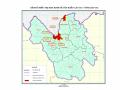
Currently, Lao Cai has 1 international border gate, 1 national border gate (main border gate), 4 secondary border gates and some traditional openings. Orientation to 2020 requires detailed planning, surveying investment needs for the entire border gate system according to the Project on planning border gates of Lao Cai province for the period 2006-2015 approved by the Prime Minister. In particular, the planning expands Lao Cai Economic Zone from the current 79.7 km2 to 202.7 km2 , including 26 communes and wards in the districts: Simacai, Bat Xat, Lao Cai, Bao Thang, Muong Khuong and Lao Cai city.
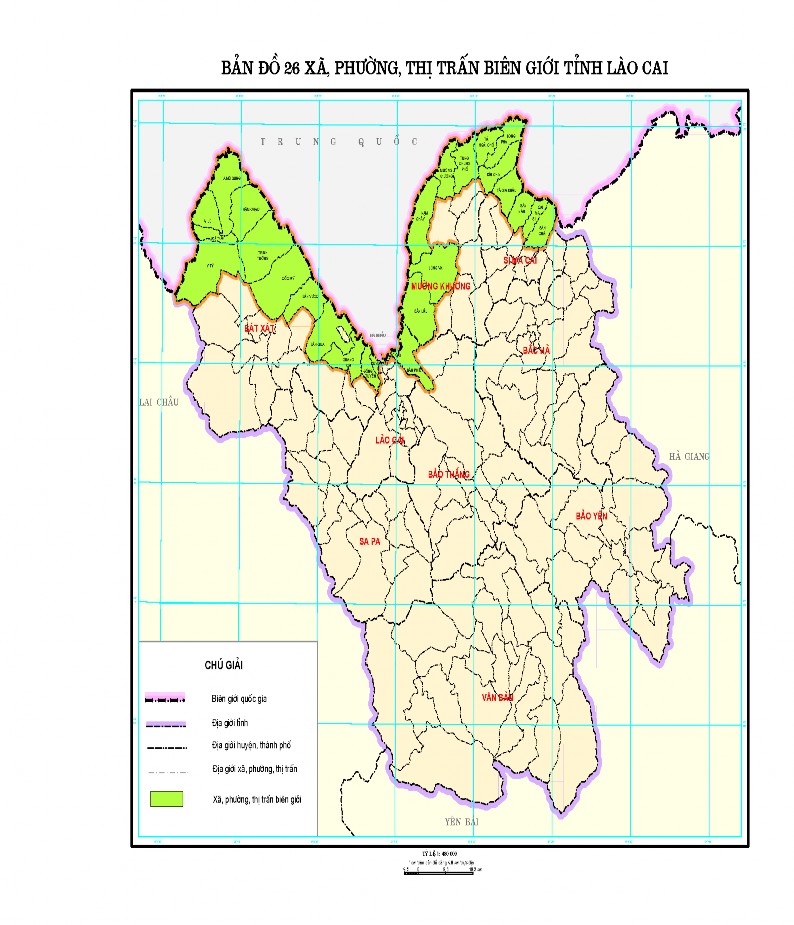
Source: Author's synthesis.