
23.5g/l in May and 13.1g/l in June. Such a rapid decrease in salinity also has many impacts on people, especially shrimp farmers. In 2015, the salinity of the region will increase higher than the same period in 2014 but with a somewhat reduced amplitude from 19.3g/l to 24.3g/l (Southern Institute of Water Resources Research).
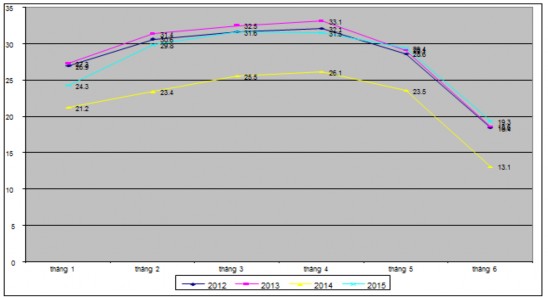
Figure 2.4. Salinity concentration changes at Dinh An estuary in 2012 - 2015
(Source: Southern Institute of Water Resources)
Thus, XNM is becoming more and more evident and with increasing severity. In the face of complex developments, appropriate policies are needed to guide people to adapt effectively and raise public awareness.

Planning Overview
2.3.1. Types of planning in Vietnam

Vietnam's political system in terms of apparatus (institutional system)
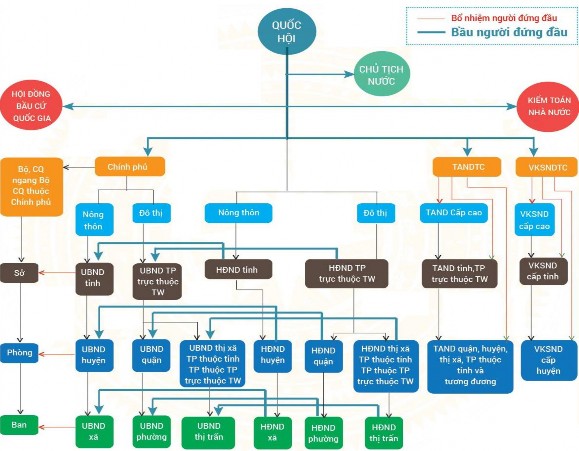
Figure 2.5. Vietnamese State apparatus
(Source: Tan, S, 2012)
Our country's political system in terms of apparatus (institutional system) includes:
- Communist Party of Vietnam
- State
- Vietnam Fatherland Front and mass organizations such as Vietnam General Confederation of Labor, Ho Chi Minh Communist Youth Union, Vietnam Farmers' Union, Vietnam Women's Union, Vietnam Veterans' Association
In our country's political system, the Communist Party of Vietnam leads the state and society and is the core of the political system.
The Socialist Republic of Vietnam is the pillar of the political system - including the National Assembly, the President, the Government, the judicial system (Court and People's Procuracy) and local governments.
The National Assembly is the highest representative body of the people, the highest State power body of the Socialist Republic of Vietnam.
+ The National Assembly of our country has the following functions: Legislation; deciding on social issues, national defense and security, main principles on organization and operation of the State apparatus, on social relations and activities of citizens.
+ The National Assembly exercises supreme supervision over State activities.
The President is the head of state, representing the Socialist Republic of Vietnam in domestic and foreign affairs.
+ The President is elected by the National Assembly from among its deputies.
+ The President is responsible and reports on his work to the National Assembly.
The Government is the executive body of the National Assembly, the highest State administrative body of the Socialist Republic of Vietnam. The Government unifies the management of the implementation of the political, economic, cultural, social, national defense, security and foreign affairs tasks of the State. The Government and the Prime Minister are responsible to the National Assembly, the National Assembly Standing Committee and the President; and must report on their work to the National Assembly, the National Assembly Standing Committee and the President.
Local people elect People's Councils at their level. People's Councils are the local state power bodies.
The People's Council elects the People's Committee, which is the executive body of the People's Council, the local State administrative body, responsible for implementing the Constitution, laws, documents of higher-level State agencies and resolutions of the People's Council.
People's Court and People's Procuracy
The functions and duties of the People's Court and the People's Procuracy are to protect the Constitution and laws of our State. To carry out that duty, these agencies must perform a number of tasks such as investigation, prosecution, trial, and execution of judgments...
The court system in our country includes: the Supreme People's Court, local people's courts, military courts and other courts prescribed by law. These are the judicial bodies of the Socialist Republic of Vietnam.
In special situations, the National Assembly may prescribe the establishment of a special court. The court shall conduct trials in public. Judges and jurors shall only obey the law when conducting trials.
The Supreme People's Procuracy exercises the right to prosecute and supervise judicial activities. Local People's Procuracies and Military Procuracies exercise the right to prosecute and supervise judicial activities within the scope of their responsibilities prescribed by law.
In our country, state power is concentrated in the National Assembly (the highest representative body, the highest state power body). Other bodies such as the President, the Government, the People's Court and the Procuracy are all elected by the National Assembly, are responsible to the National Assembly and report their work to the National Assembly. The Government is also the executive body of the National Assembly.
Although State power is unified and indivisible, there is a clear division of labor and responsibilities, allowing power subjects to be proactive and creative in exercising State power.
The Vietnam Fatherland Front and some of its members are part of the political system:
The Vietnam Fatherland Front is a political alliance, a voluntary union of political organizations, socio-political organizations, social organizations and individuals representing all classes, social strata, ethnic groups, religions and Vietnamese people residing abroad. The Vietnam Fatherland Front is a part of the political system, the political basis of the people's government. The Communist Party of Vietnam is both a member and leader of the Front. The Front operates on the principles of voluntariness, democratic consultation, coordination and unity of action among its members.
Socio-political organizations of the working people: Vietnam General Confederation of Labor; Vietnam Farmers' Association; Women's Union; Ho Chi Minh Communist Youth Union; Veterans' Association. Depending on the nature, principles and purposes that have been determined, mobilize and educate union members to comply with laws and policies; care for and protect the legal and legitimate rights and interests of union members; help union members,
Members improve their qualifications in all aspects and build a new life; participate in state management and social management.
The Party respects autonomy, supports all voluntary, positive, creative activities, and sincerely listens to the opinions and contributions of the Front and mass organizations. The Party and the State have mechanisms and policies to create conditions for the Front and mass organizations to operate effectively, and to perform the role of social supervision and criticism.

Types of planning in Vietnam
Normally, Vietnam follows a top-down approach with a socio-economic development plan implemented for 5-10 years under the direction of the Party. There are many confusing issues in the terms “planning” and “planning”. But in general, it can be understood that “planning” will be implemented first, it is the premise for a more specific and clear plan. However, there are still many difficulties here because there are too many terms in the Vietnamese state apparatus related to the process of establishing a decision such as: “Policy”, “Strategy”, “Direction”, “Vision”. And these understandings have caused many different understandings and are related to the characteristics of policies in the Vietnamese state apparatus.
To see the problems in state planning. We can learn through table 2.1.
Table 2.1. Documents related to socio-economic development planning for the period 2006 - 2010
Regulatory documents
plan
Characteristic | The agency onion | Editorial agency grass | For example | |
10-year socio-economic development strategy | National, 10-year term. National political vision with long-term development. Advantages development | Communist Party of Vietnam | Institute of Investment and Agricultural Development Planning | Socio-economic development strategy for the period 2001-2010 |
Maybe you are interested!
-
 Economic value of wetland resources at Ba Lat estuary, Nam Dinh province - 24
 -
 Effect of Initial Glyphosate Concentration on Processability of Electrochemical Fenton Process
 -
 Students Participate in Exploring the Dragons at Ngoai Gate - National Treasures at the Temple of King Dinh Tien Hoang
 -
 Research Model of Factors Impacting Work Motivation of Tour Guide Team in Binh Dinh Province
 -
 The relationship between travel motivation, destination image and destination choice - A case study of Binh Dinh province tourism destination - 1
country, region, and industry. | ||||
5-year socio-economic development plan | National, 5 years. Specify the development strategy and control the master plan. branch. | National Assembly | Ministry of Planning and Investment | Socio-economic development plan 2001- 2005, 2006- 2010 |
Socio-economic development strategy by sector | Regional, long term. Set goals for the region. | Prime minister | Departments of the Ministry of Planning and Investment work with relevant ministries | Service industry development strategy to 2020; Environmental protection strategy to 2010 with orientation to 2020. 2020 |
Socio-economic development planning by region | Regional and area-specific, long-term. Set goals for the area. | Prime minister | Planned and coordinated by the Ministry of Planning and Investment working with relevant Ministries | Master plan for socio-economic development in the Mekong Delta to 2010, Master plan for socio-economic development in the Mekong Delta during the period 2001-2005 |

Annual socio-economic development planning | National, annual. | National Assembly | Ministry of Planning and Investment | Socio-economic development planning 2007, 2008, 2009 and 2010 |
Provincial socio-economic development planning | Provincial, 10 years. Set goals for the province. | Prime minister | Department of Regional and Local Economy of the Department of Planning and Investment | Master plan for socio-economic development of Can Tho city in the period 2006-2020, Master plan for socio-economic development of An Giang province by 2020 |
Mekong Delta Plan (MDP) 2013 – A typical example of strategic planning
2.3.1.3.1. What is Mekong Delta Plan 2013?
MDP 2013 is a joint product of the Embassy of the Netherlands and Vietnam. The Dutch Government is ready to support Vietnam in solving problems caused by the impact of climate change in the Mekong Delta region. This region has many similarities with the Netherlands in terms of soil conditions, so with experience, modern technology, and implemented water management solutions, the Netherlands wishes to transfer them to Vietnam for application. MDP 2013 presents realistic and very useful scenarios for policy makers and is currently supported by the World Bank, the Netherlands, the United States, Australia and Japan for strategic planning in the delta region.
2.3.1.3.2. Mekong Delta 2013 – A typical example of strategic planning
The Netherlands developed the first Delta Plan after the devastating floods of 1953 in the southwestern Dutch Delta. The Dutch responded with a
The plan is resolute with detailed measures to protect the coast, water resources and water quality, with a wide range of changes towards the country's future economic development. Based on the experience of the 1953 Dutch Delta Plan, the Netherlands supported Vietnam in developing the 1993 Mekong Delta master plan (implemented by Nedeco), contributing to supporting the economic development of the Mekong Delta in the recent period.
In 2008, the pressure on the Netherlands from climate change was clear. The predicted rise in sea levels and the greater variability of river flows forced the Dutch to look to the future, to broaden their scope and to anticipate further changes. Immediately after the 1953 floods, the Commission’s main concern was a reliable flood protection system, including hydraulic structures. After 2008, maintaining a high standard of flood protection was still important, but the main challenge was to develop a harmonised programme with a combination of structural and non-structural measures. And it was essential to build appropriate institutions, mobilize and secure funding for implementation and to strengthen the administrative coordination of the competent authorities to make decisions.
The 2008 Dutch Delta Plan is not a master plan like the 1953 Delta Plan, because the objectives of the Delta Commission are:
1. Provide a coherent, long-term vision and integrated advice to keep the Netherlands safe from floods and respond effectively to climate change developments up to 2100;
2. Share with all relevant authorities the urgent need for solutions and actions to address long-term challenges;
3. Ensure that key strategic advice and recommendations are adopted and incorporated into the long-term Delta Programme.
Similarly, the 2013 Mekong Delta Plan will not be the same as the previous 1993 Master Plan. The Mekong Delta Plan aims to provide strategic advice regarding the long-term, integrated development of the Mekong Delta. Similar to the 2008 Dutch Delta Plan, existing expertise will be used primarily to develop the Mekong Delta Plan. The expertise will be related to the areas of natural resource use and management (water), socio-economic development that affects land and water use, climate change, development, and management of natural resources.