
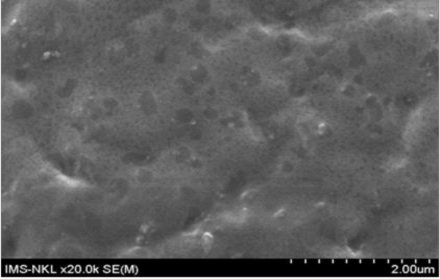
Figure 3.18. SEM image of fracture surface of CSTN/BR blend sample (75/25)
3.3.1.4. Glass transition temperature of CSTN/BR blend sample
The dynamic mechanical analysis (DMA) method was used to determine the glass transition temperature of the material and was measured on the DMA 8000 (PerkinElmer) at a temperature range from -120 o C to 20 o C. The analytical results obtained are shown in Table 3.10 and Figures 3.19 - 3.21 below.
Table 3.10. Glass transition temperature (T g ) of rubber samples
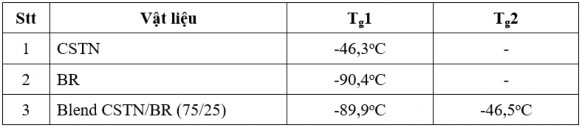
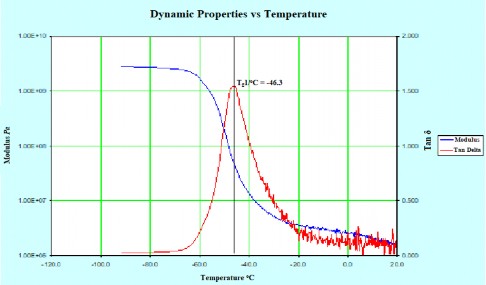
Figure 3.19. DMA chart of CSTN sample
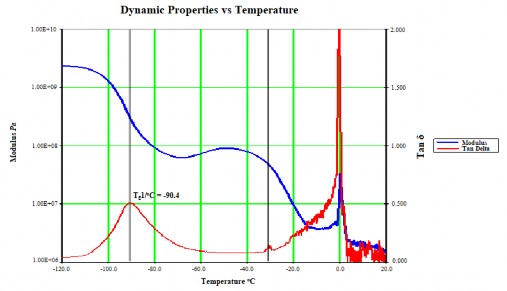
Figure 3.20. DMA chart of BR sample
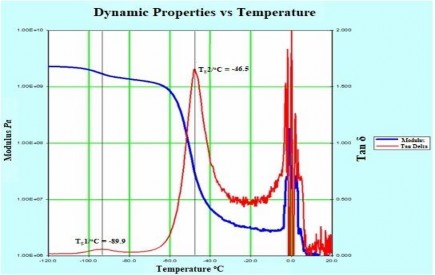
Figure 3.21. DMA chart of CSTN/BR blend sample
Through tables 3.10 and figures 3.19 to 3.21, it can be seen that the glass transition temperature (T g ) of CSTN and BR are -46.3 o C and -90.4 o C, respectively . With the CSTN/BR blend (75/25), the glass transition temperature T g 1 is -89.9 o C (this temperature corresponds to the T g value of BR), which means that the increase is insignificant and the peak intensity is very weak, not clearly shown, this is because BR is a dispersed phase scattered in the CSTN matrix (continuous phase) (as shown above, SEM image). At the glass transition temperature T g 2 is -46.5 o C (this temperature corresponds to the T g of CSTN), it shifts to a lower temperature. From this, it can be seen that, with the glass transition temperature of CSTN/BR blend (75/25), T g 1 and T g 2 move insignificantly closer together, which shows that the two rubbers are also less compatible with each other [1]. The T g measurement results are also completely consistent with the results in the study of thermal properties and morphological structure to determine the incompatibility of these two rubbers.
3.3.2. Research on manufacturing nanocomposite rubber material based on blend of CSTN/BR and nanosilica
3.3.2.1. Effect of nanosilica content on physical and mechanical properties of materials
To investigate the effect of nanosilica content on the mechanical properties of nanocomposite rubber materials based on CSTN/BR, keeping the elements, raw material composition and manufacturing process of nanocomposite rubber materials unchanged, changing the NS content from 0 to 16pkl. The results of the investigation of nanosilica content are presented in Table 3.11 and Figure 3.22.
Table 3.11. NS content affects mechanical properties of materials based on CSTN/BR blend
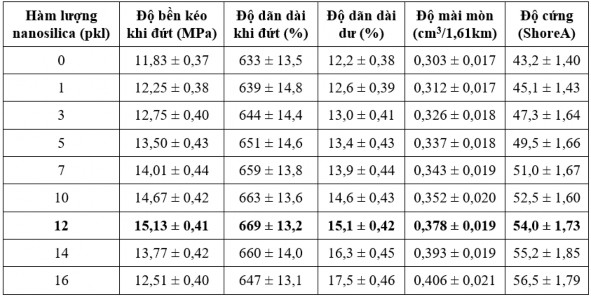
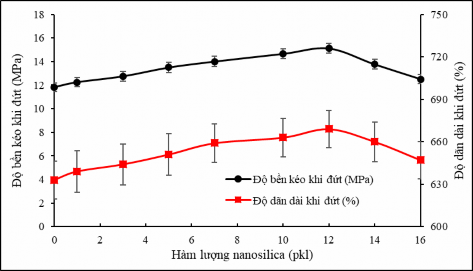
Figure 3.22. NS content affects tensile strength at break and elongation at break of materials based on CSTN/BR blend
The results of Table 3.10 and Figure 3.22 show that, when increasing the NS content, some tensile properties of the material (elongation at break and tensile strength at break) tend to increase and reach a maximum value at a content of 12 ppt. If the NS content continues to increase, the tensile properties of the material tend to decrease. The material abrasion does not increase much because NS has increased the hardness of the rubber somewhat. Moreover, the presence and increase in NS content makes the hardness and residual elongation of the CSTN/BR blend rubber material increase, this is also due to the general effect of inorganic additives, of which NS is an inorganic additive with nano size.
This is explained as follows, when the NS content is still less than or equal to 12pkl, the NS additive particles will be evenly dispersed in the rubber matrix, forming an interwoven reinforcement and rubber network, helping the material structure become tighter and more regular and increasing the mechanical properties of the material. But when the NS content exceeds (greater than) 12 pkl, the excess NS particles will create a separate phase, making the material irregular, less flexible and harder, as shown by the increased value of the material's residual elongation and hardness but the elongation at break decreases. Therefore, we choose the NS content of 12 pkl for further studies.
3.3.2.2. Effect of NS TESPT on the properties and morphological structure of CSTN/BR blended rubber material
In this study, to improve the ability of uniform distribution and interaction between NS and the rubber blend, we used the TESPT NS that was performed in section 3.1.2. The results of the survey of some mechanical properties and thermal properties of nanocomposite materials based on CSTN/BR blended rubber are presented in table 3.12 and
3.13. Thermal properties of the material were evaluated by thermogravimetric analysis (in PL4 in the appendix). Field emission scanning electron microscopy (FESEM) was used to evaluate the morphological structure of the material (Figure 3.23).
Table 3.12. Nanosilica content (NS and NS TESPT ) affects the mechanical properties of CSTN/BR blended rubber materials
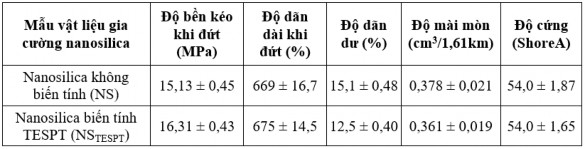
Through table 3.12, it can be seen that, with the same content of 12pkl, the material using NS TESPT has higher mechanical properties (tensile strength at break and elongation at break) than using NS. This is explained that the silane TESPT connecting compound is like a bridge that helps increase the bonding ability of NS with rubber molecules, so NS disperses better into the rubber matrix and reduces the ability of NS particles to aggregate, so the structure of the material is tighter and smoother, thereby increasing the mechanical properties of the material.
Table 3.13. TGA results of materials from CSTN, BR and some CSTN/BR blends
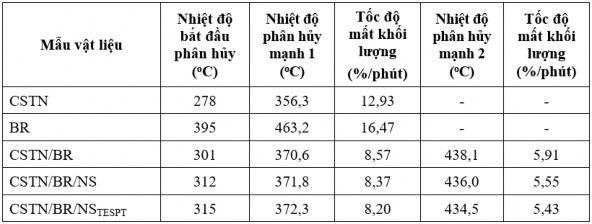
Table 3.13 shows that when blending to form CSTN/BR blend, the initial decomposition temperature of the blend is 301 o C, the strong decomposition temperature 1 is 370.6 o C (corresponding to the temperature of CSTN) and the strong decomposition temperature 2 is 438.1 o C (corresponding to the temperature of BR). Obviously, the thermal resistance of CSTN/BR blend is between the thermal resistance of each individual rubber (CSTN and BR). When NS or NS TESPT is present , the thermal resistance of CSTN/BR blend has increased, as the initial decomposition temperature and strong decomposition temperature 1 tend to increase. This is due to the shielding effect of the inorganic reinforcing additive nanosilica [65].
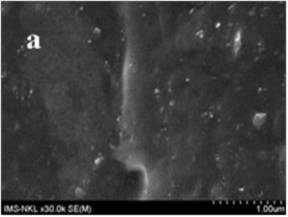
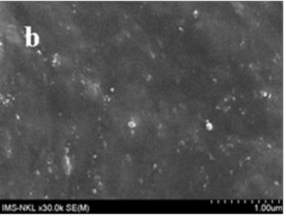
Through FESEM images of the cross-sectional surface of nanocomposite rubber materials based on CSTN/BR blend (Figure 3.23), it can be seen that CSTN/BR/NS material (Figure 3.23a) has NS particles with sizes in the range of 100 - 200 nm, dispersed relatively evenly,
Although there are still some areas that are not uniform due to the presence of large NS particles; the CSTN/BR/ TESPT NS material (Figure 3.23b) has TESPT NS particles with a size of less than 100 nm, dispersed more evenly, this is because TESPT NS has a better interaction with the rubber matrix than NS.
|
Maybe you are interested!
-

 Research on combining nano additives to enhance the physical and technical properties of natural rubber materials and some of its blends - 2
 -
 Research on Manufacturing Blend Rubber Materials Based on Nitrile Butadiene Rubber and Polyvinyl Chloride Resin
 -
 Research on treatment of rotator cuff tears using modified Mason-Allen tendon endoscopic suturing technique and creating micro-damage at the attachment area - 2
 -
 Research Model of Factors Impacting Work Motivation of Tour Guide Team in Binh Dinh Province
 -
 Research on the fabrication and gas sensitivity of heterostructures between SnO2 nanowires and some semiconducting metal oxides - 16
Figure 3.23. FESEM images of the cross-sectional surfaces of the material samples ((a) CSTN/BR/NS and (b) CSTN/BR/NS TESPT )
This is explained by the fact that NS particles are hydrophilic, have many hydroxyl groups (-OH) on the surface and have a large surface energy, so NS particles always tend to aggregate to form large particles, leading to poor dispersion in the rubber matrix. With NS TESPT , the surface of NS particles becomes more hydrophobic, reducing the ability to form large aggregates, and small particles separate from each other. The TESPT bridges on the NS surface help to link NS TESPT - rubber molecules to form a more stable and tight network. That is what helps materials using NS TESPT have better mechanical and thermal properties than materials using NS. This is also consistent with the results given in Tables 3.12 and 3.13 above.
3.3.3. Research on manufacturing nanocomposite rubber material based on blend of CSTN/BR by combining nanosilica and other additives
3.3.3.1. Effect of carbon black content on physical and mechanical properties of CSTN/BR blend material
In this study, we continue to investigate the content of carbon black additives affecting the mechanical properties of nanocomposite materials based on CSTN/BR blend reinforced with 12pkl NS TESPT . Here, the technological process of manufacturing materials and other additives remain unchanged, the survey of carbon black content varies from 0 to 40pkl. The survey results of carbon black content are presented.
in table 3.14 and figure 3.24.
Table 3.14. The content of carbon black combined with NS TESPT affects the mechanical properties of nanocomposite materials based on CSTN/BR blend
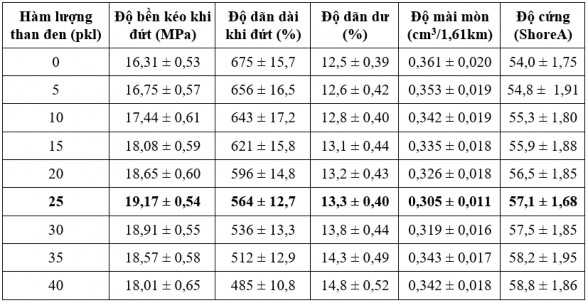
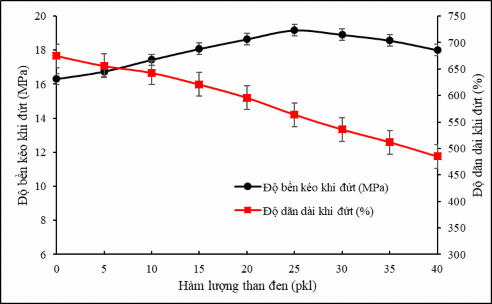
Figure 3.24. Carbon black content affects tensile strength at break and elongation at break of materials based on CSTN/BR blend
Through table 3.14 and figure 3.24, it can be seen that when the carbon black content increases, the tensile strength at break of the material tends to increase and reaches the highest value at the content of 25 pkl. If the carbon black content continues to increase (> 25pkl), the tensile strength at break of the material tends to decrease slightly. Obviously, when the carbon black content increases, the tensile strength at break of the material fluctuates up and down through the value of 25pkl, as a result, the abrasion value of the material also fluctuates down and up quite similarly; but
The elongation at break always tends to decrease, while the residual elongation and hardness of the material tend to increase, but the rate of increase or decrease in the values is quite small.
This is explained that, when the carbon black content is below the appropriate level (<25pkl), the material has a tighter and more regular structure because the carbon black and reinforcing additives are dispersed more evenly and uniformly in the rubber matrix, forming a tightly interwoven additive-rubber network, which helps to increase the mechanical properties of the material. However, with the carbon black content increasing beyond 25pkl, the excess carbon black makes the material less durable and less flexible, so the material becomes harder; for that reason, the hardness and residual elongation of the material tend to increase, while the elongation at break of the material decreases, but at the content below 25pkl, this effect is more limited because the additives are dispersed more evenly in the rubber matrix. Obviously, when exceeding the appropriate content, the tensile properties of the material change. From these research results, we chose the carbon black content of 25 pkl combined with 12 pkl NS TESPT to reinforce the CSTN/BR blend material.
3.3.3.2. Effect of additive D01 on physical and mechanical properties of materials
To enhance the distribution and interaction between NS and rubber molecules in the CSTN/BR blend rubber matrix, the silane coupling agent bis(3-triethoxysilylpropyl) tetrasulphite was used in the above section. In addition, to reduce the viscosity of the rubber system as well as increase the dispersion and interaction between the components, and to increase the elongation at break and abrasion resistance of the material, a compatibilizer from vegetable oil was mentioned in this study, which is tung oil (in the study called agent D01), and was used at a content of 2% compared to rubber [134]. Tung oil is a vegetable oil, a type of drying oil (meaning it forms a good film, similar to cashew nut oil, hemp oil, etc.). The drying ability of the oil depends on the amount of unsaturated fatty acids that make it up (this is the chemical nature of the oil), which is determined through the iodine index. Therefore, drying oil is defined as an oil containing many unsaturated fatty acids, the acid molecule has many double bonds, and the iodine index is in the range of 130 - 200. Tung oil is mainly composed of unsaturated fatty acids, including α-eleostearic acid (80.0%), oleic acid (12.5%), some saturated acids (about 5.0%),... Tung oil (agent D01) is used as a compatibilizer (or dispersant). In the α-eleostearic acid molecule, there are 3 conjugated C=C bonds as shown in Figure 3.25.