
with this outstanding balance. To assess the risk in investment and the quality of bond investment activities, the following indicators are often used:
(2) Ratio of total value of bonds invested by commercial banks/total assets of commercial banks
This indicator is calculated based on the level of total asset allocation of the bank for bond investment activities, thereby reflecting the scale of investment as well as the level of concentration of commercial banks in this activity.
(3) Ratio of total value of bonds of other credit institutions invested by commercial banks/total assets of commercial banks
Commercial banks investing in bonds issued by other credit institutions is essentially similar to investing in corporate bonds. However, investing in bonds issued by credit institutions can lead to distortions and pose risks to the commercial banks themselves as well as the system. Therefore, monitoring and controlling the level of investment by commercial banks in bonds issued by other credit institutions is necessary.
(4) Ratio of total value of bonds in industries/business sectors with high potential risks invested by commercial banks/total assets of commercial banks
The level of risk in bond investment of commercial banks is governed by the business performance of the issuing organization or enterprise. It is necessary to assess the level of participation in bond investment in industries and sectors that are showing unstable, declining or high-risk trends in the economy to orient bond investment activities as well as control these activities.
(5) Ratio of total value of secured bonds/total assets of commercial banks
If the above ratios comply with the limits prescribed by the State Bank/State Bank and the internal regulations of the bank, on the one hand, it reflects compliance with the law, on the other hand, it contributes to ensuring the established business structure and limiting risks in bond investment. On the contrary, if the commercial bank invests in bonds with a ratio that is too large compared to total assets, or invests too much in one/a group of bonds, it will increase the risk.
(6) Overdue debt and overdue debt ratio in bond investment
Overdue debt ratio in bond investment = Overdue debt in bond investment
/Total outstanding bond investment
(7) Bad debt and bad debt ratio in bond investment
Bad debt ratio in bond investment = Bad debt in bond investment / Total outstanding debt in bond investment
The ratios of overdue debt and bad debt in bond investment reflect the quality and efficiency of bond investment activities of commercial banks. The higher this ratio, the greater the risk of capital loss. Similar to credit activities, the above ratios need to be reviewed and controlled closely and regularly to ensure risk control in banks.
(8) Investment bond structure
Investment bond structure = Total value of type i bonds/ Total value of investment commercial bank bonds
The structure of investment bonds reflects the level of portfolio risk in bond investment. If investment banks focus too much on bonds of risky industries/business sectors, invest too much in unsecured bonds, the potential risk of recovering principal and interest will be higher. In addition, banks that do not comply with the regulations of state management agencies (the Central Bank/State Bank) on investing in bonds issued by other credit institutions... may also encounter legal risks.
(9) Level of compliance with current legal regulations on conditions and limits for bond investment (regulations on principles, organization of investment process implementation, limits on bond investment ratio, cross-investment between credit institutions...).
In the context of comprehensive financial development becoming a popular trend, in addition to paying attention to investing resources in income-generating business activities, commercial banks need to pay attention to developing activities that demonstrate corporate social responsibility. Some studies also show that compliance with the law and the implementation of some banking activities, although not bringing immediate benefits (income), contribute to enhancing the reputation and brand of the bank, thereby contributing to improving the efficiency of banking operations in the long term. This is also an important content that the internal control department of each bank needs to pay due attention to during the implementation process to contribute to enhancing the position and reputation of the bank.
Banks should not consider this as the responsibility of state management agencies in the banking sector.
* Indicators reflecting income from bond investment activities
(10) Total income (profit) from bond investment activities
(11) Rate of return from bond investment activities
(12) Ratio of income (profit) from bond investment to total income (profit) of the bank.
If the above indicators achieve the set goals, it proves that the bank's bond investment activities have achieved good results. On the contrary, if the income from investment activities is low, the risk is high, there are signs of violations of internal regulations and current laws on bond investment, it proves that the bank's investment activities are ineffective, have potential risks and many problems need to be further solved and overcome.
2.4.2. Research model on the impact of bond investment activities on the business results of commercial banks
The research model of the impact of bond investment on the business results of commercial banks comes from research models on the relationship between diversification and bank performance (DeYoung and Rice, 2003; Odesanmi and Wolfe, 2007; Chiorazzo et al., 2008; Baele et al., 2007;…). To measure diversification in banking activities, studies often use 2 approaches: (1) income-based approach and (2) asset-based approach.
With the income-based approach, studies use the ratio of each source of income to the total income of the bank into specific components as follows: income from lending (interest income) - (LoanInc), income from services - (ComInc), income from investment activities/bond investment - (TradInc).
With the asset-based approach, studies use the ratio of each type of profitable asset to total assets to assess the impact of asset allocation on banking activities with the following components: lending - (Loan), investment/bond investment - (Trad).
Research model:
Income Approach:
Bank Risk (or Profitability) i,t = α 0 + α 1 × LoanInc/OpInc i,t + α 2 × ComInc/OpInc i,t + α 3 × Trad/OpInc i,t + α 4 × Controls t + v i + ε i,t
Asset-Based Approach:
Bank Risk (or Profitability) t = β 0 + β 1 × Loan/TA i,t + β 2 × Trad/TA i,t + β 3 × Controls t-1 + v i + εit
In which Bank Risk or Profitability are the dependent variables ROA, ROE to measure business efficiency and Z-Score to measure bank risk.
⁄
Z-Score i,t =
Where σROAit is the standard deviation of ROAit + Eit/Ait is the equity-to-assets ratio. The Z-score varies inversely with the level of risk. A higher Z-score represents a lower level of risk.
Controls are the control variables in the model, specifically including:
TA - Bank size: large banks can invest more in technology and management, therefore, have better operational efficiency as well as risk management capabilities and have better opportunities to exploit natural resources (DeYoung and Rice, 2003; Chiorazzo et al., 2008). The study only uses the TA variable in the case of dependent variables being ROE and SHROE. The TA variable is measured by the logarithm of the bank's total assets.
LOAN - Loans to total assets ratio: represents the impact of lending strategy on bank performance. According to Chiorazzo et al. (2008), Stiroh (2004), banks that focus on lending will pay less attention to other activities and vice versa.
EQUITY - Equity ratio to total assets: when a bank has a high equity ratio, it is considered safe, avoiding liquidity risks and creating trust with customers; in addition, banks with a lot of equity will have the advantage of providing many types of
more financial services to customers. The study only uses this variable in case the dependent variable is ROA and SHROA, (Chiorazzo et al., 2008)
COST - Ratio of operating expenses to total assets: when salary expenses increase faster than income from new operations, it will reduce the bank's business efficiency (Lepetit et al., 2007).
DTL - Customer deposits to total liabilities ratio: this indicator shows the bank's funding structure. A high ratio will increase the bank's business efficiency due to saving on capital costs because capital from customer deposits is considered a stable and cheaper source of funding compared to other sources of funding.
GDP - Economic growth: Real GDP measures the growth potential of the economy, contributing to improving business efficiency for banks and vice versa.
INF - Inflation rate: measured by the consumer price index CPI. Inflation affects banking performance through wages and other operating costs of banks (Revell, 1979).
Table 2.2: Summary description of variables used in the research model
Variable
Interpretation | Recipe | |
Dependent variable | ||
ROA (ROE) i,t | Business performance (including return on assets and equity) |
( ) |
Z-SCORE i,t | Bankruptcy risk | ⁄
|
Independent variable | ||
LoanInc/OpInc i,t | Loan Income Ratio | Income from lending year t/Total income in year t |
ComInc/OpInc i,t | Service Income Ratio | Service income year t /Total income year t |
Trad/OpInc i,t | Rate of return on stock investment | Income from securities trading Contract year t /Total income year t |
Maybe you are interested!
-
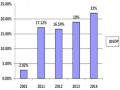
 Current status of investment activities in bond trading of Vietnam Commercial Bank
 -
 Research Model and Research Methodology to Analyze the Impact of Bad Debt on Bank Efficiency
 -
 Research Model of the Impact of Website Quality on Purchase Intention Through Customer Satisfaction
 -
 A Modified Research Model on the Impact of Training Service Quality on Student Satisfaction at Saigonact School
 -
 Bond investment activities of Vietnamese commercial banks 1683880233 - 27

Loan/TA i,t
Loan Rate | Loans year t/ Total assets year t | |
Trad/TA i,t | Investment scale ratio stock | Investment scale year t/ Total assets year t product |
Control variables | ||
TA i,t | Bank size | Logarithm (total assets) of bank i year t |
LOAN i,t | Loan outstanding ratio | Total outstanding loans year t/total assets year t |
EQUITY i,t | Equity Ratio | Equity year t/total assets year t |
COST i,t | Operating expense ratio | Total annual operating costs t/total assets year t |
DTL i,t | Customer deposit ratio | Customer deposits per year t/total liabilities year t |
GDP i,t | Economic growth | GDP |
INF i,t | Inflation rate | Consumer Price Index CPI |
2.4.3. Factors affecting bond investment activities of commercial banks
According to Vu Hoang Nam's research (2015), the scale and efficiency of bond investment activities depend on 5 factors: bank ownership structure, bond market size, macroeconomic fluctuations and some other factors (control variables) such as bad debt ratio, bank asset size... In his thesis, based on Vu Hoang Nam's research, the author of the thesis supplements and develops two groups of factors: subjective factors (including 5 factors); objective factors (including 4 factors).
2.4.3.1. Subjective factors
* Bank business strategy
The business strategy of commercial banks is the basis for managers to build
Establishing investment policies including bond investment. Short-term, medium-term and long-term development goals and strategies have a decisive influence on the development of bond investment activities at what scale and which market share to occupy in each stage in accordance with the internal resources of commercial banks. Business strategy is also the guideline for all bond investment activities of commercial banks in a long period and can be adjusted to suit each market stage but does not change the nature and results of the strategy.
* Financial potential
In a market economy, all input factors of business activities must be purchased or invested in advance. Therefore, to invest in bonds, banks must have a certain amount of capital. The financial potential of a bank is not only the existing capital but also the ability to exploit and use financial resources inside and outside the bank to serve the business strategy. A strong enough financial potential allows the bank to expand its scale and diversify its investment activities, minimize costs, maximize profits and minimize risks in the bank's investment activities. The financial potential of a commercial bank is demonstrated through indicators such as equity, asset size and quality, high and stable profitability, and liquidity.
* Risk management activities in bond investment
According to international practice, credit risk management, including bond investment activities, has two popular risk management models being applied by commercial banks: centralized risk management model and decentralized risk management model.
The centralized risk management model is a model that clearly separates the risk management and business functions with the main advantage of systematically managing risks on a bank-wide scale, ensuring long-term competitiveness, establishing and maintaining a synchronous risk management environment, consistent with the management process associated with the operations of business units, improving the capacity to measure and monitor risks, and building a unified risk management policy for the entire system. This model is very suitable for large commercial banks because it takes time and effort to invest, requiring a team of qualified staff.
deep understanding of knowledge and implementation practices. However, not all commercial banks when applying this model achieve the same results due to the different levels of attention paid to the factors in the model.
The decentralized risk management model does not separate risk management and business, in which business units fully perform all stages of credit/investment from appraisal, disbursement, control to debt settlement. This model, thanks to its simplicity and compactness, is applied by small-scale commercial banks. The weakness of this model is that risk management is intermittent, not specialized, mainly focusing on debt settlement without risk forecasting and having measures to prevent risks from occurring.
Depending on the development strategy, commercial banks will choose compatible risk management models. Commercial banks that can implement a credit risk management model that is consistent with the development strategy, build a tight/optimal bond investment process, and perfect credit risk management/bond investment policies and mechanisms will ensure safe and effective operations.
* Human resource quality
Human resources are an extremely important factor in all activities, reflected through the qualifications, qualities, motivation, loyalty and professional expertise of human resources. In fact, the existence and development of commercial banks depends largely on the effective exploitation of resources in terms of capital, science and technology, facilities and labor. These resources are closely related to each other and have mutual impacts. Factors such as capital can be mobilized, facilities can be purchased, science and technology can be copied, but these cannot be done with human resources. People are the subjects that make decisions on bond investment, business strategies, investment decisions or purchase of other resources. Commercial banks that want to invest in bonds effectively must have a sufficient number of staff, ensure quality, have solid expertise and understand all aspects of the business. In addition, the legal compliance and professional ethics of bank employees also have a great impact on the interests of the bank.