
2000 and 2001 did not change much, perhaps because the number of surveyed enterprises increased significantly.
including many small businesses.
The average growth rate of labor for all enterprises increased significantly from 2003 to 2004, and reached the highest growth rate in 2002 with a growth rate of 10.9%. Meanwhile, in 2005, the average labor size decreased by -0.54% compared to 2004. In 2006, the growth rate of labor in enterprises improved and reached 0.099%. On the contrary, in 2007 and 2008, the growth rate of labor in enterprises decreased by 1.67% and 0.82%, respectively.
The capital growth rate for all enterprises in the research period from 2000-2008 was quite high, with the lowest year being 11.28% in 2001 and the highest being 52% in 2008.
Maybe you are interested!
-

 Accounting for revenue, expenses and determining business results at Hoang An private enterprise - 12
 -
 "Completing the organization of revenue and cost accounting and determining business results" at Tan Phu Agricultural Processing Enterprise - 2
 -
 Results of Linear Regression Analysis on Factors Affecting Land Complaints in Vinh City
 -
 Calculate Results Based on Reagent Equivalent Concentration
 -
 Regression Model Results of 6 Factors Affecting 8 Listed Joint Stock Companies
To calculate the impact of FDI on the productivity growth of domestic enterprises, we need to calculate the level of foreign participation in the industry ( the share of FDI enterprise capital on the total capital of the industry ). The thesis uses the coefficients of the 2000 IO table to structure the vertical and horizontal relationships of the impact of FDI through the variables Backward , Forward , Horizontal .
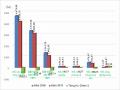
Appendix 2.20 shows that the value of the Backward variabletends to increase and decrease unsteadily . Specifically, the value of the Backward variable in 2000 was 0.01037 and by 2008 this valueonly 0.0051. This indicates that the main trend of the Backward variable is decreasing, meaning that the level of backward linkage between FDI enterprises and domestic enterprises in other industries tends to decrease.
The Forward variable has a similar trend to the Backward variable. Thus , the main trend of the Forward variable is also decreasing , but decreasing at a very small rate. This shows that the level of forward linkage between FDI enterprises and domestic enterprises also tends to decrease.
The Horizontal variable also had a decreasing trend in the years 2006 - 2007. However, in recent years , this variable has tended to increase. This shows that the level of spillover effects from FDI enterprises to domestic enterprises in the same industry is tending to increase and decrease erratically .
2.3.2. Estimated results
Assess the spillover effects of FDI on domestic enterprises through influences such as:
First , knowledge and technology can flow from FDI enterprises to domestic enterprises through the process of training workers and managers. This will gradually bring benefits to domestic enterprises.
Second , it can promote improvements in the quality and reliability of services.
Inputs provided by local suppliers.
Third , domestic enterprises can “ learn through observation .”
Fourth, FDI inflows can bring greater competition and force enterprises to
Inefficient domestic firms must either innovate or close down.
As expected from the theory, the coefficients are positive and significant for changes in production inputs as well as changes in the FDI share. This implies that increasing the foreign capital share in a firm can promote faster output growth. This result indicates a positive and significant correlation between firm productivity and foreign presence in the industry of the production chain.
2.3.2.1. Results of first-difference regression estimation
Appendix 2.21 presents the estimation results from the first-difference model using different methods: the Levinsohn-Petrin semi-parametric method with intermediate inputs as control variables and the fixed-effects and random-effects estimation methods . These methods are applied to different sample groups, including: the entire sample, domestic enterprises and by enterprise size .
The results of the difference-order estimation for the entire sample give the following conclusions:
First , the impact of FDI on economic regions in the country has strong statistical significance with the estimation of the random effects model, and this model shows that FDI has spillover effects between regions.
Second , the coefficients of the spillover effects of Horizontal and Backward FDI carry
d is negative and statistically significant in all three models. The coefficient of the Forward variable in the semi-parametric model and the fixed effects model is positive and significant.
statistics at 1% level .
Third, the Hausman test results show that, in the case of estimating two models with random effects and fixed effects, we should choose the model with random effects.
Appendix 2.22 is the estimation result for domestic enterprises according to three semi-parametric, random effects and fixed effects models . The results obtained are exactly the same as the estimation for the entire sample: Between the two random effects and fixed effects models, the random effects model should be chosen. The coefficients are all statistically significant at the 1% significance level; and the coefficients of the Horizontal and Backward variables are negative for all three methods. However, the coefficient of the Forward variable is positive for all three methods.
The value of the Horizontal variable is negative and statistically significant at the 1% level in all three estimated models for domestic textile enterprises, indicating that the presence of FDI enterprises has reduced the output growth of domestic textile enterprises . This result is consistent with the evidence of negative impacts within the industry of developing countries. The reason for the negative horizontal spillover effect in Vietnam may stem from the fact that the presence of FDI enterprises reduces the productivity of domestic textile enterprises through the competition effect. FDI enterprises with advanced technology advantages have attracted demand and resources, forcing domestic textile enterprises to reduce their productivity and consumption of their goods. Moreover, the negative impacts from competitors may be larger than the positive impacts of demonstration and imitation created by the presence of FDI enterprises.
On the other hand, the coefficient of the Backward variable shows that the backward linkage from FDI makes
reduce productivity growth of textile enterprises in Vietnam. This can be explained by the fact that FDI enterprises have an advantage over domestic textile enterprises in terms of technology. Therefore, domestic textile enterprises without cooperation with FDI enterprises will have to bear more competitive pressure from the appearance of FDI enterprises.
In contrast, the coefficient of the Forward variable in the semi-parametric model and the
The fixed effect is positive and statistically significant at the 1% level . Estimated results
shows that the presence of FDI enterprises has a positive impact on the forward linkage of domestic textile enterprises, increasing the output growth of textile enterprises in Vietnam . This means that the more relationships a textile enterprise has with FDI enterprises, the more it can learn and benefit from purchasing higher quality and cheaper input products or machinery from FDI enterprises.
Appendix 2.23 presents the regression results based on the size of the enterprise using three methods. The purpose of this regression is to analyze the influence of the size of the enterprise on the spillover effects of FDI.
For the group of micro-sized enterprises : The estimated coefficients of the Horizontal and Backward variables are negative and vice versa, the coefficient of the Forward variable is positive according to all three methods. However, the coefficient of the Horizontal variable according to the semi-parametric estimation method has a weak effect with a rejection probability value of 10%. Meanwhile, the coefficients of the remaining models all have a confidence probability of 95%. In addition, the coefficient of the Forward variable is not statistically significantin the semi-parametric model and the fixed estimation model , and the probability of rejecting this coefficient in the random model is accepted at 10%. Thus, the results indicate that the spillover effect of FDI has no vertical and backward linkage in micro-sized enterprises according to the two semi-parametric and fixed estimation methods; and in the random estimation method, this coefficient has a weak effect. On the contrary, the model results show that the spillover effect of FDI on the group of micro-sized enterprises is a fairly strong impact of the competitive effect. Therefore, for the group of micro-sized enterprises, the spillover effect of FDI is only a narrowing of production and there is not much improvement in depth such as technological change.
For the group of small-sized enterprises : The estimated results of the signs of the coefficients of the Horizontal variableand the Forward variable are similar to the estimated results for the group of micro-sized enterprises. However, in this case, the coefficient of the Backward variable according to the estimated results of all three methods is not statistically significant . This indicates that the spillover effect of FDI according to the backward linkage for small enterprises is non-existent . On the contrary, the coefficient of the Forward variable according to the three methods is significant.
statistically significant, at the 1% significance level, so there is a spillover effect of FDI in the vertical and downstream linkages from FDI enterprises to enterprises in other industries . Thus, it can be concluded that, for the group of small-sized enterprises, the spillover effect of FDI will only have a positive effect in the vertical and downstream direction and a negative effect in the horizontal direction. Therefore, it can be seen that for the group of small-sized enterprises, FDI is beneficial in in-depth development such as changing technology and designs and will have to endure strong competitive pressure from FDI enterprises.
For the group of medium-sized enterprises : The estimation results by three methods for this group of enterprises tend to be similar to those of small-sized enterprises. However, in this case, the downstream spillover effect of FDI on the group of medium-sized enterprises is weak. Specifically, the coefficient of the Forward variable by the semi-parametric estimation method is only significant if we take the statistical significance level as 10%. This group of enterprises is under competitive pressure and may have to reduce the scale of production.
For the group of large-scale enterprises : The estimation results according to the 3 methods for this group of enterprises tend to be similar to the group of micro-scale enterprises and opposite to the remaining 2 groups of enterprises ( small and medium-sized enterprises ). The Horizontal variable is negative but not statistically significant , implying that large-scale Textile and Garment enterprises have the capacity
competition, so it is not affected by the reduction in production and business scale by FDI enterprises. Meanwhile, the Forward variable is positive but also not statistically significant, implying that large-scale textile and garment enterprises, which can take the initiative in raw materials, may not cooperate with FDI textile and garment enterprises to purchase raw materials, but these enterprises may directly cooperate with parent companies abroad. Therefore, the conclusion for the spillover effect of FDI on the group of large-scale enterprises is that there is no horizontal or vertical impact.
2.3.2.2. Summary of estimation results
Empirical evidence has been found that there is a negative spillover effect of the presence of FDI enterprises on the enterprises in the sample. This is reflected in the negative and statistically significant coefficient of the Horizontal variable. This result implies that the presence of FDI enterprises has reduced the output growth of domestic textile enterprises . However , for each group of enterprises with different scales, there will be different effects.
Specifically, for the group of micro-sized enterprises, the spillover effect of FDI only has a negative horizontal spillover effect and no vertical impact, which are not positive impacts. On the contrary, for the group of small and medium-sized enterprises, the spillover effect of FDI is vertical and has a horizontal impact, but very weak. This indicates that the spillover effect of FDI on the group of small and medium-sized enterprises is positive, meaning that these enterprises will develop and produce in depth. Thus, small and medium-sized enterprises will boost production but mainly focus on improving technology and product quality, which are the premises for sustainable development of enterprises. As for large-sized enterprises, they themselves have competitive capacity, so they are not affected by the reduction in production and business scale by FDI enterprises. At the same time, large-scale textile enterprises can take the initiative in raw materials and do not have to cooperate with FDI textile enterprises to purchase raw materials. These enterprises can directly cooperate with parent companies abroad.
2.4. General assessment of the spillover effects of foreign direct investment on Vietnamese textile and garment enterprises
2.4.1. Positive results
2.4.1.1. Contribute to improving the competitiveness of textile enterprises
Vietnam sewing
The presence of FDI enterprises has encouraged textile and garment enterprises, especially large-scale domestic enterprises , to make efforts to invest in production, focus on product design innovation, consolidate and develop brands, and expand distribution channels to capture domestic and international market share. The domestic textile and garment enterprise sector accounts for 40.9% of the total export turnover of the industry [31]. Domestic textile and garment enterprises have become more professional, responding more effectively to market fluctuations and increasing competition with foreign rivals. According to the survey results of VCCI (2011), most enterprises have recognized the need to adapt to the pressure to innovate, improve their competitiveness and proactively improve their competitiveness in the domestic market. 48.42% of surveyed textile and garment enterprises have increased their competitiveness, 35.2% of enterprises continue to maintain their position in the domestic market [53].
To increase competitiveness, domestic textile and garment enterprises have clearly defined product strategies, which products are the main ones to produce in order to have measures to implement specialization ; which market share to aim for, high-end, medium or low-end to have appropriate marketing methods ; correctly assess competitors to have the right competitive methods [56]... Domestic textile and garment enterprises have gradually shifted from growth in quantity ( width ) to improving labor productivity, increasing local content ( depth ). Focusing on producing and trading products with technical requirements, good and high quality, taking advantage of the ability and flexibility in meeting small and medium-sized orders, relatively urgent delivery times to form niche markets of Vietnamese textile and garment .
This clearly demonstrates the flexibility and effectiveness of the two-market strategy that the Textile and Garment industry applies: ( i ) continuing to maintain existing markets well, especially taking advantage of competitive advantages in niche markets; and ( ii ) focusing on increasing market share in new markets such as Russia, Eastern Europe, the Middle East... rather than simply investing in market expansion to chase quantity [32].
Improving competitiveness has helped Vietnamese textile products meet the requirements and gradually gain a large market share in the domestic market . If before 2000, textile products in the domestic market, especially the Northern market, were mainly imported goods and mainly Chinese goods, then by 2011, the revenue of Vietnamese textile products in the domestic market reached
17,200 billion VND, an increase of 15% [37] and capable of meeting 80% of domestic demand . A series of brands have been known to domestic consumers such as Viet Tien shirts, May 10 shirts, Nha Be vestons, Thanh Cong t-shirts, Dong Xuan autumn-winter shirts, KT Viet Thang fabrics, Thai Tuan brocade fabrics [10]. This has helped Vietnamese textile products gain a large market share in the domestic market.
Enterprises have made progress in building their brands in the international market. They have increased trade promotion activities, actively participated in fairs and exhibitions, joined associations, registered for prestigious and quality titles to build their image and find more new customers and partners in this market.
2.4.1.2. Facilitate and promote innovation and enhance technological capacity
of domestic textile enterprises
The presence and fierce competition of FDI textile enterprises have stimulated and promoted domestic textile enterprises to innovate and improve their technological capacity. FDI textile enterprises have created opportunities for domestic textile enterprises to absorb scientific and technological achievements in the most favorable way. Many modern textile production lines have been put into production, thereby increasing labor productivity and enhancing the competitiveness of Vietnamese textile products in the world market.
In recent years, machinery, equipment and technological lines in the industry have been improved. The Garment industry has innovated about 95% of machinery and equipment, of which about 40% are high-quality, automated machines. Although the Textile industry is much lower, the innovation rate also reaches 30 - 35% [9]. The process of technological innovation has promoted the development of the Textile and Garment industry and the accessory industries, thereby attracting millions of jobs. Enterprises all recognize the importance of technological innovation and carry out investment activities in technological innovation. The investment rate for technological innovation reaches 2.94% of total revenue . Domestic technology supply is gradually being trusted by enterprises with 20% of surveyed enterprises purchasing technology of domestic origin.
With the goal of innovating equipment, technology, and management methods to shorten the gap with countries in the region, the Textile and Garment industry has prioritized FDI projects with modern machinery, equipment, and production lines, so in recent times, a number of FDI enterprises have created products with higher quality than domestic products. Every year, Vietnamese Textile and Garment enterprises continue to import more specialized machinery and equipment through FDI projects. The process of technological innovation results in improved machinery and equipment or newly equipped with more modern and synchronous production lines . Technological innovation will increase the productivity of machinery and equipment and increase labor productivity. Moreover, when the quality, design, price, etc. of products are improved as a result of technological innovation, it will increase consumer demand for these products, thereby affecting the market share and increasing profits for enterprises .