
Educate customers and potential customers about solutions to help them solve their problems and thereby build their love and trust. A place to develop and strengthen long-term relationships with customers. It can be said that the website is the face of the business on the internet environment. Therefore, the website must ensure quality, be professionally designed and have attractive content, the form and presentation of the website must be attractive enough, attract and retain users. In addition, a website with a professional interface will attract users to visit and keep them on the website longer. The meaning of retaining users first is not only to increase sales but also to help search engines evaluate the website, create positive signs and help the website achieve high search rankings naturally on search engines.
The website has the following advantages:
Firstly, websites help businesses keep up with market trends and grasp psychology,
user preferences quickly and accurately.
Maybe you are interested!
-

 Building a Research Model of Factors Affecting Agribank's Brand Value
 -
 Building a Scale and Research Model of Factors Affecting Customers' Decision to Choose a Bank to Deposit Savings at
 -
 Research on building a model of high-level male badminton athletes through biological, pedagogical and psychological values - 2
 -
 Building a Research Model on Factors Affecting the Effectiveness of Internal Control System in Social Insurance Collection
 -
 Research on building a model of high-level male badminton athletes through biological, pedagogical and psychological values - 1
Second, online marketing costs are more effective than traditional marketing.
at a lower cost.
Third, websites help businesses promote their products, services and brands globally easily and effectively, while creating high trust for users thanks to detailed and specific information.
Fourth, the website is a place for businesses to receive customer feedback and reviews and have plans to adjust and change accordingly.
Criteria needed for a professional website:
(1) The website must ensure regular operation time and minimize downtime.
Intermittent time.
(2) The website must have a fast page loading speed. According to general statistics, users do not have enough patience for more than 10 seconds when entering a website and still do not see any components of the website appear.
(3) The website must have an eye-catching interface, images, and colors that attract users to visit.
(4) The website must have a layout and present complete and reasonable information, not too cumbersome and redundant, suitable for the needs of the users that the business is targeting.
(5) The website must have high interaction, keeping users on your website longer to find information. This also helps your website increase the conversion rate from a web visitor to your customer.
(6) Product and service information and business introduction must be complete and transparent.
clear, helping visitors to easily find information about you.
(7) Website functions must be easy to use, focusing on essential needs and avoiding cumbersome procedures that are not suitable for demanding and impatient users.
(8) A final and general criterion is that the website must bring business benefits to the enterprise, be a powerful support tool to help the enterprise increase sales and save time and costs.
Email Marketing
Email marketing is a marketing activity through email, including a complete cycle, from collecting customer email data, sending customer care emails and filtering emails that are no longer of marketing value to the business to refresh the email warehouse. Emails sent to customers have the purpose of regularly interacting with customers, advertising, gratitude, introducing new products. According to Rob Stokes in Emarketing - The essential guide for marketing, 2009 , Email Marketing is defined as a form of direct marketing using electronic devices to convey messages to customers.
Email has the following advantages:
Firstly, Email is a tool that helps you reach customers on a large scale and in large numbers. In a campaign, you can send from 3000 - 5000 emails to customers. This is considered the fastest way to reach customers because nowadays everyone has their own email address. Automate email marketing campaigns: Unlike direct marketing, email marketing can operate automatically. Your company can easily schedule emails to be sent monthly or weekly.
effectively. Automation is extremely useful, especially if you are preparing to launch a seasonal product (like Christmas), advertise or announce events that are planned for the year. With email marketing, you can set up email notifications and schedule them to be sent at specific times to help customers learn about your company's products.
Second, you can organize and track all of your data to improve your business and understand how your email marketing campaigns are performing. For example, you can see how many people open your emails, how many click on the links in your emails, and the number and conversion rate (tracking sales compared to the number of emails sent). These numbers are the results of your email marketing campaign. You can also track which customers forward your emails, unsubscribe, or mark them as spam. This will help you better understand how your recipients interact with your emails and make changes to avoid being marked as spam. This data will help you identify the best content for your recipients.
Third, when comparing email marketing with direct marketing, email marketing has a great advantage in terms of cost efficiency. A direct marketing campaign can cost several million VND for a formal letter printed on paper, while email marketing costs almost nothing and can still be "sparkling". Furthermore, email marketing is a form of targeted marketing - meaning you can contact people who you know are interested in what is presented in the email. Email marketing also helps you build trust and loyalty with customers by providing useful, reasonable information in the emails you send to them.
1.1.3. Reference model and building a research model to evaluate Online Marketing activities
1.1.3.1. Reference model
Cutlip, Center and Broom's (1985) communication evaluation model: preparation, implementation, impact (pii)
This model plays an important role in helping to evaluate part of the quality or
the effectiveness of a business's communication activities. The model makes it easy to see
communication steps from the pre-communication stage - preparation stage. This model also helps businesses compare with the effectiveness scales to make suggestions to help improve or adjust the criteria for evaluating the effectiveness of communication activities.
Levels and steps of evaluating communications and public relations programs
Social and cultural change
Number of people repeating the behavior
Number of people who act as desired Number of people who change their attitude
Number of people changing their minds
Number of people who see/hear/know the message content Number of people who pay attention to the message and activities Number of people who receive the message and activities
Number of messages posted and number of actions performed
Number of messages sent to the press and number of activities designed Quality of message and activity presentation Appropriateness of message and activity content
The completeness of the information base for the designed program
Figure 1. 1 Communication evaluation model: preparation, implementation, impact (pii) of Cutlip, Center and Broom (1985)
According to Cutlip, Center and Broom (1985), the communication evaluation model includes the following 3 steps:
The first step is Preparation, which includes three levels: (1) Complete campaign information; (2) Appropriateness of the content of the activity message; (3) Quality of the message and activity presentation.
The second step is Implementation, which consists of four levels: (1) Number of messages sent to the media and activities designed; (2) Number of messages remembered and activities performed; (3) Number of people receiving the messages and activities; (4) Number of people interested in the messages and activities.
The final step is Impact, which has six levels: (1) Number of people who learn the content of the message; (2) Number of people who change their opinions; (3) Number of people who change their attitudes; (4) Number of people who express a desire; (5) Number of people who repeat their attitudes; (6) Cultural and social change.
AIDA Model (Mind Tools Editorial Teams, 2014)
In a world that is flooded with information and advertising on every medium from print to websites, from billboards to radio, from television to text messages – every message is trying its best to stand out. As the world of marketing communications becomes more competitive, people are becoming more discerning, to persuade people to do something, you still need to get their attention, make them interested in your products and services, create a desire for your products and make them take the action you want them to take. Such as buying a product or visiting a website and that is how consumers act according to the AIDA model (Mind Tools Editorial Teams, 2014). The AIDA model is one of the micro models in marketing communications, used as a formula when designing a marketing communications program to focus on the process of turning a person who knows nothing about your product or service into a customer (Source: AIDA Model - Sustainable Sales Growth Solution, Marota Training Center - Nguyen Tuan Anh, 2014)
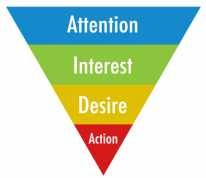
Figure 1. 2 AIDA Model
(Source: https://gobranding.com.vn )
This model consists of 4 stages:
Phase 1: Attracting customers (A – Attention). In the first phase of the AIDA model, all efforts of the business need to be aimed at attracting the attention of customers. It can be through the top 1 position of the website on Google, through catchy headlines, or just with an advertisement with a new style, etc. In this first step, the business needs to directly show the features that are most impressive to customers. The messages conveyed through the channels need to be polished. Because the lasting impression of the first contact between the business and the customer is extremely important. Like reading a book, if you are impressed with the title of the book, you will be interested in reading the rest of the book.
Stage 2: Interest (I – Interest). Once customers begin to recognize and connect with the messages you provide. It’s time to provide more information so that customers can understand the product. The point to note at this stage is: the information provided must be of the same quality as the values you used to attract customers’ attention before. Absolutely avoid the case of “hanging a sheep’s head but selling dog meat”. Continuing to retain customers for as long as possible is the goal of this interest stage. If you have a large number of customers following your information. Even if these customers have not yet converted, you have succeeded in this stage.
Stage 3: Desire Stage (D). The first two stages have been passed. And now you are approaching the sprint stage – the stage where customers “desire” the product. You need to focus on fully demonstrating every aspect and benefit that you can bring. At the same time, thoroughly exploit insights to target the needs of the target audience. And when there is a consistency between customer needs and product benefits, customers will definitely want to own the product immediately.
Stage 4: Decision stage (A – Action). If the customer is still with you at this stage, you only need one more step to close the sale. The effectiveness of this final stage depends largely on the strategy you use with call to action. Along with that are incentives and policies to promote faster action.
1.1.3.2. Building a research model to evaluate online marketing activities
Through inheriting the research model of Preparation, Implementation, Impact and the AIDA model as well as referring to previous topics, the author has proposed a research model to suit the internship basis as follows:
Attraction
Attraction
Quest
Course of action
Online Marketing System Acceptance
Sharing
In there:
Figure 1.1 Proposed research model
(Source: Author's research)
(1) Attraction: is the first step for customers to come to the business. For customers to know about the product or service, the business needs to have something special that attracts customers. To attract customers, the company's images, advertising videos or content not only need to be beautiful but also unique and attractive to the viewer.
(2) Attraction: in the field of media communication, a good marketer must make the reader attracted and curious about the service.
(3) Search: After being curious about the service, customers will often search for information on Google or social networking sites. Therefore, businesses need to make the most of it so that their advertisements are at the top of the search results.
(4) Action: after users search for information on Fanpage, they will tend to take action such as: buying, viewing products, going to a page link,.. or leaving the page. If we want users to act, we must find ways to direct their actions through calls to action.
(5) Sharing: customers often tend to share information with everyone, so when the company's service is really good and promotes customers' sharing actions, it will help the business gain more customers without having to spend a lot of marketing costs.
1.1.3.3. Scale design
The scale of factors in the model according to 5 levels of Likert scale from (1) is Completely disagree to (5) is Completely agree as suggested by Davis et al. (1989) to measure the components synthesized from previous studies.
The proposed scale includes 22 observed variables to measure 5 components of the research model. Of which, Attraction, Attractiveness, Searching have 5 observed variables; Action process has 4 observed variables; Sharing has 3 observed variables.
The questionnaire is built based on observed variables and scales combined with closed and open questions: Closed questions are used to guide customers to choose 1 or more available options in the questionnaire, easy for customers to understand and answer; Open questions are used to find new information related to the problem that the closed questions do not fully describe or are missing.