
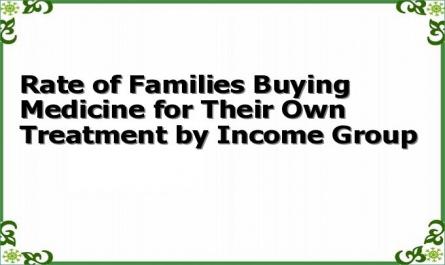
Drug interactions, drug allergies... and especially an important cause leading to widespread drug resistance in the community [73]. The phenomenon of self-medication and self-medication is relatively common in Vietnam, possibly because it is quick, convenient, does not require time to go to the doctor and get treatment, and may also be due to the lack of strict management of drug prescriptions [42]. Moreover, for poor households, self-medication also saves a sum of money on travel expenses, medical examination fees, and other expenses [45]. Among the reasons for self-medication, economic reasons vary the most according to socio-economic characteristics, by region. If only 1% of rich people who are sick answer that they self-medicate for economic reasons, then up to 17% of poor people who are sick buy their own medicine for economic reasons (17 times more - Chart 1.1) [19] . The rate of self-medication for economic reasons of households headed by ethnic minorities in the South and Central/Central Highlands are very high with the respective rates of 24% and 25%, more than 4 times higher than that of Kinh/Hoa households (6%). The difference in the rate of self-medication among ethnic groups is large. While the rate of self-medication among households headed by ethnic minorities in the Central and Central Highlands is only 49%, this rate among households headed by ethnic minorities in the South is up to 77% (1.6 times higher). The rate of self-medication among households headed by Kinh/Hoa or ethnic minorities in the North is also high at 74% [19] .
Percentage
18.0
Maybe you are interested!
-

 The Level of Emotional Intelligence of Investigators in the Security Investigation Department of the Ministry of Public Security
 -
 Absolute growth rate of experimental chickens over weeks of age
 -
 The impact of job satisfaction on employee commitment to the Bank for Agriculture and Rural Development of Ben Tre - 3
 -
 Law on establishment and management of science and technology enterprises under public higher education institutions in Vietnam - 11
 -
 Management of non-public museums in Vietnam - 1
16.0
14.0
12.0
10.0
8.0
6.0
4.0
2.0
0.0
Poor Poor Average Fairly Rich
Chart 1.1: Percentage of households buying medicine for self-treatment by income group
Go to the doctor
Going to the hospital when sick is the most positive way to deal with it. There are many forms and levels to access and use medical services. The closest to the people is the rural health care.
Although village health care is the lowest level, closest to the people, the level of contact between households and village health workers is not high. The results of the National Health Survey show that the percentage of households that have contact with village health workers in the 4 weeks between 2 interviews nationwide is only 1.8%. People with low education levels and living standards are the ones who have the most contact with village health workers. The survey data shows that more than half (57.1%) of people do not have to pay when using village health workers [19].
The results of the National Health Survey also show that the rate of medical examination and treatment in the total number of general illnesses nationwide is 23.2%; the use of inpatient treatment services is 5.45% [19]. In terms of the structure of medical service use, there is a difference between the poorest and richest groups, between rural and urban areas. Poor people have less opportunity to access and use high-quality medical examination and treatment services compared to the rich. Poor people and rural people tend to use inpatient medical examination and treatment services at commune health stations, regional polyclinics and district hospitals; while the rich group and urban people tend to use inpatient medical examination and treatment services at district hospitals, provincial and central hospitals (medical levels with higher medical technology and quality). District hospitals are where poor people and rural people use inpatient medical examination and treatment services the most.
The results of the National Health Survey show that the rate of people using outpatient medical services within a 4-week period is quite high at 17%, mostly children aged 0-5. The rate of people using outpatient medical services at the commune level is 7% - equal to the rate of people using private medical services and double the rate of people using outpatient services at hospitals (3.4%) [19]. Outpatient services are mainly used for medical examination and treatment, accounting for over 80%, the remaining rate of outpatient services is used for vaccination, other prevention, health check-ups, pregnancy check-ups, etc. The structure of outpatient service use by medical level is different: The rate of people using outpatient medical services at commune health stations in rural areas is 35.2%, twice as high as in urban areas (15.2%). Rural areas are areas with more difficult conditions than urban areas. The commune health station is the public health facility closest to the people and has lower costs than the upper level, so people in rural areas often go to the commune health station for medical examination and treatment at a higher rate than in urban areas. Urban areas have better economic conditions and more convenient transportation, so people have better conditions than in the region.
rural areas to go to district hospitals for medical examination and treatment. On the other hand, commune/ward/town health stations are places that provide medical examination and treatment services with lower quality, people have less trust, so when urban people have the conditions, they will go to higher levels for medical examination and treatment. The rate of rural people going to state hospitals for outpatient medical examination and treatment is quite low at 15.4% compared to urban areas at 27.4%. There is a significant difference between living standards groups in the average number of outpatient medical examination and treatment services per capita in 12 months with 2.9 times in the poor group and 4.7 times in the rich group. The rich group has the conditions and they are interested in health check-ups, when they are sick, they go to the hospital immediately, so the number of outpatient medical examination and treatment services used by the rich group is higher than that of the poor group.
1.3.3. Equity in health care and challenges
Our Party and State believe that equity in health care does not mean equality, leveling, does not mean that those with more or less needs are cared for equally, but that those with more needs are cared for more. Equity means giving priority to poor areas, poor people, and disadvantaged groups [28], in which women and children are the most disadvantaged groups [114]. According to Professor Do Nguyen Phuong, equity in health care is measured by opportunities to access basic health care services of good quality, equity in health care means solving the relationship between needs and ability to pay, equity in health care is always linked to needs, not to purchasing power, to the ability to pay of the population [49]. Implementing equity in public health care is first of all ensuring that people have access to good quality basic health care services, based on health care needs, with support policies to develop health care services in rural and remote areas, and support for the poor to receive health care when they are sick. Paying attention to health care for the poor is to ensure social equity in health [47].
Equity is different from equality; equity means treatment and response according to the needs of each person or group of people, while equality means the same treatment and response between groups of people or between people, even though they have different high and low needs [38].
In order to strengthen and improve the grassroots health network, increase access to and use of health care services, and ensure fairness in health care, the Secretariat has
issued Directive No. 06/TC-TW [2]. Implementing this directive, in recent years, the grassroots health system has been continuously invested in and strengthened in many aspects: station facilities, providing equipment, training medical staff. In order for people, especially the poor, to have access to health care services, improve equity in health care, and at the same time reduce the financial burden on the health sector in health care for the people, the Prime Minister issued Decision No. 139/2002/QD-TTg [56] and Decision No. 298/QD-TTg [57] with the aim of ensuring access to health care services for the poor and near-poor, especially in inpatient treatment. The Vietnamese health system is moving towards the goals of equity, efficiency and development, which is also the desire of many countries [8].
Equity is an important goal of society and the health sector, especially for those in the 62 poor districts nationwide. The health status of the poor is often poorer and the ability to access and use health care services is more difficult than that of others. Health not only affects the quality of life but also the ability to participate in economic activities and escape poverty. High medical costs or prolonged illness tend to push households into poverty and hunger. The problem for policy makers is to create equity in access and use of health care services for people, especially in poor areas.
Faced with the mentality of patients and their families treating illnesses according to the motto "while there is life, there is hope, when there is illness, we must pray to all directions", facing the pressure of survival and development of medical facilities applying new technology to meet the increasingly high and diverse needs in health care [74]. This has caused the cost of medical examination and treatment to continuously increase and the risk of people falling into poverty after treatment has become a challenging reality in the fight against poverty in every country, especially in developing countries, including Vietnam [89]. In addition, drugs and pharmaceuticals are increasingly using high technology and producing expensive drugs with high treatment effectiveness, which has pushed the price of medical examination and treatment to increase many times [104], [105]. The issue of increasing access to medical examination and treatment services and equity in health care has become an important and challenging issue for Vietnamese health [97], [100].
High health care costs are a cause of poverty and inequality in health care. Vietnam is assessed by the World Bank as a country with a very high rate of household health spending, with most households' out-of-pocket health care costs exceeding a reasonable proportion of their income [118], [102] . Additional costs are increasing rapidly, creating a financial burden for the poor [117]. The need for households to spend on health care has pushed many families into poverty or even poorer, a situation known as the "poverty trap". Hospital costs are increasing rapidly and the annual increase is too large [118].
1.4. Some factors related to access and use of medical examination and treatment services
1.4.1. Economic conditions
Economic conditions have a great influence and determine many areas of life, economy, politics, society, including health care: usually the poorer people are, the less likely they are to go to medical facilities. If a household has a high income, they will easily decide to go to medical facilities, even the farthest from home, but with the best quality [87]. On the contrary, poor people often tend to treat themselves at home or limit costs by going to a doctor near their home to ask, examine, buy medicine to reduce expenses for travel, food, drink, caregivers, and limit going to high-quality medical facilities with high fees [81], [84], [85].
Household income affects access to and use of health care services. When people have high income, they will also be able to use more health care services and have the conditions to use services with higher prices and better quality of health care services. High income levels will meet the needs of provincial and central health care services and private health care services, which means there is a difference in the use of health care services between rich and poor groups. Accepting the market economy, the gap between rich and poor is inevitable, the income gap is getting higher and higher, meaning that the task of the health sector is getting more difficult in ensuring fairness in health care.
According to the latest assessment of the Ministry of Health, many new and high-tech medical techniques have been applied in many medical facilities, but most patients only receive basic medical services because the cost of using them is high.
Using high-tech medical services is still too expensive compared to the average income. Moreover, the current budget investment for health care of about 8 USD/person/year is hindering investment in high-tech services. Mostly, only the rich and the wealthy have access to high-tech services. Meanwhile, people with average living standards when going for medical examination and treatment mainly rely on the health insurance policy to enjoy high-tech, high-cost medical care services. However, currently, health insurance also has strict regulations for patients with health insurance cards in using high-tech, high-cost services. When participating in health insurance, when going for medical examination and treatment beyond the prescribed level at medical examination and treatment facilities that meet grade I standards, the health insurance fund will pay 30% of the cost and not exceed 40 months of minimum salary for one use of high-tech, high-cost services. The health insurance fund will pay 50% of the cost of cancer treatment drugs and anti-rejection drugs that are not on the list prescribed by the Ministry of Health [22].
For many areas in Africa, economic factors are a major determinant of people's access to health care services [99]. High fees limit access to and use of health care services. This means that the level at which people can or cannot afford to pay depends on the health care services they need.
Another aspect is that the imbalance between provinces and between socio-economic groups has also increased significantly [117] . In urban areas, where the majority of people have a well-off life, most of the State's funding sources are used for central-level hospitals, while in poor areas, mountainous areas, remote areas where the majority of the poor are concentrated, people only receive primary health care services with low funding sources or only receive district-level medical examination and treatment services. Poor people and poor areas are unlikely to receive central-level medical examination and treatment services [88] . According to the World Bank's 2002 Vietnam Health Sector Overview Report, the rate of using medical examination and treatment services at public hospitals is highest in the Southeast and Red River Delta regions, and lowest in the Northern mountainous areas and Central Highlands [44] . Even more noteworthy is the trend of inequity in the treatment of childhood illnesses [118].
According to Ha Van Giap [33], the ability to access health care services for the poor is often more difficult than that of the rich, especially in terms of funding. According to the author, the reasons for not going to the hospital between the rich and poor groups are different, in which the main reason is
The poor group gave the reason of not having enough money (24.2%) while none of the rich people gave this reason. Also because of the financial reason, the poor group said that treatment at private and commune health facilities is more convenient than going to the hospital.
In India, health expenditure accounts for 3% of total expenditure of the richest households and 12% of total expenditure of the poorest households and the impact of health expenditure on household economy has limited the use of health care services among the poor [34] .
According to the 2006 Vietnam Health Report [8], nearly 60% of poor households are in debt due to medical expenses and about 1/3 of all inpatients have to borrow money to pay for medical expenses. The poor have to borrow money to pay for inpatient treatment much more than those in the middle-income and high-income groups. Nearly 2/3 of the poor have to borrow and sell assets to pay for medical expenses [115]. Thus, economic conditions are one of the major barriers affecting people's access to and use of medical services, especially the poor and near-poor.
1.4.2. Health Insurance
Health insurance is applied in the field of health care, not for profit, organized and implemented by the State [51] . The nature of health insurance is based on the principle of pooling and sharing health and illness risks. When sick or having an accident is often just an unexpected and unpredictable event. Health insurance will help reduce risks and increase financial protection for each individual facing the risk of financial loss due to illness or disease [82] . The greater the level of risk sharing of the health financial system, the less financial burden people have due to the risk of illness and the easier it is for them to access medical examination and treatment services when necessary [26]. When sick and having to use medical services, individuals participating in health insurance will be paid and compensated for the costs incurred. The level of payment is determined by the insurance agency based on the health insurance contribution level of each individual and the calculation of the possibility or frequency of illness risk of each individual. This compensation level is called the benefit that health insurance participants are entitled to [75].
Health insurance must ensure adequate financial resources for health care so that people can receive health care when needed and are protected from financial disasters or poverty caused by it.
must pay for health services [5] . According to WHO recommendations, to evaluate a health insurance system, it is necessary to consider all three aspects: (1)- Coverage breadth (proportion of people with health insurance); (2)- Depth (scope of services); (3)- Coverage height (proportion of direct costs paid).
State policy on health insurance [51] : The State pays or supports health insurance premiums for people with revolutionary contributions and some social groups; The State has preferential policies for investment activities from the health insurance fund to preserve and grow the fund [94] . The fund's revenue and profits from investment activities from the health insurance fund are exempt from tax [108] ; The State creates conditions for organizations and individuals to participate in health insurance or pay health insurance premiums for groups of subjects [11] ;
In Vietnam, private health insurance has also begun to develop. This is a form of voluntary health insurance, with the participation cost determined according to the health risk of each individual, operated by a non-state legal entity on a for-profit or non-profit basis [125] . According to Elias Mossialos and Thomson, private health insurance can have three functions: first, to replace compulsory social health insurance; second, to provide additional benefit packages outside of the social health insurance benefit package; and third, to supplement convenient services [90] . This type of health insurance often covers and adapts to the population with a high standard of living. In some countries, the private sector buys back state health insurance at a common face value, then adds an additional amount to insure customers, so that the rich still share risks with the poor, but are still free to choose according to their needs and capabilities [75], [108]. Private health insurance can also serve as a complementary health financing method to social health insurance to achieve the goal of universal health care [95]. However, there are still many debates surrounding this issue about the unfair aspects in the operation of private health insurance [86].
Community-based health insurance is a model in which the community participates in risk sharing and management directly or through its representatives [75]. This form of health insurance has three basic characteristics: Prepayment for health care of community members; Community control; Voluntary nature. This health insurance model operates on a non-profit basis and applies the principle of risk sharing. The advantage of this model is that it can cover both people